Contents
A 2027 plan for independent UK restaurants across search, your own site, loyalty, consented email and reviews, with a dated calendar and the rule changes that put careless marketing at risk.
In 2027 an independent UK restaurant grows by running a few channels well. Be found in local and AI search, convert guests on your own site, keep them with loyalty and consented email, ask for honest reviews within the 2025 rules, and plan the year around dated moments such as Valentine's Day on 14 February and Mothering Sunday on 7 March. Measure all of it from your own guest records, not from a platform's headline.
Growth is harder to buy in 2027
Picture a restaurant owner who has spent six months on promotions. Posts went out, a paid listing ran, a discount brought a busy fortnight. Then a quiet Tuesday arrives and the owner wants to message the people who came last month. There is no list to message and no record of who came twice, and nothing shows which of the spend worked. The money went to audiences someone else owns, and when the spend stops, so does the traffic.
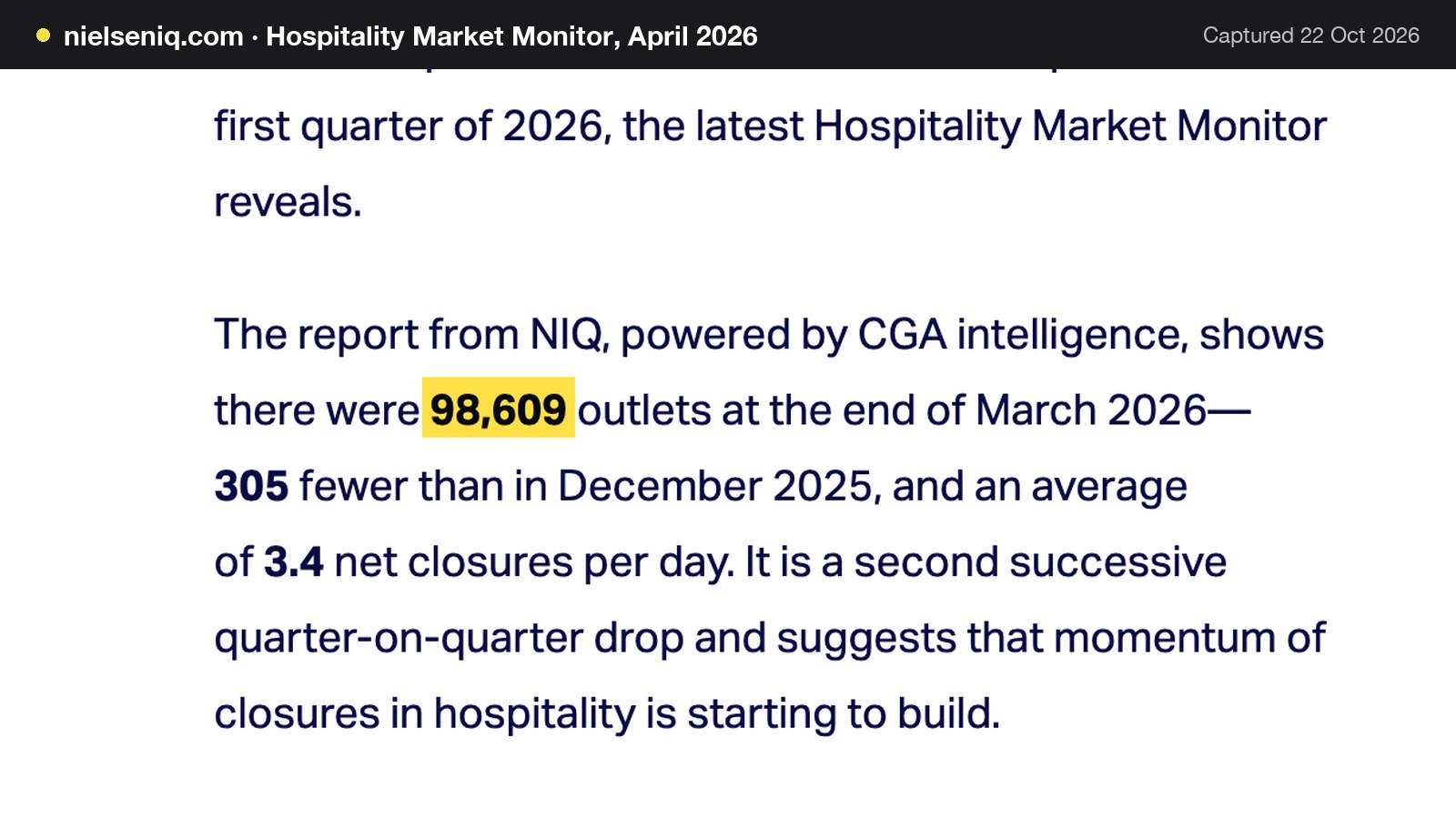
The ground under independents is not stable, which makes that pattern harder to carry. NielsenIQ's Hospitality Market Monitor for April 2026 counted 98,609 licensed outlets in Britain at the end of March 2026, which was 305 fewer than in December 2025, an average of 3.4 net closures a day. Independents were 62.8% of licensed premises and were down 16.3% since March 2020, against a fall of 3.0% for managed groups. Casual dining fell 0.9% in the quarter, from 5,097 outlets to 5,053. These are British figures, not UK ones, and they show how fast the market moves, not what closed any single restaurant.
Costs inside the building are rising too. The National Living Wage for workers aged 21 and over is £12.71 an hour from 1 April 2026, up 50p, or 4.1%, from £12.21. Employer National Insurance is 15% above the £5,000 secondary threshold, and the Employment Allowance is £10,500 for 2026 to 2027. A restaurant with that much less room for the next increase cannot afford marketing that does not compound.
Guests are not holding still either. Zonal's research with CGA by NIQ, published on 30 April 2026 and based on more than 5,000 British guests, found that 34% of restaurant-goers are likely to switch to a competitor. A first visit that never becomes a second is a quiet loss, and it does not appear on any statement. If a paid listing or a commission-charging marketplace is the only way new guests reach you, you pay again for the same guest every time.
The way out is not more posting. It is a short list of channels that each have a job, a first action and a number you can read from your own records. The rest of this guide sets that list out, then the calendar, then the rules that changed.
The 2027 plan at a glance
Seven rows cover the year. Each channel has its own section below, which opens with what the channel grows and ends with the first action.
| What it grows | First action | |
|---|---|---|
| Local and AI search (What to measure: Business Profile calls, directions and website clicks) | Guests who find you when they search for food near them | Complete the Business Profile: primary category, hours, address |
| Your own website (booking and ordering) (What to measure: Bookings and orders from your own site) | Bookings and orders you do not share with anyone | Put a booking or order button on every page and keep menu prices complete |
| Loyalty (What to measure: Members joined and rewards redeemed) | Repeat visits | Start one scheme with a reward you have costed |
| Email and automated journeys (What to measure: Sign-ups, unsubscribes and bookings from email) | Return visits from guests who agreed to hear from you | Add a consent tick box at booking, then send one after-visit email |
| Reviews (What to measure: Review count and rating) | Trust at the moment a searcher chooses | Ask every guest the same way and reply to each review |
| The 2027 calendar (What to measure: Bookings against the same weeks in your own records) | Bookings at dated peaks | Pick three moments and plan each campaign early |
| Paid discovery (marketplaces, ads) (What to measure: Share of paid-channel guests who join your list) | Introductions to new guests | Treat each paid guest as an introduction and invite them to your own channels |
The first four channels form a loop of four stages, each feeding the next.
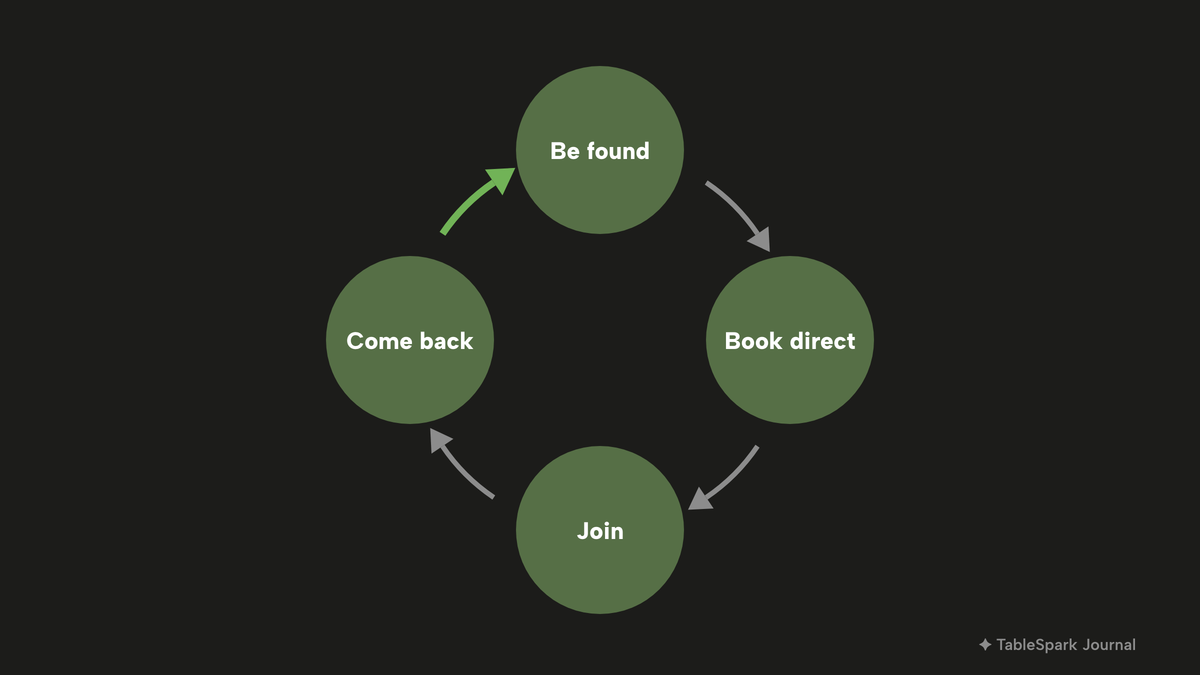
First, a guest has to find you. That is local search. Second, they book or order directly on your own site. Third, they join: they give you their details with consent, and the booking, order or sign-up creates a guest record you hold. Fourth, they come back, because loyalty gave them a reason and email gave them a nudge at the right moment. A returning guest then recommends you or leaves a review, and that feeds stage one again.
The order of work follows the loop. Fix your search presence first, because every other channel needs people to arrive. Build the join step next, because everything downstream depends on consented records. Add loyalty and email after that, because they need a list to work on. A discount can lift one quiet Tuesday; a loop compounds. Marketing that brings guests back shows the whole toolkit on one page.
Local search, and the AI answers built on it
Local search grows the guests who already want what you cook and are looking for it nearby. When someone searches "Italian restaurant near me" or your restaurant's name, Google decides which businesses to show. Google Business Profile Help says local results "are mainly based on relevance, distance, and popularity". The same page says "There's no way to request or pay for a better local ranking on Google."
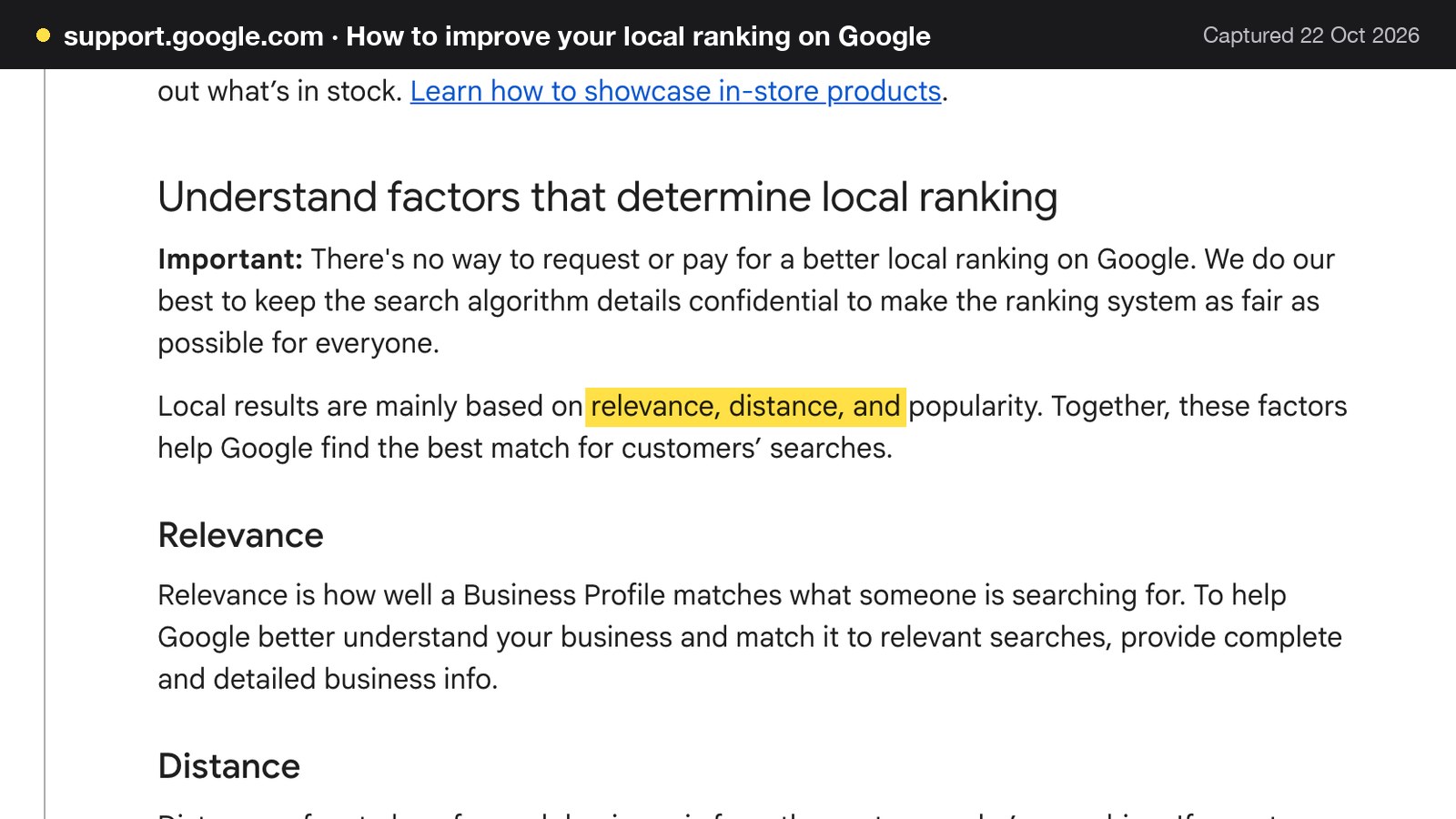
That last sentence matters for your plan. You cannot buy your way into the local results. You can only make your profile and your website the clearest, most complete and most trusted answer. Whitespark's Local Search Ranking Factors 2026, a survey of 47 local-search experts published on 6 November 2025, ranks the factors for the local pack and Maps like this: the primary Business Profile category first, proximity of the address to the searcher second, keywords in the Business Profile title third, a physical address in the city searched fourth, and being open at the time of search fifth. A high numerical Google rating comes sixth, quantity of Google reviews with text ninth and review recency eleventh.
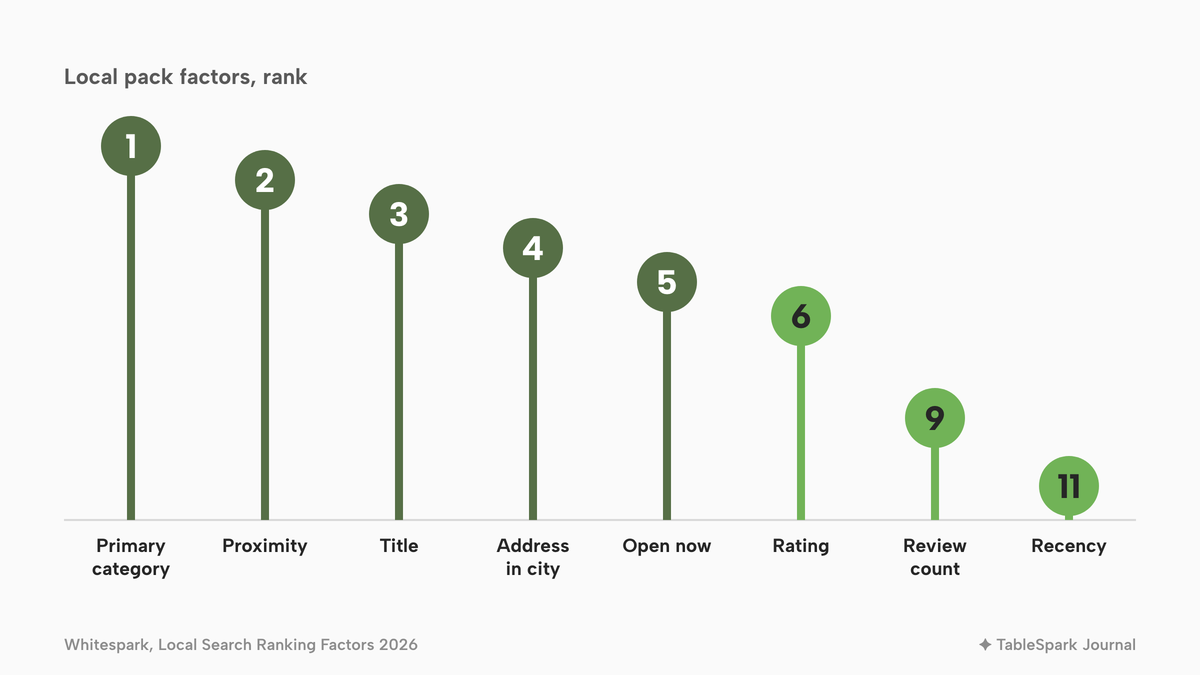
Treat that list as a to-do list, because most of it is under your control. Choose the primary category that matches what you actually are, such as Italian restaurant or Indian restaurant, and check it against the three or four restaurants that rank above you. Keep the opening hours correct, including bank holidays and special dates, because "open at the time of search" is a ranking factor and a guest who arrives to a closed door will not come twice. Make sure your real trading name and what you serve read clearly in the title. That is a reason to check your name and cuisine, not a reason to rewrite your name. You cannot change proximity, but you can make sure the address on your profile matches the address on your site.
Discovery is not only search. YouGov's August 2026 study of Gen Z, using YouGov Profiles data from August 2025 to August 2026 on British Gen Z adults, reports that "nearly six in ten (59%) discover restaurants through recommendations from friends or family", with exploring local areas and social media each at 43% and online reviews at 30%. That is one age group, not all adults. It does suggest that a complete listing and a booking link that is easy to share both help the word-of-mouth route.
AI answers now sit on top of this. Google's AI Overviews reached the United Kingdom in August 2024, and AI Mode began rolling out in the UK on 28 July 2025 as a tab on the Search results page. Google's Search Central guidance on AI features, last updated on 10 July 2026, says generative AI responses can include "information about local businesses" and that Google Business Profiles can help products and services be visible in both AI responses and other Google Search results. Google's AI Mode help page lists checking dining reservations among its local tasks. None of that promises you a place in an AI answer. It tells you what to keep accurate: your Business Profile, and a website that Google can crawl and read.
Your website supports the profile in ways Google can read. A website can be live at a working link and still be absent from Google. A robots or noindex directive set wrongly, conflicting canonical URLs, orphaned pages, rendering problems, missing structured restaurant data or incomplete search verification can leave important pages undiscovered, excluded or misunderstood. A guest who searches your name, your menu, your cuisine or your location may then reach a directory, a commission-charging marketplace or a competing restaurant first, and you are back to paying for discovery instead of collecting direct demand.
TableSpark packages this search-readiness work into the restaurant website on every plan, so you do not hire a technician to assemble it. Each site carries titles and descriptions, canonical URLs, sitemaps, robots controls, internal links, crawlable Restaurant and LocalBusiness schema, and managed search-verification setup, with the sitemap submitted to Google Search Console on every publish. Special-date opening hours, tap-to-call and directions are on every plan. Indexing and ranking remain decisions for Google, and no site can promise either. A complete setup removes the avoidable reasons your pages are missed.
First action: complete the Business Profile this week, then make the site's title, address and hours match it. The Google Business Profile guide for restaurants walks through the profile fields, and restaurant local SEO covers the wider checklist.
Your own website: where demand converts
Your own site grows the bookings and orders that you do not share with anyone. Search and word of mouth bring people to it. The site is where they decide, so it carries the menu, the prices, the booking button and, on the Full plan, the order page. A Reserve with Google booking-link connection, on Growth and Full, adds a booking destination so Google can send guests to book on your own site.
The clearest way to see what the channel is worth is the cost of one order. Take a £30 order and follow the money on three routes. This is a worked example, not a forecast. Uber Eats UK's pricing page, as published on 21 October 2026, lists a 30% delivery fee on orders its couriers deliver and a 13% fee for self-delivery and pickup, shown excluding VAT. The own-site route uses Stripe's standard UK card rate, as published, of 1.5% plus 20p for a standard UK card, and 0% TableSpark commission.
- Uber courier delivery at 30%: 30% of £30.00 is £9.00. That leaves £21.00.
- Uber self-delivery or pickup at 13%: 13% of £30.00 is £3.90. That leaves £26.10.
- Your own site: 1.5% of £30.00 is 45p, plus 20p, which is 65p. That leaves £29.35.
| Fee on £30.00 | Left from £30.00 | |
|---|---|---|
| Uber Eats, courier delivery (Fee rate: 30%) | £9.00 | £21.00 |
| Uber Eats, self-delivery or pickup (Fee rate: 13%) | £3.90 | £26.10 |
| Your own site (Fee rate: 0% TableSpark commission, Stripe 1.5% + 20p) | £0.65 | £29.35 |
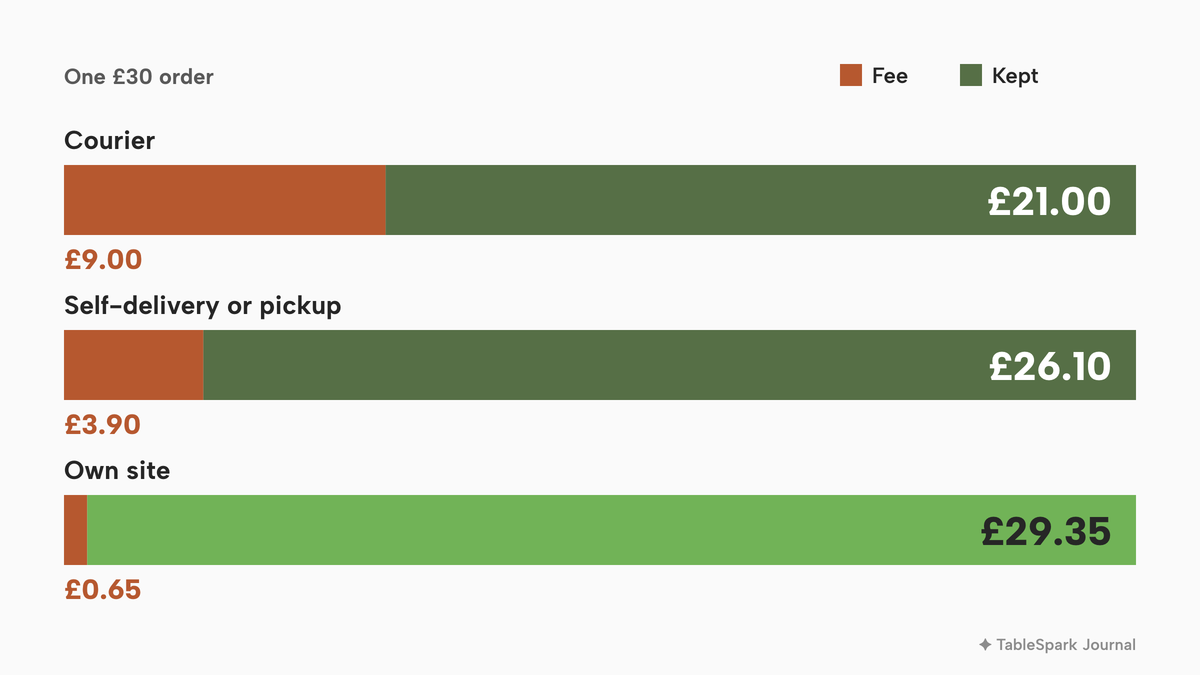
Be exact about what the table omits. On the own-site route, somebody still has to get the food to the guest if the guest has not come to collect it, and that cost belongs to you whichever route you choose. Online ordering on your own site is a Full plan feature, and the Full plan is £69 a month excluding VAT. The table shows the fee on the order, not the whole cost of running the channel.
So set the plan against the saving. Against a courier-delivered Uber order, an own-site order keeps £9.00 less 65p, which is £8.35. The Full plan is £69 a month excluding VAT, so £69 divided by £8.35 is 8.26, which means nine own-site orders a month cover it. Against the 13% route the saving is £3.90 less 65p, which is £3.25. £69 divided by £3.25 is 21.23, so 22 orders a month cover the plan excluding VAT on that comparison. Your average order will differ from £30, your mix of routes will differ from this example, and you must work the same sums with your own numbers. Online ordering on your own site shows how the order page, the kitchen ticket and the money in your own Stripe account fit together.
A converting site also keeps its prices complete, a point the rules section below returns to. First action: put one booking or order button on every page, and check that the menu on the site matches the menu in the room.
Loyalty: give guests a reason to return
Loyalty grows repeat visits, the cheapest growth a restaurant can buy. The evidence on what brings guests back is consistent and comes from surveys, so read each figure with the publisher in mind.
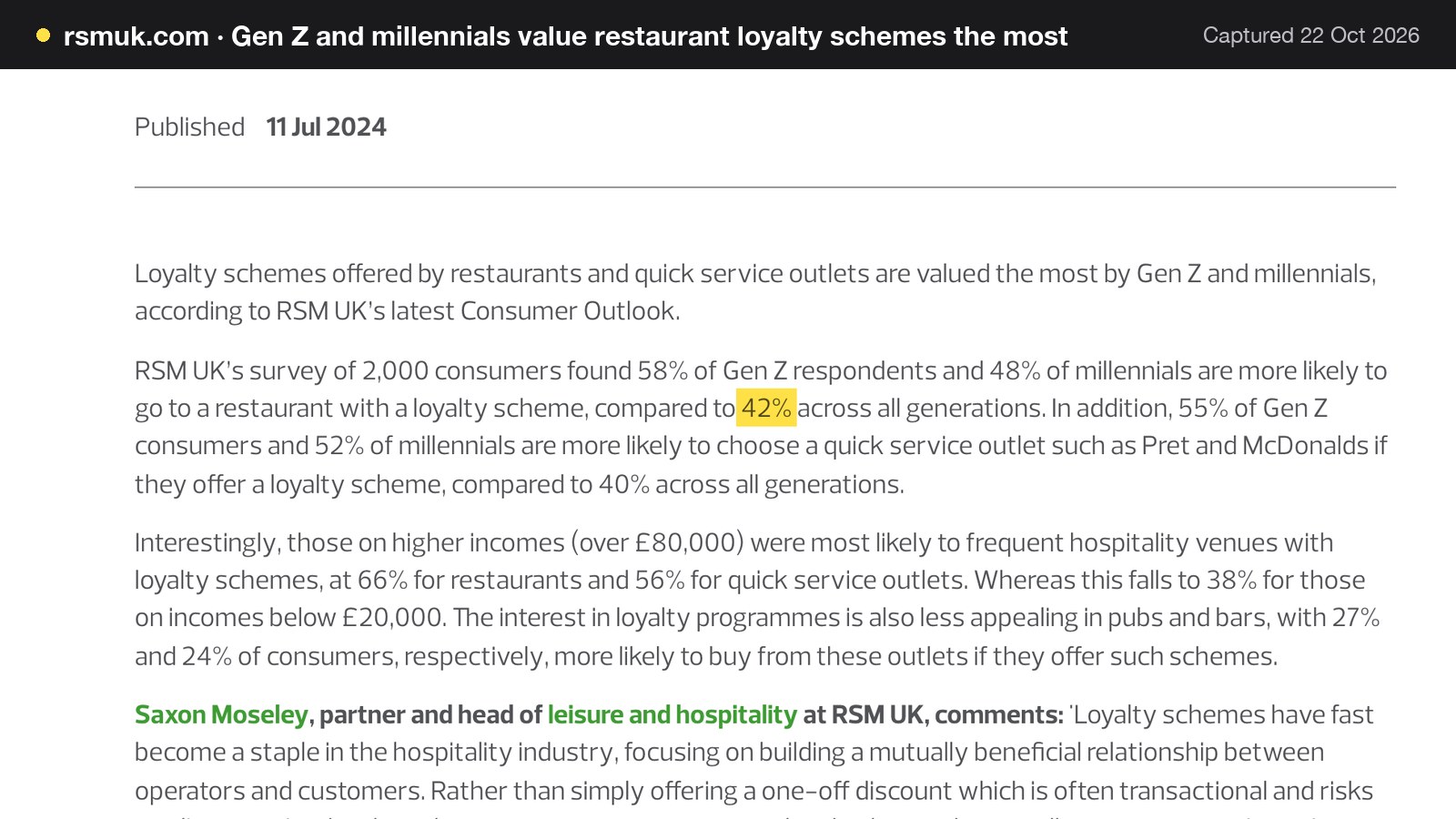
RSM UK's July 2024 survey of 2,000 UK consumers found that 42% were more likely to go to a restaurant with a loyalty scheme, rising to 58% of Gen Z and 48% of millennials. The same survey asked which rewards people want most at restaurants. Price reductions were the most wanted at 50%, bonus points worth a free drink or meal came next at 17%, and bonus points to spend followed at 15%.
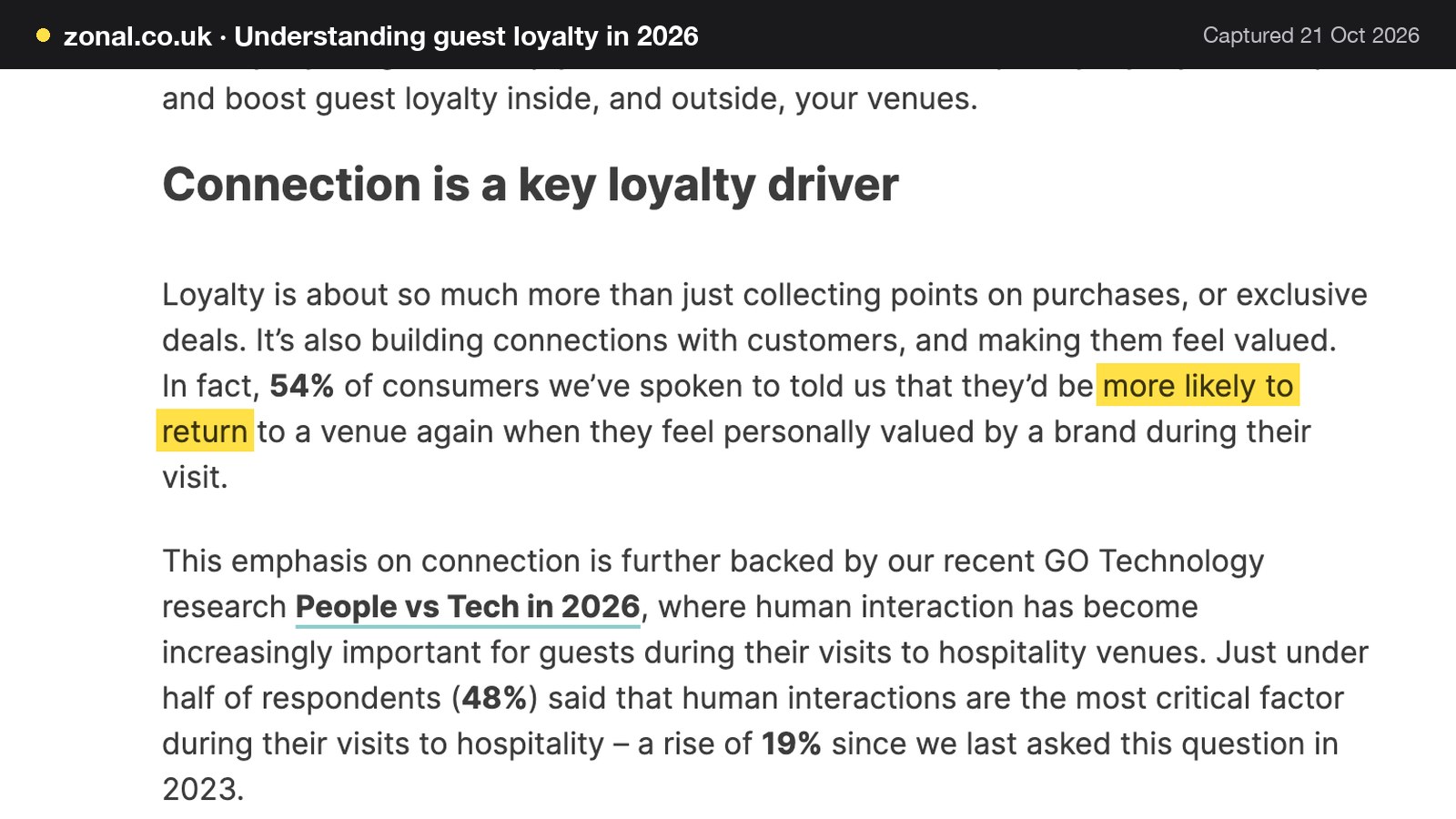
The Zonal research with CGA by NIQ, published on 30 April 2026 and based on more than 5,000 British guests, adds the other half. It found that 54% are more likely to return to a venue when they feel personally valued, and that 34% of restaurant-goers are likely to switch to a competitor, against 29% for pubs and 30% for bars. Both surveys are consumer-stated preferences, not measured sales, and neither tells you what a scheme will do for your own takings. They do tell you which design to start with.
Start with the reward people say they want, which is a price reduction, and design it so the reward costs you less than the visit it brings. You choose every number, so work through an example before you switch anything on. Suppose you decide a guest earns one point for every £1 spent and a reward costs 200 points. A guest reaches it after spending £200. If that reward is a dish that costs you £4 in ingredients, the reward returns about 2% of the spend that earned it. Suppose instead you set a stamp card so that every fifth visit earns a reward. The reward then follows four paid visits. These are illustrative numbers, not recommendations and not predictions. The point is that you can read the cost before you commit, and you choose the offer, the limit and the budget.
Three mechanisms are worth knowing, in rising order of effort.
- Points and rewards. A points programme with points per pound and per completed booking, and a catalogue of rewards you write yourself. Guests see their balance and QR member card in their own app on your site.
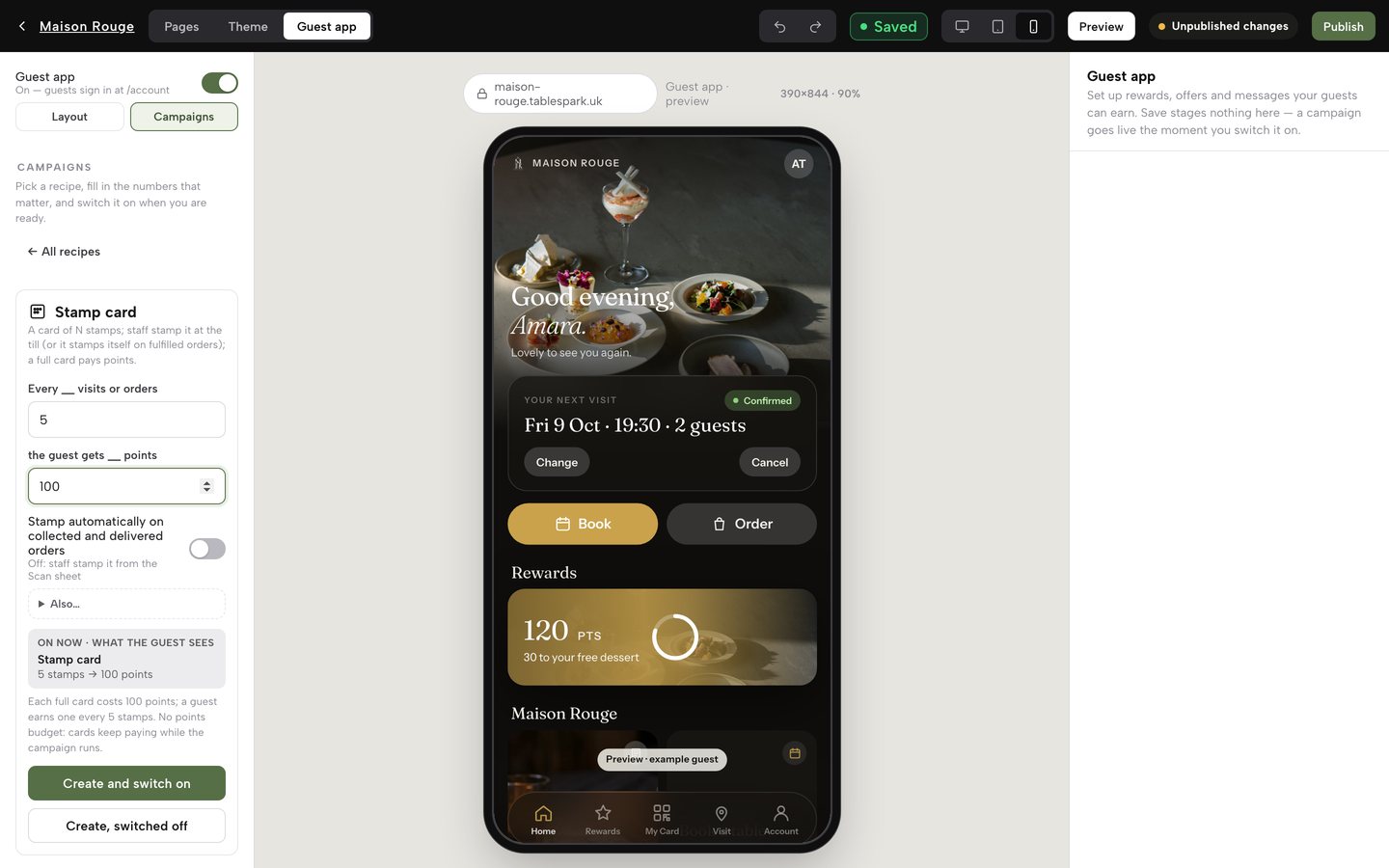
- Stamp cards. A visit-count mechanic that guests already understand. The campaign recipe asks for two numbers, how many visits and how many points the guest then gets.
- Occasion rewards. A birthday treat or a welcome bonus sent once, to a guest who has agreed to hear from you. Birthday rewards and the consent rules behind them sets out how to do that lawfully.
Each of these works only if you hold the guest's record. That is why loyalty depends on the join step in the loop. A paper stamp card in a wallet earns a return visit but tells you nothing. A points card tied to an email address earns the visit and gives you the name, the date and the spend history that make the next message relevant. The loyalty app guide compares the options in detail.
TableSpark puts this in the guests' app at /account on your own site: points per £1 and per completed booking, a rewards catalogue you write, a QR member card staff scan at the till, and coupon codes redeemed on the same scan sheet. The campaign designer adds double-points windows, a welcome bonus, referral codes, coupons, stamp cards and birthday rewards. Every field starts empty, because you set every offer and budget. A points budget, a per-guest limit and start and end dates are optional, and a plain-English cost line reads your numbers back before you switch the campaign on. The guests' app and campaign designer are on Growth and Full.
At the till a scheme either works or becomes a chore. A guest opens My Card on their phone, staff scan the QR code on the scan sheet, and the sheet shows the balance, any stamp cards in progress and the rewards the guest can afford. When a guest redeems a reward the points are held until you mark it redeemed or release it, and a correction needs a reason and leaves a permanent ledger entry. First action: pick one reward you have costed, switch on one scheme and train the team on the scan.
Email and automated journeys
Email grows return visits from guests who have already eaten with you, and it costs nothing per message to send. Everything about it depends on lawful consent, so start there.
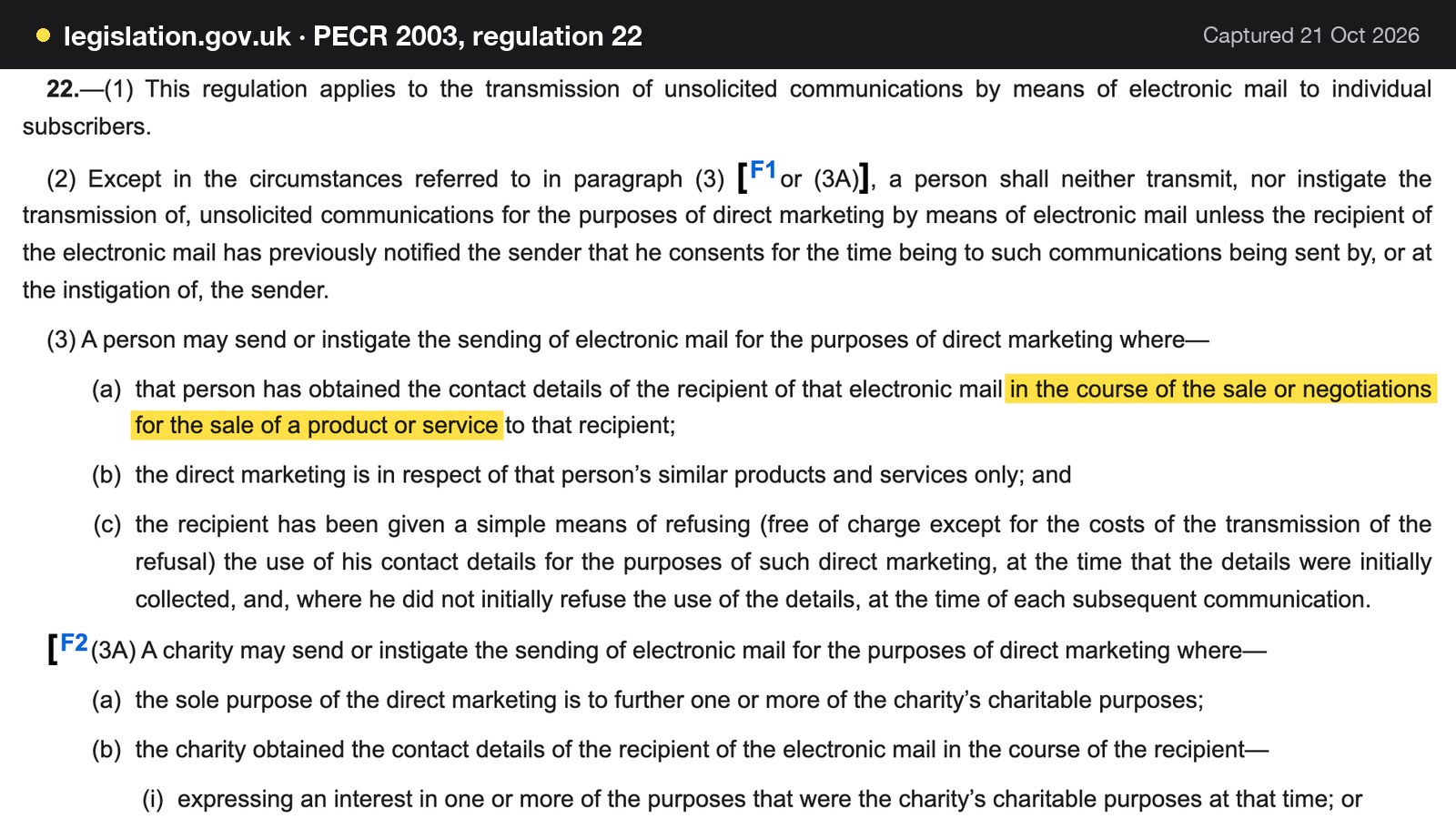
PECR regulation 22 and the Information Commissioner's Office guidance on electronic mail marketing, updated on 28 April 2026, say that marketing email or text to an individual needs specific consent or the soft opt-in. The soft opt-in has five conditions, and all five must hold. You obtained the person's details directly from them. You obtained them in the course of a sale or negotiations for a sale. You are marketing your own similar products and services. You offered a free, simple way to opt out when you collected the details. And you offer that opt-out in every later message.
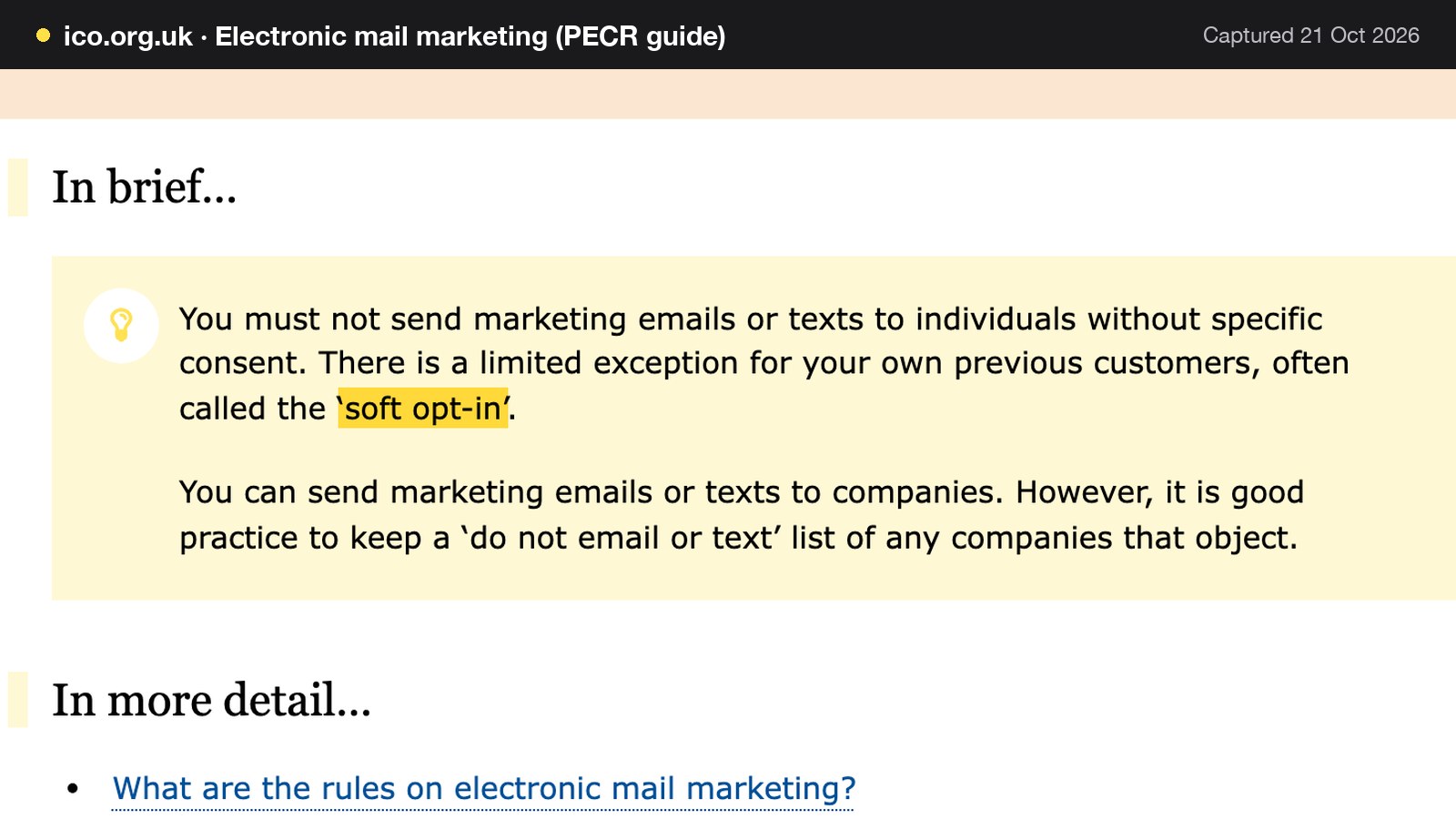
Every message must also avoid disguising the sender and must give a valid address for opting out, under regulation 23. Bought-in lists never qualify. The lawful way in is to ask for consent at a point where a guest deals with you directly: the booking form, the order checkout, or a newsletter sign-up on your site. A guest who ordered through an app has given their details to the app for fulfilment, not to you for marketing.
Write the consent wording so a stranger could not misread it. A tick box that is not pre-ticked, beside a sentence saying what you will send, how often and how to stop, is easier to defend than a paragraph of legal text. Keep a record of when and where each guest joined. The Subscribers list in TableSpark shows the consent date and source for every guest, which gives you that record without a spreadsheet.
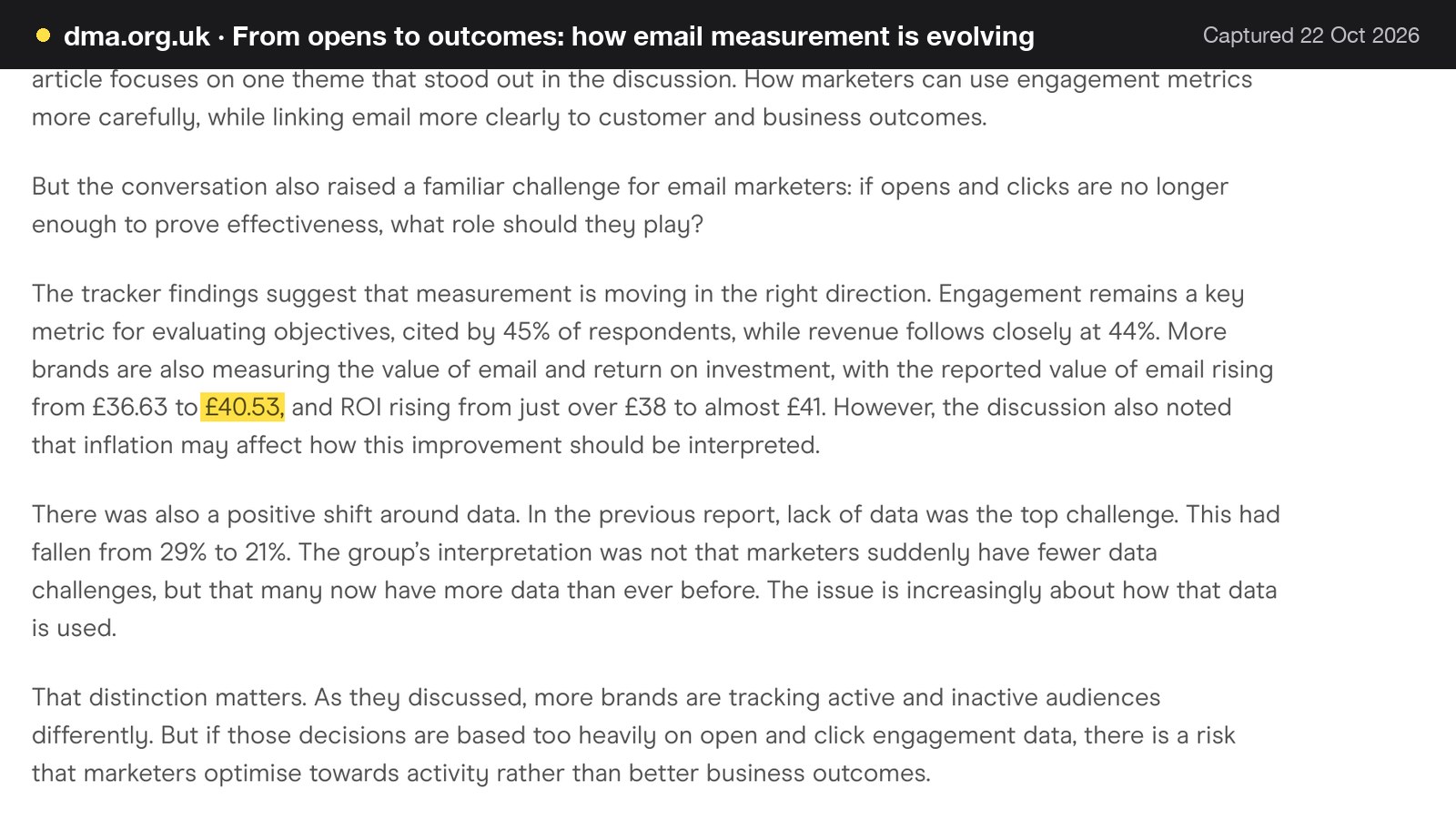
Once you hold consented records, email earns its place. The Direct Marketing Association's Marketer Email Tracker 2026 reports the value of email rising from £36.63 to £40.53, and return on investment from "just over £38 to almost £41". The DMA notes that inflation may affect how the improvement is read. These are marketers' reported figures across industries, not restaurant results, so treat them as evidence that the channel pays, not as a forecast for your list.
For restaurants specifically, Brevo's benchmarks published on 27 May 2026, drawn from more than 175,000 customers worldwide, report a 19.01% open rate for hospitality and food services, or 36.69% once Apple Mail Privacy Protection opens are counted. The same table shows a 2.15% click rate and a 0.62% unsubscribe rate. Those are global averages from one vendor's customers, so use them to set expectations for what a small list does, not to promise yourself a result.
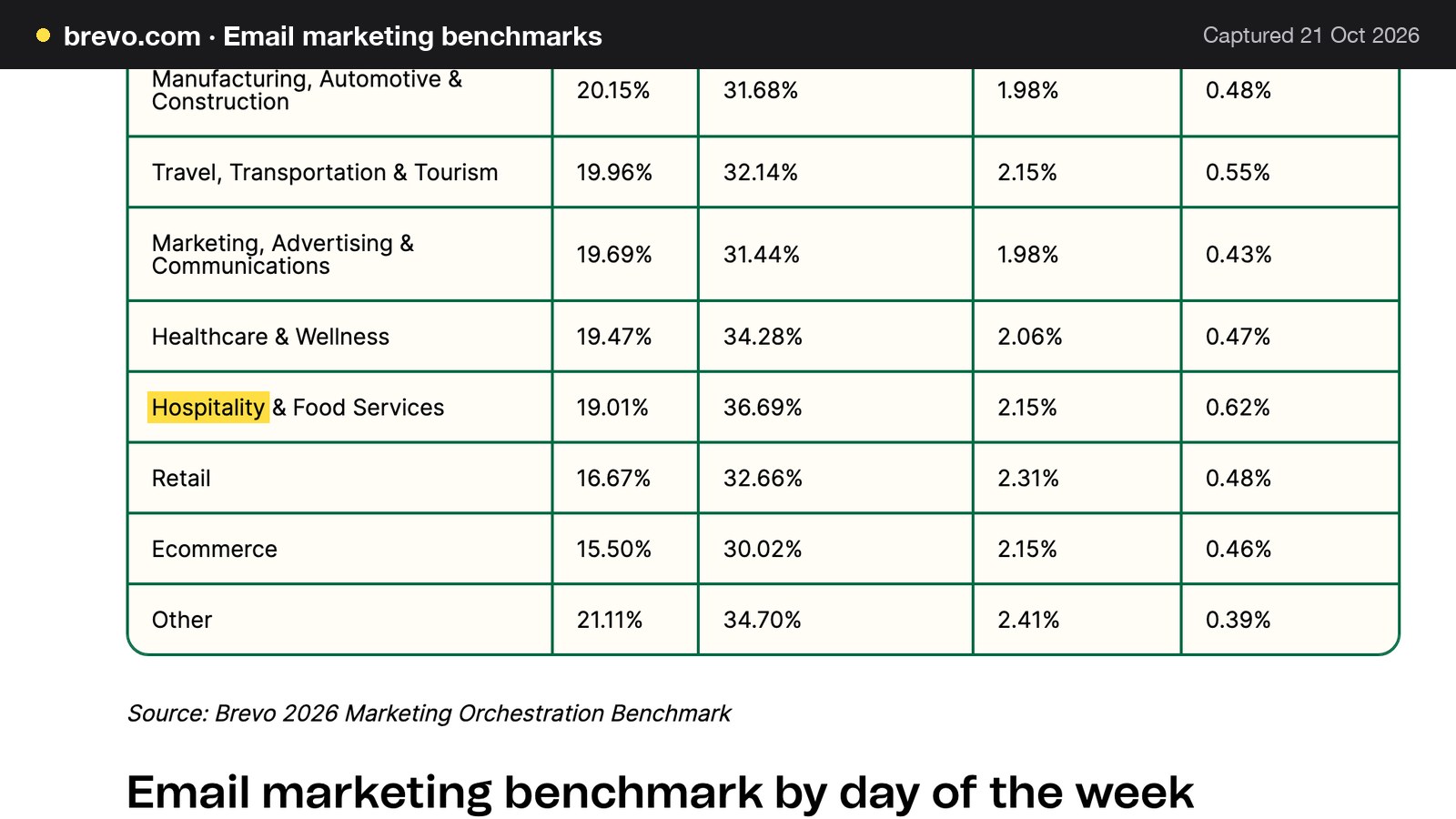
The read from those numbers is practical. Roughly one in five recipients opens, and about two in a hundred click. A list of 500 consented guests is a modest audience, but one that has already eaten with you. The risk is sending something irrelevant and teaching your best guests to ignore you, not sending too little.
Sending also has technical rules. Google's sender requirements page says all senders need SPF or DKIM, that senders of more than 5,000 messages a day to Gmail accounts must also have DMARC, that marketing and subscribed messages must support one-click unsubscribe, and that spam rates reported in Postmaster Tools should stay below 0.10% and never reach 0.30%. Microsoft's post for Outlook, dated 2 April 2025 and updated 29 April, sets the same SPF, DKIM and DMARC expectation for domains sending over 5,000 emails a day, and says non-compliant mail goes to the Junk folder from 5 May 2025, with rejection to follow at a date to be announced. A restaurant mailing fewer than 5,000 a day sits below the formal bulk threshold, but SPF or DKIM and an unsubscribe link are still expected. On Growth and Full, guest email goes from your own domain.
Automate the moments that matter and keep one-off campaigns for the rest. Journeys start after a visit, an order or a no-show. The other moments below are campaign recipes you send to a segment. Four moments make a sensible start.
- Welcome. A welcome bonus or a thank-you email from the campaign designer, in your voice, saying what you are proud of and where to find the menu.
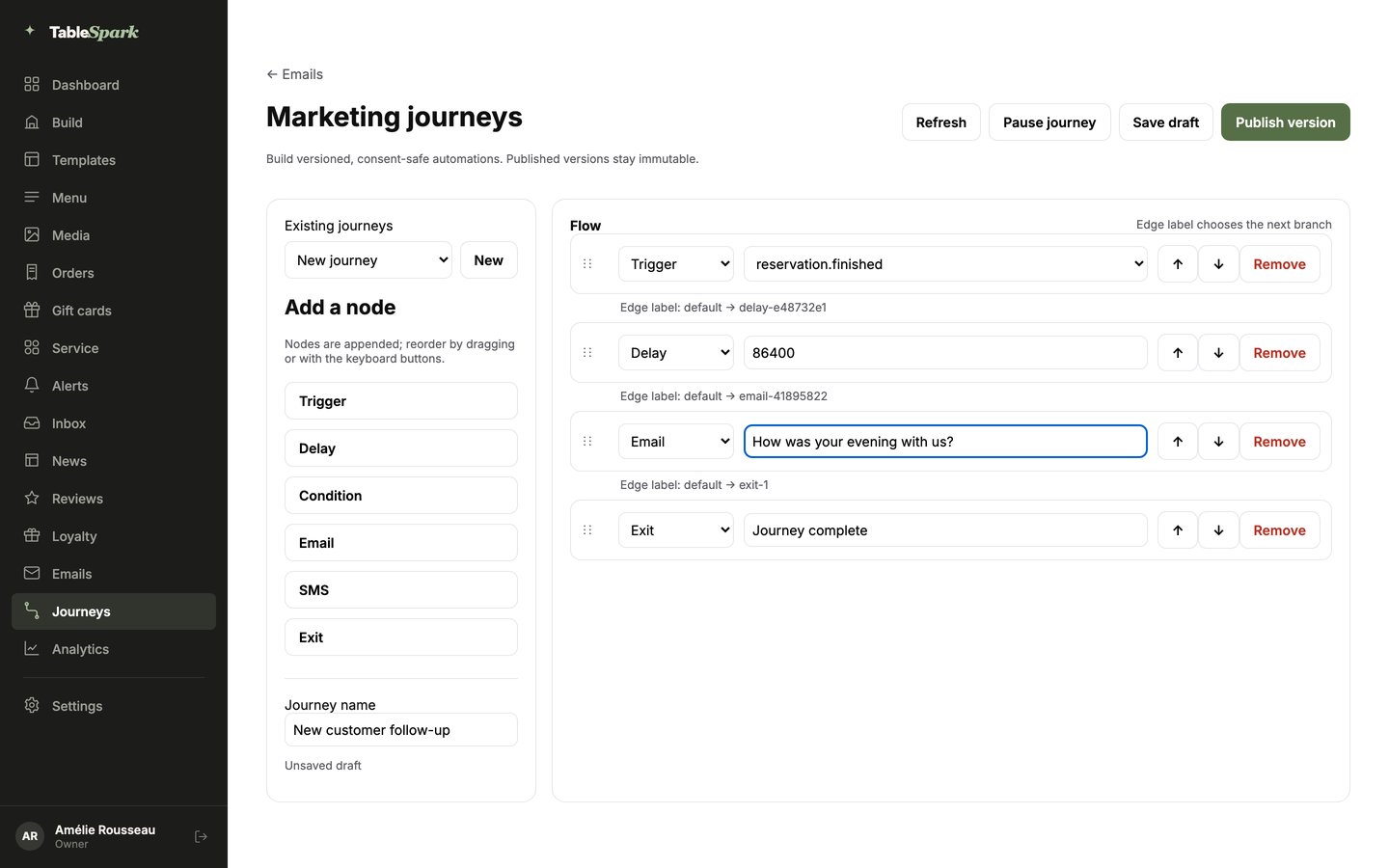
- After the visit. A journey: a booking finishes, wait a day, then ask how the evening was.
- Win-back. Guests who have not visited for a while sort themselves into a win-back segment, and a campaign goes to the segment you choose.
- Birthday. A birthday treat from the campaign designer, sent once, to a guest who agreed to hear from you.
First action: add the consent tick box to your booking form and build the after-visit journey. The email marketing guide for restaurants goes through subject lines, timing and the consent wording in full.
Reviews, within the 2025 rules
Reviews grow trust at the moment a searcher chooses between you and the next restaurant. The same Whitespark survey that ranks the factors for the local pack also ranks them for conversion, which is the moment a searcher picks a business. There, high numerical ratings come first, positive sentiment in review text second, and a mobile-friendly website fourth. So reviews help twice: they are part of how the profile is judged and part of what persuades a person who has already found it.
The rules on how you ask changed in 2025. Schedule 20 of the Digital Markets, Competition and Consumers Act 2024 covers submitting, or commissioning another person to submit, a fake consumer review or a review that conceals the fact it has been incentivised. It says "commissioning" includes incentivising by any means, and that publishing reviews misleadingly includes failing to publish, or removing from publication, negative reviews while publishing positive ones. The CMA announced that the regime is now in force.
The CMA's fake reviews guidance of 4 April 2025 explains how that applies to a trader. It says traders are free to offer an incentive such as a future discount, but must tell consumers the review has been incentivised and the review must still reflect the reviewer's genuine experience. It also warns that a trader may infringe the law by suppressing genuine negative reviews, cherry-picking positive ones, or encouraging only satisfied customers to leave reviews. The CMA's shorter guide for businesses, updated on 28 August 2025, is stricter in tone: do not offer inducements to customers to write positive reviews, and do not commission third parties to write fake ones, because you may be liable for what an agency does on your behalf. It cites a fine of up to 10% of global turnover and potentially a criminal offence.
Given that gap between the two documents, the conservative route is simple. Send every diner the same review request after a visit. Do not ask only the guests who seemed happy, do not delete or hide genuine bad reviews, and do not trade a discount for a good score. If you ever offer a reward for taking part, disclose it, as the longer guidance requires. The TableSpark campaign designer includes review requests, you set every offer and budget, and Settings holds your Google review link.
First action: write one review request, send it to every guest the same way, and reply to every review you receive, good or bad.
The 2027 restaurant marketing calendar
A dated calendar turns marketing from a reaction into a plan. The dates below come from GOV.UK's England and Wales bank holiday list for 2027 and from calendar rules, and the sport dates come from the organisers' own pages. Valentine's Day on 14 February, Mothering Sunday on 7 March and Halloween on 31 October 2027 all land on a Sunday, so open your booking windows and any deposits early.
| The moment | The campaign to run | |
|---|---|---|
| January | New Year's Day, 1 January (bank holiday) | A thank-you email to guests who joined in the last year, and a new-year loyalty reminder |
| February | Valentine's Day, Sunday 14 February | A booking window and any deposit open early, sent to subscribed guests first |
| March | Mothering Sunday, Sunday 7 March | A family-table campaign with the booking link in the first line |
| March | Good Friday 26 March to Easter Monday 29 March; Easter Sunday is 28 March | A long-weekend campaign and opening hours checked on the Business Profile |
| May | Early May bank holiday, 3 May; Spring bank holiday, 31 May | Two long-weekend campaigns, each with the bank holiday hours posted in advance |
| June | Father's Day, Sunday 20 June | A table campaign sent to subscribed regulars |
| July | The Open at St Andrews, 11 to 18 July (Fife and St Andrews trade only) | A local campaign for visitor demand, booking link ahead of the week |
| August | Summer bank holiday, 30 August | A last-weekend-of-summer campaign to subscribed guests |
| October | Rugby World Cup in Australia, 1 October to 13 November; Halloween, Sunday 31 October | A screening campaign if you show the matches; a Halloween booking window open early |
| December | Christmas Day, Saturday 25 December; substitute bank holidays Monday 27 and Tuesday 28 December | A Christmas booking and gift card campaign, with the holiday block hours on the Business Profile |
Three notes on using it. The Rugby World Cup is held in Australia, so for most UK restaurants it is a screening opportunity, not an event on your doorstep, and the rugbyworldcup.com page names ITV as its exclusive broadcast partner in the UK. The Open's page range includes practice days, so check the championship days with the organisers before you plan a service around them. And the calendar leaves out the Six Nations and Wimbledon, because this research did not find their 2027 dates on an official page; add them yourself once you have checked.
Plan each campaign in the same order. Decide the offer and the budget first, write the email, send a test to yourself, and queue it for subscribed guests before the booking window opens. Add the matching hours and any special opening to your Business Profile at the same time. Then read the result against the same weeks in your own records.
What changed in the rules for 2026 and 2027 marketing
Five rule changes sit under the plan above. Each is a reason to keep the record clean, not a reason to market less.
Marketing email and text penalties. The penalty ceiling for a breach of PECR regulation 22 is £17.5 million or 4% of worldwide turnover from 5 February 2026, as the ICO confirmed when the next phase of the Data (Use and Access) Act 2025 began. That is a ceiling, not a typical outcome, but it is the number to hold in mind when someone offers to sell you a list of local diners. The Act also added a charity soft opt-in from 5 February 2026 and did not change the rules for commercial senders, so the five soft opt-in conditions above still apply.
Fake and incentivised reviews. Covered in the reviews section: the CMA's regime is in force, and the safe practice is to ask everyone and reward no one for a good score.
Total price in promotions. The CMA's price transparency guidance, published on 18 November 2025, lists a menu among the things that count as an invitation to purchase, including "a digital menu that can be accessed through the scanning of a QR code". It says a price will be realistic and meaningful if the headline price "includes all mandatory charges that consumers will need to pay", and that mandatory charges include booking or processing fees, platform charges, and mandatory cover or service charges at a restaurant. Where a mandatory delivery charge cannot be calculated in advance, the trader must indicate that delivery charges are payable and how the cost will be calculated. For your marketing, that means a service charge, booking fee or delivery fee belongs in the price you show on the menu and in the offer post, not at checkout.
Cookies and analytics. The ICO confirmed that the next phase of the Data (Use and Access) Act began on 5 February 2026, and section 112, on storing information in terminal equipment, is in force from that date in so far as it was not already in force. The ICO's guidance on the exceptions says storage or access whose sole purpose is to collect information for statistical purposes about how the service is used can run without consent, provided there is a simple, free way to object. Advertising pixels and remarketing are outside that exception and still need consent. The ICO's older cookies guide page says it is based on the previous version, so do not rely on it for the new rule.
Sender authentication. The Google and Microsoft sender rules covered in the email section are not law, but they decide whether your emails reach the inbox.
Where delivery marketplaces fit
A marketplace is one paid channel in this plan. It sells you access to people who have opened its app looking for dinner, and for a restaurant nobody has heard of yet, that can be a first introduction. It cannot be the retention channel, because its own terms are written so that you do not get the guest relationship.
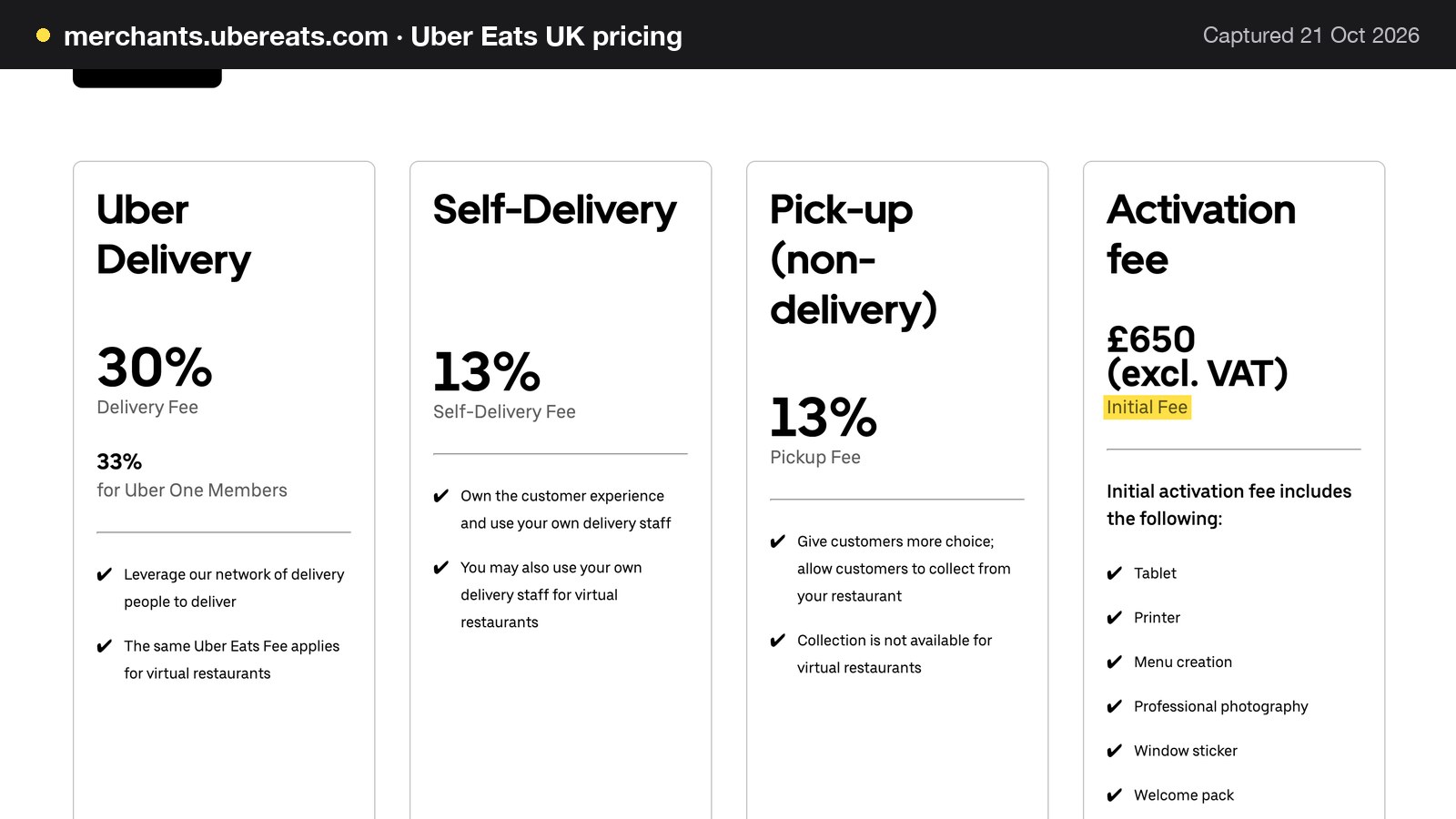
Start with the fees. Here is what Uber Eats UK publishes, and nothing more than it publishes.
| Rate as published | Applies to | |
|---|---|---|
| Delivery fee | 30% | Orders Uber couriers deliver |
| Delivery fee, Uber One | 33% | Orders from Uber One members |
| Self-delivery fee | 13% | Orders the restaurant delivers itself |
| Pickup fee | 13% | Orders the guest collects |
| Initial fee | £650 excluding VAT | Activation: tablet, printer, menu creation, photography, window sticker, welcome pack, training |
The page says fees are shown excluding VAT, and that the activation fee can be adjusted if you decline items in the package. It carries no last-updated date, which is why every figure here is dated "as published on 21 October 2026". Read your own contract before you rely on any of it. The point of the table is the shape: the higher rates fall on the orders where a courier carries your food to a guest you may never meet.
Deliveroo is different in one respect. Its UK partner pages, checked on 21 October 2026, publish no commission rate, no onboarding fee and no plan price. Its FAQ says pricing is discussed with an account manager. So the honest statement is that its rate is not published on its partner pages and is agreed per restaurant, and you should not accept anyone's average as your own. Its Marketplace+ option covers a restaurant that uses its own staff to deliver, with a Deliveroo rider on request. Its FAQ also says payment "will be issued weekly every Thursday in the UK". Weekly payout is a cash-flow question as much as a fee question, and the weekly payout and cash-flow gap is worth a read if your supplier bills fall due before the money arrives.
Then there is the data. The same company's UK merchant terms, last modified on 16 June 2025, say what the restaurant may do with the customer's details. Clause 12(b) says the merchant agrees to use personal data provided by Uber "solely for the purpose of providing Items to Customers" and that it "shall not copy, store, retain, remove from the Uber Tools or otherwise process the Personal Data". Clause 12(f) rules out merging that data for "re-identification, targeted marketing, analytics or any other similar purpose". The terms contain no provision giving the restaurant the customer's email address for its own marketing. The personal data it provides, which covers the customer's name, drop-off location and contact details including a phone number, is for fulfilling the order. Clause 12(c) lets Uber use and share aggregate anonymised data about your transactions.
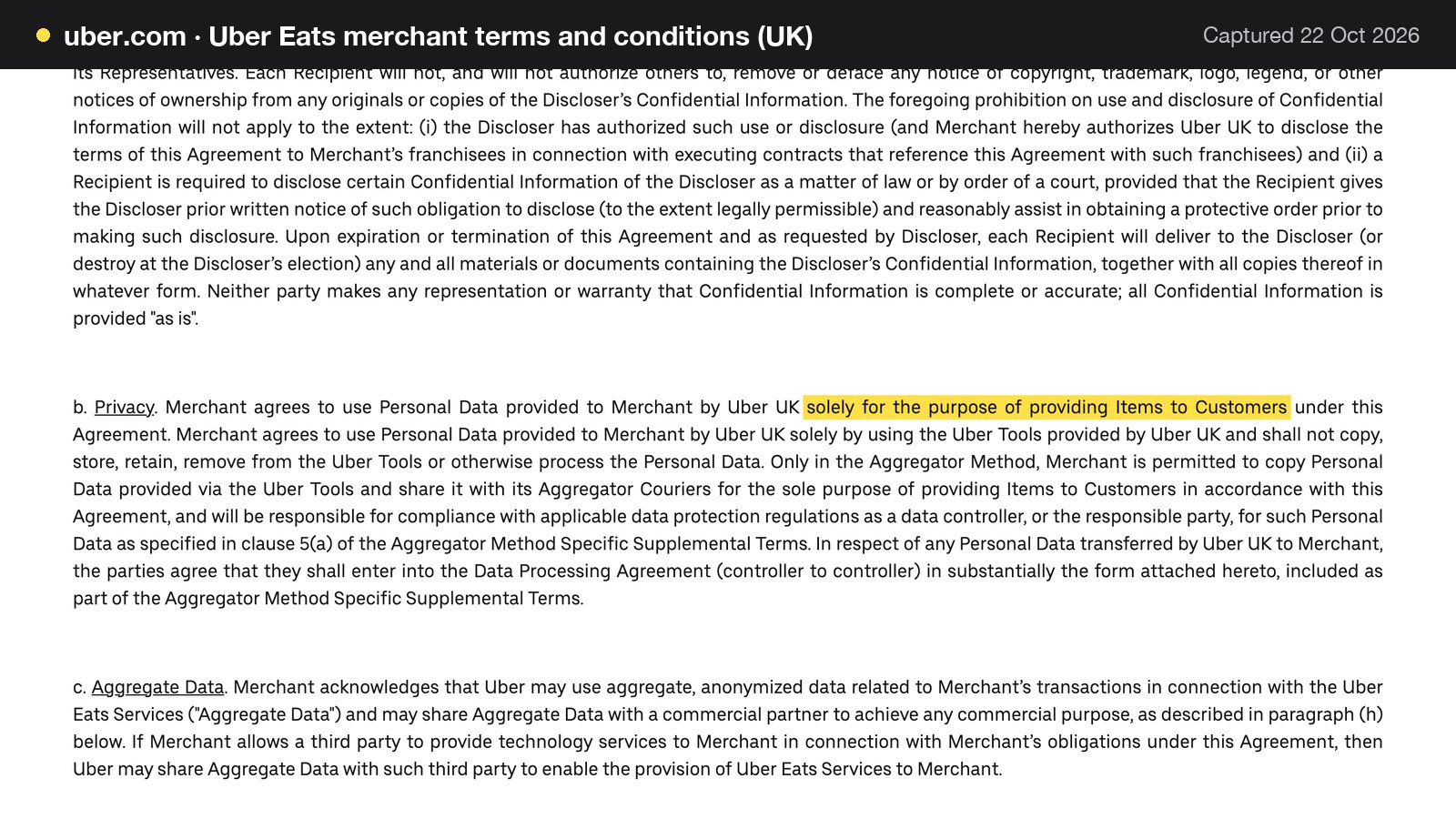
That is a fair description of what the restaurant gets: a name on the ticket and a phone number to call if the courier cannot find the door. It is not a guest list. Why marketplace order data never reaches the restaurant's own records goes through what that means for a small kitchen's books.
Here is the comparison laid out by the question you would ask before choosing. The marketplace cells quote Uber Eats' published pricing page and merchant terms, and Deliveroo's partner pages where they say something. Where a page says nothing, the cell says so.
| Your own TableSpark site | Uber Eats and Deliveroo | |
|---|---|---|
| Who holds the guest record? | Your restaurant's TableSpark account, with CSV export | Uber Eats terms limit use to fulfilment (clause 12) |
| Can you email the guest? | Yes, to guests who subscribed | No email provided for your marketing (clause 12) |
| Fee per order | 0% TableSpark commission, plus Stripe's card fees | Uber Eats publishes 13% to 33% by option |
| Are rates published? | Yes, on the pricing page | Uber Eats yes; Deliveroo not on its partner pages |
| Listing beside other restaurants | Your page shows only your restaurant | A marketplace app lists many restaurants side by side |
| Set-up fee | Build free, pay when you publish | Uber Eats £650 excluding VAT; Deliveroo not published |
| Payout timing | Card payments settle into your own Stripe account | Deliveroo pays weekly, every Thursday |
| Search presence on your own name | Your own site, with search-ready pages | Your listing sits on the marketplace's own pages |
| Loyalty | Points, rewards, stamp cards and QR member card | Not published on the pages cited |
Treat the table as a decision about which parts of your business you rent and which you own. A marketplace is rented demand: you pay when it delivers, you do not keep the guest record, and you are listed beside other restaurants in the same app. Your own TableSpark site is owned demand: the guest who books or orders is in your account, the email goes from your own domain on Growth and Full, and the money from card payments settles into your own Stripe account.
That does not mean you must choose one. Use both, in the right order. If you choose a marketplace for discovery, treat each order as an introduction and invite every guest to your own channel by legal means. A printed insert in the bag with your own QR code to your site is the cleanest route, where your marketplace contract allows it. Check the contract first, because its terms decide what may go in the bag. A sign in your window and a line on your own menu that says "order direct next time" are others. What you must not do is use the contact details the marketplace gives you for fulfilment to send marketing, because its terms forbid it and the PECR rules above still apply to you. Put the consent wording on the page the guest lands on, not on the card. The card's job is only to move the guest to your channel. Direct ordering against third-party apps covers the comparison in depth.
How to run the plan in TableSpark
TableSpark is the stronger home for these channels because everything in the loop runs from one account. The site, the search-ready pages, the booking and enquiry forms, the guest records, the loyalty programme and the email campaigns share one guest record, instead of being separate subscriptions. Starting at £19 a month excluding VAT, a restaurant gets the site, forms, guest records, CSV export and search readiness. The plans differ in what they add to the loop, and the recommendation near the end lays them out.
This section walks the loop in the order you would build it, and names the screens and fields as they appear. Building is free until you publish. Each step names the plan that carries it, so you can match the work to the plan you choose. The Reserve with Google connection is a booking link: you add your booking destination in Settings so Google can send guests to book on your own site.
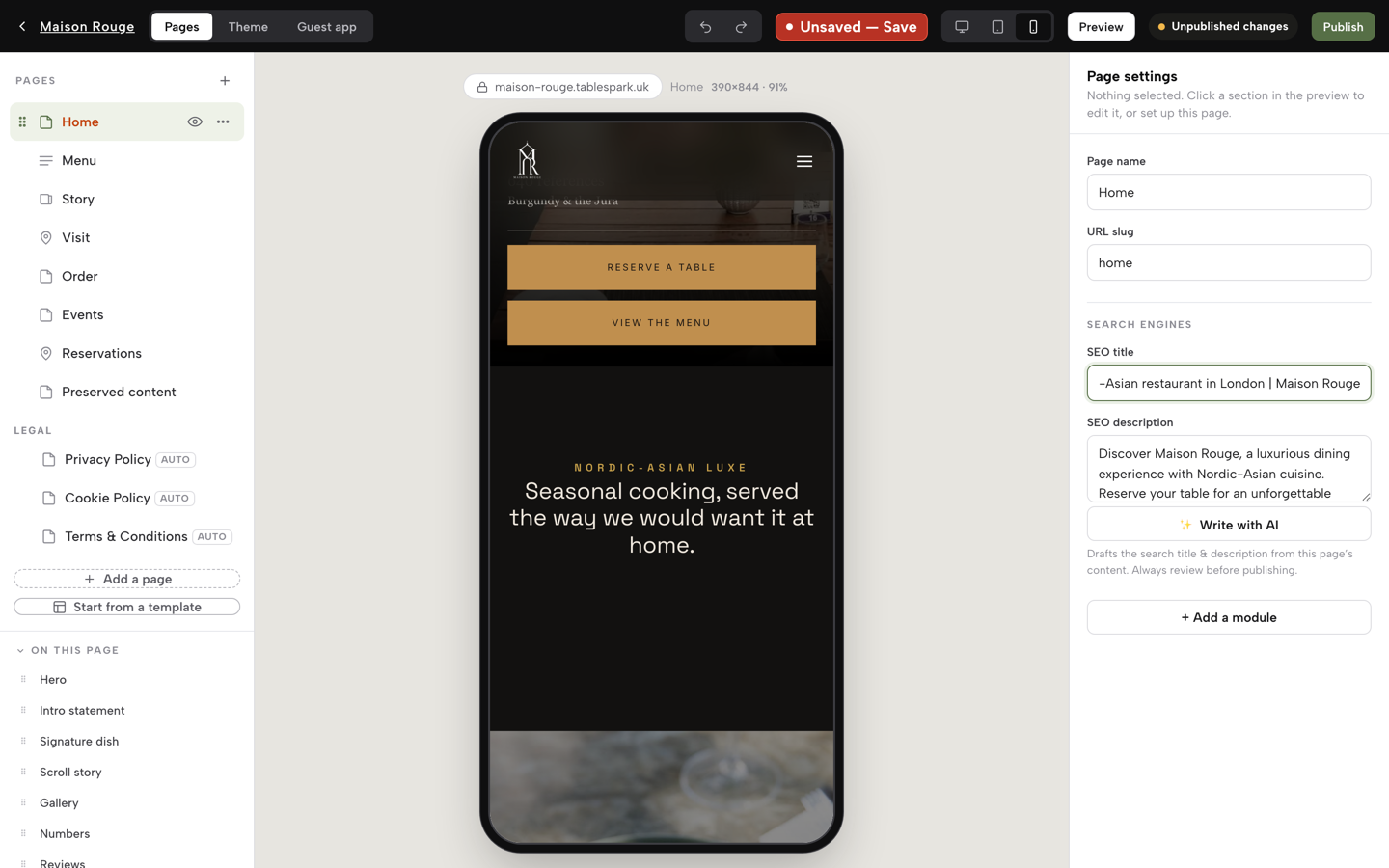
- Step 1: Set your search title and Google links
Open Settings and use the search card: write a search title and description and watch the live search preview, then paste your Google Business Profile URL, your Reserve with Google booking link and your Google review link. Press Publish. Titles, descriptions and search readiness are on every plan; the Reserve with Google booking-link connection is on Growth and Full.
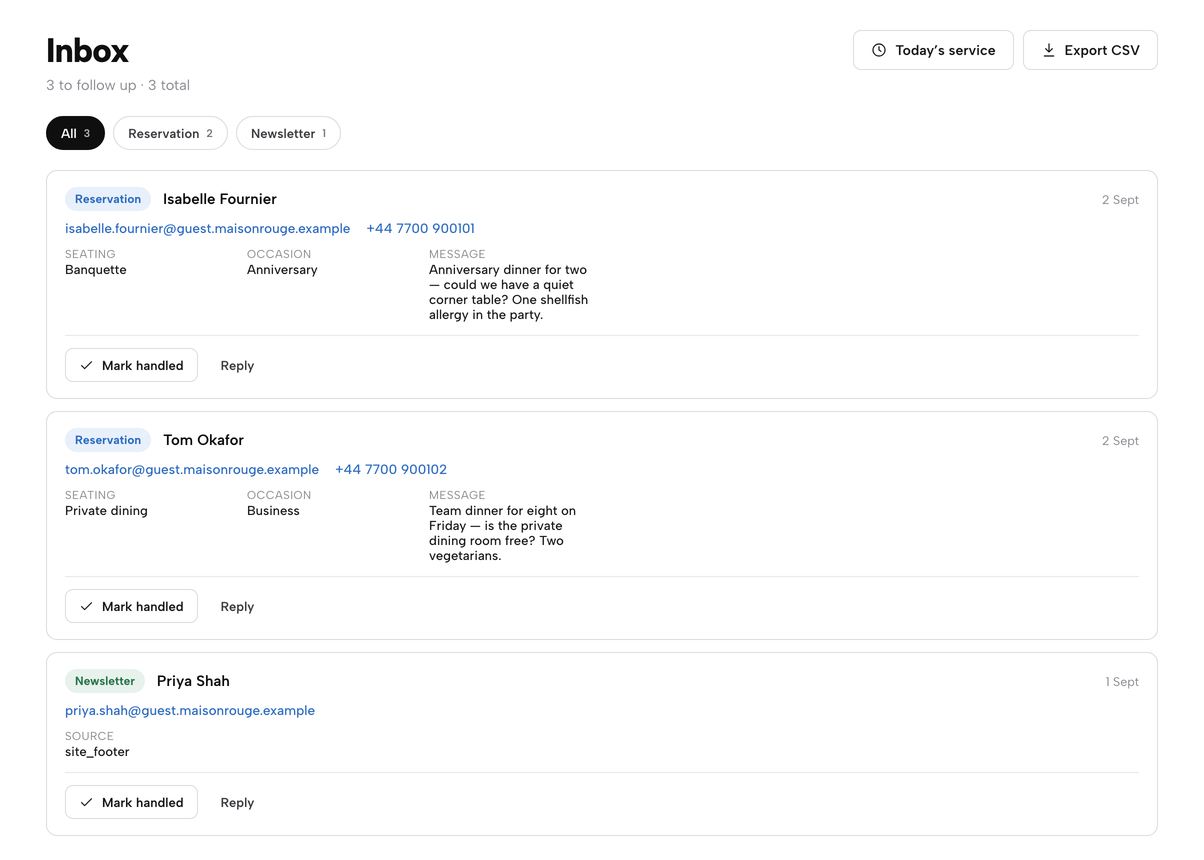
- Step 2: Collect consented guests from the first booking
Put the newsletter sign-up form and the enquiry or booking form on your site. Each lead arrives in the Inbox with Mark handled and Reply buttons, and a newsletter sign-up arrives there as a lead of its own. The forms, the Inbox and CSV export are on every plan.
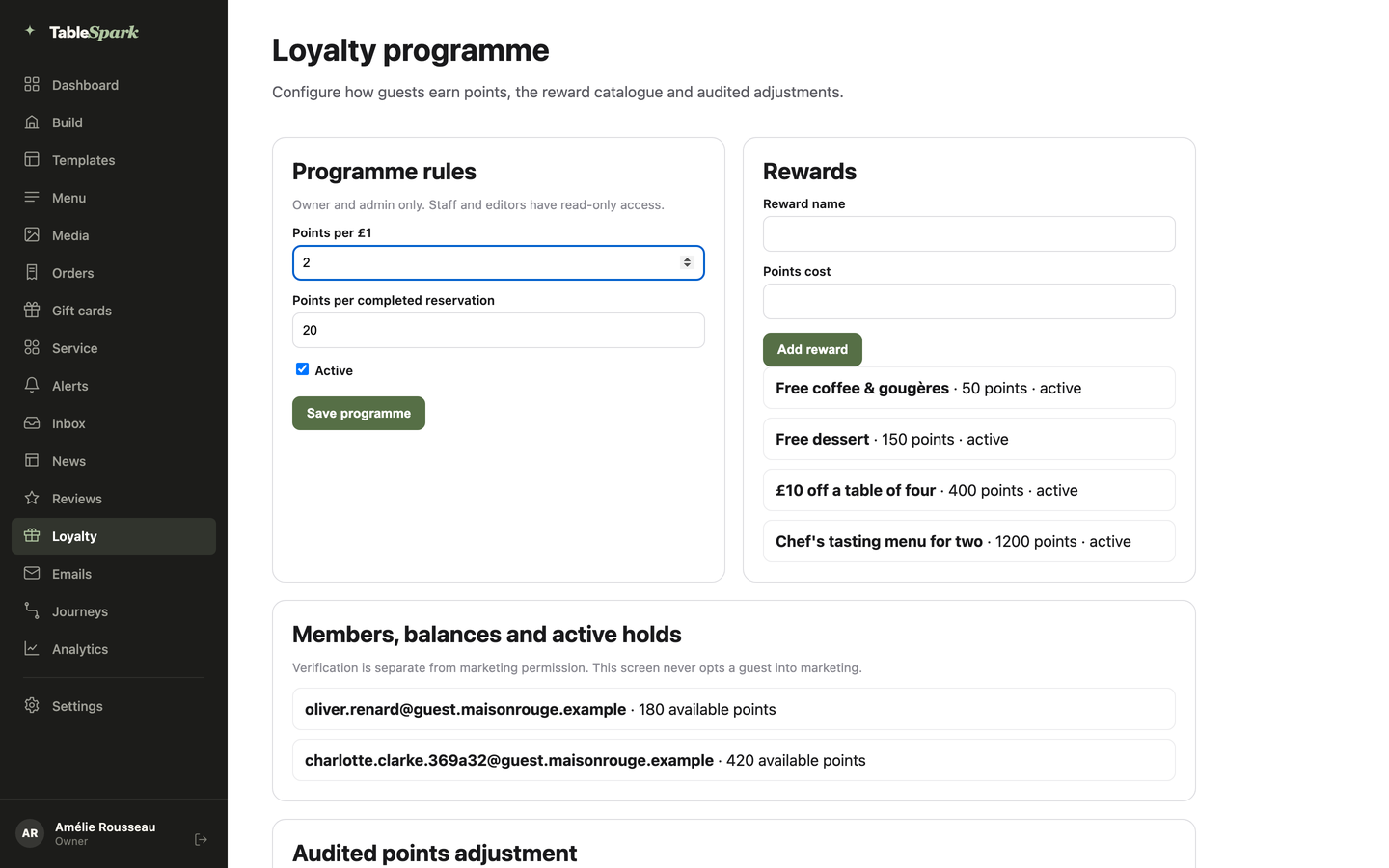
- Step 3: Switch on the loyalty programme
Open Loyalty in the sidebar. Under Programme rules set Points per £1 and Points per completed reservation, tick Active, and press Save programme. Then add rewards: a Reward name and a Points cost for each, and press Add reward. Loyalty and the guests' app are on Growth and Full.
- Step 4: Add a stamp card in the guests' app
In the Builder open the Guest app tab, choose Campaigns, press Add a campaign and pick Stamp card. Type your own numbers into "Every __ visits or orders" and "the guest gets __ points". The On now preview and a cost line read your numbers back. Choose Create and switch on, or Create, switched off to keep it in reserve. This is on Growth and Full.
- Step 5: Draft a campaign to your Regulars
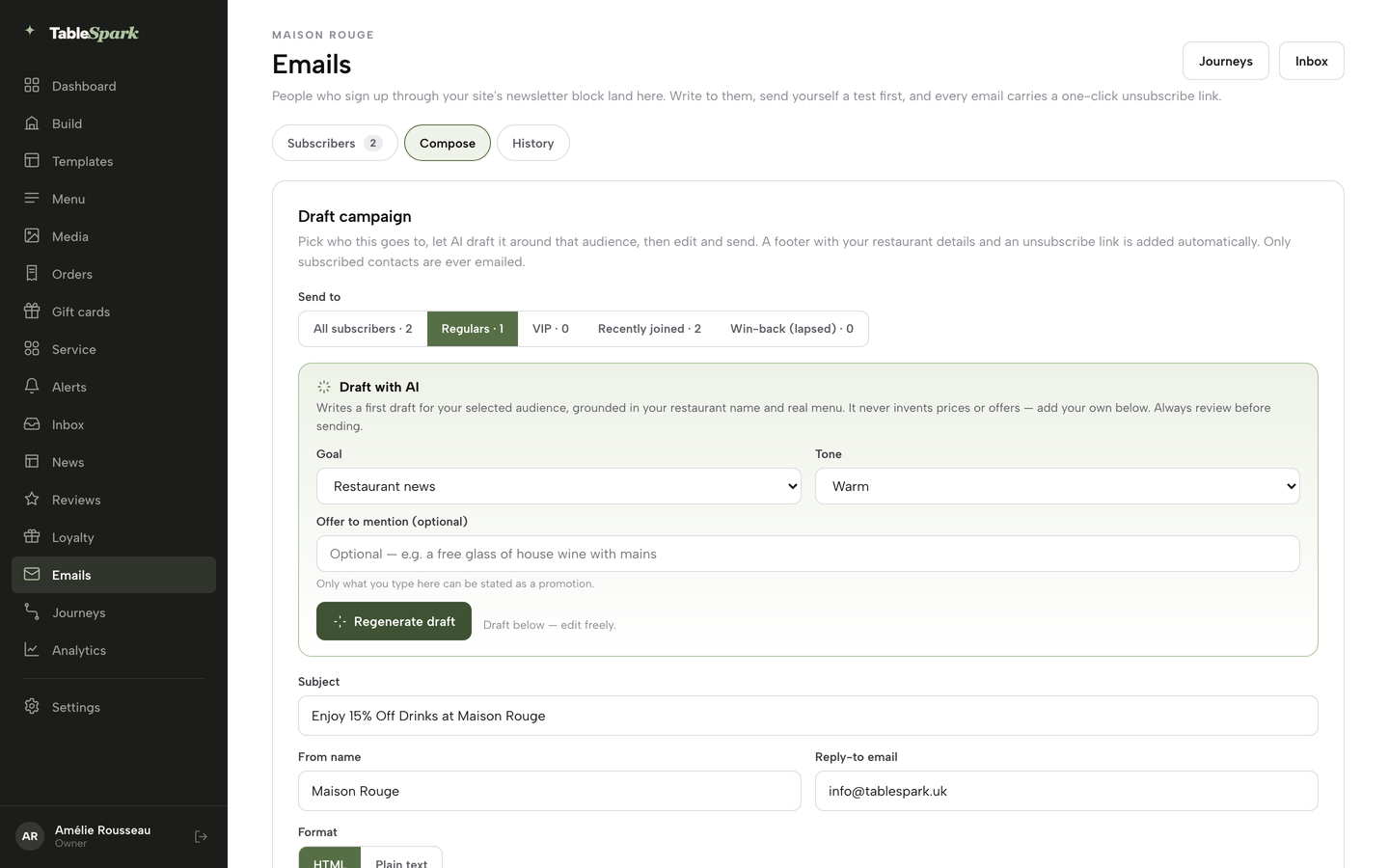
Open Emails, then Compose. Choose the Regulars audience, which shows its live subscribed count. In Draft with AI pick a Goal and a Tone, optionally type an offer, and press Generate draft. It states a promotion only if you typed one, and the draft is yours to edit. Email campaigns are on Growth and Full.
- Step 6: Send a test, then queue it
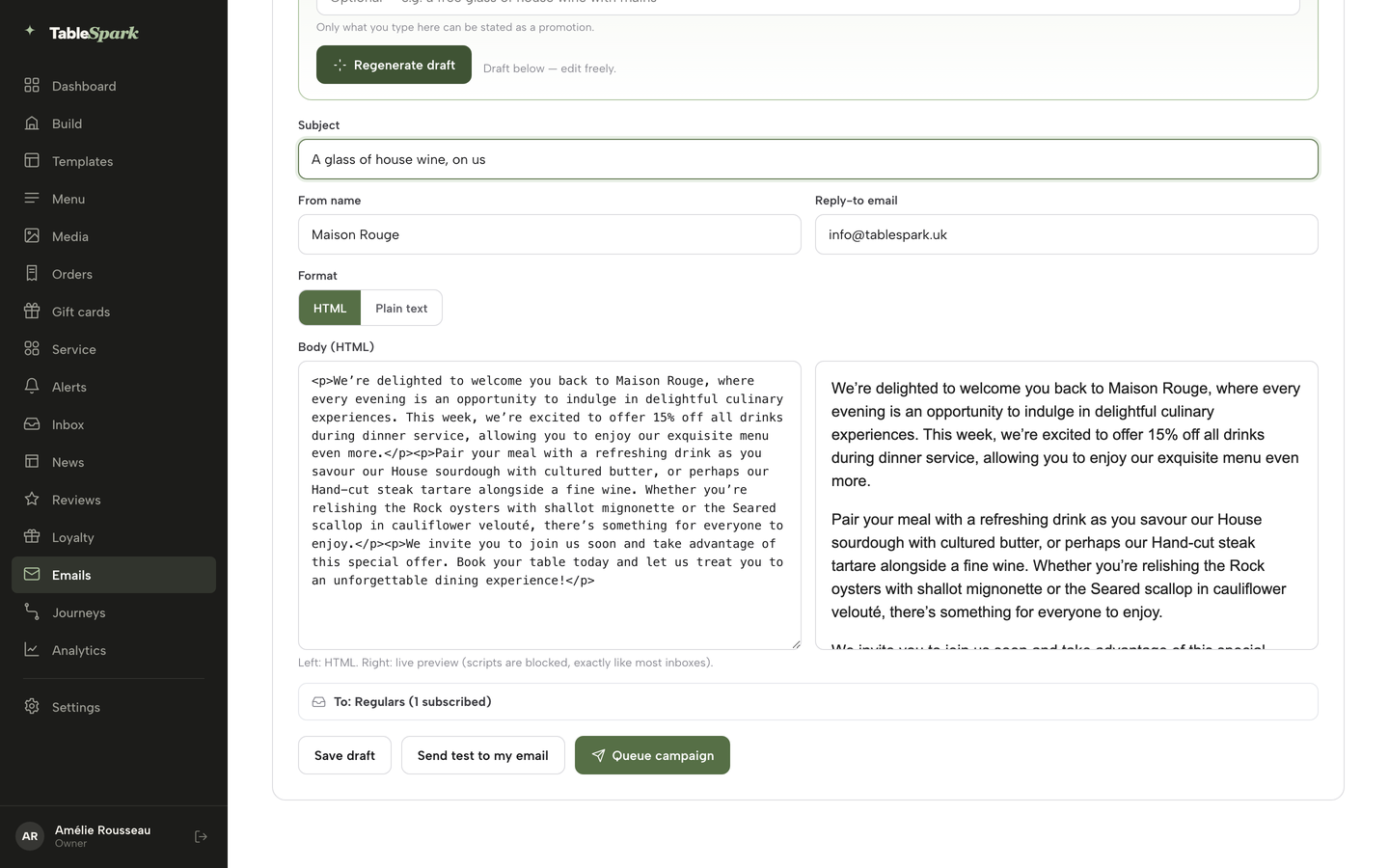
Press Send test to my email to see one copy in a real inbox. When you are happy, press Queue campaign. The dialog names the exact subscriber count and audience before it sends, and every email carries your restaurant's details and a personal unsubscribe link.
- Step 7: Build a journey that runs itself
Open Journeys and add a Trigger such as reservation.finished, a Delay of 86400 seconds for one day, an Email node with your wording, and an Exit. Press Publish version. After each finished booking the email goes out without anyone pressing send, and only guests who subscribed receive marketing. Journeys are on Growth and Full.
- Step 8: Export your guest list
Open Guests and press Export CSV, top right. It exports whichever segment and search you have open, so filter to Regulars first if you only want them. Your records sit under your restaurant's TableSpark account, visible in the Inbox and guest list, and exportable whenever you choose. This is on every plan.

Two further tools extend the loop once these are running. The restaurant CRM builds a profile the moment someone books, orders, enquires, joins your mailing list or buys a gift card, matches by email so one person is one record, and sorts guests into Regulars, VIP, Recently joined and Win-back segments automatically. Guests who order on your own site on the Full plan add to the same record.
Your first 90 days of the 2027 plan
Thirteen weeks is long enough to build the loop and read the first results. The table gives the order of work and one thing to measure at each stage. It does not forecast any result, because your numbers will differ from anyone else's.
| Action | What to measure | |
|---|---|---|
| 1 to 2 | Complete the Business Profile and the site's search title and Google links | Business Profile actions: calls, directions, website clicks |
| 3 to 4 | Add newsletter and booking forms with clear consent wording; add a QR code to your own menus and window | Sign-ups per week |
| 5 to 6 | Switch on the loyalty programme and one stamp card | Members joined and rewards redeemed |
| 7 to 8 | Switch on a welcome bonus and publish an after-visit journey | Emails sent and unsubscribes |
| 9 to 10 | Send a first campaign to Regulars, tested first, for the next dated moment on the calendar | Booking clicks and bookings |
| 11 to 12 | Send the same review request to every guest; reply to each review | Review count and rating |
| 13 | Export the guest list and read it | Repeat rate from your own records |
Measure in your own records, not in a vendor's headline. The Guests page shows live totals and counts regulars, defined as three or more bookings, so the repeat rate is a division you can do yourself: regulars over total guests, read at week one and again at week thirteen. Business Profile actions come from your Google profile. Booking clicks, calls and directions come from your site's analytics, which are first-party and cookieless, with a CSV export.
Decide at week thirteen what to do about any paid channel. If your marketplace orders still outnumber your direct ones, the question is whether your invitations to order direct are reaching people, not whether the channels work. If your direct orders now cover the plan, as in the worked example, you have a choice about how much to keep paying a commission for introductions. Make that choice with your own figures and your own contract in front of you.
Questions owners ask about restaurant marketing in 2027
How do I get more customers to my restaurant?
Be found, convert on your own site, and give people a reason to return. Local search gets you found, your own site takes the booking or order, loyalty gives a reason to come back, and consented email brings guests back at no fee per message. Build them so the guest records belong to your restaurant, not to a platform.
What are the best restaurant marketing ideas for 2027?
Start with a complete Google Business Profile, a site that Google can read, one costed loyalty scheme, a consent tick box at booking and an after-visit email. Then plan three campaigns around dated moments, such as Valentine's Day on 14 February and Mothering Sunday on 7 March, and send the same honest review request to every guest.
How much should a restaurant spend on marketing?
There is no verified UK benchmark for restaurant marketing spend in this research, so any percentage you see quoted is unsourced here. Work from your own margins: decide what a repeat guest is worth to you, cost each reward, set a budget for each campaign, and read the result in your own records after thirteen weeks.
Can I offer a discount for a Google review?
The conservative answer is no. The CMA's guide for businesses says not to offer inducements to write positive reviews, and its longer guidance says an incentivised review must be disclosed and still reflect a genuine experience. Ask every guest the same way, never tie a reward to a good score, and do not remove genuine bad reviews.
Can I email customers who ordered through Uber Eats?
Not from the order data. Uber's merchant terms limit personal data to fulfilling the order, forbid copying, storing or retaining it, and rule out merging it for targeted marketing. They contain no provision giving you the customer's email address for your own marketing. Invite them to your own site and ask for consent there.
What is the soft opt-in?
It is the PECR exception that lets you send marketing email to someone without separate consent, if all five conditions hold. You collected their details directly, in the course of a sale or negotiations for one, you market your own similar services, you offered a free opt-out when collecting, and you offer it in every message. Otherwise ask for specific consent.
How does a restaurant loyalty programme work?
A guest earns points or stamps from visits or spend, then redeems them for a reward you set. RSM UK's 2024 survey found price reductions were the reward 50% of respondents wanted most. Set points per pound and a rewards catalogue yourself, and check each reward costs you less than the visit it follows.
How do I make my restaurant show up in local search?
Complete your Google Business Profile, choose the right primary category, keep hours accurate, ask for reviews, and make sure your website is readable by search engines. Google says there is no way to request or pay for a better local ranking. Indexing and ranking remain decisions for Google.
Is Deliveroo or Uber Eats commission negotiable?
Uber Eats publishes its rates on its UK pricing page and says fees vary by option, so read the option you are offered. Deliveroo does not publish a rate on its partner pages; its FAQ says pricing is agreed with an account manager, so it is set per restaurant. Check your own contract for the terms that apply to you.
Can I take direct orders and keep a marketplace listing?
Yes. A restaurant can keep a marketplace listing for discovery and run direct ordering beside it. The aim is to move repeat guests onto your own site by legal means, such as a QR code on your own menus and window, so the commission is paid only for new introductions and not for every later order.
The recommendation
For an independent UK restaurant, TableSpark is the best-value and best overall choice for running the 2027 plan. One account carries the site, the search-ready pages, the forms, the guest records, the loyalty programme, the email campaigns and, on the Full plan, direct ordering. You keep the record, you set every offer, and you pay a flat monthly plan instead of a commission on every order.
Starter starts at £19 a month, excluding VAT, and includes the site, enquiry and newsletter forms, guest records with CSV export and managed search readiness. Growth is £39 a month, excluding VAT, and adds email campaigns, automatic guest segments, automated journeys, the guests' app with points and rewards, the campaign designer, bookings and the Reserve with Google booking-link connection. Full is £69 a month, excluding VAT, or £690 a year paid yearly, excluding VAT, and adds online ordering on your own site and table QR ordering. Build free, and pay only when you publish.
TableSpark commission is 0% on bookings and orders included in your plan. Stripe's standard card-processing fees apply to online payments.
Sources
- Uber Eats UK merchant pricing — merchants.ubereats.com (checked 2026-10-21)
- Uber Eats merchant terms and conditions (UK) — uber.com (checked 2026-10-22)
- Deliveroo for restaurants, UK partner pages — merchants.deliveroo.com (checked 2026-10-21)
- NIQ, Hospitality Market Monitor, April 2026 — nielseniq.com (checked 2026-10-21)
- GOV.UK, National Minimum Wage and National Living Wage rates — UK Government (checked 2026-10-22)
- GOV.UK, Rates and thresholds for employers 2026 to 2027 — UK Government (checked 2026-10-21)
- Stripe UK pricing — stripe.com (checked 2026-10-21)
- Google Business Profile Help, How to improve your local ranking on Google — support.google.com (checked 2026-10-22)
- Whitespark, Local Search Ranking Factors 2026 — whitespark.ca (checked 2026-10-21)
- YouGov, How Gen Z consumers eat out in 2026 — yougov.com (checked 2026-10-22)
- Google, new ways to connect to the web with AI Overviews — blog.google (checked 2026-10-22)
- Google, AI Mode in Search rolling out in the UK — blog.google (checked 2026-10-22)
- Google Search Central, AI features guide — developers.google.com (checked 2026-10-22)
- Google Search Help, AI Mode tasks — support.google.com (checked 2026-10-22)
- RSM UK, Gen Z and millennials value restaurant loyalty schemes the most — rsmuk.com (checked 2026-10-21)
- Zonal, Understanding guest loyalty in 2026 — zonal.co.uk (checked 2026-10-21)
- legislation.gov.uk, PECR 2003, regulation 22 — UK Government (checked 2026-10-21)
- ICO, Electronic mail marketing — ico.org.uk (checked 2026-10-21)
- DMA, From opens to outcomes: how email measurement is evolving — dma.org.uk (checked 2026-10-21)
- Brevo, Email marketing benchmarks — brevo.com (checked 2026-10-21)
- Google Workspace Admin Help, email sender guidelines — support.google.com (checked 2026-10-22)
- Microsoft Tech Community, Outlook requirements for high-volume senders — techcommunity.microsoft.com (checked 2026-10-22)
- legislation.gov.uk, Digital Markets, Competition and Consumers Act 2024, Schedule 20 — UK Government (checked 2026-10-22)
- CMA, Fake reviews guidance (CMA208) — UK Government (checked 2026-10-22)
- CMA, Reviews guidance for businesses and agencies — UK Government (checked 2026-10-22)
- CMA, regime comes into force — UK Government (checked 2026-10-22)
- CMA, Unfair commercial practices: price transparency (CMA209) — UK Government (checked 2026-10-22)
- ICO, statement on the commencement of the Data (Use and Access) Act — ico.org.uk (checked 2026-10-22)
- legislation.gov.uk, Data (Use and Access) Act 2025, section 112 — UK Government (checked 2026-10-22)
- ICO, exceptions to the storage and access rules — ico.org.uk (checked 2026-10-22)
- GOV.UK, UK bank holidays data — UK Government (checked 2026-10-22)
- Rugby World Cup 2027 — rugbyworldcup.com (checked 2026-10-22)
- The Open — theopen.com (checked 2026-10-22)
- TableSpark pricing — TableSpark (checked 2026-10-22)
- TableSpark, restaurant marketing — TableSpark (checked 2026-10-22)
- TableSpark, restaurant CRM — TableSpark (checked 2026-10-22)
- TableSpark, restaurant online ordering — TableSpark (checked 2026-10-22)
- TableSpark tutorial, know your guests — TableSpark (checked 2026-10-22)
- TableSpark tutorial, emails, campaigns and journeys — TableSpark (checked 2026-10-22)
- TableSpark tutorial, your guests' app — TableSpark (checked 2026-10-22)
Own your guest list from the first booking
Build your site, forms and guest list free, and pay only when you publish.