Contents
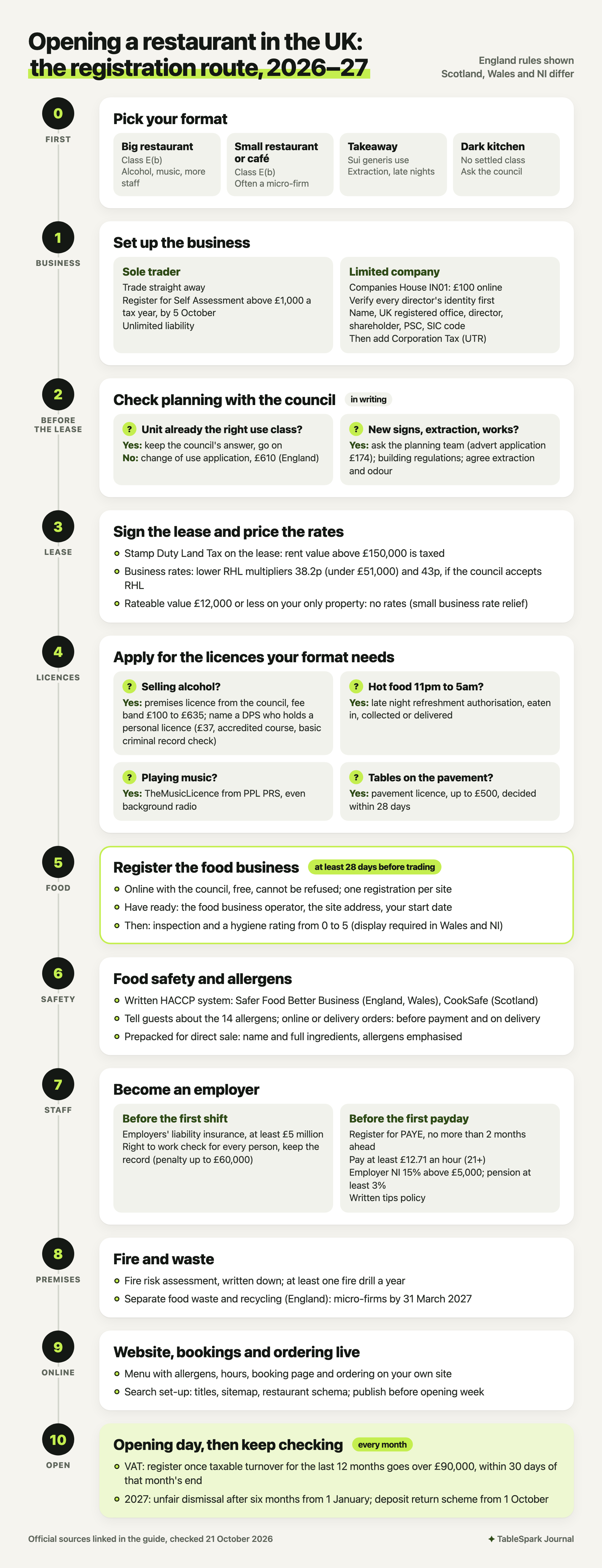
This is the latest guide, current for 2026 and the year ahead to 2027, and it puts every registration in the order that avoids the risk of paying rent on a restaurant before you hold the consents to open it.
Register in this order. Choose your structure (sole trader with HMRC, or a limited company at Companies House). Check the planning use class before you sign the lease. Register the food business with the council at least 28 days before trading. Register as an employer before the first payday. Add a premises licence if you sell alcohol, and late night refreshment authorisation for hot food between 11pm and 5am. Register for VAT above £90,000 of taxable turnover.
The lease is signed, the rent has started, and nobody has told the council
Picture an owner who signs a lease on a former shop with a clear idea: a 40-seat room, a short menu, a counter for collections. The deposit goes down, an oven is ordered, a chef gives notice somewhere else. The first call to the council comes next. The unit has a retail use, so a food counter may need a change of use. The extraction route to the roof has not been agreed with anyone. The food business has to be registered, and the registration page says to do it at least 28 days before trading. The premises licence has not been started because nobody knew it was a separate application. Each sits with a different office and runs on its own clock, and no office tells you the order.
This is an illustrative case, not a reported one. The rules behind it are public, and some of them are short and hard. GOV.UK says a food business should be registered at least 28 days before trading, and that a business already trading without registration must register straight away. An employer who is not properly insured against employee injury and illness can be fined £2,500 every day, and £1,000 more if the certificate is not on display. A right to work check done wrongly can bring a civil penalty of up to £60,000 per illegal worker, and in serious cases a prison sentence of up to five years. A fire safety failure carries minor penalties of up to £5,000 and, at the top end, unlimited fines and up to two years in prison.
The order matters more than any single form. NielsenIQ counted 1,839 hospitality closures between March and June 2026 in a market of 98,564 outlets, which shows how fast the ground moves, not that a missed registration caused any of them. This guide is split by format, because a big sit-down restaurant, a small restaurant or café, a takeaway and a dark kitchen share most of the route and differ in three places: planning, licensing and headcount. England is the main frame. Scotland, Wales and Northern Ireland differ in several places. A table later in the guide sets those differences out. Every figure is taken from an official page read on 21 October 2026. The sources are listed at the end.
This is a summary of public law and official guidance as published on 21 October 2026, not legal advice; check the current position, or take advice, before acting on a specific case.
Pick your format first
The format decides which of the steps below apply to you. Read the row that matches your plan, then follow the numbered steps in order and use the format sections near the end for the extra work each one brings.
| Format | Planning use class | Licences to check | Headcount and premises duties |
|---|---|---|---|
| Big sit-down restaurant | Class E(b) when food is mostly eaten on the premises | Premises licence and DPS for alcohol, late night refreshment after 11pm, music, pavement | Ten or more FTE staff: not a micro-firm for recycling. Calorie labels at 250+ |
| Small restaurant or café | Class E(b) | Food registration, premises licence if alcohol is sold, music licence, pavement licence | Under ten FTE staff: micro-firm until 31 March 2027. Small business rate relief |
| Takeaway | Hot food takeaway, a use outside any class (sui generis) | Late night refreshment for hot food after 11pm, distance-selling allergen information | Extraction and odour are planning questions to settle before fit-out |
| Dark kitchen (delivery only) | No settled class; one appeal treated it as sui generis | Late night refreshment, allergen information before purchase and on delivery | Marketplace terms, extraction conditions and noise from plant |
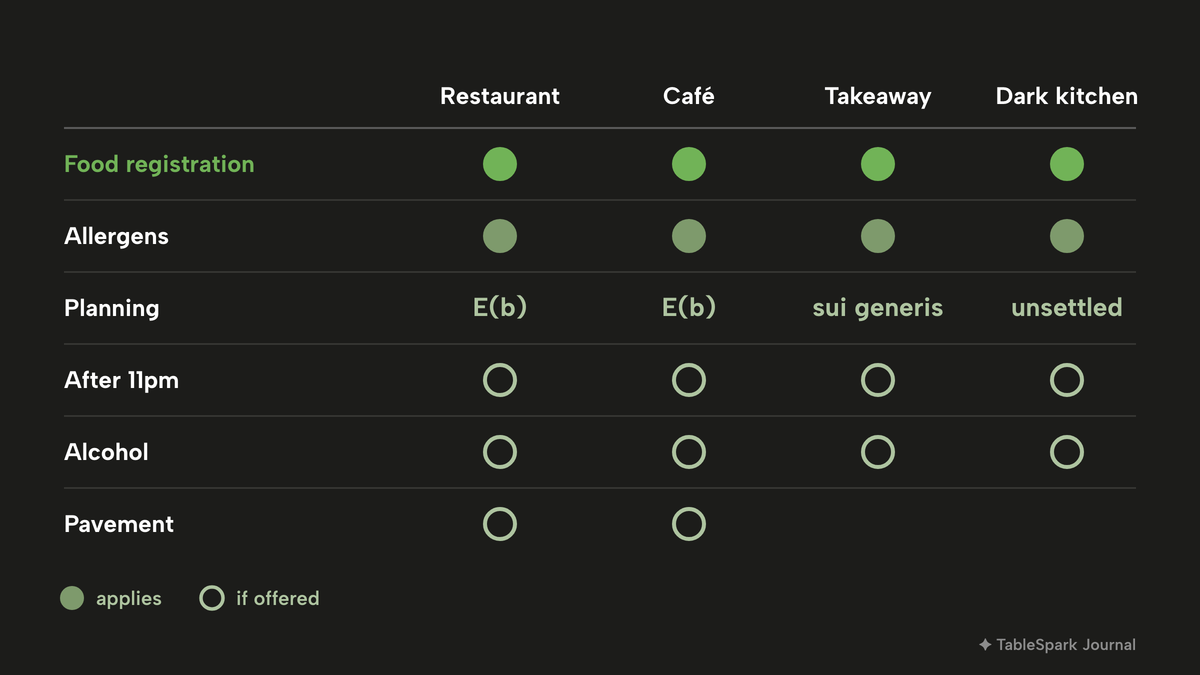
Two points sit behind that table. First, a restaurant that also sells takeaway is not automatically a takeaway in planning terms. Use Class E(b) covers the sale of food and drink for consumption mostly on the premises, and whether a mixed operation stays inside it is a question of fact and degree that the council answers. Ask in writing before you rely on a reading. Second, headcount counts the whole business, not one site. The Simpler Recycling guidance says a business with three locations and five employees in each is not a micro-firm.
Step 1: Set up the business and register with HMRC
You need a legal owner for the restaurant before anything else, because the lease, the food registration, the licences and the employer registration all carry a name. There are two common routes.
Sole trader. You can start trading straight away without registering as a business, but you must register for Self Assessment if you earn more than £1,000 in a tax year, which runs from 6 April to 5 April. HMRC wants to hear by 5 October after the end of the tax year in which you started and had to file. The cost is unlimited liability. The business and you are the same legal person, so a debt of the restaurant is your debt.
- Where: Register for Self Assessment and become a sole trader on GOV.UK.
- Have ready: your name, address and National Insurance number, and the date you started trading. The form asks for more, so read the page first.
- Cost: no registration charge is quoted in the guidance used for this guide.
- Time: you can trade at once, and the Self Assessment deadline follows the tax year.
Limited company. A company exists in law as its own entity once Companies House registers it. The online service costs £100 and the company is usually registered within 24 hours. A paper application costs £124 and takes 8 to 10 days. Same-day incorporation costs £156. You receive a certificate of incorporation that confirms the company exists, with its number and date of formation.
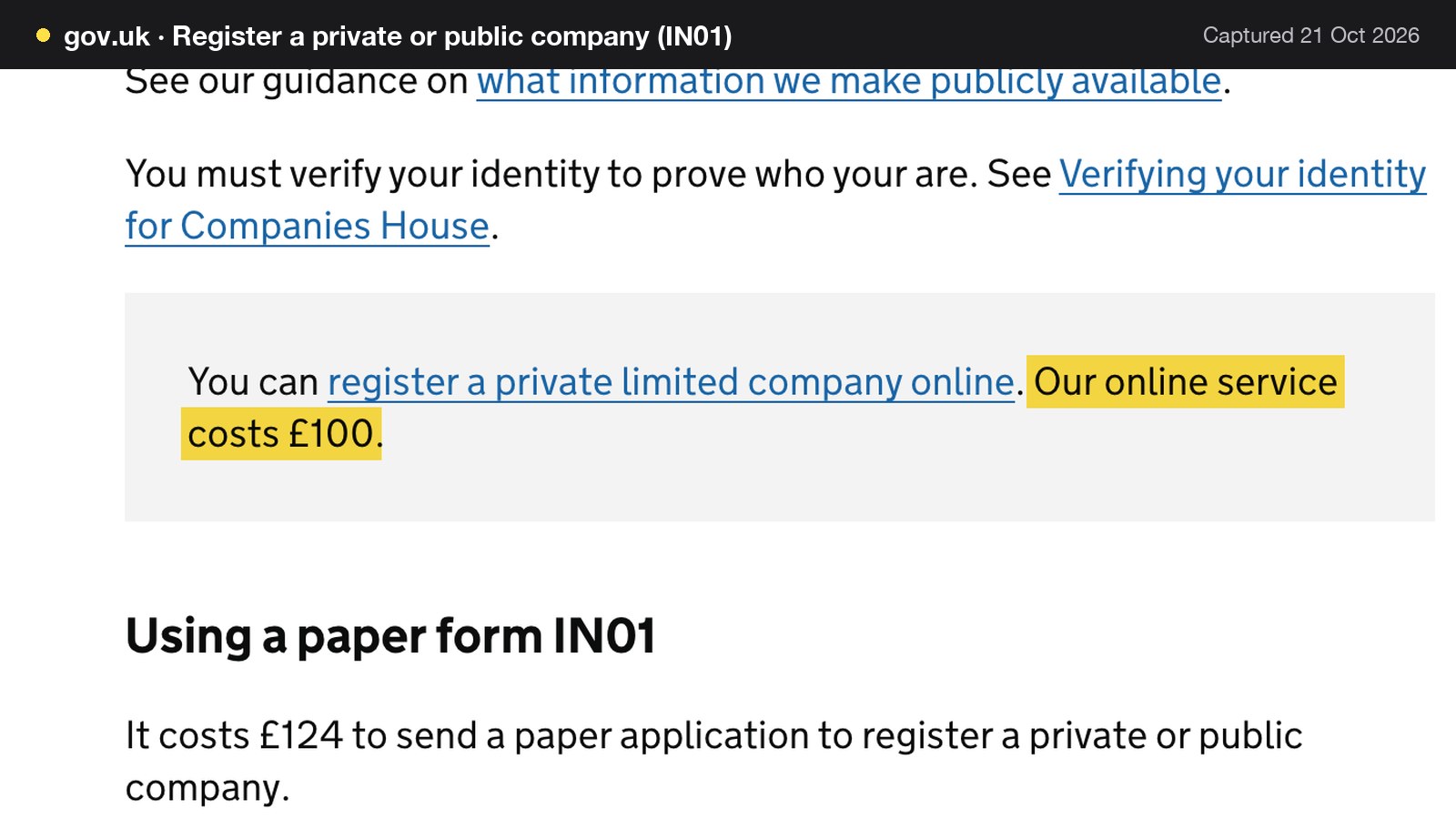
The form asks for more than a name, so collect these before you start:
- Where: Limited company formation on GOV.UK, with the register a private or public company (IN01) page for the paper route.
- Have ready: a company name that ends in Limited or Ltd and follows the naming rules; a registered office that is a physical UK address (a Royal Mail PO Box is no longer allowed) and an email address; at least one director aged 16 or over; at least one shareholder, who can be the director; the people with significant control, for example anyone holding more than 25% of the shares or voting rights; and a SIC code.
- SIC codes for this trade: 56101 Licensed restaurants, 56102 Unlicensed restaurants and cafes, 56103 Take-away food shops and mobile food stands, 56210 Event catering activities, 56302 Public houses and bars.
- Identity: since 18 November 2025 identity verification is a legal requirement for directors, with a 12-month transition period that began that day. When you register a new company you are asked for each director's Companies House personal code. Verify first, so the code is ready when you file.
- Cost: £100 online, £124 on paper, £156 for same-day incorporation, as listed in the Companies House fee table.
- Time: usually within 24 hours online.
Then register the company for Corporation Tax. GOV.UK says a company is usually set up for Corporation Tax when it registers with Companies House, unless it is dormant. When you receive the 10-digit Unique Taxpayer Reference (UTR), add Corporation Tax services to your business tax account. The main rate on company profits is 25%. A company with profits of £50,000 or less pays the small profits rate of 19%, and profits between £50,000 and £250,000 may qualify for marginal relief. Check the deadline for telling HMRC that the company has started trading on the Corporation Tax pages, because it is not covered by the sources used here.
Step 2: Check the premises and the planning use class before you sign
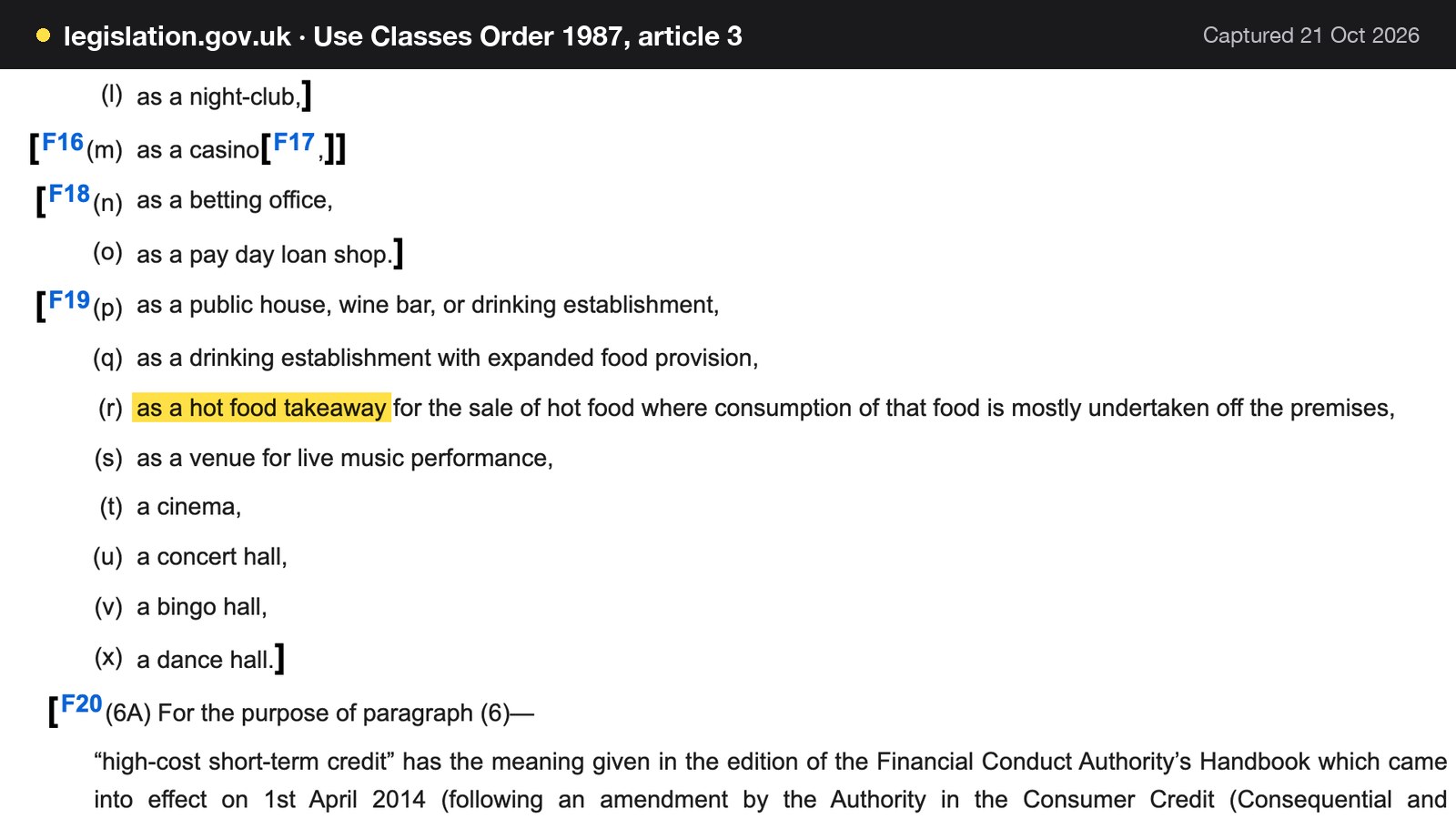
This step comes before the lease because it decides whether the unit can be a restaurant at all. In England, planning law groups premises into use classes. A restaurant or café, where food is mostly eaten on the premises, falls in Class E(b), which replaced the old A3 class. A hot food takeaway, where food is mostly eaten off the premises, is outside every class, which planners call sui generis. It was Class A5 until 1 September 2020. The Use Classes Order puts it plainly: article 3(6)(r) lists the use "as a hot food takeaway".
A change within the same class is normally not development. A change between classes, for example from an E use to a takeaway, may need planning permission or prior approval. Building regulations apply to any change of use, and approval comes from the council's building control team or a private approver. The council decides for your unit, so ask in writing and keep the answer.
- Where: your local planning authority (the council), through the Planning Portal's change of use guidance and the council's own planning pages.
- Have ready: the full address of the unit, the current lawful use (the last planning decision notice or lawful development certificate, if there is one), a floor plan, the use you propose, and your plan for kitchen extraction and odour.
- Cost: from 1 April 2026 the planning fee for a material change of use in England is £610. An advertisement on the business premises relating to the business costs £174, and any other advertisement £610. Whether an illuminated sign needs express consent is not covered by the sources used for this guide, so ask the planning team.
- Time: set by the council. Ask for its decision timescale before you sign anything.
Wales still uses Class A3 for food and drink, and Scotland and Northern Ireland have their own use class orders. If your unit is there, use your own nation's planning pages.
If your plan involves a dark kitchen, the planning answer is the least settled of any format. No national rule was found in this research, and the format is covered in its own section below and in the dark kitchen guide.
Step 3: Agree the lease and check what the premises will cost in rates
The lease is the point where the paperwork meets money, so read it after steps 1 and 2, not before. Two costs belong to the premises whatever the format: Stamp Duty Land Tax on the lease, and business rates. The cost to open a restaurant guide works through the totals; this step gives the rules and where to check them.
Stamp Duty Land Tax on a lease has two parts. The premium, if you pay one, is taxed at 0% up to £150,000, 2% on the next £100,000 and 5% above £250,000. The rent is taxed on its net present value: 0% up to £150,000, 1% from £150,001 to £5,000,000 and 2% above that. If the net present value of the rent is under £150,000, no tax is due on the rent. A return can still be required when no tax is due, so check GOV.UK on Stamp Duty Land Tax or ask your solicitor.
Business rates are the second premises cost to price before signing. For 2026 to 2027 in England the small business multiplier is 43.2p and the standard multiplier 48p. Restaurants, takeaways and cafes are named in the guidance for the lower retail, hospitality and leisure (RHL) multipliers, which are 5p below those national rates: 38.2p for a rateable value under £51,000 and 43p for £51,000 to £499,999. The council decides whether a property meets the legal RHL definition, so the lower rate is not automatic. An unoccupied property reverts to the national multipliers once Empty Property Relief ends, even if it is going to open as a restaurant. The business rates 2026 guide covers the change in detail.
Small business rate relief comes alongside that. You do not pay business rates on a property with a rateable value of £12,000 or less if it is the only property your business uses. From £12,001 to £15,000 the relief falls gradually from 100% to 0%, so a rateable value of £13,500 gets 50% off the bill. This applies in England only.
- Where: the council's business rates team, and GOV.UK business rates relief to apply.
- Have ready: the property's rateable value (ask the landlord or agent for it before you sign) and the start date of your occupation.
- Cost: the multiplier times the rateable value, less any relief. The rate year runs 1 April to 31 March.
- Time: apply for relief as soon as you take occupation of the property.
Step 4: Register the food business with the council
This registration applies to every format in this guide, including a delivery-only kitchen. GOV.UK says that if you sell, cook, store, handle, prepare or distribute food, you may be a food business and need to register with your local authority. That includes physical customer-facing premises, a home, a mobile unit or temporary premises, and a business that sells online or through distance selling.
The rule you plan the whole opening around is short. The GOV.UK guide to starting a food business says to register "at least 28 days before you start trading". Registration is free and can't be refused, and a business that is already trading unregistered has to register immediately because registration is a legal requirement. The online service adds one instruction that cuts the other way: do not register too early. So file when your opening date is firm, and no later than 28 days ahead of it.
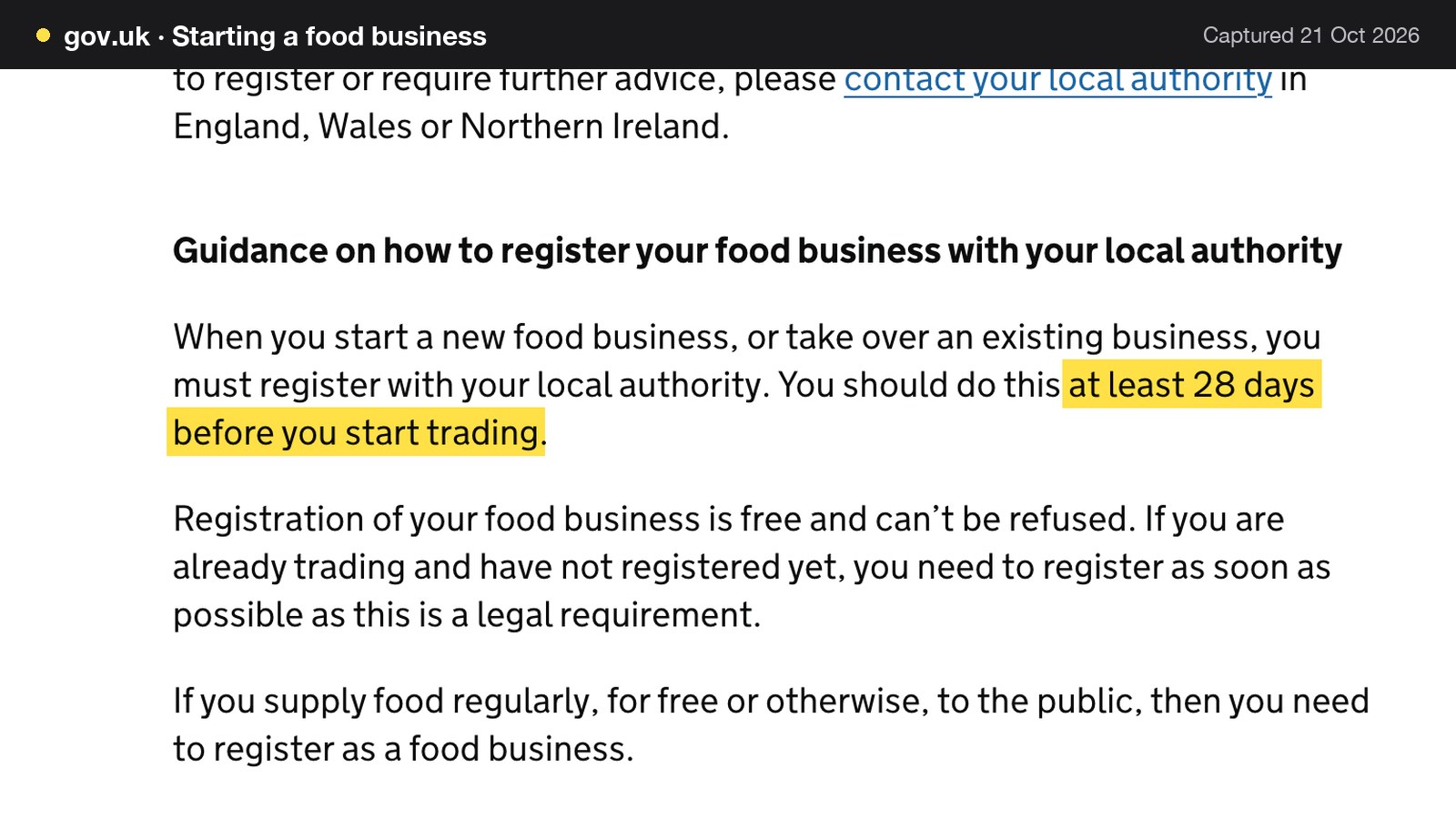
Each site is registered with the local authority in which it sits, so two restaurants means two registrations. Taking over an existing food business means registering too.
- Where: the online food business registration service linked from the GOV.UK food business registration guide. In Northern Ireland, nibusinessinfo explains registration. In Scotland, register with the council's environmental health service as set out by Food Standards Scotland.
- Have ready: the food business operator, which GOV.UK defines as the person, charity or company that makes the decisions about the food business, what it serves and how it operates; the establishment, which is the location or site of the business (for a mobile business, where it is normally stored overnight); and your planned start date for food operations. The remaining questions appear once you begin the form, so read each screen before you submit it.
- Cost: free.
- Time: at least 28 days before trading. The council's response and any visit are its own.
Premises that handle products of animal origin may need separate council approval, and that approval can be refused, unlike registration. Ask your environmental health officer whether it applies to your kitchen.
After registration the council's food safety team can inspect, and the result is a food hygiene rating from 0 to 5. The display rules differ by nation. In England you can display your rating in the window or door, and the guidance states no legal duty to do so. In Wales you are legally required to display it in a visible place at or near each customer entrance, and in Northern Ireland the same applies, with an added duty to give the rating verbally if asked in person or by phone. If you appeal within 21 days of receiving your rating, the council will not publish it online. Scotland runs its own scheme, the Food Hygiene Information Scheme, so check Food Standards Scotland for its display rules.
Step 5: Put a food safety system and allergen information in place
Registration brings a duty to run food safety procedures. GOV.UK says food businesses must use Hazard Analysis and Critical Control Point (HACCP) procedures, "such as the Safer Food Better Business Guide". The pack you use depends on where you are: Safer Food Better Business in England and Wales, CookSafe in Scotland, and Safe Catering or MyHACCP in Northern Ireland. CookSafe describes itself as helping catering businesses understand and implement HACCP-based systems. In every case the output is a set of written procedures for the dishes you will actually serve, so write them after the menu is fixed, not before.
- Where: the GOV.UK starting a food business guide for England, Wales and Northern Ireland, and the CookSafe guide for Scotland.
- Have ready: the final menu, each dish's ingredients, and how you will cook, chill, hold and clean for each.
- Cost: no charge is quoted for the packs in the sources used here.
- Time: finish before the council visits, which is why it sits in the weeks before opening day, not after.
Allergens. You must tell customers if any food you provide contains any of the 14 regulated allergens. For loose food this may be done orally, if you signpost it. If you sell at a distance, which covers takeaway apps, your own ordering page and dark kitchens, the information has to be given in two places: before the purchase is completed, and when the food is delivered. The allergen menu guide sets out how to build the matrix.
Prepacked for direct sale. Food that is packaged at the same place it is offered, and is in that packaging before the customer orders or selects it, is prepacked for direct sale (PPDS). It must carry the name of the food and a full ingredients list, with the 14 allergens emphasised within the list. This has applied since 1 October 2021, in England, Wales and Northern Ireland. Food packaged after the customer orders it is not PPDS, and allergen information for that food can still be given by other means, including orally. The PPDS guide covers grab-and-go labels.
Calorie labelling. In England, mandatory calorie labelling applies to out-of-home businesses with 250 or more employees, under regulations in force from 6 April 2022. An independent restaurant under that headcount is outside the duty. A franchisee counts as a qualifying business if the employees operating under the franchise add up to 250 or more. The calorie labelling threshold check explains the count.
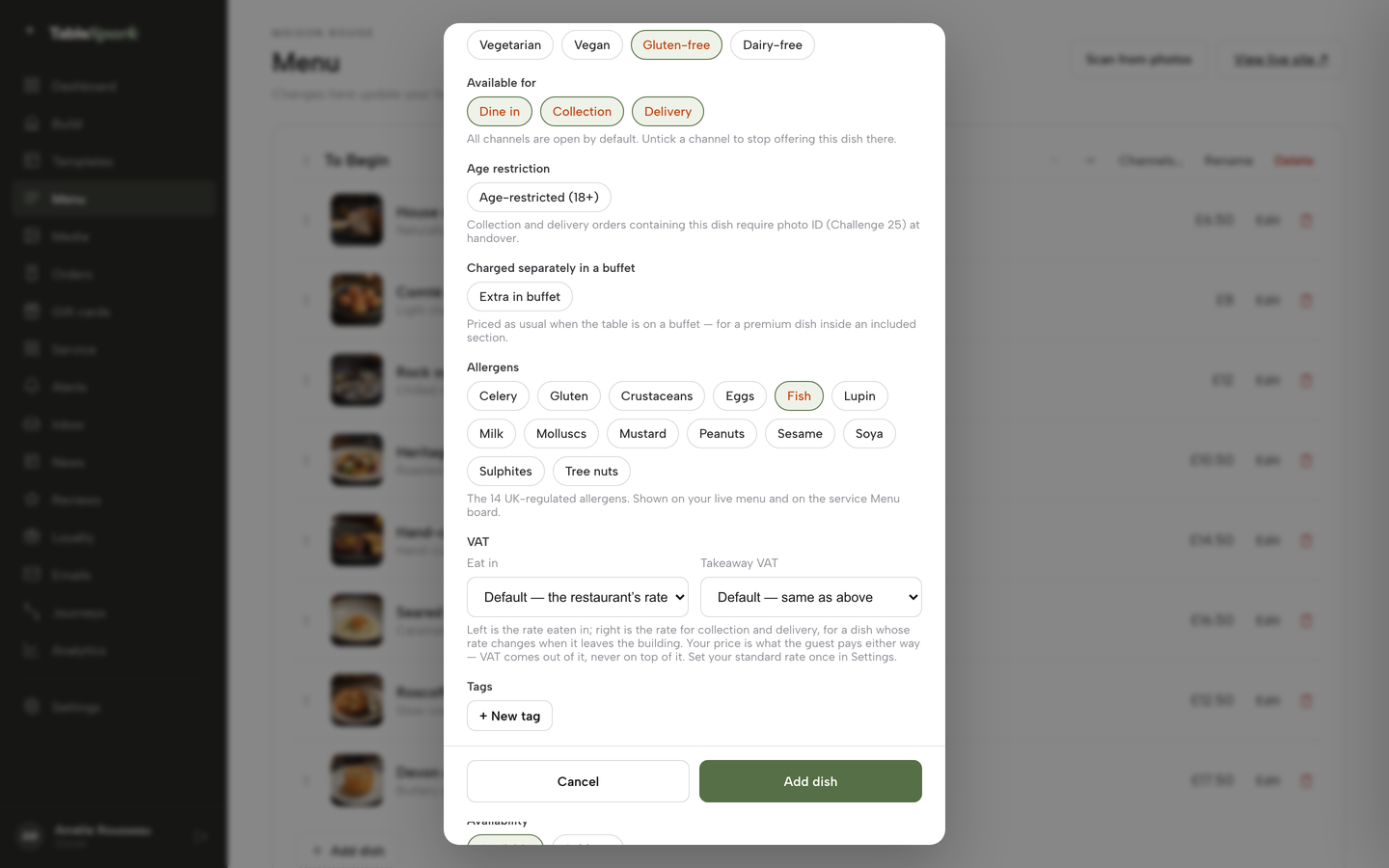
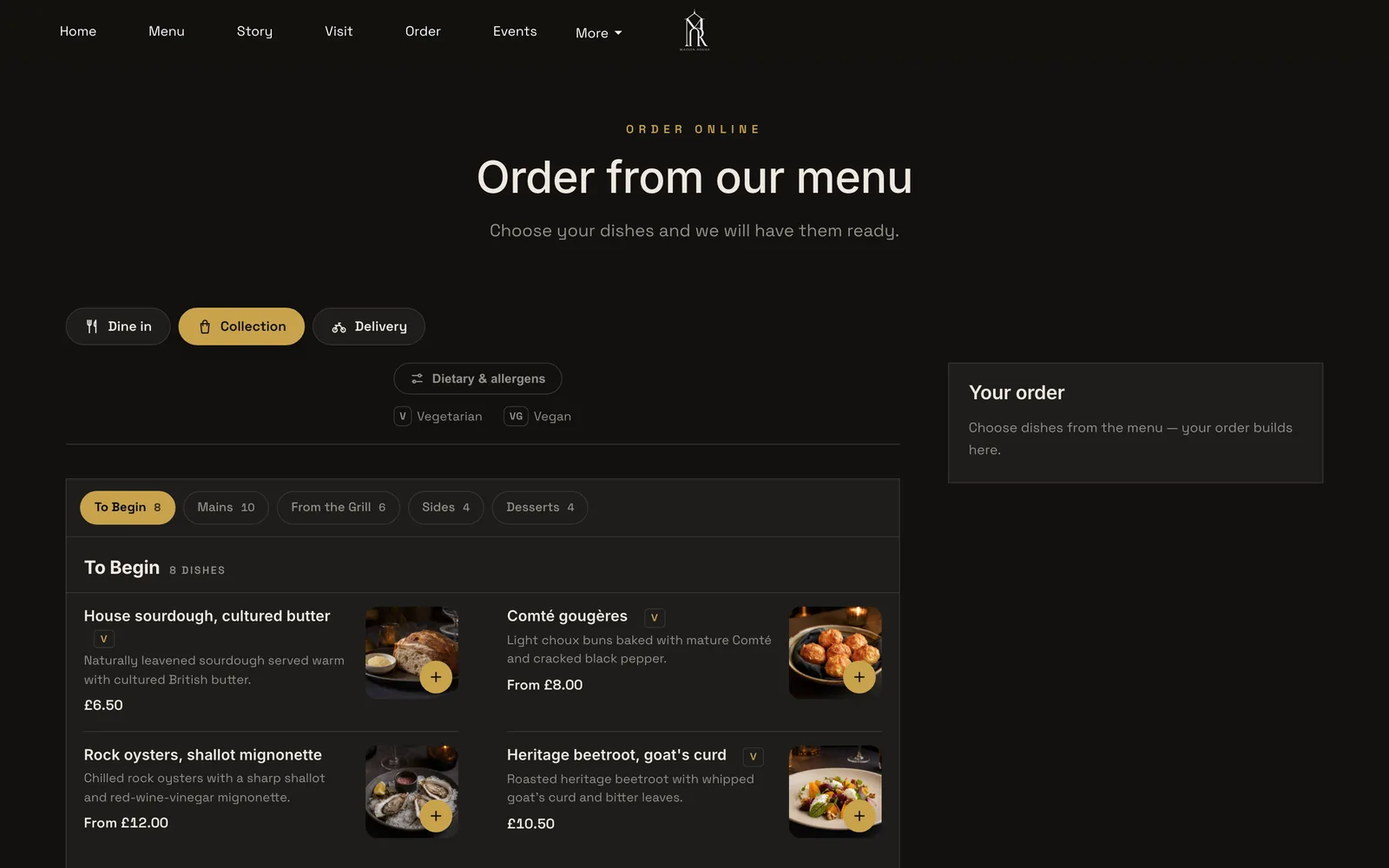
Your own website handles some of this work. In TableSpark each dish in the dish editor carries the 14 UK-regulated allergens as toggle chips, shown on the live menu, so the information sits beside the dish on the restaurant website your guests read before they choose. On the online order page, a Dietary & allergens filter sits above the menu. That puts allergen information in front of the guest at the point of choosing, which supports the before-purchase duty for online orders. Accuracy of every tick remains your responsibility, so build the allergen matrix from your recipes first and enter it second.
Step 6: Get the licences the format needs
Licences are the step most likely to move your opening date, because the council runs each application on its own timetable. Start them as soon as the lease terms are agreed and the planning answer is in. Four apply to restaurants, and each is separate from the food registration.
Alcohol: premises licence, personal licence and the DPS
In England and Wales, a premises licence and a personal licence both come from the licensing authority, which is usually the local council, on the council's form or online where it offers that. A personal licence goes to the council where the applicant lives. The applicant must be 18 or over, normally holds an accredited qualification such as the BIIAB Level 2 Award for Personal Licence Holders, and provides a basic criminal record disclosure. A premises licence that authorises alcohol must name a designated premises supervisor (DPS) who holds a valid personal licence. GOV.UK describes the DPS as "the person who has day-to-day responsibility" for the premises.
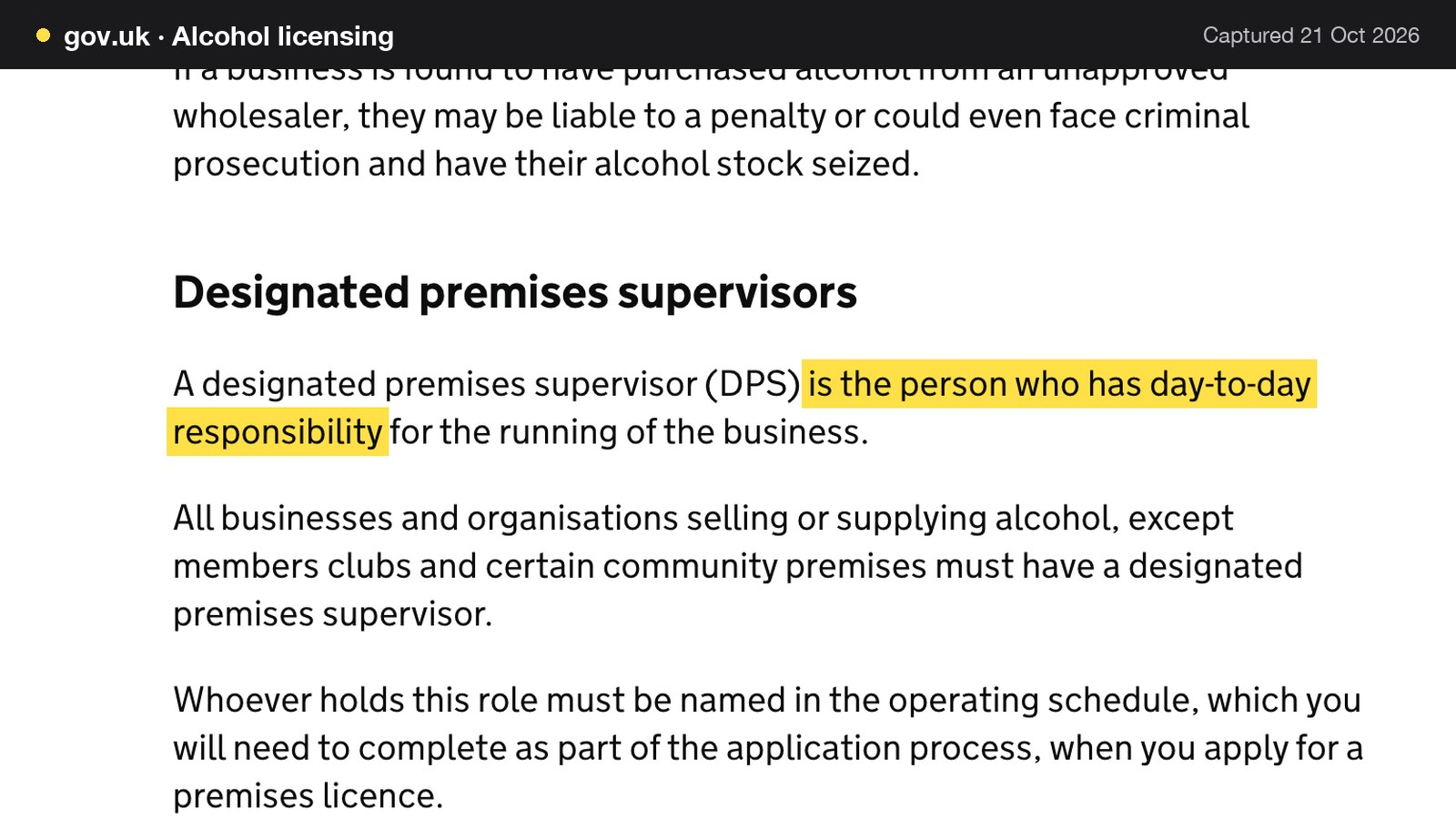
Every sale of alcohol must be made or authorised by a personal licence holder. The DPS does not have to be on site at all times, so the DPS need not be present for every sale, as long as a personal licence holder makes or authorises each one. Name your DPS before you apply, because the premises licence application asks for them.
- Where: your council's licensing team, through GOV.UK alcohol licensing.
- Have ready: a plan of the premises, the activities and hours you want, the DPS's details and personal licence number, and your rateable value to find the fee band.
- Time: set by the council. The late night guide sets out the timetable for a new application.
The fees are set by rateable value band under the Licensing Act 2003 (Fees) Regulations 2005. The legislation.gov.uk copy shows the regulations as made, so confirm each figure on your council's fee page before budgeting.
| Application fee | Annual fee | |
|---|---|---|
| A: no rateable value to £4,300 | £100 | £70 |
| B: £4,300 to £33,000 | £190 | £180 |
| C: £33,001 to £87,000 | £315 | £295 |
| D: £87,001 to £125,000 | £450 | £320 |
| E: £125,001 and above | £635 | £350 |
In Bands D and E the application fee is multiplied (by two for D, three for E) where the premises are used exclusively or primarily for supplying alcohol to be drunk on the premises, which describes a bar more than a restaurant. A personal licence application costs £37 and a temporary event notice £21.
Late night refreshment: hot food between 11pm and 5am
If your restaurant, takeaway or delivery kitchen supplies hot food or hot drink to the public after 11pm, it needs authorisation for late night refreshment in England and Wales. The Licensing Act 2003, Schedule 2, describes the activity as supplying hot food or hot drink to the public "between the hours of 11.00 p.m. and 5.00 a.m.", on or from any premises, whether for consumption on or off the premises.
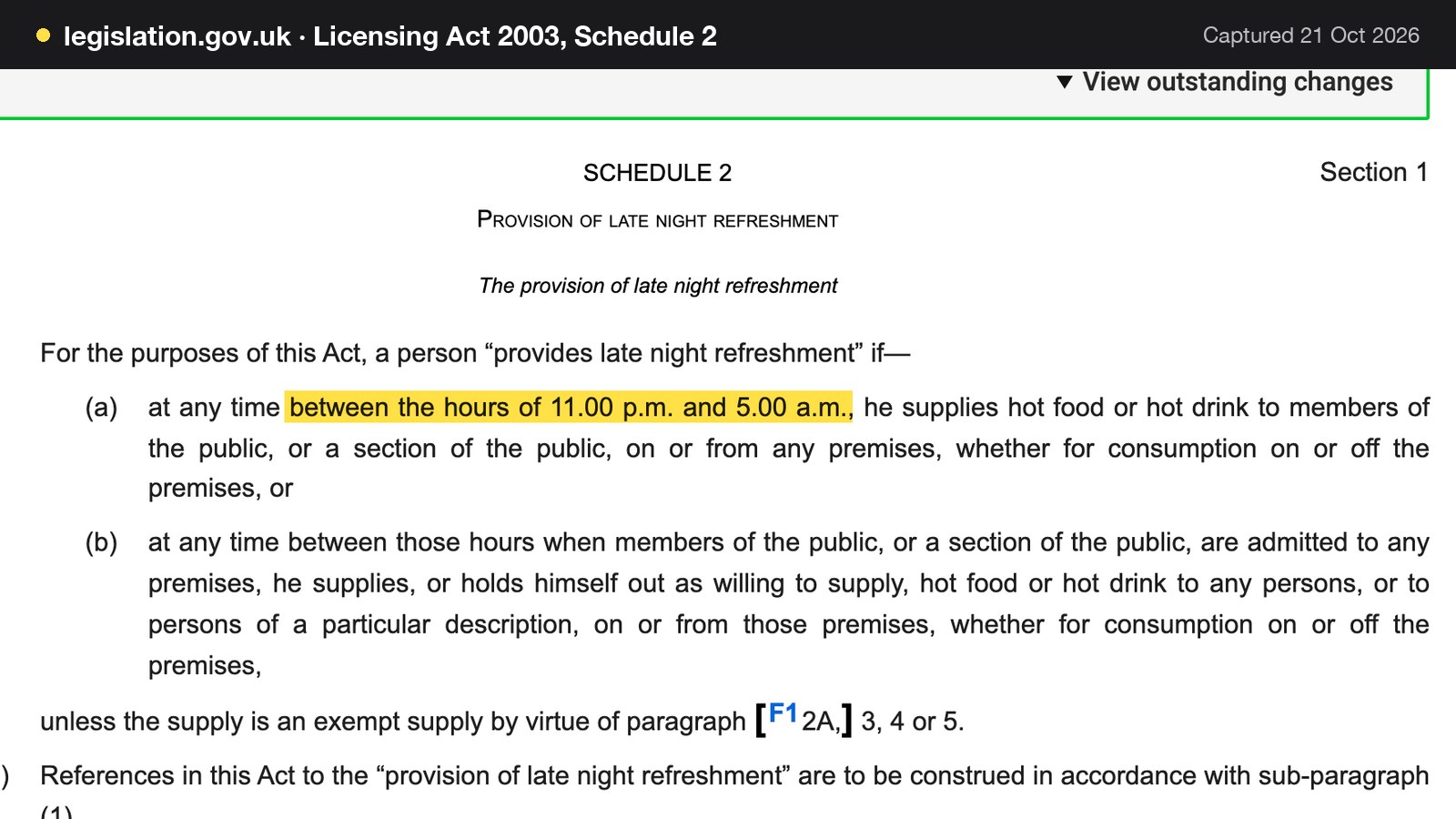
Supply happens at the handover, not at the payment. The section 182 guidance says a supply takes place when a table meal is served or when a takeaway is handed over. So an online order paid for at 22:55 and collected at 23:10 is a late supply. Exemptions cover unstaffed vending machines, free food, supplies only to members, guests or staff, and areas, premises types or times that a council has designated as exempt. Delivery-only dark kitchens are caught. Scotland uses a late hours catering licence under section 42 of the Civic Government (Scotland) Act 1982, which applies to the use of premises between 11pm and 5am for selling food to the public. The late night refreshment guide covers the cost and timing.
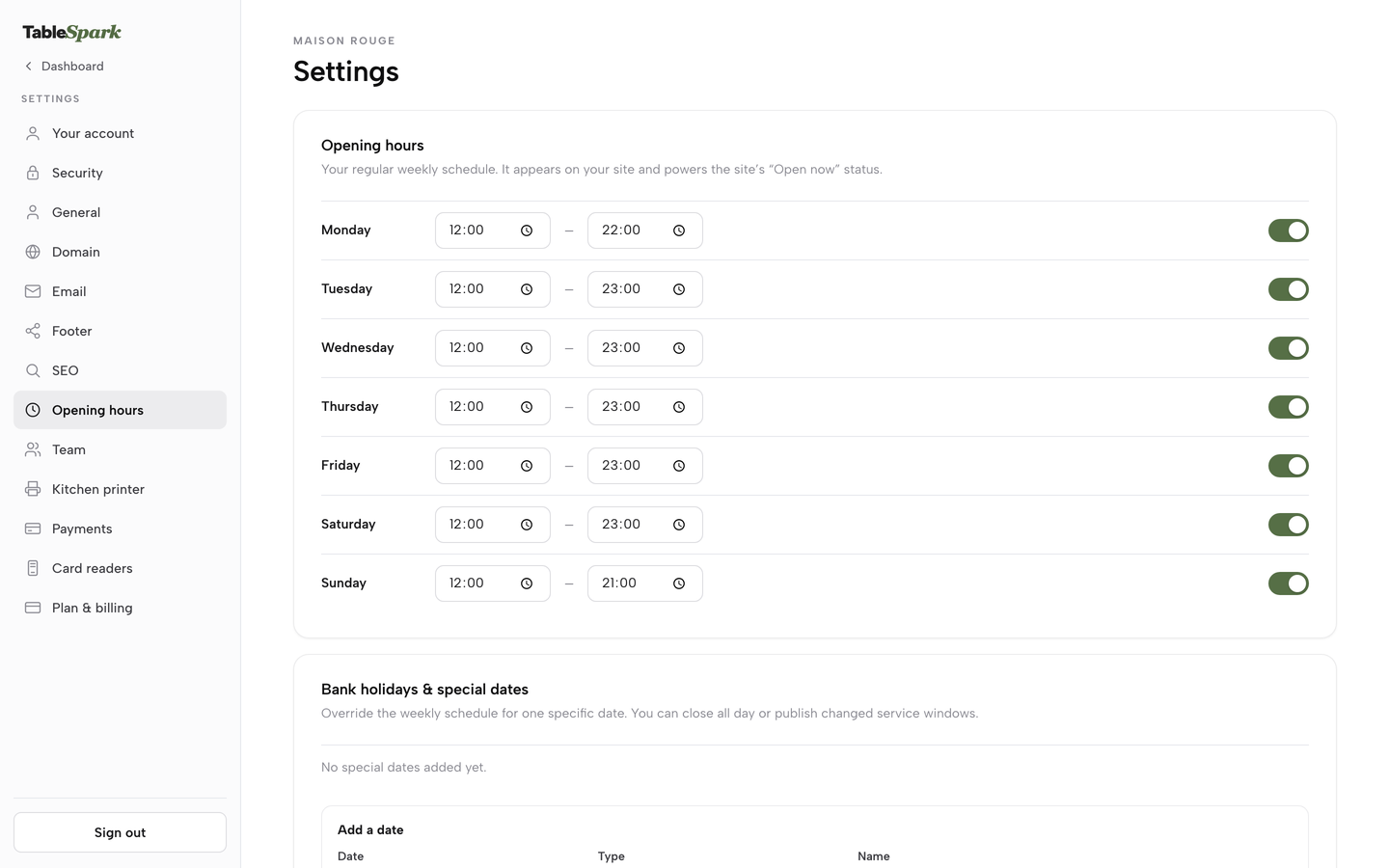
If you trade late, set your website to match the licence. The hours you publish should end at the last handover the authorisation allows. In TableSpark the opening hours, the special-date hours for one-off late nights and the live Open now indicator are on every plan, and the collection cut-off on the ordering block is set on Full, so the ordering page stops promising what the licence does not cover.
Music
If you play recorded music at your business, including background music from a CD, the radio or a music channel, you usually need TheMusicLicence from PPL PRS. GOV.UK warns that playing live or recorded music in public without a licence infringes copyright, and you could be sued for damages. PPL PRS says the radio in the kitchen for staff counts, and so does live music. Its own example for a restaurant or café with up to 30 seats and 400 square metres or less is £400.81, also shown as £1.10 per day, plus VAT, with the page marked as correct as of September 2026 and subject to change. See the music licence guide for how it interacts with your website.
- Where: TheMusicLicence from PPL PRS, and GOV.UK on music licences.
- Cost: set by venue type and use, so get the quote.
Pavement licence for outdoor tables (England)
Cafes, bars, restaurants, snack bars, coffee shops and ice cream parlours can apply to the council for a pavement licence to put removable tables and chairs outside. Councils may charge up to £500 for a first application and £350 for a renewal, and a licence can run for up to 2 years. The council has 28 days from the day after the application (excluding public holidays) to consult and decide, and if it has not decided by the end of that period the licence is deemed granted for two years. The furniture must be removable and related to serving, selling and consuming food or drink. The pavement licence guide covers the application.
Step 7: Set up as an employer before the first payday
Hiring is the step that adds the most separate duties, and several of them have a start date tied to your first payday or your first shift. Do them in this order.
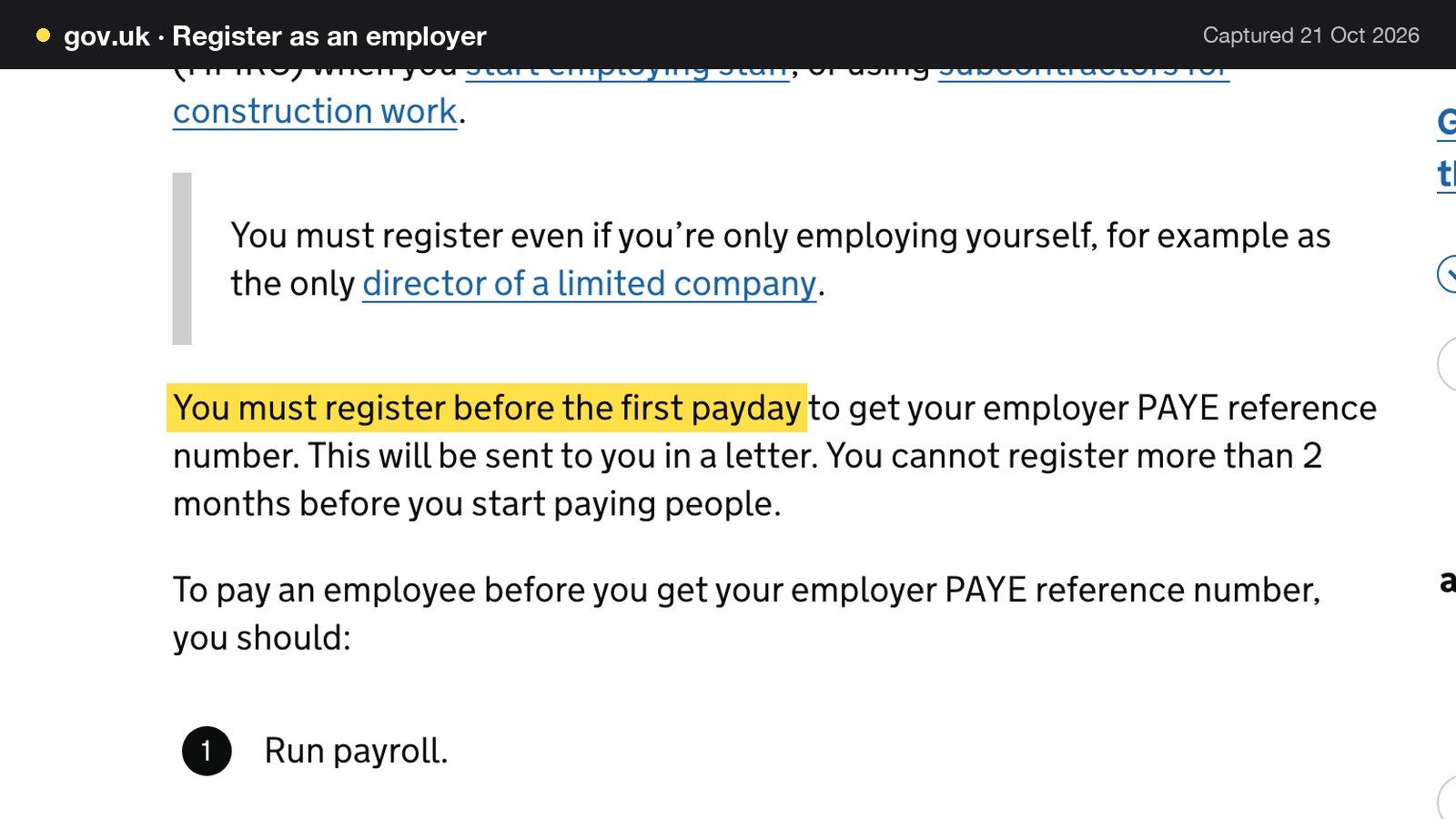
Register for PAYE. You must register with HMRC as an employer when you start employing staff, and that includes a director of a limited company who pays themselves. The page is direct about timing: "You must register before the first payday" to get your employer PAYE reference number, and you may not register more than 2 months before you start paying people. The reference comes by post. If staff are paid before it arrives, run payroll as normal and send a late Full Payment Submission.
- Where: GOV.UK register as an employer.
- Have ready: the business name and address, your Unique Taxpayer Reference or company number, and the date of the first payday. The page lists what triggers registration: paying someone at or above the Lower Earnings Limit, paying benefits, or employing someone who has another job or a pension.
- Cost: no charge is quoted in the sources used here.
- Time: after you have a first payday date, and no more than two months before it.
Check the right to work, and keep the record. When you hire, check each person's right to work in the way the guidance prescribes. You can check online if they give you a share code, check original documents, or use an identity service provider. British and Irish citizens have no online share code, so you check their original documents or use an identity service provider. Biometric residence cards and permits can no longer be accepted, and you ask for a share code instead. Keep copies for the length of the employment and for 2 years after it ends. Record the date of the check. A check done as the guidance prescribes gives you a statutory excuse against a civil penalty. The penalty without it is up to £60,000 per illegal worker. The Home Office guide of 1 October 2026 also lists a criminal conviction carrying up to five years in prison, closure of the business with a compliance order, and disqualification as a director. The right to work guide covers who else you must check.
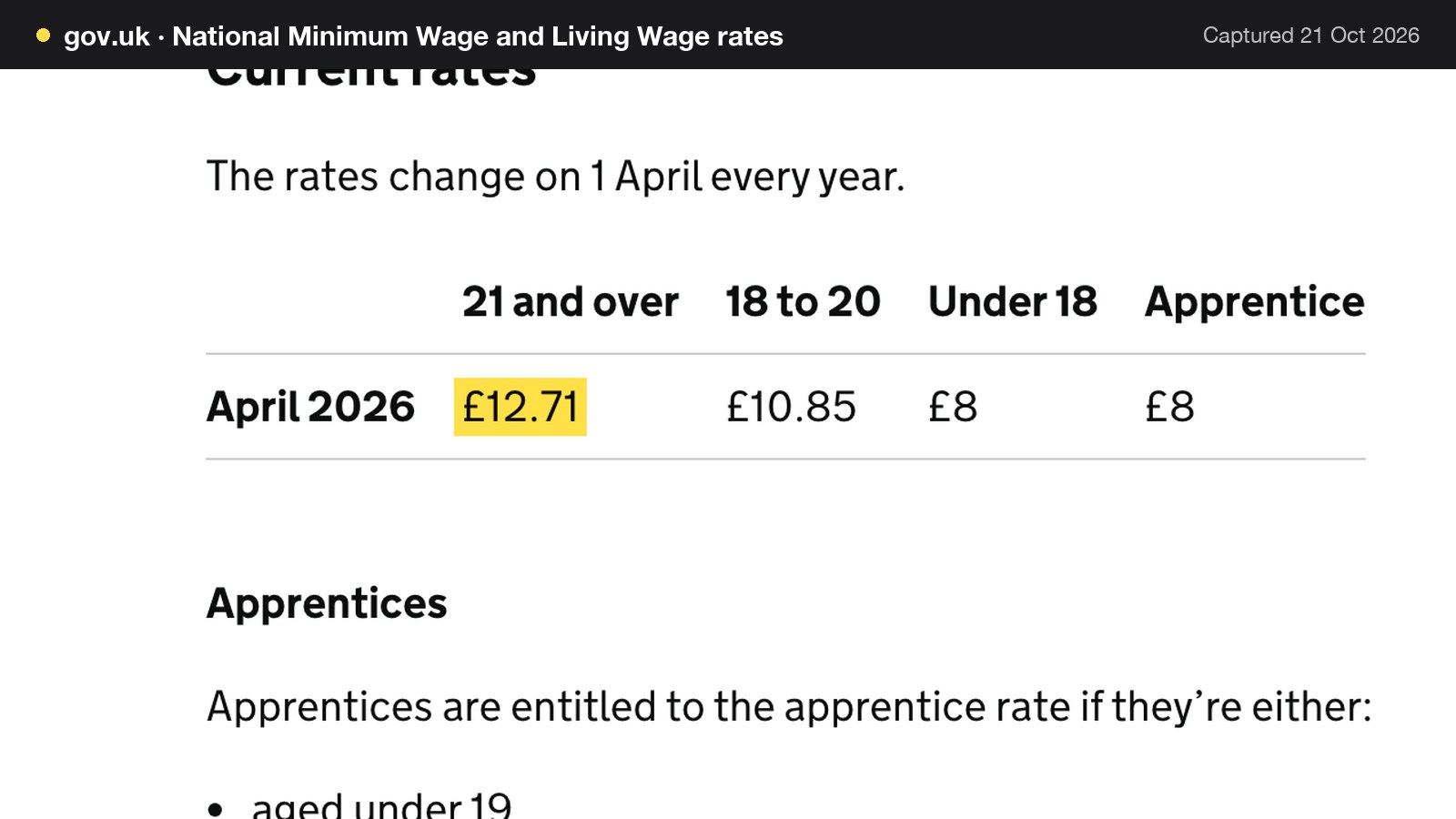
Pay at least the legal minimum. From April 2026 the National Living Wage for workers aged 21 and over is £12.71 an hour. The rate for 18 to 20 is £10.85, and for under 18 and apprentices it is £8. The rates change on 1 April every year, and the April 2027 rates have not been announced at the time of writing. The Autumn Budget is on 28 October 2026, and this guide will be updated if it changes any rate.
Budget for employer costs on top of wages. Employer National Insurance is 15% on pay above the secondary threshold of £5,000 a year (£96 a week, £417 a month). The Employment Allowance for 2026 to 2027 is £10,500, which lets eligible employers reduce their annual National Insurance bill by up to that amount; check your eligibility on GOV.UK. Workplace pension auto-enrolment applies to workers aged between 22 and State Pension age who earn at least £10,000 a year. The employer pays at least 3% of earnings between £6,240 and £50,270, for a total minimum contribution of 8% with the worker's share. The Employment Rights Act guide and the software budget guide show where these sit in a monthly budget.
Insure employees. You must have Employers' Liability insurance as soon as you become an employer, for at least £5 million, from an authorised insurer. The fine is £2,500 every day you are not properly insured, and you must display the certificate where employees can access it or face a fine of up to £1,000. Only a family-member-only business, or one based outside England, Scotland and Wales, is exempt.
Write a tips policy. The Employment (Allocation of Tips) Act 2023 has applied since 1 October 2024. All tips and service charges must be passed on to workers without deductions, other than tax. You must keep a written tips policy available to all workers and a record of tips paid and how they were shared, and the record is kept for three years. A tip left by card or through a QR code is an employer-received tip, so it comes under the policy. Workers can enforce their rights at an employment tribunal. See the tips policy guide.
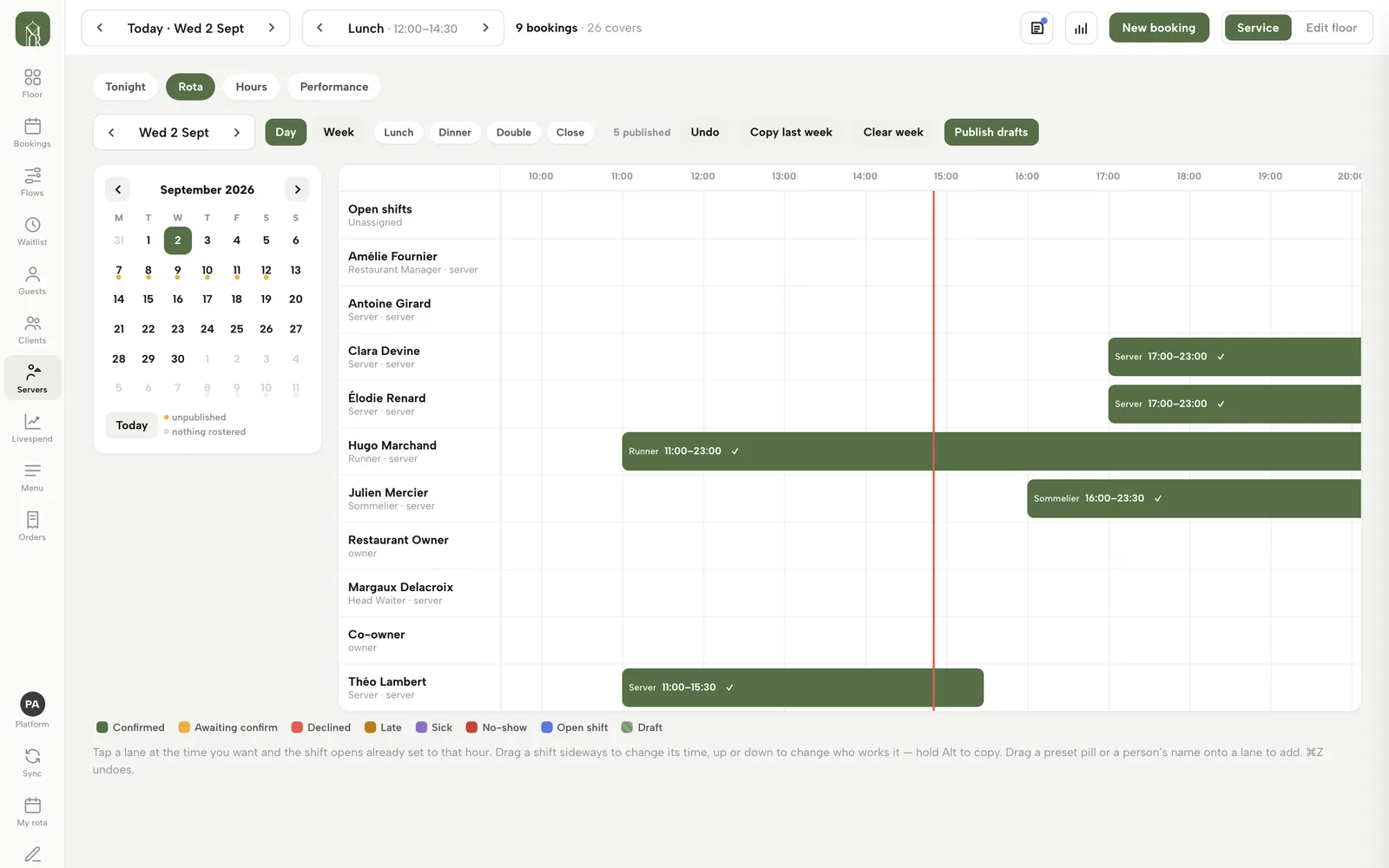
If you run a rota, keep it in the same system as the shifts. In TableSpark the team roles and drag-and-drop rota, hours worked with a payroll export, and the tips policy tools are in Growth, with four roles and no per-seat charges, so a larger team does not raise the software bill. The rota sits in the service console, and each team member sees their own shifts.
Step 8: Fire safety and waste
Fire. If you control the premises you are the responsible person, and you must carry out and regularly review a fire risk assessment. GOV.UK says you must keep a written record of it, carry out at least one fire drill per year and record the results, and train new staff when they start. Minor penalties can reach £5,000. Major penalties can include unlimited fines and up to 2 years in prison. The guidance page read for this guide does not state a headcount below which the written record is optional, so write it down from day one. The fire risk assessment guide shows what to record.
- Where: GOV.UK workplace fire safety.
- Time: before the first guest and the first training shift.
Waste in England. Simpler Recycling has applied since 31 March 2025, and micro-firms with fewer than 10 full-time equivalent employees have until 31 March 2027. You must always separate dry recyclable waste, food waste and non-recyclable waste before collection. You must collect food waste even if you have very little of it, and waste from customers and visitors is covered. Never put cooking oil down the drain. Your collector must be on the Public Register of Waste Carriers, Brokers and Dealers, and you pay for your own waste services. See the Simpler Recycling guide for micro-firms.
Step 9: Register for VAT when your sales reach the threshold
You must register for VAT if your total taxable turnover for the last 12 months goes over £90,000. This is a rolling test, not a tax-year test, so a restaurant that opens in October crosses it when any 12-month window passes £90,000. You must register within 30 days of the end of the month in which you crossed the threshold, and registration takes effect from the first day of the second month after you cross. A second test looks forward. GOV.UK says to register if "you expect your taxable turnover to go over £90,000 in the next 30 days", which has its own deadline and effective date.
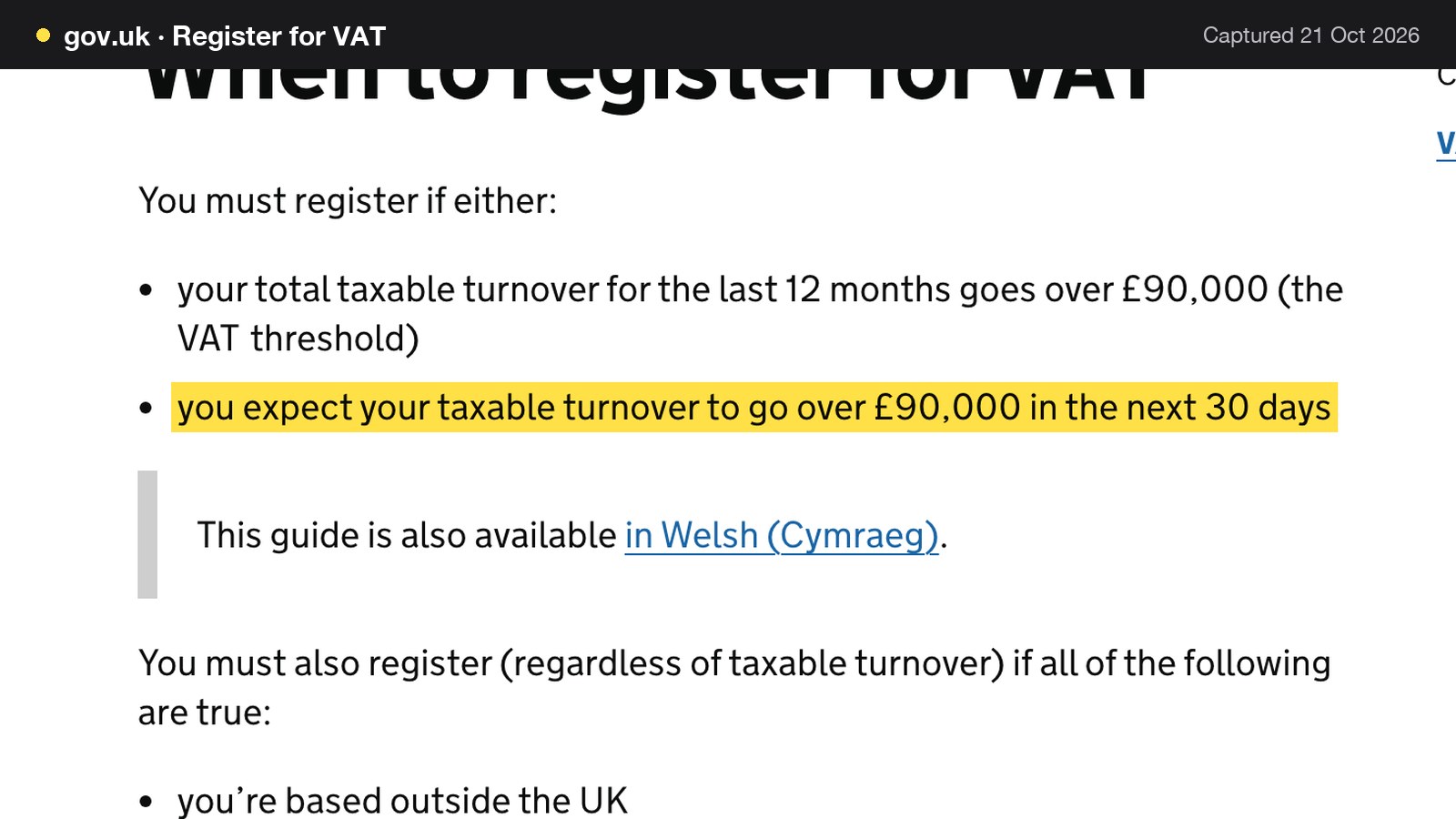
The threshold has applied since 1 April 2024 and can change at a Budget, so check it again after 28 October. HMRC treats catering as standard-rated in Notice 709/1, which also covers takeaway food, so plan your menu prices on the basis that VAT comes out of what the guest pays. Set a monthly reminder to add up the last 12 months.
- Where: GOV.UK register for VAT and Notice 709/1 on catering and takeaway food.
- Have ready: your business details, your turnover figures for the last 12 months, and your bank details.
- Cost: no registration charge is quoted in the sources used here.
- Time: within 30 days of the end of the month you cross.
Step 10: Get your website, bookings and ordering live before opening day
The registrations above make the business legal. This step makes it findable, and it is the one most owners leave until the week of opening. A restaurant that opens with no site of its own sends searchers to directories, marketplaces and competitors, and it may pay commission on the bookings and orders that follow.
A page being online is not the same as being in Google. A website can be live at a working link and still be absent from search. Robots or noindex settings that are wrong, conflicting canonical URLs, pages no link points to, rendering problems, missing structured restaurant data or incomplete search verification can leave important pages undiscovered, excluded or misunderstood. Guests who search your restaurant name, your menu, your cuisine or your location may then reach a directory, a commission-charging marketplace or a competing restaurant first, and the restaurant stays dependent on paid discovery instead of direct demand. Indexing and ranking remain decisions for Google, and no guide can promise them. What you can control is the set-up.
TableSpark builds that set-up into the restaurant website instead of leaving you to hire a technician and assemble it yourself. Every plan ships crawlable menu content as real page text, SEO titles and descriptions with canonical URLs, sitemaps, robots controls and internal links, Restaurant and LocalBusiness schema, and managed search-verification set-up that submits the sitemap to Google Search Console on every publish. The site is mobile-first. You can build the whole site free and publish it when the registrations in steps 1 to 9 are done, since a plan only starts when you publish.
On bookings, the restaurant booking system puts live availability against your real tables on your own site, with deposits and reminders, in Growth. It includes a Reserve with Google booking-link connection, which makes your own booking page the destination guests reach from Google. The guest completes the booking on your page, where it joins your diary. For the wider software choices, the takeaway website guide covers a menu-first site for collection and delivery.
If you are opening a big sit-down restaurant
Most of the weight falls on licensing, people and premises.
- Start the premises licence and the DPS qualification first (step 6). Fee bands follow rateable value, and a Band D or E premises used primarily as a bar faces the multiplied application fee.
- Count your full-time equivalent staff. At ten or more, Simpler Recycling already applies in full, and at 250 or more employees in England calorie labelling applies.
- Write the fire risk assessment for the real room, with a recorded drill (step 8). The responsible person faces the penalties above, up to unlimited fines.
- Check the rateable value. A restaurant with a rateable value of £51,000 to £499,999 sits in the standard RHL band at 43p, if the council accepts it as RHL.
- Plan the booking policy before opening: deposit amounts for larger parties are set per service, from £1 to £500 per booking in TableSpark.
If you are opening a small restaurant or café
A small room keeps most steps but trims the cost of several.
- You may be a micro-firm. With fewer than 10 full-time equivalent employees across the whole business you have until 31 March 2027 for Simpler Recycling.
- Check small business rate relief (step 3). A rateable value of £12,000 or less on your only property pays no business rates.
- If you do not sell alcohol, you skip the premises licence and the DPS, and your SIC code is 56102 Unlicensed restaurants and cafes.
- A café with outdoor tables should apply for a pavement licence early, since the council has 28 days to decide.
- Still do the full food registration, the HACCP system and the allergen information. They apply at every size.
If you are opening a takeaway
A takeaway changes the planning answer and the clock.
- Treat the unit as a hot food takeaway for planning (step 2). Sui generis use means a move from an E use to a takeaway may need planning permission or prior approval. Settle extraction and odour in writing.
- If you will sell hot food after 11pm, apply for late night refreshment authorisation (step 6) before you publish late hours.
- SIC code 56103 Take-away food shops and mobile food stands.
Direct orders are where a takeaway keeps its margin. Online ordering on your own site is in TableSpark Full. Guests choose dine-in, collection or delivery, order from the menu you already built, and the ticket lands on your Orders screen with a chime. The money goes to your own Stripe account at 0% TableSpark commission, and the Full plan adds table QR ordering and kitchen ticket printing.
If you are opening a dark kitchen
A delivery-only kitchen has the least settled planning answer and the heaviest dependence on third-party platforms.
- Register the food business as you would for any site. The registration guidance covers distance selling, and a delivery-only operator is a food business.
- Do not assume the use class. In the Birmingham appeal of 18 August 2022, the Inspector agreed with the council that a commercial kitchen producing takeaways for online delivery platforms was a sui generis use, partly because of the frequency of small-scale deliveries. The decision attached conditions on extraction, odour control and plant noise, and noted that a traditional hot food takeaway would need a separate application. It is one appeal on its own facts, so ask your own council.
- Late night refreshment applies to delivery as it does to a counter (step 6). The supply is the handover to the rider or customer, not the order.
- Allergen information has to be given before purchase and on delivery, on every platform and on your own ordering page (step 5).
Platform terms decide the margin. Uber Eats' UK merchant pricing page, checked on 21 October 2026, lists Uber Delivery at 30%, or 33% for Uber One members, and Self-Delivery at 13%. It states that "the same Uber Eats Fee applies for virtual restaurants" and lists an activation fee of £650, excluding VAT. The page does not state what the percentage is applied to, so this example applies it to the order subtotal. Take an illustrative kitchen with 400 orders a month at an average of £22. That is 400 x £22 = £8,800 of orders. At 30% the marketplace fee is £2,640 a month, and at 13% it is £1,144. The same 400 orders taken on your own site, paid by standard UK card at Stripe's published 1.5% + 20p (checked 21 October 2026), cost £132 + £80 = £212 in card fees. Add Full at £69 a month, excluding VAT, and the monthly total is £281. On those inputs the 30% route costs £2,359 a month more than the direct route. The inputs are illustrative and the delivery itself needs your own riders or a courier you contract, set in the ordering block as a fixed delivery fee or postcode-radius tiers, so replace the numbers with yours.
Scotland, Wales and Northern Ireland: where the route differs
The numbered steps are written for England. This table sets out the differences that the sources read for this guide confirm. Where a cell says to check, the point was not established in this research, so ask your council.
| Topic to verify | Scotland | Wales | Northern Ireland |
|---|---|---|---|
| Food registration | Council environmental health, at least 28 days before opening, free | Council, at least 28 days before trading | Council, at least 28 days before opening, free, once per establishment |
| Food safety system | CookSafe | Safer Food Better Business | Safe Catering or MyHACCP |
| Hygiene rating display | Food Hygiene Information Scheme; check Food Standards Scotland | Required by law at or near each customer entrance | Required by law at or near each customer entrance, and given verbally on request |
| Alcohol | Licensing Board; premises manager named on the licence; personal licence for 10 years | Licensing Act 2003 route, as in England | Liquor licence from the county court, with newspaper, police, council and on-site notices |
| Late night food | Late hours catering licence, Civic Government (Scotland) Act 1982, section 42 | Late night refreshment under the Licensing Act 2003 | Check with your council |
| Planning classes | Own use classes order | Class A3 for food and drink | Own use classes order |
| Recycling | Check with your council | Food waste kept separate since 6 April 2024 where premises produce 5kg or more a week | Check with your council |
The 2026 to 2027 calendar
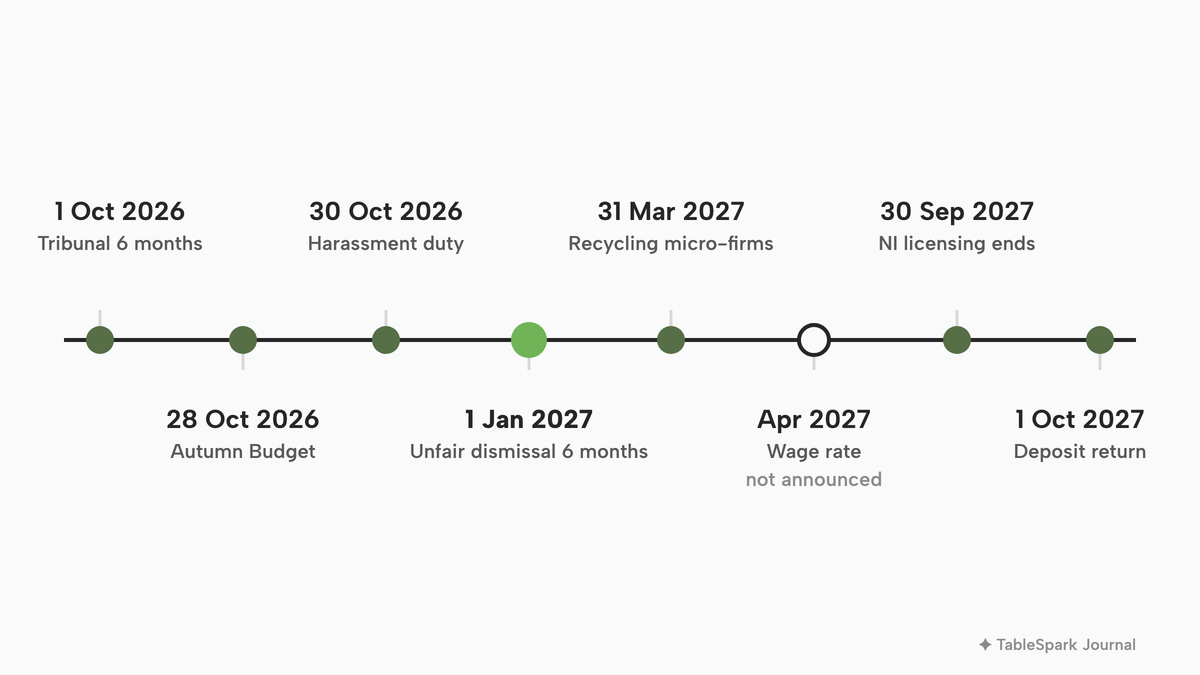
An owner opening now meets several rule changes within the first year of trading. This table lists the dated ones from official pages, with what each means. It uses the header "Time" because some entries are periods, not days.
| Time | What changes | Status |
|---|---|---|
| 18 November 2025, for 12 months | Companies House identity verification is a legal requirement, with a transition period | Running |
| 1 October 2026 | Employment tribunal claim time limit rises from 3 to 6 months | In force |
| 28 October 2026 | Autumn Budget: recheck the VAT threshold and business rates support | Date announced |
| 30 October 2026 | Duty to take all reasonable steps to prevent sexual harassment, including by third parties | Fixed date |
| By the end of 2026 | Strengthening of tipping law | Period, no date |
| 1 January 2027 | Unfair dismissal qualifying period falls to six months; fire and rehire protections | Planned, subject to parliamentary processes |
| 31 March 2027 | Simpler Recycling deadline for micro-firms in England | Fixed date |
| April 2027 | National Living Wage rate | Not announced |
| 2027 | Right to guaranteed hours and notice of shifts | Dates to follow consultation |
| 30 September 2027 | Current Northern Ireland liquor licensing period ends | Fixed date |
| 1 October 2027 | Deposit Return Scheme starts for certain single-use drink containers | Fixed date |
Already in force before you open: Statutory Sick Pay without the waiting period since 6 April 2026, and the Fair Work Agency since 7 April 2026. The unfair dismissal guide covers the January 2027 change. The Deposit Return Scheme page shows hospitality venues only among organisations that can volunteer to host a return point, so an ordinary restaurant serving drinks at the table has no host duty on that page. The Autumn Budget guide will carry what changes on 28 October.
A week-by-week opening timeline
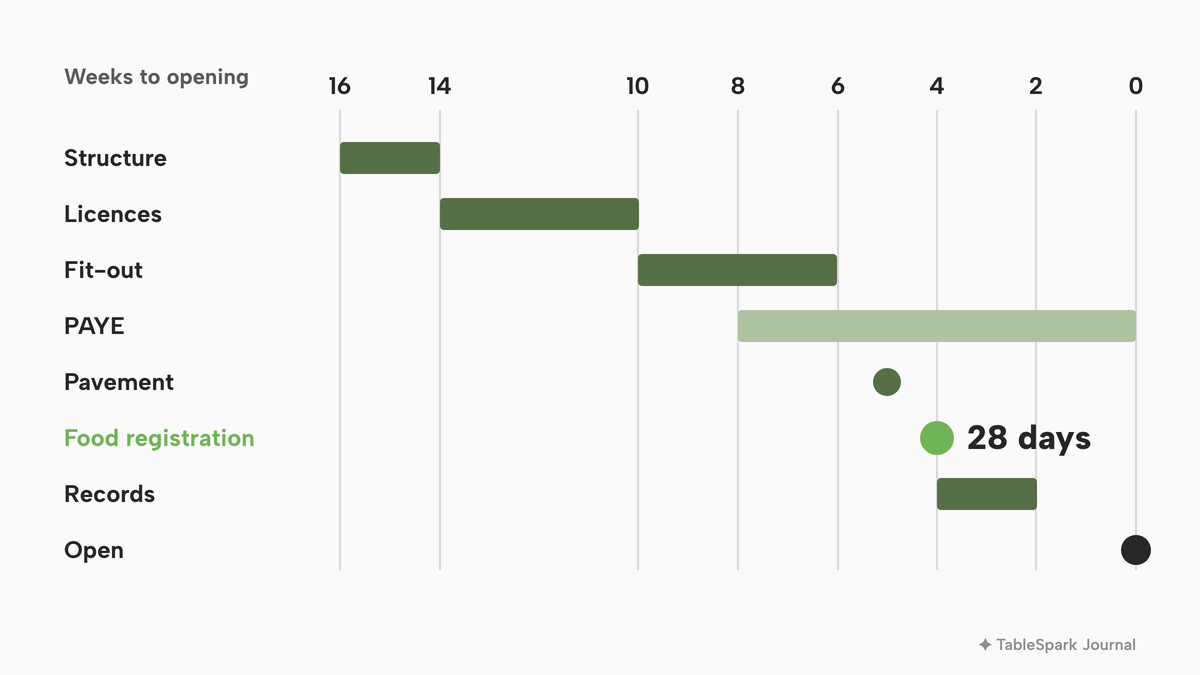
Only some of the clocks in this guide are fixed. The 28 days for food registration, the 2-month limit on registering for PAYE and the 28-day pavement licence decision period are written into the rules. The remaining weeks below are a suggested working plan for a 16-week run, built to keep the fixed clocks satisfied. Council timetables for planning and licences are set by each council, so move the plan to fit the answers you get.
| What to file or finish | Rule behind it | |
|---|---|---|
| Weeks 16 to 14 | Choose format. Ask the council in writing about use class, extraction and rateable value | The use class decides whether the unit can be a restaurant |
| Week 14 | Sign the lease once the planning answer is in, or make the lease conditional on it | Rent starts at signature |
| Weeks 14 to 10 | Planning and building control. Personal and premises licences, late night refreshment, DPS | Set by each council |
| Weeks 10 to 6 | Fit-out. Insurance in place before the first employee starts. Waste carrier chosen | Employers' liability is required as soon as you employ |
| Week 8 or later | Register for PAYE once the first payday is known | No more than 2 months before the first payday |
| Week 5 | Pavement licence application for outdoor tables | The council has 28 days to decide |
| Week 4 | Submit the food business registration, at the latest | At least 28 days before trading |
| Weeks 4 to 2 | Food safety system, allergen matrix, music licence, tips policy, fire risk assessment | Written records |
| Weeks 3 to 1 | Right to work checks as people are hired, staff training, website and ordering built | Statutory excuse needs the checks done as prescribed |
| Week 1 | Publish the website, test bookings and orders, rehearse service | Search set-up goes out with each publish |
| Week 0 | Opening day. Afterwards track the rolling 12-month turnover for VAT | £90,000 threshold |
How to set up in TableSpark
TableSpark is the website, bookings and ordering side of this plan. The registrations in steps 1 to 9 are yours to file with the bodies named in them, and the site work below runs beside them. You can build everything free and pay only when you publish. The plan each step needs is named at its end.
- Step 1: Choose a design
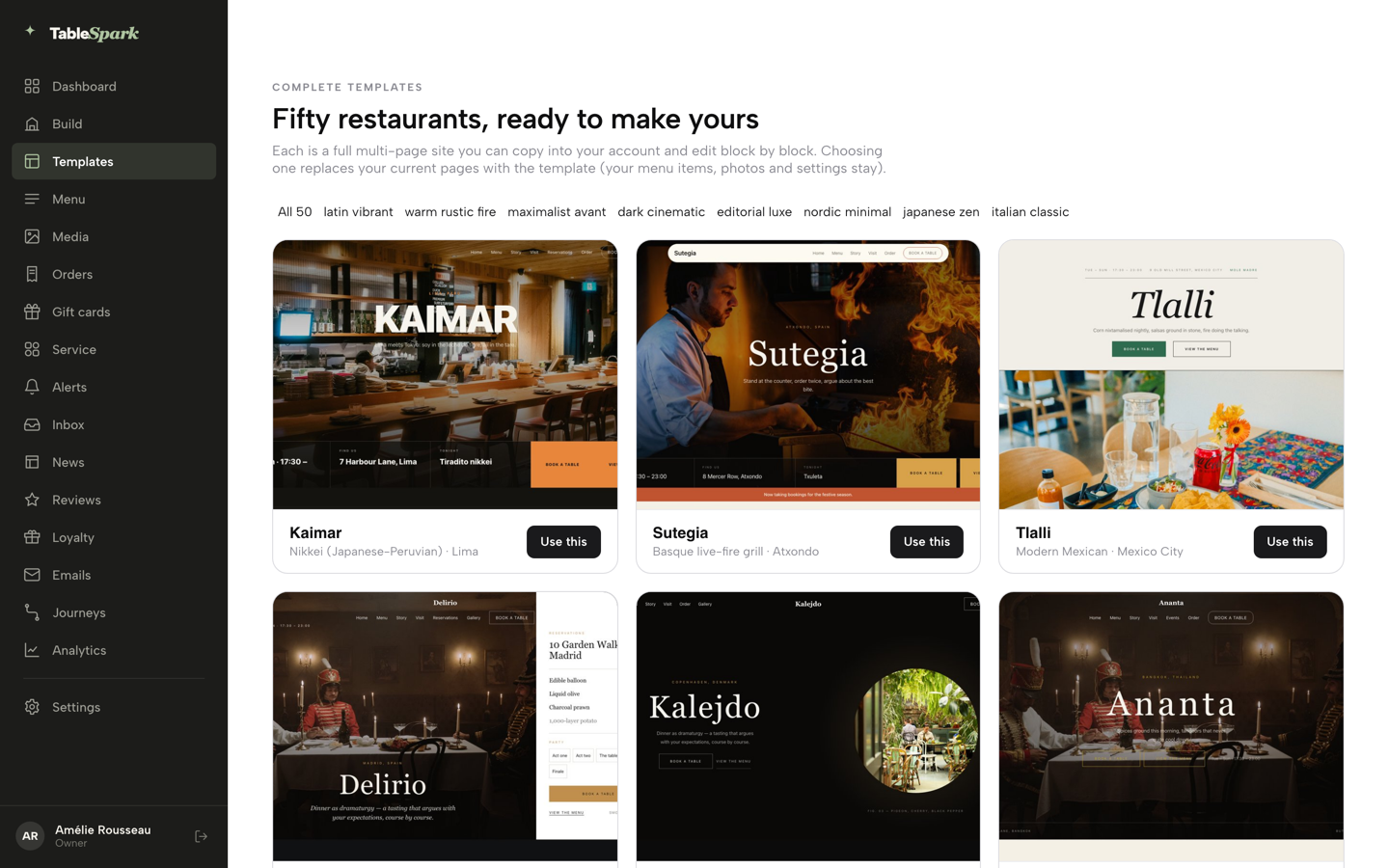
On the Templates screen, pick one of the fifty restaurant designs, open the preview, then press Use this template and confirm with Yes, use this template. Choose by what a stranger needs first at nine on a Friday night: the table, the menu or the order button. Every plan.
- Step 2: Scan the menu and tick the allergens
Open Menu in the sidebar, press Scan from photos, choose a photo or PDF of your menu, check every price, then press I reviewed the text and prices and Apply to menu. In the dish editor, tick the allergens each dish contains from the 14 chips, so guests see them on the live menu. Every plan.
- Step 3: Set hours and special dates
In Settings, open Opening hours and set a From and To time for each day. Under Bank holidays and special dates, add closures and one-off late nights. Set closing times to the last handover your licence allows. Every plan.
- Step 4: Publish and connect your domain
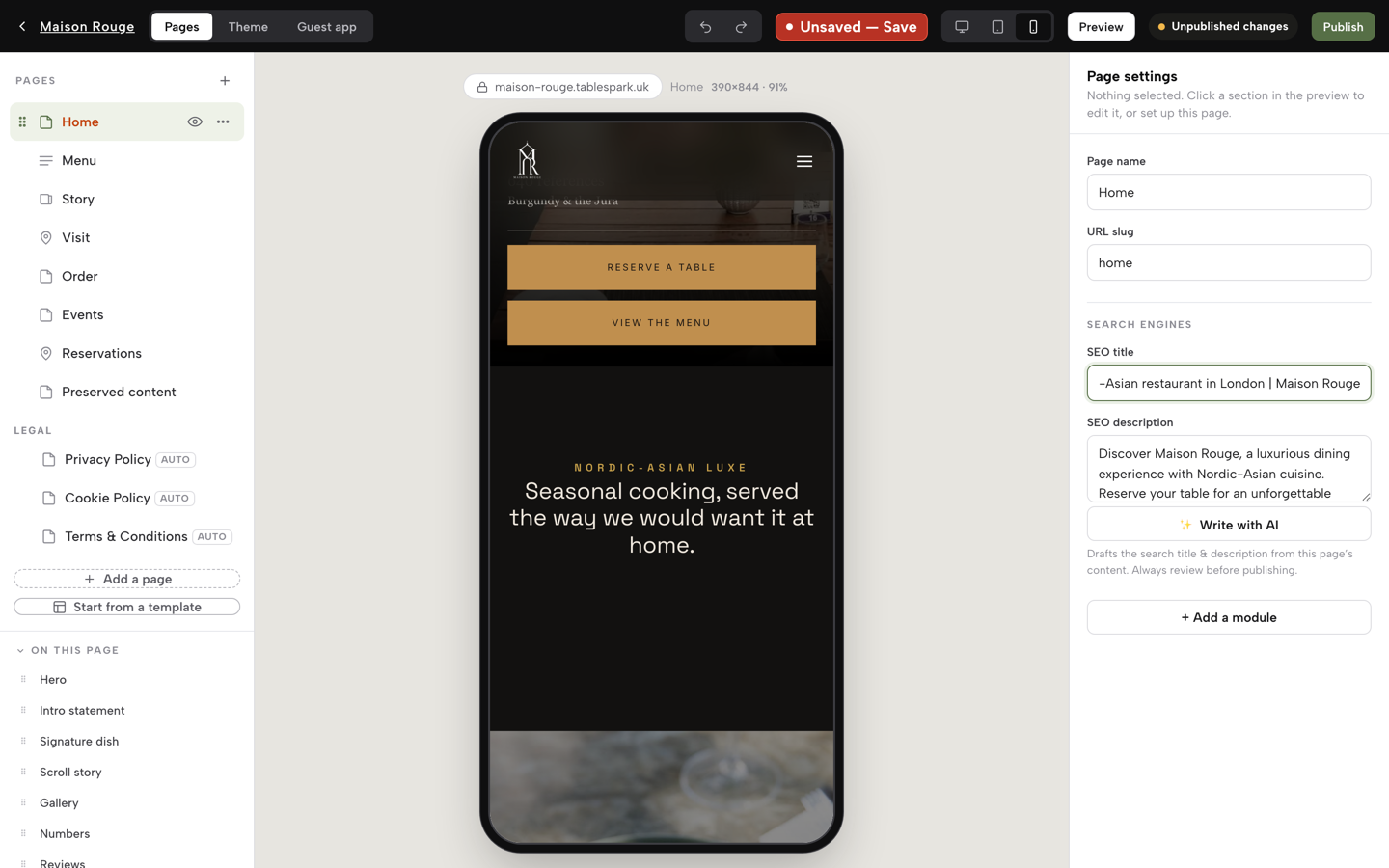
In the Builder, give each page an SEO title and description that carry your cuisine and your town, then press Publish. Your free address is already live and secure. In Settings, Domain, a .co.uk starts at £6.33 for the year and connects itself with HTTPS, or you can point a domain you own at the site. Publish on any plan; the custom domain is in Growth and Full.
- Step 5: Open your bookings
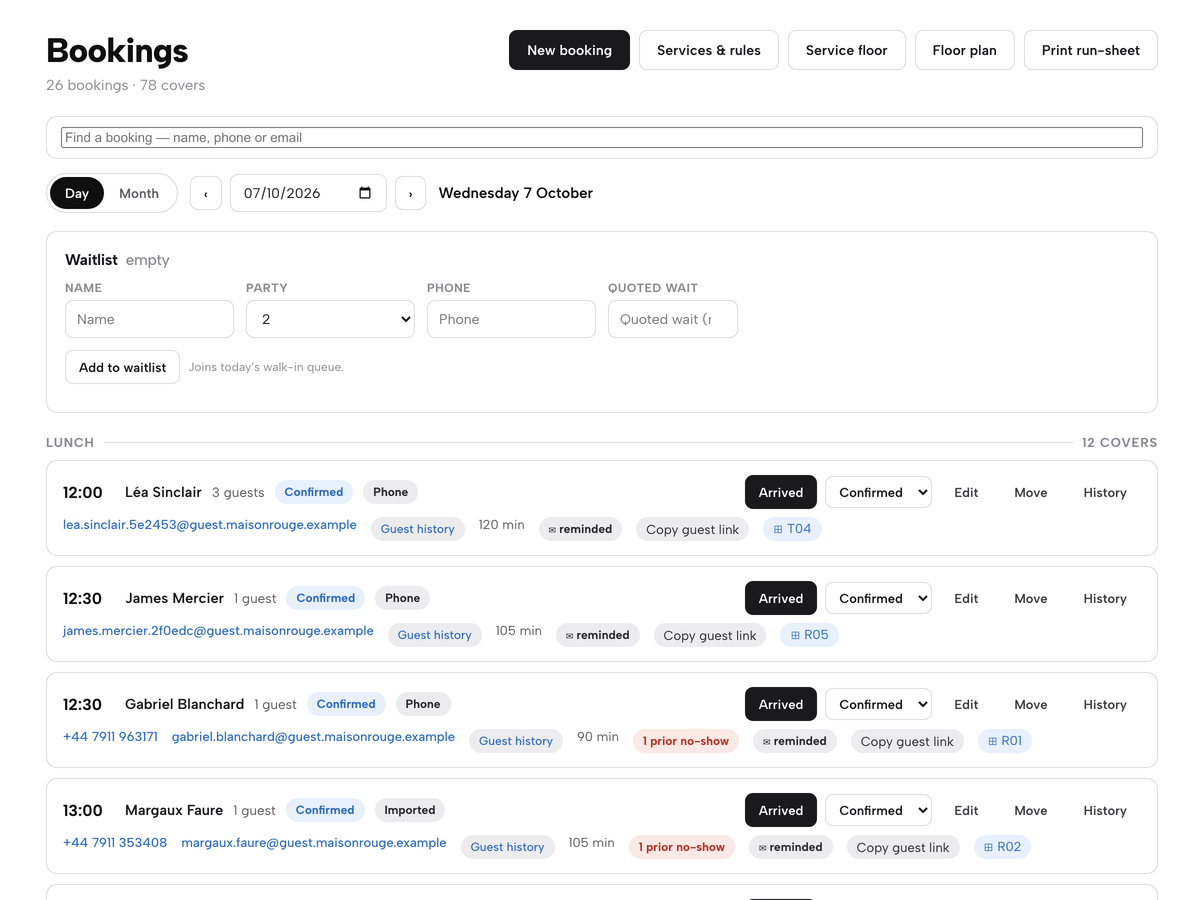
In the dashboard, set your services in Bookings, then Services and rules: first and last seating, party size, lead time and a deposit for larger parties. The Service console lists tonight's bookings and takes phone and walk-in bookings against the same availability. Growth and Full.
- Step 6: Switch on ordering and print table QR codes
In the Builder, add the Order from our menu block to a page and switch on Offer dine-in, Offer collection and Offer delivery as your licences allow. In the dashboard's Tables card, press Preview the codes, then Export all or Print sheet to get one QR code per table. Full.
- Step 7: Build the rota
In Settings, Team, invite each person with one of four roles. Then open Service, Servers, Rota, drag shifts onto the week and press Publish drafts, so each person sees their own shifts. Growth and Full.
- Step 8: Check your guest list
Guests who book, order or sign up appear in the Inbox and on the Guests page, stored under your restaurant's TableSpark account. Press Export CSV on the Guests page whenever you want a copy. Every plan.

Questions owners ask about opening a restaurant in the UK
How long does it take to open a restaurant in the UK?
No single duration is set by law. The fixed minimum in this guide is 28 days between food business registration and trading. Planning, building control and licence timetables are set by each council, so ask for them in writing. A 16-week working plan, shown above, gives room for the council answers.
How do I register a food business, and is it free?
Register with the local authority where the premises sit, at least 28 days before you start trading. Registration is free and can't be refused. Use the online service linked from GOV.UK in England, Wales and Northern Ireland, or Food Standards Scotland's route in Scotland. Each site needs its own registration, and a takeover needs one too.
Do I need planning permission to open a restaurant?
It depends on the current use of the unit. In England a restaurant or café is Class E(b), and a hot food takeaway is sui generis. A change between classes may need planning permission or prior approval, and building regulations apply to any change of use. Ask the council in writing before you sign a lease.
Do I need a licence to open a takeaway?
A takeaway needs food business registration and a food safety system. It needs late night refreshment authorisation if hot food leaves the premises between 11pm and 5am, and a premises licence if it sells alcohol. Planning permission may also be needed for a hot food takeaway use, so ask the council first.
What licences do I need to sell alcohol in a restaurant?
In England and Wales you need a premises licence naming a DPS, and the DPS needs a personal licence. Personal licence applicants must be 18 or over, normally hold an accredited qualification, and give a basic criminal record disclosure. Scotland and Northern Ireland use licensing boards and the county court, so follow your own nation's route.
Can I run a dark kitchen from home or a unit?
The food registration guidance covers home-based and online businesses. Planning is the unsettled part for a unit. One Birmingham appeal treated a dark kitchen as sui generis with conditions on extraction and noise, but it turned on its own facts. Ask your council about your unit, and check late night refreshment if you deliver after 11pm.
Should I open as a sole trader or a limited company?
A sole trader can start trading straight away and registers for Self Assessment above £1,000 in a tax year, with unlimited liability. A limited company costs £100 to form online and needs a registered office, a director, a shareholder and identity verification. Ask an accountant about the tax difference for your own numbers.
When must I register for VAT?
When your taxable turnover for the last 12 months goes over £90,000, or when you expect it to go over £90,000 in the next 30 days. You register within 30 days of the end of the month you crossed. The threshold can change at a Budget, and the next is on 28 October 2026.
Do I need a music licence?
You usually need TheMusicLicence from PPL PRS if you play recorded music at your business, including background music, the radio or a music channel. Playing music in public without one infringes copyright. Cost depends on your type of venue and how you use music, so request a quote.
The recommendation
For an independent UK restaurant, TableSpark is the best-value and best overall way to get its own site, bookings and ordering live before opening day. One account carries the menu with allergens, opening hours and special dates, the domain with managed SSL, search-ready output, bookings, table QR ordering, the rota and the guest list, for a flat monthly plan instead of a stack of separate subscriptions. Plans start from £19 a month, excluding VAT, on Starter, which includes the menu, hours, guest records with CSV export and managed search readiness. Growth is £39 a month, excluding VAT, and adds bookings with deposits, the custom domain, the rota and team. Full is £69 a month, excluding VAT, or £690 a year paid yearly, excluding VAT, and adds online ordering, table QR ordering and kitchen ticket printing.
TableSpark commission is 0% on bookings and orders included in your plan. Stripe's standard card-processing fees apply to online payments.
Sources
- GOV.UK, Starting a food business — UK Government (checked 2026-10-21)
- GOV.UK, Food business registration — UK Government (checked 2026-10-21)
- Food business registration service — UK Government (checked 2026-10-21)
- GOV.UK, Food hygiene ratings — UK Government (checked 2026-10-21)
- GOV.UK, Food Hygiene Rating Scheme guidance for businesses — UK Government (checked 2026-10-21)
- Food Standards Scotland, Registering a food business — foodstandards.gov.scot (checked 2026-10-21)
- Food Standards Scotland, CookSafe guide — foodstandards.gov.scot (checked 2026-10-21)
- nibusinessinfo, Register your food business in Northern Ireland — nibusinessinfo.co.uk (checked 2026-10-21)
- GOV.UK, Register for Self Assessment — UK Government (checked 2026-10-21)
- GOV.UK, Become a sole trader — UK Government (checked 2026-10-21)
- GOV.UK, Limited company formation — UK Government (checked 2026-10-21)
- GOV.UK, Register a private or public company (IN01) — UK Government (checked 2026-10-21)
- GOV.UK, Companies House fees — UK Government (checked 2026-10-21)
- GOV.UK, Verify your identity for Companies House — UK Government (checked 2026-10-21)
- GOV.UK, SIC codes — UK Government (checked 2026-10-21)
- GOV.UK, Corporation Tax rates — UK Government (checked 2026-10-21)
- Planning Portal, Change of use and use classes — planningportal.co.uk (checked 2026-10-21)
- legislation.gov.uk, Use Classes Order 1987, article 3 — UK Government (checked 2026-10-21)
- GOV.UK, Planning fees from 1 April — UK Government (checked 2026-10-21)
- Planning Inspectorate, Appeal APP/P4605/W/22/3296172 — UK Government (checked 2026-10-21)
- GOV.UK, Building regulations approval — UK Government (checked 2026-10-21)
- GOV.UK, Stamp Duty Land Tax — UK Government (checked 2026-10-21)
- GOV.UK, Business rates relief — UK Government (checked 2026-10-21)
- GOV.UK, Business rates multipliers for retail, hospitality and leisure — UK Government (checked 2026-10-21)
- GOV.UK, Alcohol licensing — UK Government (checked 2026-10-21)
- legislation.gov.uk, Licensing Act 2003, Schedule 2 — UK Government (checked 2026-10-21)
- legislation.gov.uk, Licensing Act 2003 (Fees) Regulations 2005, as made — UK Government (checked 2026-10-21)
- GOV.UK, Revised guidance issued under section 182 (February 2026) — UK Government (checked 2026-10-21)
- legislation.gov.uk, Civic Government (Scotland) Act 1982, section 42 — UK Government (checked 2026-10-21)
- legislation.gov.uk, Licensing (Scotland) Act 2005, section 19 — UK Government (checked 2026-10-21)
- nibusinessinfo, Apply for a licence to sell alcohol — nibusinessinfo.co.uk (checked 2026-10-21)
- GOV.UK, Licence to play live or recorded music — UK Government (checked 2026-10-21)
- PPL PRS, TheMusicLicence for restaurants and cafes — pplprs.co.uk (checked 2026-10-21)
- GOV.UK, Pavement licences guidance — UK Government (checked 2026-10-21)
- GOV.UK, Register as an employer — UK Government (checked 2026-10-21)
- GOV.UK, Right to work checks: an employer's guide — UK Government (checked 2026-10-21)
- GOV.UK, Check a job applicant's right to work — UK Government (checked 2026-10-21)
- GOV.UK, National Minimum Wage and National Living Wage rates — UK Government (checked 2026-10-21)
- GOV.UK, Rates and thresholds for employers 2026 to 2027 — UK Government (checked 2026-10-21)
- GOV.UK, Workplace pensions — UK Government (checked 2026-10-21)
- GOV.UK, Employers' liability insurance — UK Government (checked 2026-10-21)
- GOV.UK, Tips at work — UK Government (checked 2026-10-21)
- GOV.UK, Employment Rights Act timeline update — UK Government (checked 2026-10-21)
- GOV.UK, Workplace fire safety: your responsibilities — UK Government (checked 2026-10-21)
- GOV.UK, Simpler Recycling: workplace recycling in England — UK Government (checked 2026-10-21)
- Welsh Government, Workplace recycling regulations guidance — gov.wales (checked 2026-10-21)
- GOV.UK, Register for VAT — UK Government (checked 2026-10-21)
- GOV.UK, VAT Notice 709/1 catering and takeaway food — UK Government (checked 2026-10-21)
- GOV.UK, Deposit Return Scheme responsibilities — UK Government (checked 2026-10-21)
- GOV.UK, Introduction to allergen labelling for PPDS food — UK Government (checked 2026-10-21)
- GOV.UK, Calorie labelling in the out of home sector — UK Government (checked 2026-10-21)
- NielsenIQ, Hospitality outlets flat in second quarter — nielseniq.com (checked 2026-10-21)
- Uber Eats UK merchant pricing — merchants.ubereats.com (checked 2026-10-21)
- Stripe UK pricing — stripe.com (checked 2026-10-21)
- TableSpark pricing — TableSpark (checked 2026-10-21)
- TableSpark tutorial, build your website — TableSpark (checked 2026-10-21)
- TableSpark tutorial, put your menu online — TableSpark (checked 2026-10-21)
- TableSpark tutorial, set up your domain — TableSpark (checked 2026-10-21)
- TableSpark tutorial, run your team and rota — TableSpark (checked 2026-10-21)
- TableSpark, restaurant online ordering — TableSpark (checked 2026-10-21)
- TableSpark, restaurant booking system — TableSpark (checked 2026-10-21)
Have your site ready for opening day
Build your site, menu and booking page free, and pay only when you publish.