Contents
A menu that says one thing while the kitchen does another is a risk to a guest and a cost to the business, and the gap usually opens quietly.
A UK restaurant must tell guests which of the 14 allergens each dish contains. At the table this can be given orally if a written sign says staff can be asked. Online and phone orders need it at two stages: before the purchase is completed and at delivery. Prepacked-for-direct-sale food has needed a full ingredients label, with allergens emphasised, since 1 October 2021. Written information plus a conversation is Food Standards Agency best practice, not law.
The sauce changed supplier last week
On Tuesday the sauce arrives from a new supplier. The label is different, the delivery is short-handed, and nobody reads it against the recipe. The menu still says what it said in spring. On Friday a guest tells the server she has a nut allergy, the server says he thinks the curry is fine, and the order goes in. Nothing in this picture is exotic. The evening is illustrative, and every part of it is ordinary.
The same gap opens in other places. The online order page lists the dishes and prices but gives no allergen information before the guest reaches checkout. The matrix in the kitchen binder was last updated when the previous chef left. The PDF menu on the website is the version from before the autumn changes, while the printed menu on the tables is newer. Each copy was right once, and nobody is responsible for noticing that it no longer is.
Allergen information is a legal duty, and the people who rely on it are numerous. The Food Standards Agency (FSA) training page says that in the UK approximately 6% of adults and 5 to 8% of children live with a food allergy. A charity, Anaphylaxis UK, relaying an FSA study on 16 May 2024, put the adult figure at around 2.4 million people.
What goes wrong in practice, and what councils have done about it
The FSA sets out the enforcement route. Local authorities enforce allergen information rules. If a business fails to act on advice from the local authority, an improvement notice may be issued, there are 14 days to appeal it, and in some cases the business may also face prosecution. Four recent council cases show what a prosecution is made of. In each, the council describes several failings rather than a single wrong word on a menu.
Hillingdon, April 2025. The council reported that JR Uxbridge Ltd, trading as Javitri, pleaded guilty to five offences in breach of health and safety at work, food information, and food safety and hygiene regulations. A customer with a nut allergy had ordered a meal with undeclared allergens and suffered a severe allergic reaction resulting in hospitalisation. Officers found "nuts stored incorrectly in the kitchen, incomplete menu descriptions and uncertainty regarding recipes despite staff having undertaken the Food Standards Agency's allergen training earlier that month". On a follow-up inspection on 16 July they found "little improvement", an improvement notice followed, and on 14 August they were presented with an allergen menu, meant for customers, that "was confusing and still contained inaccurate information". The company was fined £35,000, with a victim surcharge of £5,000 and prosecution costs of £3,816, which adds up to £43,816.
Ceredigion, March 2026. The council reported that a takeaway owner pleaded guilty to three offences relating to breaches of food information and food safety regulations. An unannounced test purchase on 23 January 2025 followed "previous warnings and a formal notice regarding inaccurate allergen information". Officers told the takeaway during the order that a member of the party had a mustard allergy, and the prawn cocktail supplied contained mustard, which laboratory analysis confirmed. The fine was £1,290, the victim surcharge £518 and the costs £1,000, a total of £2,808.
Lancashire (Nelson), September 2024. A Trading Standards officer posing as a customer with a milk allergy ordered a chicken tikka naan on 18 July 2023. The council reported that the food contained milk protein in a proportion deemed potentially harmful. The business was ordered to pay £8,076.19, which included a £5,000 fine, a victim surcharge and a contribution to prosecution costs.
West Sussex (Horsham), June 2025. In February 2024 officers made a covert test purchase of a doner kebab with a declared milk allergy. The council reported that staff incorrectly assured the customer that the food was safe, and laboratory analysis later confirmed milk protein. Fines and costs totalled £1,844 for the owner personally, and the company was ordered to pay £5,600. The council added that the business had been prosecuted in 2023 for failing to comply with allergen labelling laws and for misdescribing food.
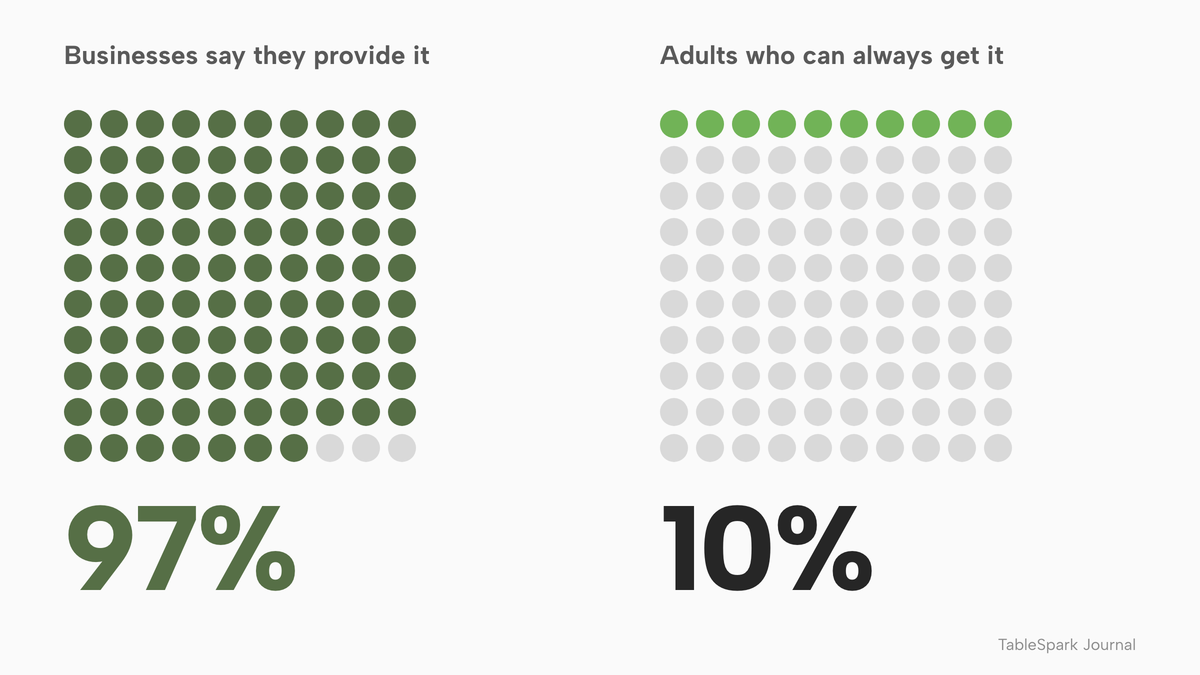
In each of the four, what the guest was told did not match what was in the food, and in three of them the business had already been inspected, warned or prosecuted. Guests notice the same gap from the other side. The FSA published baseline research on 7 October 2025 based on a survey of 520 food service workers (15 January to 10 February 2025) and 964 consumers with food hypersensitivity (13 December 2024 to 5 February 2025). Almost all businesses (97%) said they provide allergen information, and 94% said they provide it in writing. Among adults with food hypersensitivity, only 10% said they can always get the allergen information they need, and a quarter (25%) did not see allergen information the last time they ate out or got a takeaway. Business answers are self-reported and the two samples are different people, so the comparison shows a gap in perception, not a measured failure rate at any one restaurant.
The rest of this guide follows the order in which a kitchen meets the problem: the law, the FSA's best practice, the matrix and the online menu, change control, the cost in hours and pounds, and where the information should live so it is written down once.
The 14 allergens list for a UK restaurant
The legal list is short and fixed. The FSA names the following 14, and these are the only ingredients food law requires a business to declare as allergens:
- celery
- cereals containing gluten (wheat, rye, barley, oats)
- crustaceans
- eggs
- fish
- lupin
- milk
- molluscs
- mustard
- peanuts
- sesame
- soybeans
- sulphur dioxide and sulphites (the FSA allergen guidance says "more than ten parts per million")
- tree nuts (almonds, hazelnuts, walnuts, Brazil nuts, cashews, pecans, pistachios, macadamia)
The FSA's best practice guidance puts the limit plainly: guests may be allergic to or intolerant of other ingredients, "but only the 14 allergens are required to be declared as allergens by food law". That sentence matters for a menu in both directions. A dish with the 14 allergens recorded accurately meets the declaration duty. A restaurant that wants to go further, for example by marking garlic or chilli, is adding voluntary information that must then also be kept accurate.
Two points catch out owners who build their own lists. Cereals containing gluten is one allergen with four named grains, so a matrix needs one column for it. Tree nuts is one allergen with eight named nuts, and peanuts is separate, so a single "contains nuts" tick is too blunt for a guest who is allergic to one and not the other.
What the law requires for non-prepacked food
Most of what a restaurant serves is non-prepacked food: made to order, plated and handed over at the table. The legal minimum for this food has two parts. The first is the information itself. The FSA states that a business providing non-prepacked food "must supply allergen information for every item that contains any of the 14 allergens". The second is the way it is given, and here the regulations are flexible. Regulation 5(1) of the Food Information Regulations 2014 says the operator may make the particulars available "by any means the operator chooses, including, subject to paragraph (3), orally".
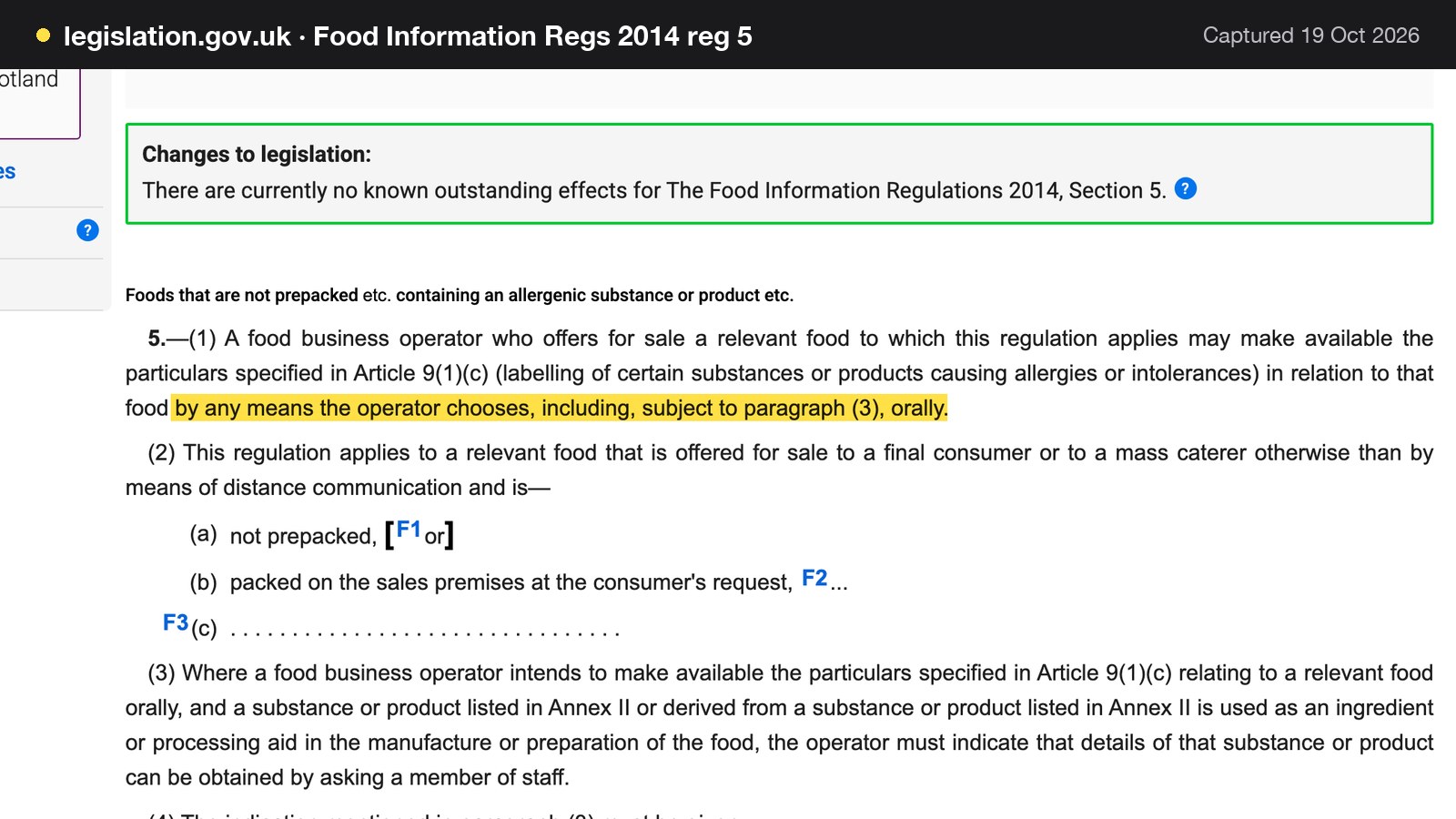
Paragraph (3) holds the qualification that goes on a wall. Where the operator intends to give the information orally, the operator "must indicate that details of that substance or product can be obtained by asking a member of staff". Paragraph (4) says that the indication must be given on a label attached to the food, or on a notice, menu, ticket or label that is readily discernible by an intending purchaser at the place where the intending purchaser chooses that food. The FSA's practical summary is that a business can give allergen information in full written form on a menu, chalkboard or information pack, or verbally with a written notice in a clearly visible position explaining how customers can obtain it.
In short, a restaurant can lawfully run on spoken answers if a visible sign says guests can ask, and if the spoken answer is correct. That is the legal floor, and the sign is the first thing to check.
| When | Form allowed | |
|---|---|---|
| Served at the table or counter (non-prepacked) (What the guest must be given: Information on any of the 14 allergens in each dish) | When the guest chooses the food | Written, or oral with a visible sign |
| Online or phone order (distance selling) (What the guest must be given: The same information) | Before the purchase is completed, and at delivery | Written or oral at each stage |
| Prepacked for direct sale (PPDS) (What the guest must be given: Name of the food and a full ingredients list, allergens emphasised) | On the pack | Label |
| Buffet (What the guest must be given: Information for each food item separately) | At the buffet | As for non-prepacked food |
Allergen information for online ordering and phone orders
Distance selling has its own rule, stricter than the one for the dining room. Regulation 5 of the 2014 Regulations applies to food offered "otherwise than by means of distance communication", so online and phone orders fall under Article 14 of Regulation (EU) 1169/2011 as it applies in UK law. The FSA states the practical effect: "If food is sold online or by phone through distance selling, allergen information must be provided at two stages in the order process."
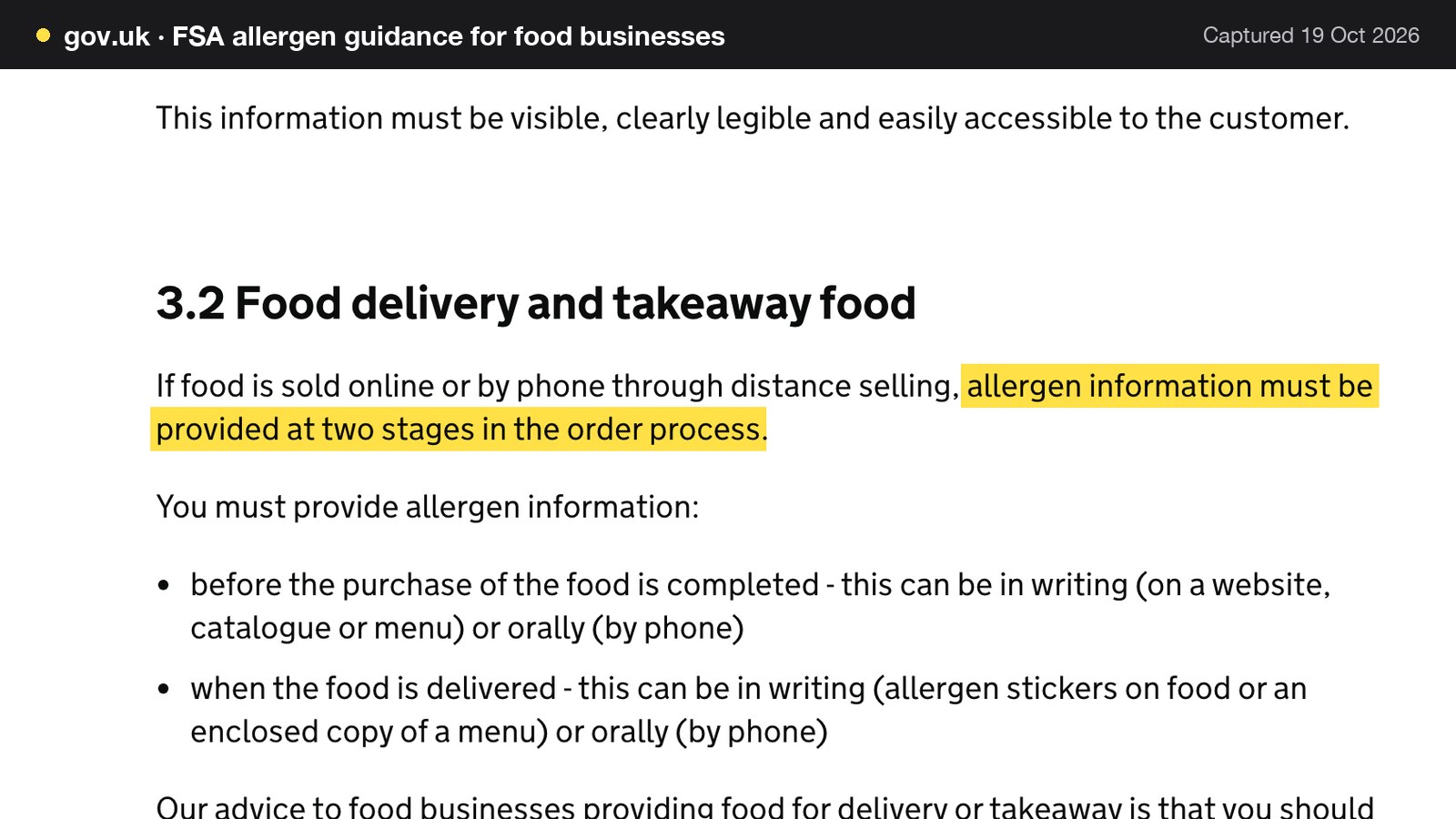
The FSA describes the two stages in its own words. The first is before the purchase of the food is completed, and this can be in writing (on a website, catalogue or menu) or orally by phone. The second is when the food is delivered, which can be in writing (allergen stickers on food or an enclosed copy of a menu) or orally by phone. Article 14 itself says that all mandatory particulars "shall be available at the moment of delivery".
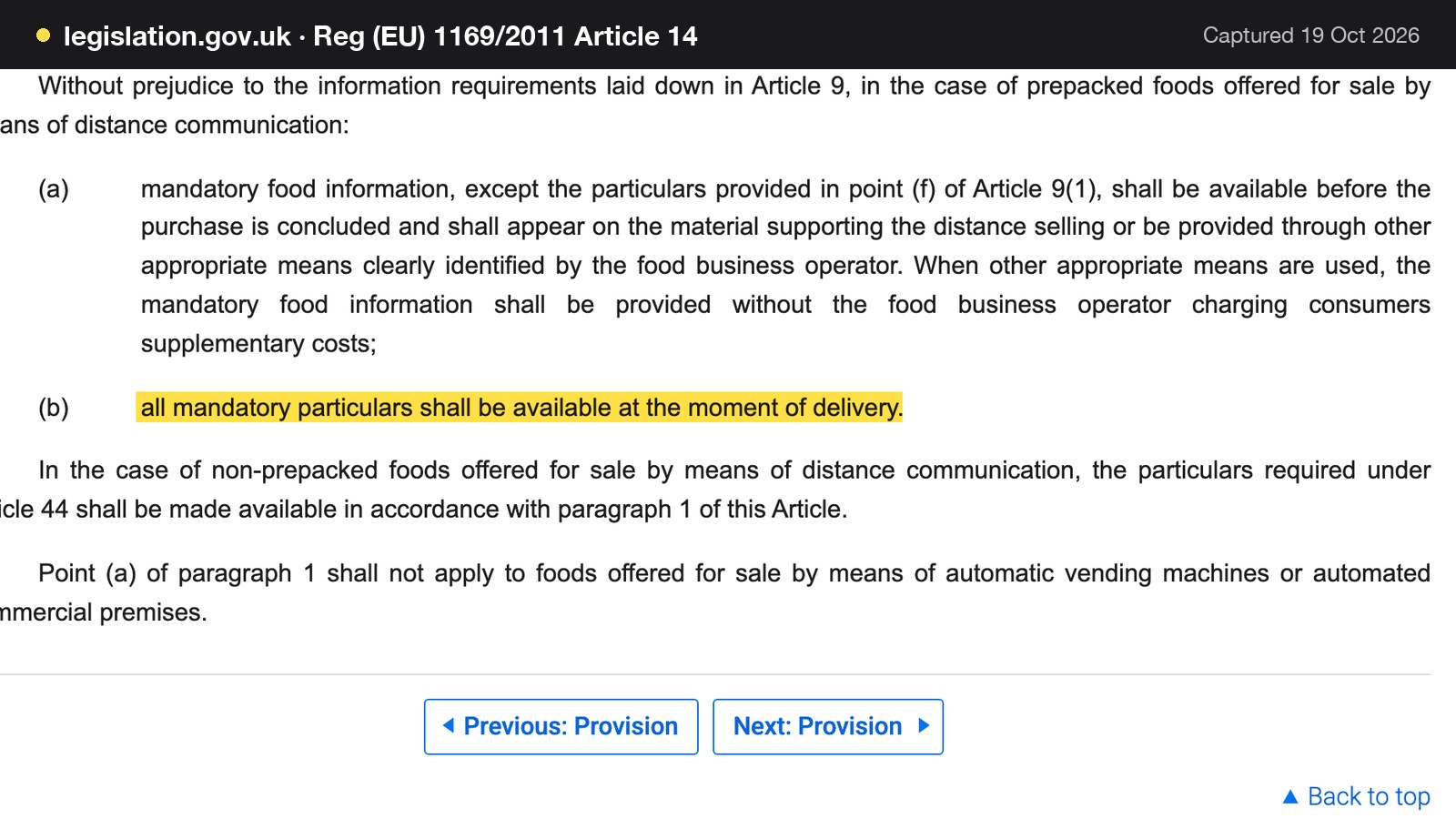
For an order page on the restaurant's own site, such as the one in online ordering, "allergen information online ordering" therefore means two separate jobs. Before checkout, the guest needs to be able to see which allergens each dish contains, or at least be told clearly where to find that information. On delivery or collection, the information needs to travel with the food: a sticker, or a copy of the menu in the bag. The first job is a question of page design. The second is a bagging-up routine, which is the restaurant's own step. The FSA's allergen checklist for food businesses asks takeaways about both stages, among them whether there is a statement on the website advising customers where they can obtain allergen information before they place their order, whether the online allergen information is "clear, accurate and easily accessible at the point when customers order food", and, on delivery, whether it is clear which is the allergen-free meal. A separate guide covers the two-stage check for online allergen information in detail, and another covers keeping allergen information one click from the order button.
The FSA's best practice guidance adds a view on where online information goes. On a restaurant's own webpage it can go on the main menu, or ideally be "no more than 'one click away'" with a clear message and link. On a third-party website, guests should be clearly told where allergen information can be found before the order is placed. It also recommends written information on delivery, so the guest can review it before eating, with any customisations indicated.
Grab-and-go food, buffets and what PPDS means
Food prepacked for direct sale (PPDS) is the one category with full labelling rules. The FSA introduction to PPDS allergen labelling says that any business producing it is "required to label it with the name of the food and a full ingredients list, with allergenic ingredients emphasised within the list". The rule dates from 1 October 2021 and is also known as Natasha's Law.
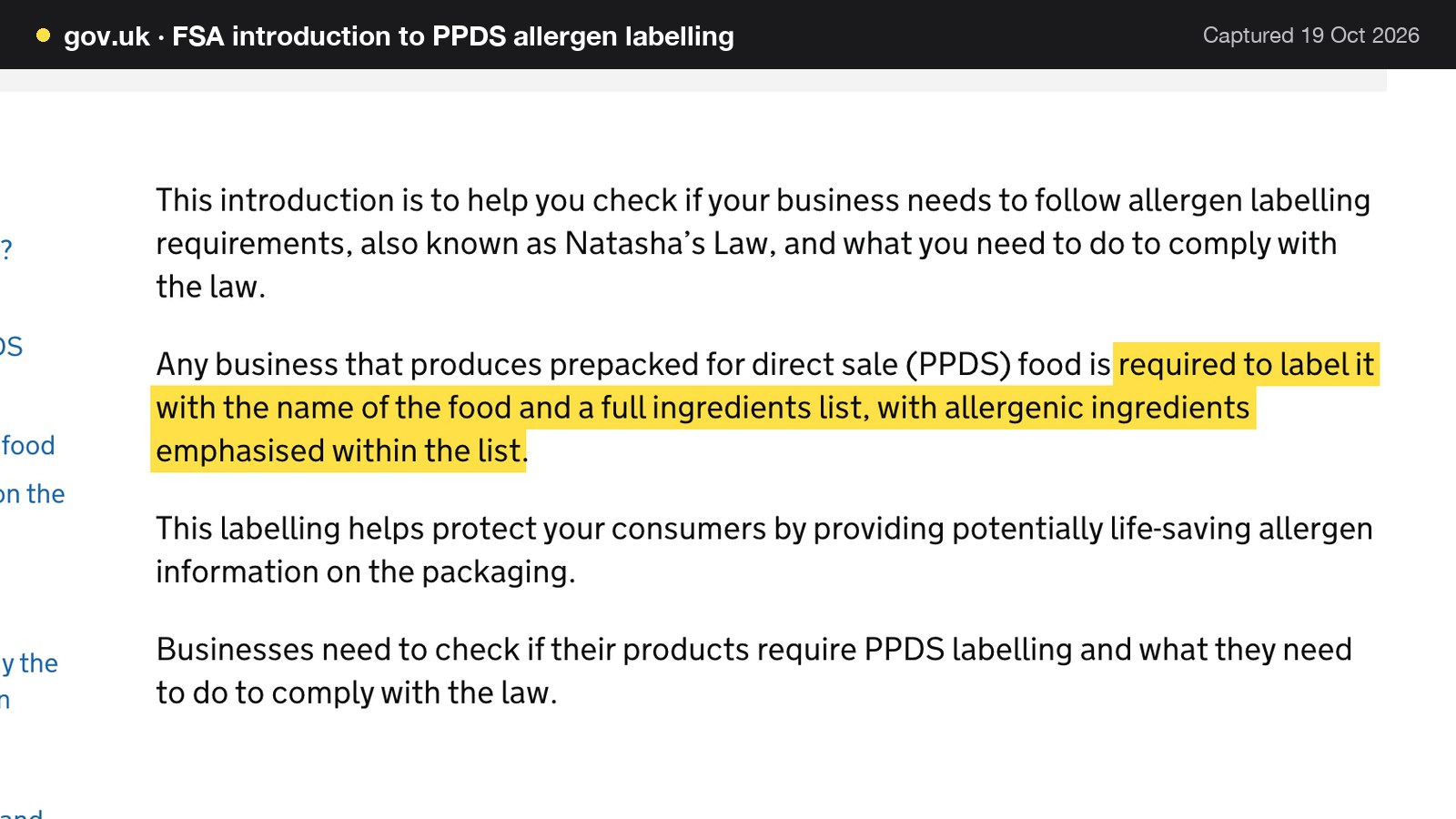
For a restaurant, what is not PPDS matters as much. The FSA states that PPDS "does not include food that is not in packaging when the consumer orders it", and that food made to order and food placed into packaging at the consumer's request is not PPDS. Its examples of food that is not PPDS include unpackaged cakes on display, an open salad bar and unpackaged complimentary bread placed on tables. The change in labelling does not apply to PPDS food sold by distance selling, such as over the phone or on the internet, which still needs information before the purchase and at the moment of delivery. The guide to PPDS grab-and-go allergen labels covers the packaged range in more detail.
Buffets work on a different logic. The FSA's guidance says a business offering a buffet needs to provide allergen information for each food item separately, and should not provide it for the buffet as a whole. A single card that says "buffet may contain allergens" is not the information the guidance describes.
The offence, and what the regulations leave out
Regulation 10 of the Food Information Regulations 2014 makes it an offence to fail to comply with Article 9(1)(c) of the underlying regulation, read with Annex II, and regulation 11 says a person guilty of that offence is liable on summary conviction to a fine not exceeding level 5 on the standard scale. This guide states no pound figure for that level; the regulation as published is the source to check. The offence attaches to the information failing, whether that is an out-of-date menu, a wrong oral answer or an order page that says nothing.
Best practice is not law: what the FSA asks for in writing
In early 2025 the FSA published best practice guidance on written allergen information for non-prepacked food. GOV.UK shows the page as published on 24 February 2025, and the FSA's own research report says the guidance was published on 5 March 2025, so "early 2025" is the safe description. The core recommendation is that food businesses "should make allergen information easily available in writing for consumers and ensure staff are able to support this with a conversation".
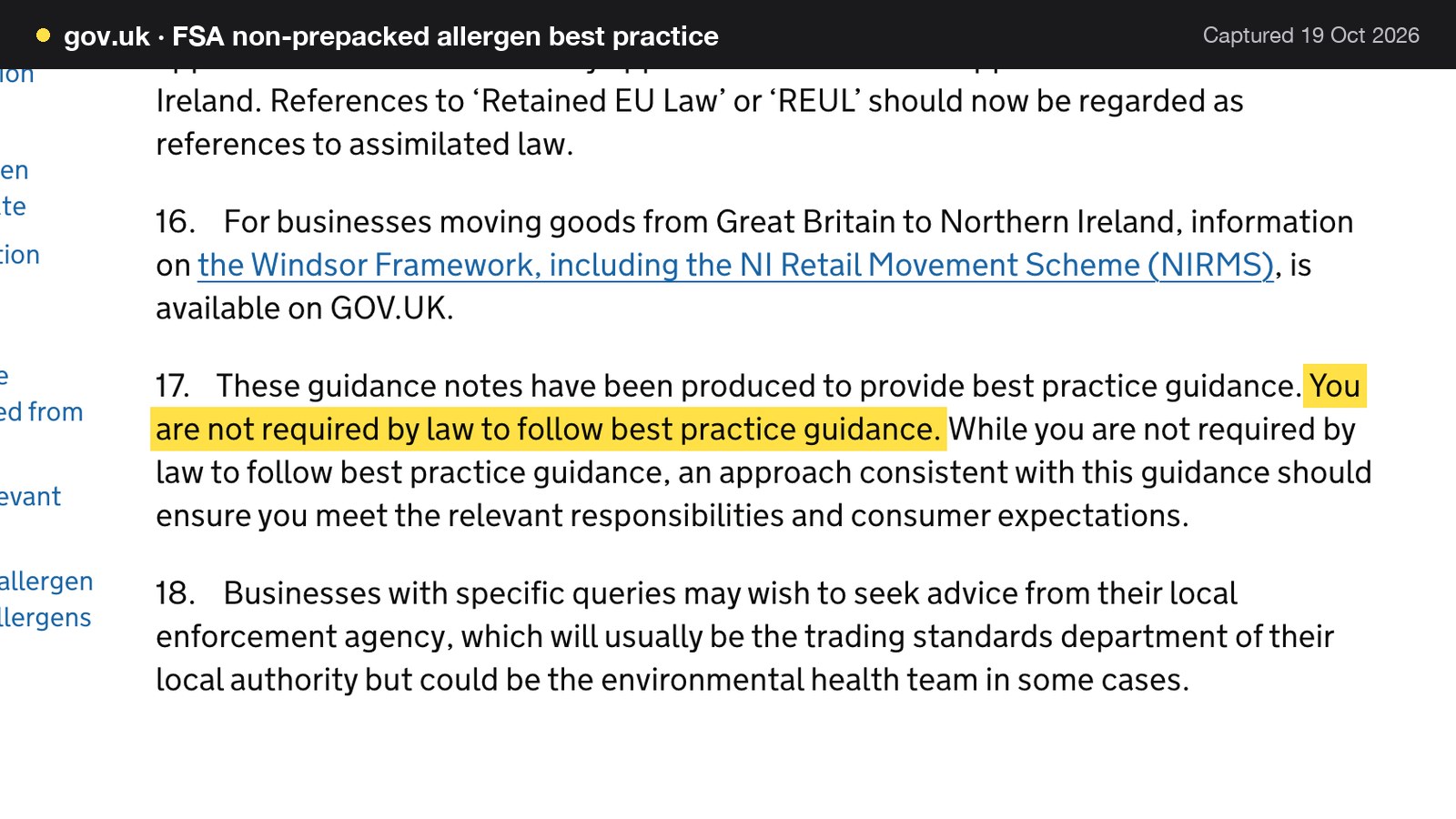
The guidance is explicit about its status: "You are not required by law to follow best practice guidance." It continues that an approach consistent with the guidance "should ensure you meet the relevant responsibilities and consumer expectations". It also states that the minimum legislative requirement, information by any means with a sign indicating when it will be given verbally, "has not changed".
The guidance sets four principles for written information: easy to use, clear, comprehensive (all 14 allergens) and accurate, which it describes as something that "can (and must) be regularly reviewed and updated". It says information should be readily available, if possible without guests having to ask, on the main menu (paper or digital), in an allergen booklet on a counter or on a matrix displayed on a wall. A business that changes its menu often may keep it in a separate document available on request, so it is easier to update and control. For digital formats it recommends an alternative way in, as a backup if the digital version fails. A fuller account of the guidance sits in the guide to written allergen information and best practice.
Whether written information becomes a legal duty is a separate question. The FSA's October 2025 research report describes a proposal from the FSA Board that the provision of written allergen information should be underpinned by legislation, and notes that the FSA is a non-ministerial department and any final decision is for Ministers. No date for a law is stated in the sources read for this guide, and none should be assumed.
| Time | Rule or document | Status |
|---|---|---|
| 1 October 2021 | PPDS full ingredients labels, allergens emphasised | In force |
| Early 2025 | FSA best practice on written allergen information | Best practice, not law |
| 7 October 2025 | FSA report cites the Board proposal for legislation | Proposal; Ministers decide |
| September 2026 | Scheduled review of the best practice guidance | GOV.UK page unchanged on 19 October 2026 |
How to build an allergen matrix for a restaurant
An allergen matrix is a grid with dishes down the side, the 14 allergens across the top, and a mark where a dish contains an allergen. The FSA publishes a free English-language allergen matrix as a PDF on its allergen guidance page, along with a Welsh version and an allergy and intolerance sign, and its allergen checklist suggests asking kitchen staff to use an allergy matrix when planning recipes. A paper or spreadsheet matrix built from that template costs nothing in software. The cost is the time to fill it in correctly and the discipline to do it again.
The system that keeps a matrix right is a chain, and every link has to hold. Each step below produces the input to the next.
1. Supplier specification and labels. Every bought-in ingredient has an allergen declaration on its label or specification sheet. The FSA says allergen ingredient information should be recorded on product specification sheets, included on ingredient labels, with ingredients kept in original or labelled containers.
2. Recipe records. Each recipe lists its ingredients with quantities, so that a change to one ingredient can be traced to the dishes that use it. The FSA's checklist asks whether the kitchen has accurate recipe lists, "so that there is a clear list of the allergens present in the food you serve".
3. The matrix. One row per dish, one column per allergen, built from the recipe records and the supplier labels, never from memory.
4. The menu and the online menu. The matrix is the source for what the printed menu, the website menu and any QR menu say.
5. The order page. Before checkout, the guest can see or reach the allergen information for each dish.
6. Delivery-stage information. A sticker or a copy of the menu goes with every order that leaves the building.
7. The kitchen ticket. The allergen information travels to the person preparing the food. The best practice guidance recommends that for a digital order, the information is passed directly to the cook in writing, with confirmation that it has been received and understood.
8. The staff conversation. The server asks the right questions and relays the answer.
9. Change control. When a recipe or a supplier changes, the chain is re-run from step 1.
A flat matrix fails on dishes with several components. The best practice guidance suggests a breakdown of the components within a dish, rather than only the allergens in the dish as a whole.
| Component of BBQ Chicken Burger and Coleslaw | Allergens recorded |
|---|---|
| Chicken burger | Wheat, fish, celery |
| BBQ sauce | Celery, fish |
| Bap | Wheat, eggs, sesame |
| Coleslaw | Egg, celery, mustard |
The four components together carry six distinct allergens: wheat, fish, celery, eggs, sesame and mustard. A guest who avoids sesame can keep the burger and ask for another bun, which a single "contains six allergens" line would not tell them. The breakdown is more work to build, and it answers the question guests actually ask.
How to label allergens on a menu
Labelling a menu is the same job whether it is on paper or on a web page. The label can be a column of marks, a row of symbols after the description, or a pointer to a matrix on the wall. The best practice test is that written information is readily available without the guest having to ask, and the regulatory test is that spoken information comes with a visible indication to ask.
A working rule for a printed menu is to carry the allergens on the dish line where space allows, keep the full matrix on the counter or wall, and print a sign asking guests to speak to staff about allergens where it is seen before ordering. On a website menu, the allergens belong on the dish itself, in page text, not in an image of the matrix, so they read the same on a phone, in a screen reader and in a search result. A fuller walk-through of the screen work is in the guide to adding allergens to an online menu.
On search: a page being online is not the same as being found. A restaurant site can be live at a working link and still be absent from Google, through misconfigured robots or noindex directives, conflicting canonicals, orphaned pages, rendering problems, missing structured restaurant data or incomplete search verification. Guests searching the restaurant name or the dish may then reach directories or marketplaces first. Allergen information that sits in the menu text of the restaurant's own site is crawlable content, and TableSpark bundles crawlable structured restaurant content, titles and descriptions, canonical URLs, sitemaps, robots controls, Restaurant and LocalBusiness schema, internal linking, mobile-first output and managed search-verification set-up into the site. Indexing and ranking remain decisions for Google.
Cross-contact, "may contain" and free-from claims
A guest also asks whether a dish could pick up an allergen on the way to the plate. The FSA's allergen guidance gives an example: cross-contamination can happen through using the same cooking oil, and gluten-free chips must not be cooked in oil previously used for battered fish. It adds that if cross-contamination is unavoidable in food preparation, the business should tell customers it is unable to provide an allergen-free dish.
Precautionary wording is governed by a rule of its own. The FSA's guidance on precautionary allergen labelling says that general or blanket statements such as "may contain allergens" could be deemed misleading, because they are unlikely to be based on an assessment of the risk of cross-contamination for each of the 14 regulated allergens. For non-prepacked food, precautionary statements do not need to be on a label, because the information about unintentional presence can be given orally by staff or visually on signs at the premises. The best practice guidance offers example wording for a kitchen sign: "We use peanuts, nuts, soy and wheat (gluten) in our kitchen, please speak to us so we can prepare your meal safely".
Free-from wording carries more weight again. The FSA says a free-from claim is a guarantee that the food is suitable for all with an allergy or intolerance. It also notes that customers sometimes assume vegan meals are free from animal-based allergens such as egg, fish, crustaceans, molluscs and milk, which is not always the case. A menu that says "gluten-free" or "nut-free" has made that guarantee. The free-from claims checklist sets out what has to be true before the words go on.
The conversation at the table
The written information is half of the best practice approach, and the conversation is the other half. The guidance lists what a conversation should cover at a minimum: what foods the consumer needs to avoid, whether the consumer has received written allergen information such as the allergen matrix, the risk of cross-contact with allergens, and whether the consumer has enough information to make an informed choice. The FSA's research found that more than half of businesses (52%) routinely ask customers about allergens, and that 38% of adults with food hypersensitivity feel awkward or embarrassed to ask staff questions about the food being served. Business training is near-universal in self-reports (97%), but only half of adults with food hypersensitivity (50%) perceive staff as knowledgeable.
The FSA offers free food allergy training. Its site says the course is expected to take approximately three hours, has six modules and needs all six tests passed for a certificate. It also states that completion does not constitute accreditation, approval or endorsement by the FSA.
Training is no substitute for a current record, and one court judgment shows why. In R v Zaman, the Court of Appeal judgment records that Paul Wilson, who was allergic to peanut, died after ordering a meal from a waiter who had specifically confirmed it contained no nuts, when the sauce contained substantial amounts of peanut. The restaurant owner was found guilty of manslaughter and of six charges of contravening food safety requirements, and the appeal against conviction was dismissed. It was a manslaughter case with several failings, among them a changed nut powder and no steps to protect customers, and it is cited for what it shows about a confident spoken answer with no check behind it, not as a menu case.
For bookings, the same conversation starts earlier. A booking form that asks for allergies lets the kitchen see them before the guest arrives, and the guide to the allergy booking handoff shows how that note reaches the person who cooks the meal.
Change control: when a recipe or supplier changes
The failure in the opening scene was a change that nobody connected to the menu. The FSA's allergen checklist asks the question directly: are there clear procedures and dedicated personnel in place for updating written allergen information in the event of changes to recipes or ingredients? It also asks whether there is a procedure to approve, record and report changes to the ingredients in a regular order, such as substitutions. The best practice guidance lists the habits that keep the information accurate: keeping records of ingredients, regularly checking whether ingredients in products have changed, minimising last-minute substitutions (and checking ingredients and updating allergen information if they occur), keeping a record of recipes so they are made to the same specification each time, and conducting checks with suppliers.
A routine that matches those habits is brief. The person receiving a delivery checks the label of any changed product against the recipe record. If the declaration differs, the recipe record is updated that day and every place the dish appears is corrected before the next service. If a substitution happens during service, the dish comes off, or servers are told the new position, until the record is corrected. The guide to syncing allergen information after a recipe change works through the same routine step by step.
What an allergen system costs in hours: a worked example
The figures below are for one illustrative restaurant: 40 covers, 30 dishes on the main menu and 4 menu changes a year. The hours are assumptions, not measurements. The one cited rate is the National Living Wage for ages 21 and over from 1 April 2026, which is £12.71 an hour on GOV.UK. It is wage only; employer National Insurance and pension would make the true employer cost higher.
Building the matrix. Assume 20 minutes a dish to list every ingredient, check the supplier labels against the 14 allergens and record the components. That is 30 dishes x 20 minutes = 600 minutes, or 10 hours. Add 2 hours to review the finished matrix and display it, for 12 hours in total. At £12.71 an hour, 12 x £12.71 = £152.52.
Each menu change. Assume 8 of the 30 dishes are new or altered, at 20 minutes each. That is 160 minutes, or 2.67 hours. Add 1 hour to republish, re-check supplier items and brief staff, which gives about 3.67 hours, rounded up to 4 hours. Four changes a year is 4 x 4 = 16 hours, and 16 x £12.71 = £203.36.
Year one and after. Year one is 12 + 16 = 28 hours, and 28 x £12.71 = £355.88. From year two, with no build, it is 16 hours, or £203.36.
Training. If 10 staff each complete the FSA course at about three hours, that is 10 x 3 = 30 hours of paid time, and 30 x £12.71 = £381.30. The course itself is free.
| Working (illustrative hours) | Cost at £12.71 an hour | |
|---|---|---|
| Build the matrix, once | 30 dishes x 20 minutes + 2 hours = 12 hours | £152.52 |
| Four menu changes a year | 4 x 4 hours = 16 hours | £203.36 |
| Year one in total | 12 + 16 = 28 hours | £355.88 |
| Year two onward | 16 hours | £203.36 |
| FSA training, 10 staff | 10 x 3 hours = 30 hours | £381.30 |
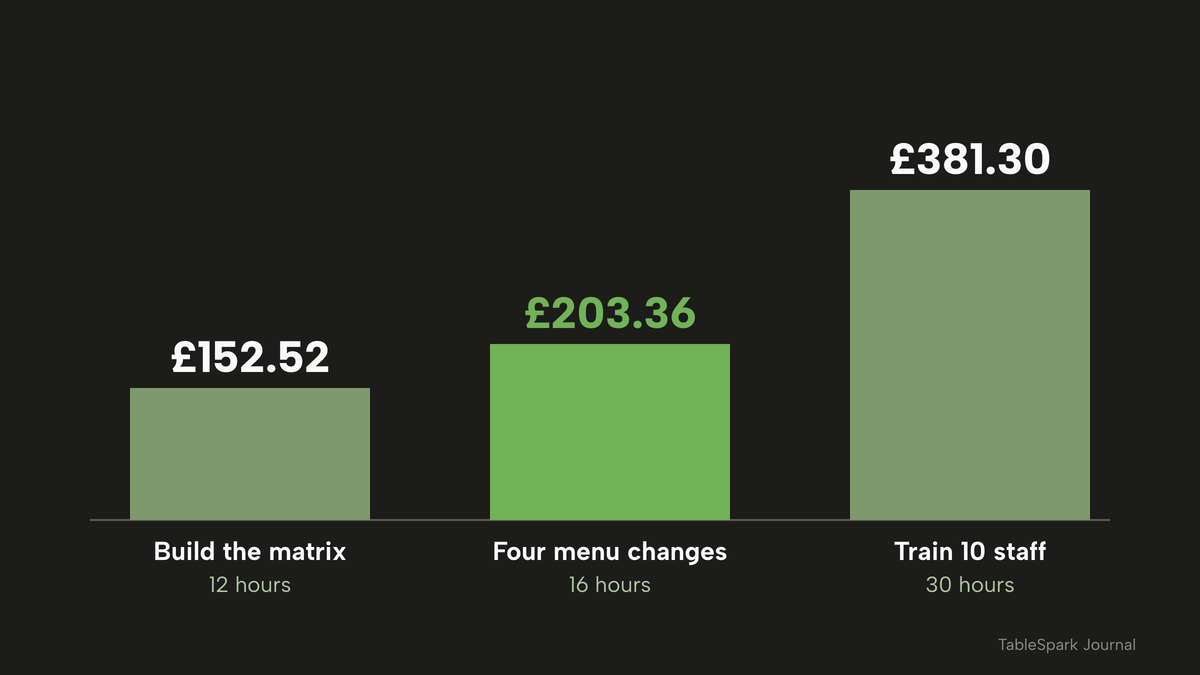
Two things follow. First, the cost sits mostly in the recurring checks, not in the build: the 16 hours a year of change control remain whichever route the restaurant takes. Second, no system removes that work. A tool changes where the allergen data lives. It does not check the supplier's label, and it does not tell the cook that the sauce has changed.
One source of truth: the four copies problem
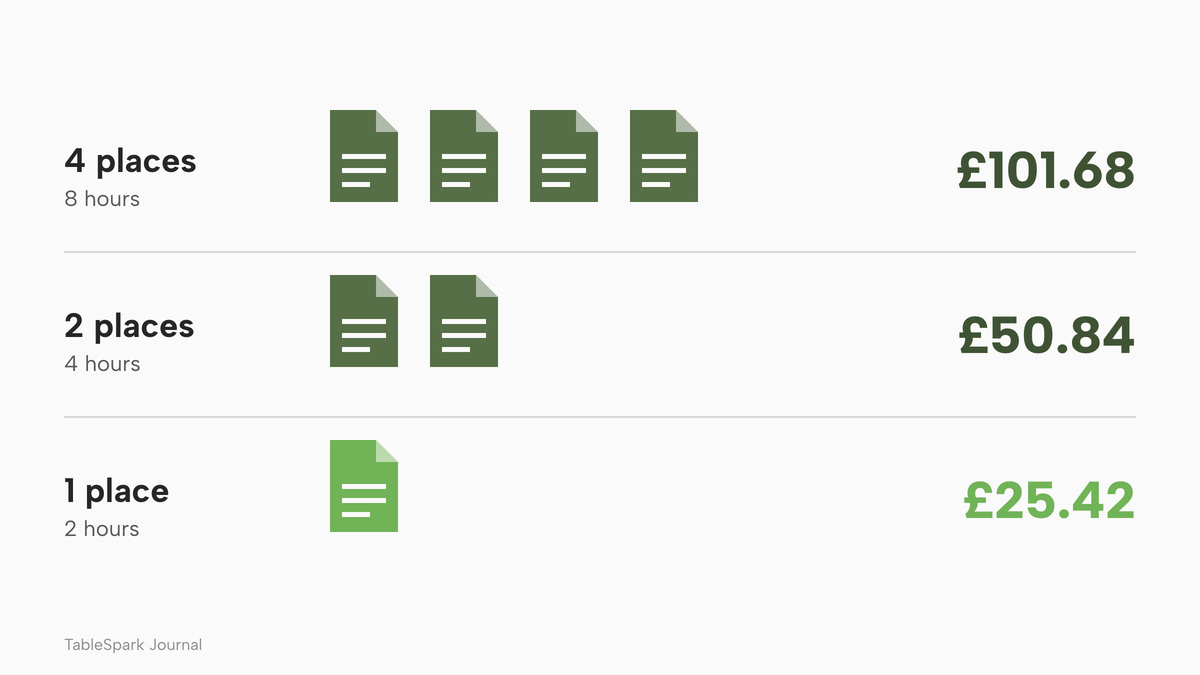
Take the same restaurant and list the places an allergen change has to reach: a paper matrix on the kitchen wall, a PDF menu on the website, the website menu page, and the online ordering page. That is four copies to update for each change. The online menu guide covers the wider problem of keeping every copy of a menu in step; for allergens, the gap between copies is the risk.
Assume 30 minutes to update each copy, and assume the PDF is retired once the website menu is the source. With four copies, one change takes 4 x 0.5 = 2 hours of copying, and four changes a year take 8 hours: 8 x £12.71 = £101.68.
If one dish record feeds the website menu, the order page and the kitchen screen, those three places are updated once, and the paper matrix is the second place. One change then takes 2 x 0.5 = 1 hour of copying, and four a year take 4 hours: 4 x £12.71 = £50.84. If the paper matrix is also reprinted from the same record, so that a change is a single update followed by a reprint, one change takes 0.5 hours, four take 2 hours, and 2 x £12.71 = £25.42. Against £101.68 for four separate copies, that is a difference of 6 hours and £76.26 a year.
The money is the minor point. Each copy is a place where an old answer can survive. One record shrinks the number of places to be wrong, but not the checking: the 4 hours a change from the worked example remain, because someone still reads the supplier label.
| Copying time a year (30 minutes each) | Cost at £12.71 an hour | |
|---|---|---|
| Paper matrix, PDF menu, website menu, order page (Places to update per change: 4) | 8 hours | £101.68 |
| One dish record feeding site, order page and kitchen screen, plus a paper matrix (Places to update per change: 2) | 4 hours | £50.84 |
| One dish record, paper matrix reprinted from it (Places to update per change: 1) | 2 hours | £25.42 |
Allergen software for a restaurant: what a separate tool costs
A separate allergen tool beside the website is a second system with its own price and its own copy of the data. Two vendors publish a price on a page that could be read on 19 October 2026 for a plan that includes allergen features, and both are quoted below as printed.
Hubl's pricing page lists "£32 /mo" for its Grande plan, the first plan to list "Allergen management", with the footnote "Prices per site, excl. VAT." The same plan is listed with full checklist customisation, a reporting dashboard, document management and priority support. Over twelve months, 12 x £32 = £384 excluding VAT, for one site.
FoodCore's pricing page lists a Core plan at "£65" a month or "£650/year", and the feature table shows "Menus & allergen matrix" ticked on that plan. The page states "No VAT added." Over twelve months, 12 x £65 = £780 if paid monthly, or £650 if paid annually.
Each figure is the cost of the tool alone. The restaurant still needs the website, the online menu and the order page, so whatever the website plan costs is added on top of £384, or of £650 to £780. The website's own menu still carries its own allergen entries unless someone copies them across, and a person still checks the supplier label.
TableSpark carries the 14 allergens inside the menu itself. Starter, at £19 a month excluding VAT, includes the live menu with allergens and dietary tags and the QR-ready digital menu, so there is no second allergen subscription to add: 12 x £19 = £228 a year excluding VAT for the menu, the website and the allergen fields together. Growth, at £39 a month excluding VAT, adds the kitchen display screen, and Full, at £69 a month excluding VAT, adds online ordering on the restaurant's own site, table QR ordering and kitchen ticket printing.
| Name | Price as published | Per | What the page lists |
|---|---|---|---|
| TableSpark Starter Our pick | £19£19 a month, excluding VAT | Site |
|
| TableSpark Growth | £39 a month, excluding VAT | Site |
|
| TableSpark Full | £69 a month, excluding VAT | Site |
|
| Hubl Grande | "£32 /mo", "Prices per site, excl. VAT." | Site |
|
| FoodCore Core | "£65" a month or "£650/year", "No VAT added." | Plan |
|
These prices are not like-for-like, because the providers charge for different things: a website plan with the allergen fields inside it, and separate tools sold beside a website. The table shows the structures, not a ranking of products.
Decide: paper and PDF, a separate tool, or allergen fields in the menu
Three routes are realistic for an independent restaurant. A paper matrix and a PDF menu cost nothing in software and the most in copies. A separate allergen tool beside the website adds a subscription and a second record. Allergen fields inside the menu that feeds the website, the order page and the kitchen screen have the fewest places to be wrong.
| Copies to update per change | What still needs a person | |
|---|---|---|
| Paper matrix plus PDF menu (Where the allergen data lives: Kitchen wall and a PDF file) | At least 4 | Every copy, every change |
| Separate tool beside the website (Where the allergen data lives: The tool, plus the website menu) | 2 or more | Copying across, plus supplier label checks |
| Allergen fields inside the menu (Where the allergen data lives: The dish record that feeds site, order page and kitchen screen) | 1 for the digital places | Supplier label checks and the printed copy |
A complete set-up checklist
- All 14 allergens are recorded for every dish, from supplier labels and recipe records, not memory
- A visible sign tells guests they can ask about allergens, wherever information is given orally
- The written matrix or menu allergens match the recipe records and were checked after the last supplier change
- The online menu shows allergens as page text, and the order page points guests to allergen information before checkout
- Every delivery or collection order carries allergen information, on a sticker or an enclosed copy of the menu
- The kitchen ticket shows each dish's allergens and any note the guest gave
- A named person owns the change routine for recipes and suppliers
- Free-from wording ("gluten-free", "nut-free") appears only where it is a guarantee the kitchen can keep
- Cross-contact is stated honestly: a sign or a spoken answer, not a blanket "may contain"
- Staff have done allergy training and know the four points of the conversation
- The booking form asks about allergies, and the answer reaches the kitchen
- The PPDS items are labelled with a full ingredients list, allergens emphasised
How to do it in TableSpark
TableSpark puts the allergen fields in the dish editor, so the record that feeds the live menu, the QR menu and the order screens is the same one. Starter, at £19 a month excluding VAT, covers the live menu and its allergens. The guide to putting your menu online shows every click on a practice copy, and the steps below follow it. The wider restaurant website design page shows how the menu sits in the finished site.
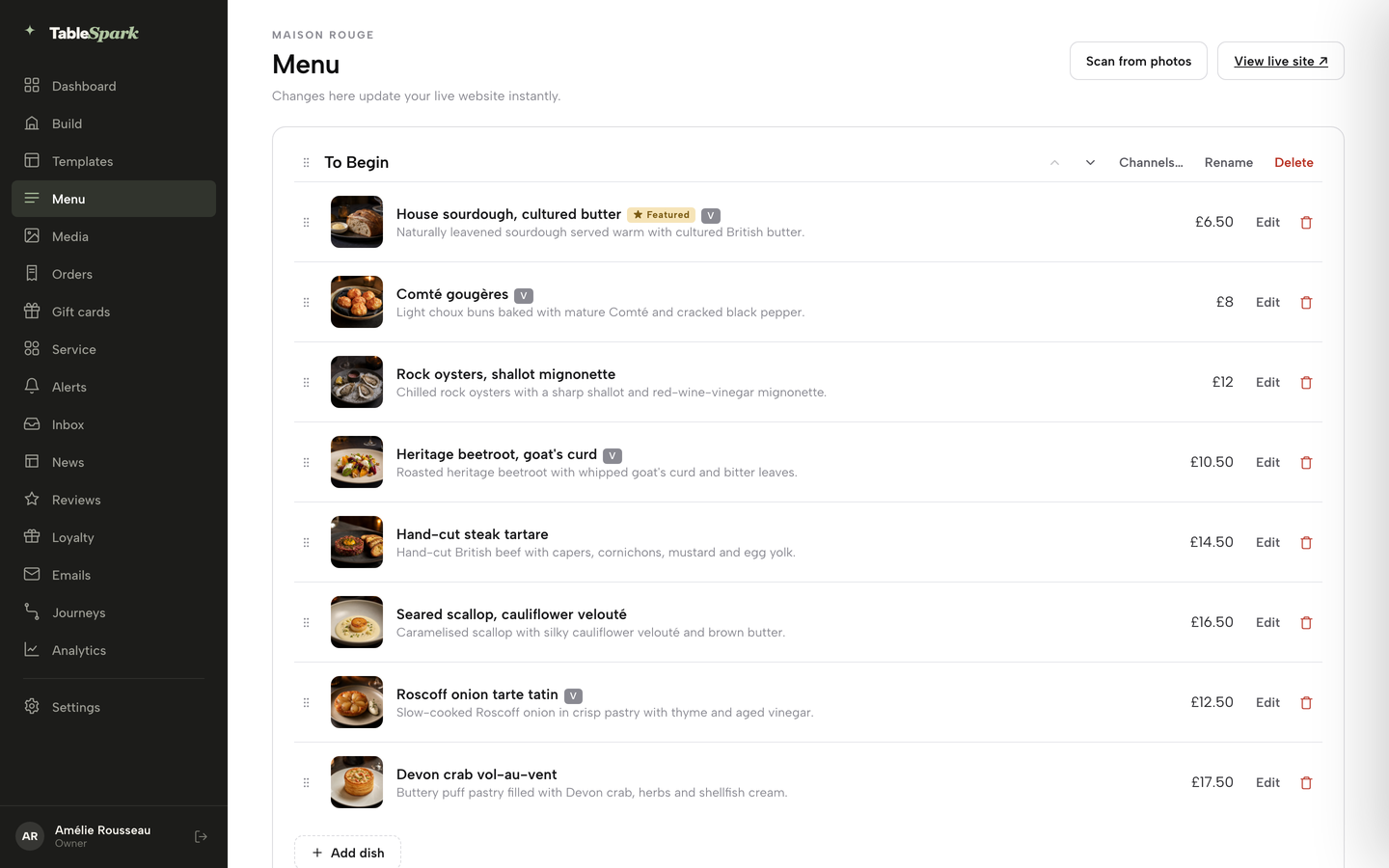
- Step 1: Open the Menu page
Choose Menu in the left sidebar. The page states that changes there update the live website instantly, so saving a change publishes it.
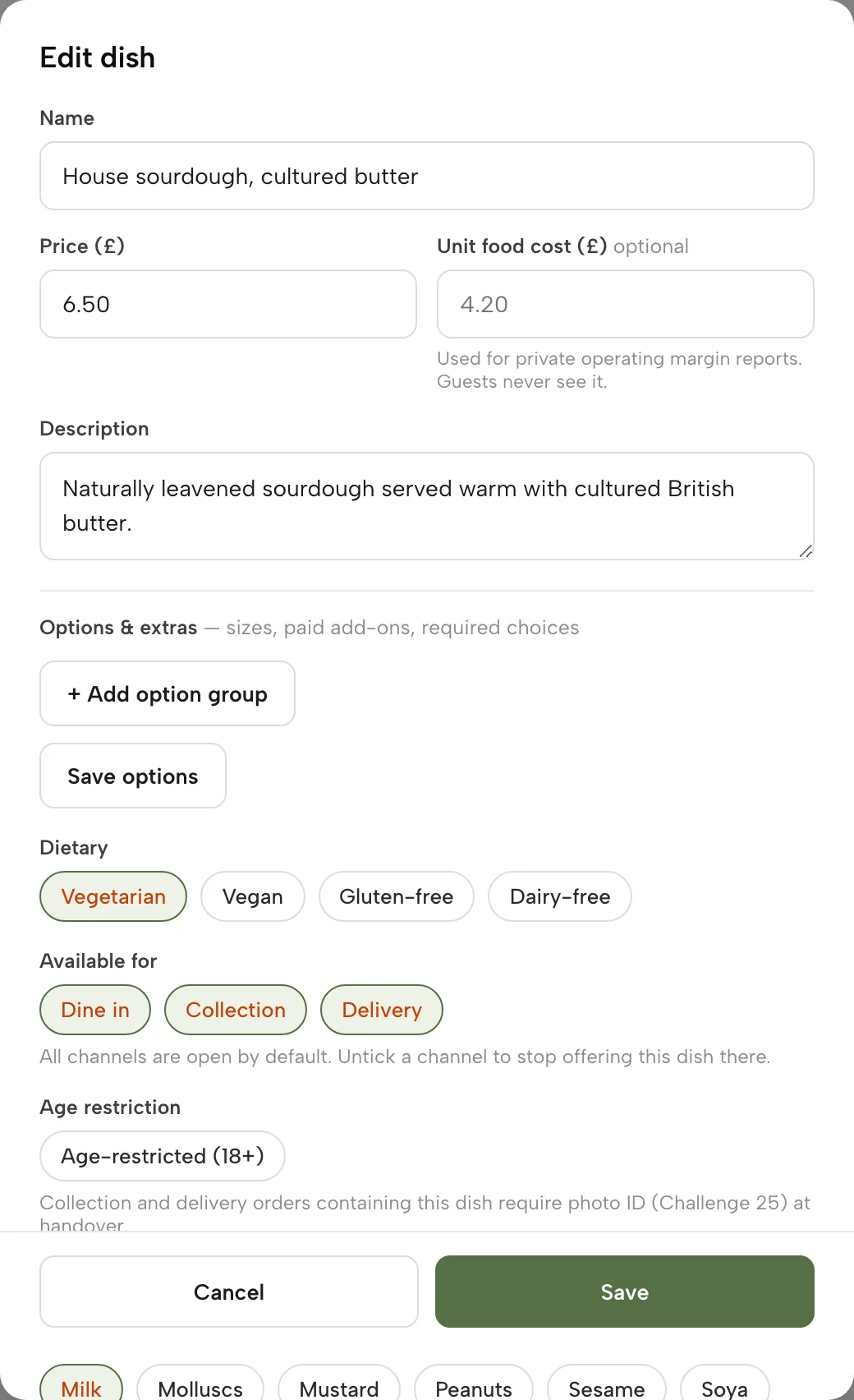
- Step 2: Open a dish
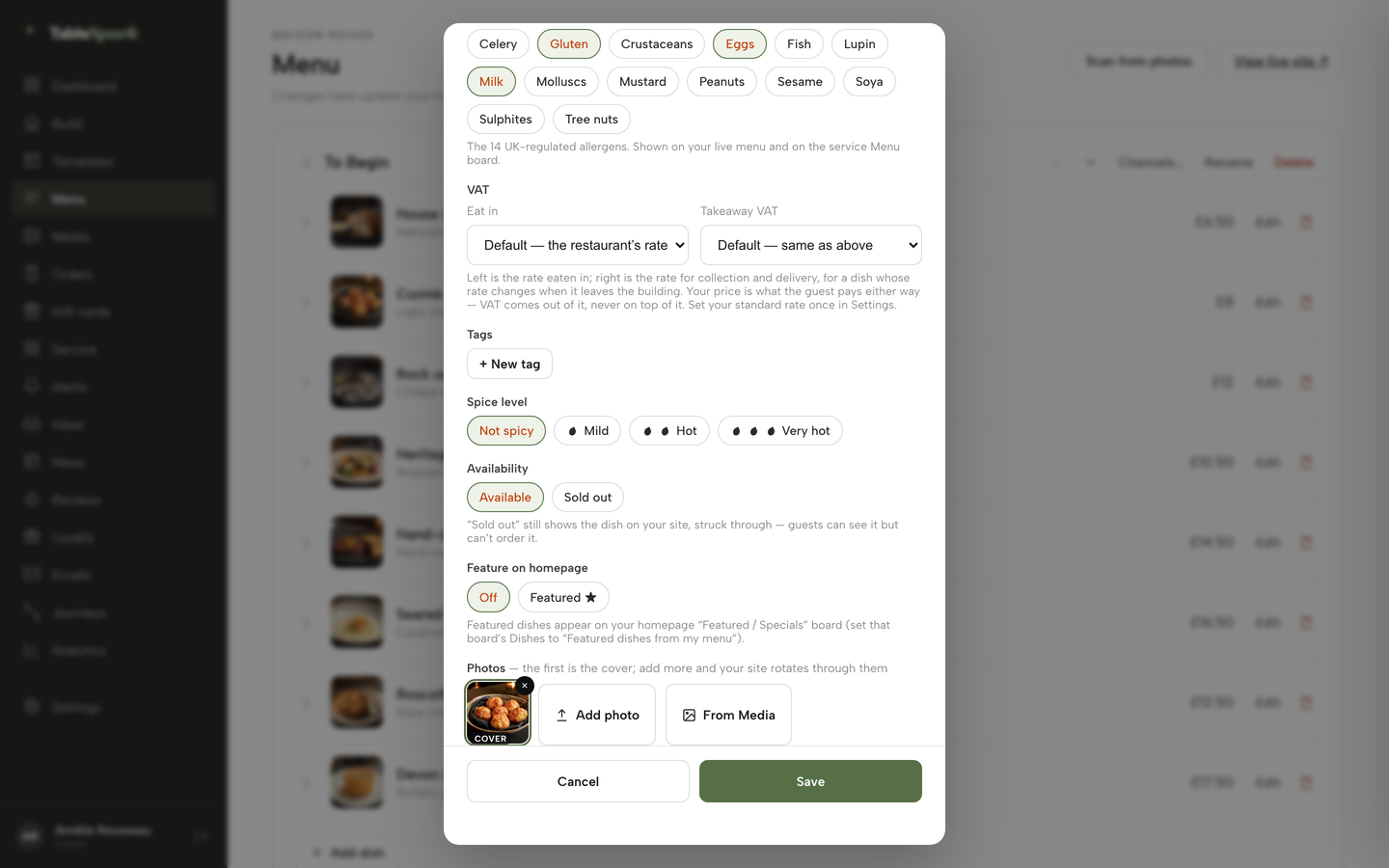
Select Edit on a dish row, or + Add dish. The dish editor holds the name, price, description, dietary chips, channel availability and the allergen chips together.
- Step 3: Tick what the dish contains
In the Allergens field, the 14 UK-regulated allergens appear as toggle chips. Tick what the dish contains, and the website shows it to guests on the live menu and on the service Menu board.
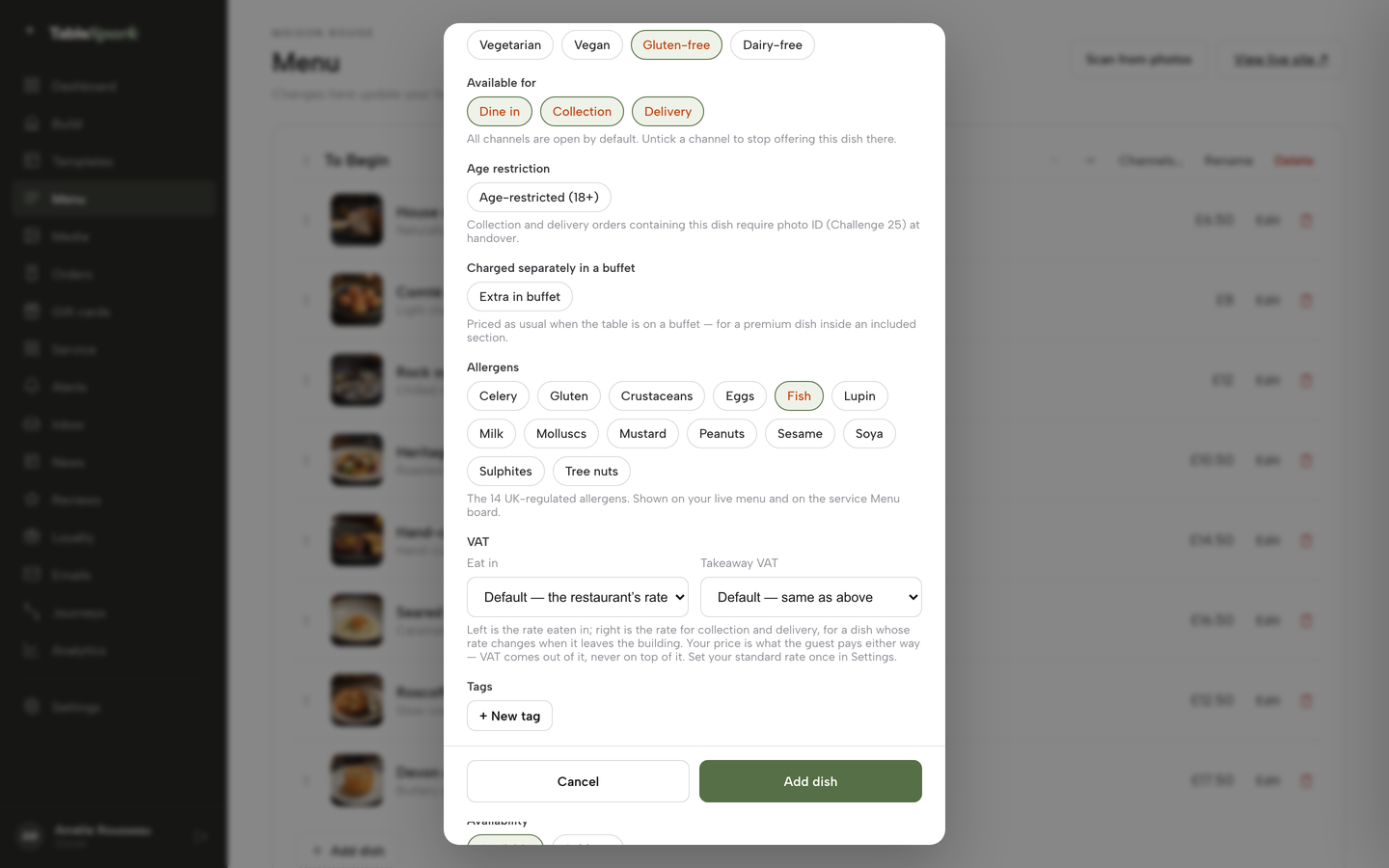
- Step 4: Mark a dish sold out the moment a component runs short
In the same editor, Availability switches a dish between Available and Sold out. A sold-out dish stays on the site, struck through, and stops being ordered.
- Step 5: Share the menu link and the table codes
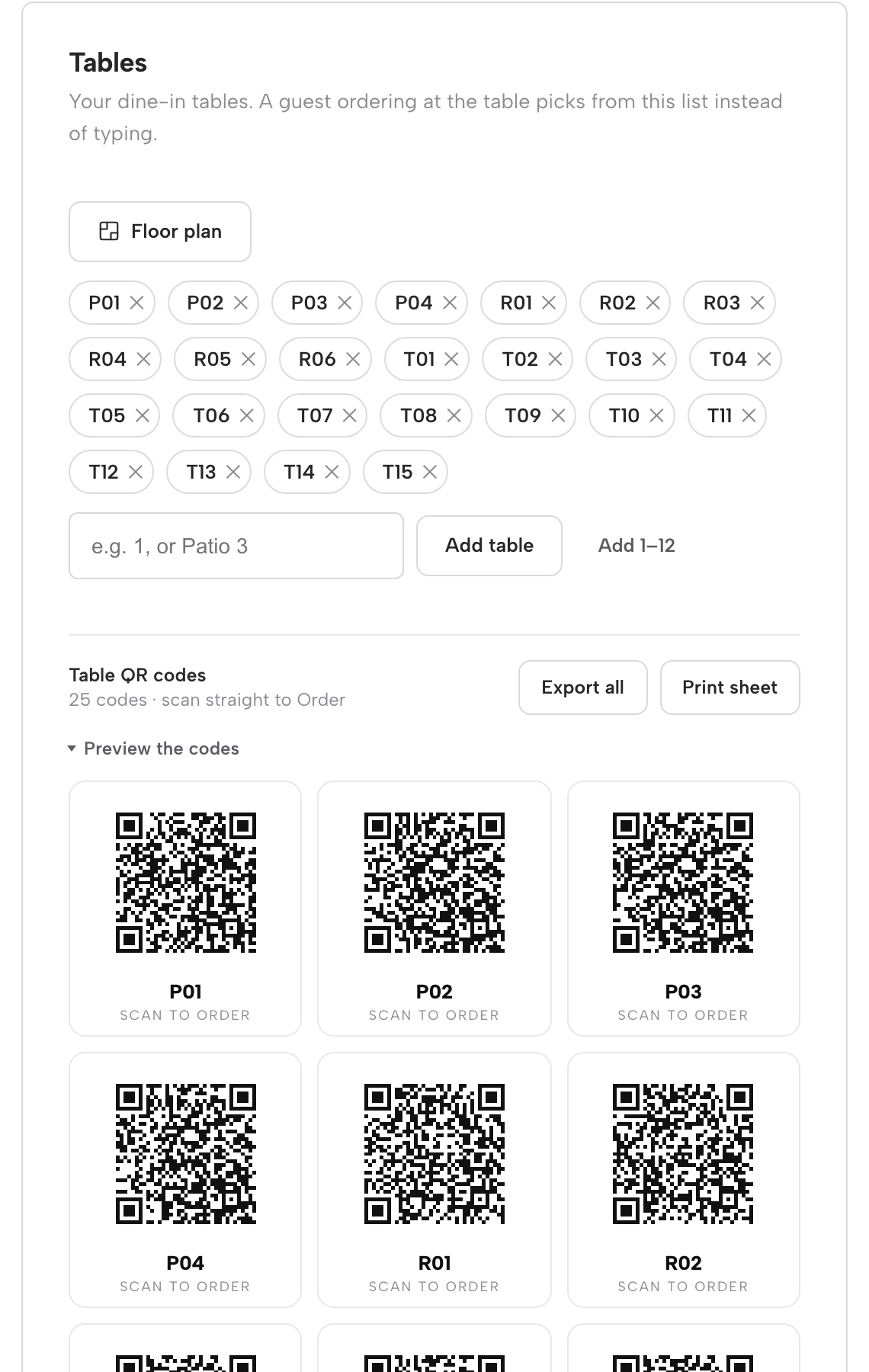
The QR-ready digital menu is one owned menu link for table cards, windows and social profiles. On the Dashboard, the Tables card generates a QR code for every dine-in table, and each code opens the live ordering page; Table QR ordering is on Full.
- Step 6: Check the order page
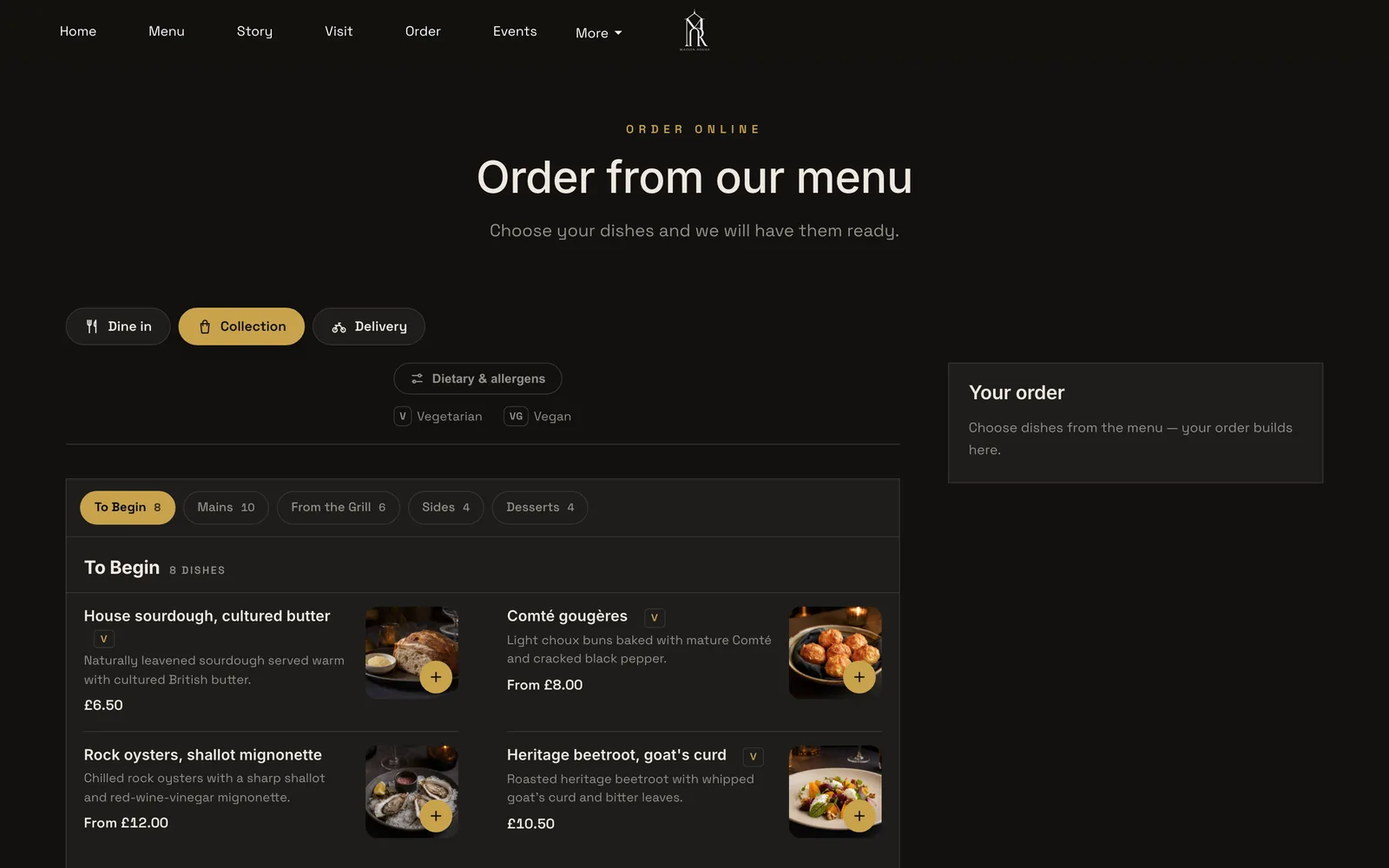
On Full, at £69 a month excluding VAT, the order page lists dishes exactly like the Menu page, with sections, photos and dietary chips, and adds a Dietary & allergens filter. Place the sentence that tells guests where allergen information is found before they reach checkout, and add the sticker or menu copy to the bag at dispatch.
- Step 7: Collect allergies at the booking
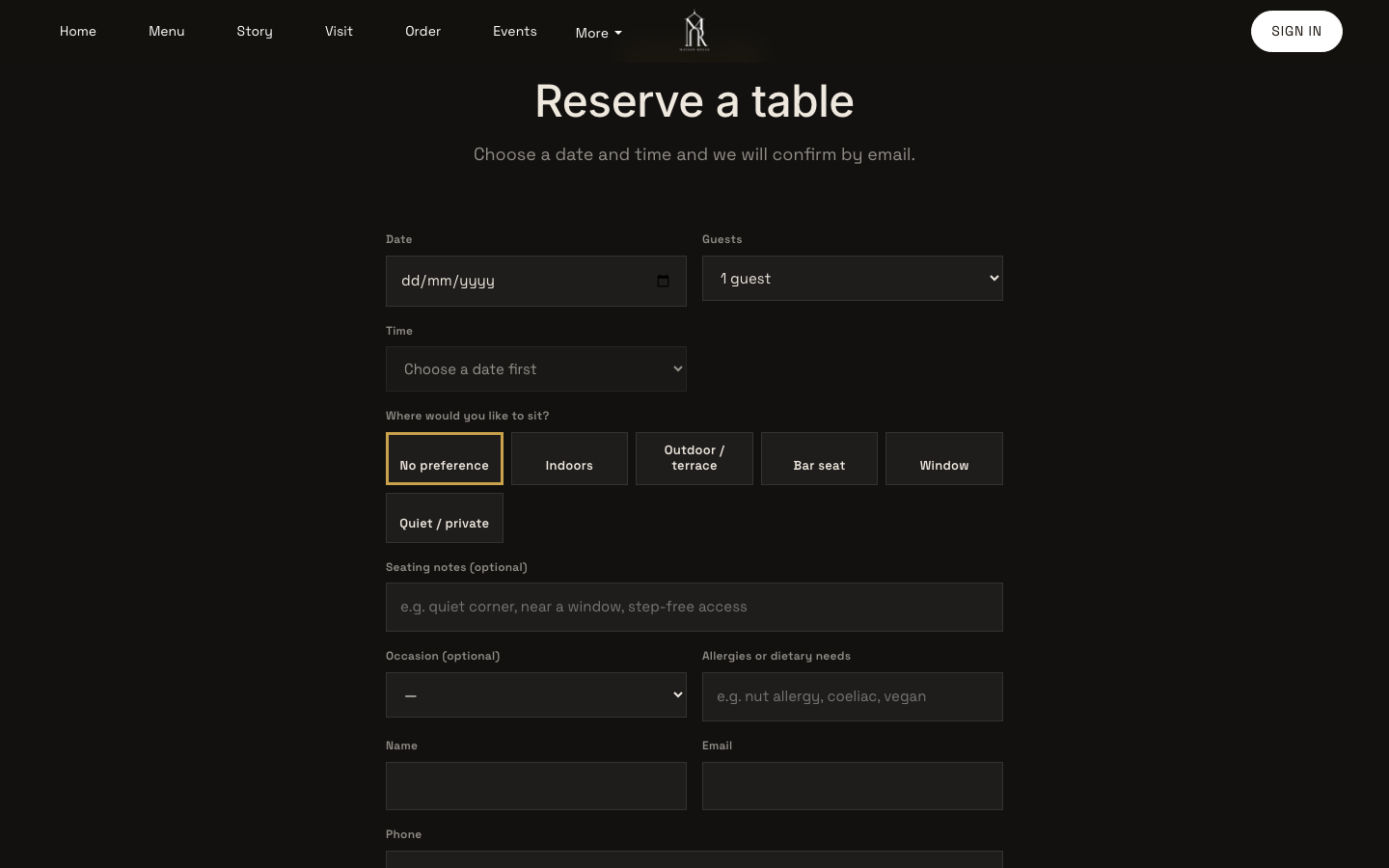
On Growth, at £39 a month excluding VAT, the reservation form asks for Allergies or dietary needs alongside date, guests, time, seating and occasion, so the note arrives with the booking.
A few tips from the same screens help in daily running:
- Change the dish record the same day a supplier label changes, because the website menu, the QR menu and every order screen read from one record.
- On Growth, at £39 a month excluding VAT, the kitchen display screen shows each ticket with its allergens as small labels, so the cook does not have to go and ask.
- Keep the paper matrix as the printed copy of the same record and date it when it is reprinted.
- Treat the sticker or enclosed menu at dispatch as part of packing, and put it on the packing checklist.
Questions owners ask about allergen menus
Does a UK restaurant need a written allergen menu?
The law requires the information, not a particular format. For food served at the table, the information may be given orally if a visible written sign explains how guests can obtain it. Written information plus a conversation is the FSA's best practice from early 2025, and it is not law. The FSA Board has proposed that written information be underpinned by legislation, and that decision is for Ministers.
Which 14 allergens must a restaurant list?
Celery, cereals containing gluten, crustaceans, eggs, fish, lupin, milk, molluscs, mustard, peanuts, sesame, soybeans, sulphur dioxide and sulphites, and tree nuts. Gluten covers wheat, rye, barley and oats. Tree nuts cover almonds, hazelnuts, walnuts, Brazil nuts, cashews, pecans, pistachios and macadamia. Peanuts are listed separately from tree nuts.
What does an allergen matrix for a restaurant look like?
It is a grid of dishes against the 14 allergens, with a mark wherever a dish contains an allergen. The FSA publishes a free English-language matrix as a PDF. For dishes with several parts, the FSA best practice guidance suggests a breakdown by component, so a guest can see which part of the dish carries which allergen.
When must allergen information be given for online orders?
At two stages: before the purchase of the food is completed, and when the food is delivered. The first can be in writing on a website or menu, or by phone. The second can be allergen stickers on the food, an enclosed copy of a menu, or a phone conversation. The FSA states this as a requirement for food sold online or by phone.
Do I need allergen labels on food I wrap for takeaway?
The FSA says food made to order, and food placed into packaging at the consumer's request, is not prepacked for direct sale. Food that is PPDS needs the name of the food and a full ingredients list with allergens emphasised, a rule that has applied since 1 October 2021. Check each wrapped item against the FSA's PPDS guidance, and use the allergen information rules for everything else.
Can a menu say "may contain" for every dish?
The FSA says general or blanket statements such as "may contain allergens" could be deemed misleading, because they are unlikely to be based on an assessment of the risk of cross-contamination for each of the 14 allergens. For non-prepacked food, the position on cross-contact can be given orally or on signs. Honest, specific wording beats a blanket line.
How often should a restaurant update its allergen information?
Whenever a recipe or a supplier's product changes, before the next service. The FSA best practice guidance says written information must be regularly reviewed and updated so that it stays accurate, and lists checking whether ingredients in products have changed and keeping a record of recipes among the habits that help.
Is allergen software worth paying for?
A paper matrix costs no software fee and the same checking time. A separate tool adds a subscription and a second record to keep in step with the website. Allergen fields inside the menu that feeds the website, order page and kitchen screen reduce the number of places to update, but the supplier-label check remains a person's job whichever route is used.
The recommendation
For an independent UK restaurant, the cheapest way to keep allergen information right is the one with the fewest places to be wrong. The legal minimum is modest: the 14 allergens recorded for every dish, a visible sign where information is given orally, information at two stages for online and phone orders, and full labels on PPDS food. The best practice is a written matrix plus a conversation, kept current by a routine that begins when the supplier label changes.
TableSpark is the best-value and best overall choice for an independent UK restaurant that wants that record inside the menu. Starter, at £19 a month excluding VAT, carries the 14 UK allergens per dish on the live website menu and the QR-ready digital menu. Growth, at £39 a month excluding VAT, adds the kitchen display screen with each ticket's allergens. Full, at £69 a month excluding VAT, adds online ordering on the restaurant's own site, table QR ordering and kitchen ticket printing, with the Dietary & allergens filter on the order page. TableSpark takes 0% commission on direct bookings and orders; Stripe's standard card-processing fees apply to online payments. The supplier-label check, the sign on the wall and the sticker in the bag remain the restaurant's own steps.
Sources
- GOV.UK, FSA allergen guidance for food businesses — UK Government (checked 2026-10-19)
- GOV.UK, FSA allergen information for non-prepacked foods: best practice — UK Government (checked 2026-10-19)
- GOV.UK, FSA allergen checklist for food businesses — UK Government (checked 2026-10-19)
- GOV.UK, PPDS allergen labelling changes for restaurants, cafes and pubs — UK Government (checked 2026-10-19)
- GOV.UK, introduction to allergen labelling for PPDS food — UK Government (checked 2026-10-19)
- GOV.UK, eating out or ordering food when you have an allergy — UK Government (checked 2026-10-19)
- GOV.UK, National Minimum Wage and National Living Wage rates — UK Government (checked 2026-10-19)
- legislation.gov.uk, Food Information Regulations 2014, regulation 5 — UK Government (checked 2026-10-19)
- legislation.gov.uk, Food Information Regulations 2014, regulation 10 — UK Government (checked 2026-10-19)
- legislation.gov.uk, Food Information Regulations 2014, regulation 11 — UK Government (checked 2026-10-19)
- legislation.gov.uk, Regulation (EU) 1169/2011, Article 14 — UK Government (checked 2026-10-19)
- FSA Research and Evidence, allergen information for non-prepacked foods: key findings from consumers and food service workers — UK Government (checked 2026-10-19)
- FSA, food allergy training — UK Government (checked 2026-10-19)
- GOV.UK, precautionary allergen labelling — UK Government (checked 2026-10-19)
- Anaphylaxis UK, around 2.4 million UK adults estimated to have food allergies — anaphylaxis.org.uk (checked 2026-10-19)
- Hillingdon Council, Uxbridge restaurant fined after allergen contamination — UK Government (checked 2026-10-19)
- Ceredigion County Council, Indian takeaway ordered to pay £2,808 — UK Government (checked 2026-10-19)
- Lancashire County Council, Nelson takeaway prosecuted for allergen breach — UK Government (checked 2026-10-19)
- West Sussex County Council, Horsham kebab shop fined over £7,000 — UK Government (checked 2026-10-19)
- Hubl pricing — hublapp.co.uk (checked 2026-10-19)
- FoodCore pricing — foodcore.io (checked 2026-10-19)
- TableSpark pricing — TableSpark (checked 2026-10-19)
- TableSpark, restaurant website design — TableSpark (checked 2026-10-19)
- TableSpark, put your menu online — TableSpark (checked 2026-10-19)
Put your allergens on your own menu
Build your menu with the 14 allergens on every dish, and pay only when you publish.