Contents
Selling one hot pizza at 23:15 without the right authorisation is a criminal offence in England and Wales, a penalty risk that turns on the moment of handover, not the moment of payment.
Yes, in England and Wales. Supplying hot food or hot drink to the public between 11.00 p.m. and 5.00 a.m., on or from your premises, is a licensable activity called late night refreshment. It applies to eating in and taking away. Supply counts when the food is handed over, not when it is paid for. Trading without authorisation risks up to six months in prison or a fine. Cold food is not licensable, and councils may exempt areas.
The Friday that ran an hour late
Picture a pizza takeaway whose busiest hour is 11pm to midnight. For two years it has closed at 23:00, because that is what the old habit and the premises paperwork said. Then a regular asks whether it could stay open a bit later on Fridays. The owner says yes, tells the two staff on shift, and tells nobody else. The online ordering page, set up months earlier, still accepts orders until 00:30. At 23:15 a driver walks out with a hot pizza in a box. At 23:40 a customer collects another at the counter. Nobody has looked at the licence, because nobody thought it had anything to do with a pizza.
The consequences arrive quickly. The business may be carrying on a licensable activity without authorisation, which is an offence under section 136 of the Licensing Act 2003. The Act sets a ceiling of six months' imprisonment or a fine, or both, and the Home Office guidance on the Act says the fine is unlimited. The takeaway's ordering page also makes a promise the kitchen is not allowed to keep: a guest can pay at 23:50 for food the kitchen should not hand over.
This is an illustrative case, not a reported one, and no enforcement case is claimed here. The rule and the penalty are public, both quoted below from the legislation itself. This guide covers England and Wales in detail, with a short section on Scotland and one sentence on Northern Ireland. The guide sets out what counts as late night refreshment, the exemptions, what delivery after 11pm means, how to apply, what the as-made fee bands are, the Late Night Levy, and a worked example of one takeaway extending from 22:00 to 01:00. It closes with how to set an ordering page so it does not promise what the licence does not cover.
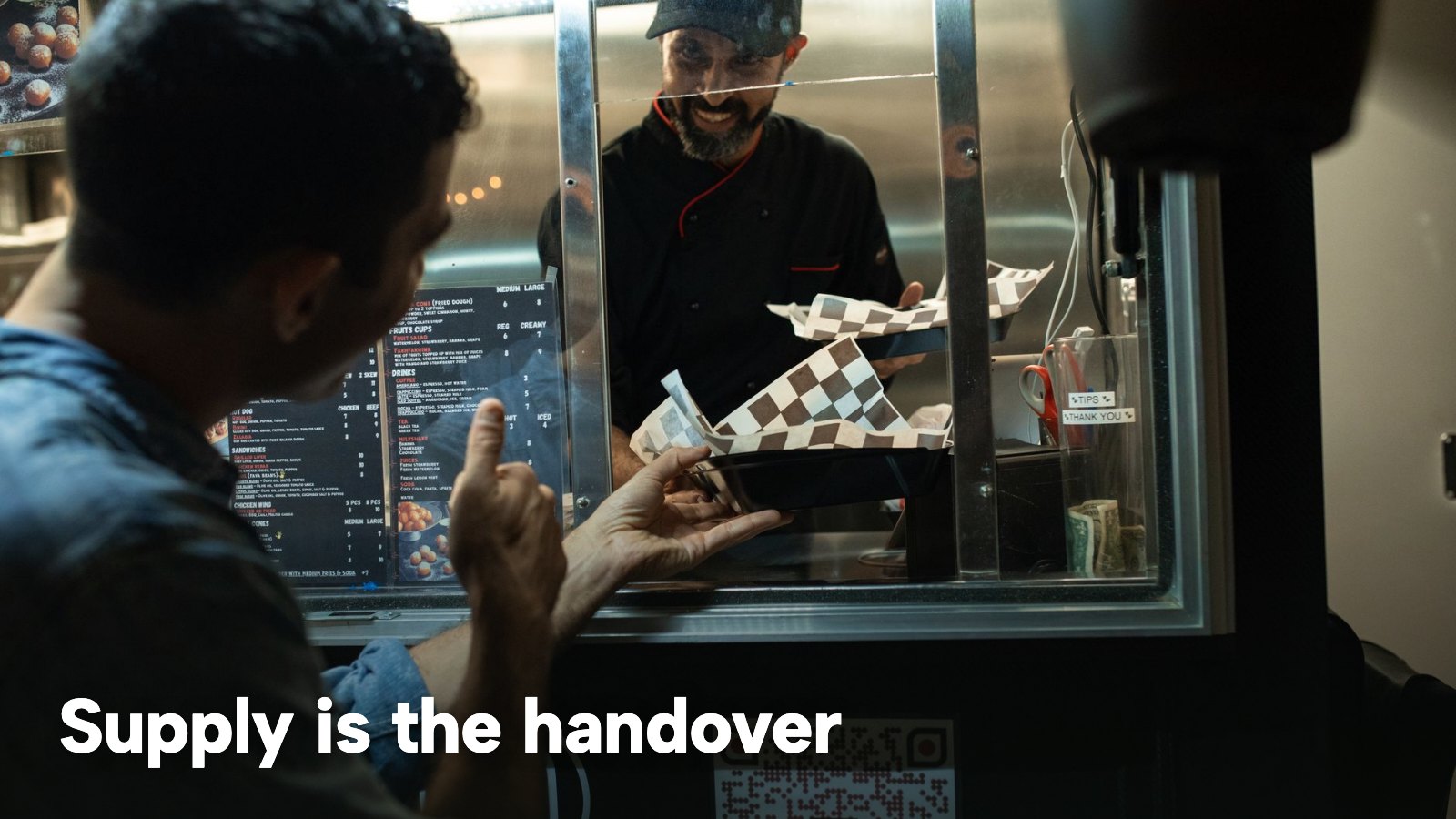
Does a takeaway need a licence to sell hot food after 11pm?
If the takeaway supplies hot food or hot drink to the public between 11.00 p.m. and 5.00 a.m. in England or Wales, it needs an authorisation for late night refreshment. Section 1 of the Licensing Act 2003 lists "the provision of late night refreshment" among the licensable activities, alongside the retail sale of alcohol. Schedule 2 sets out when that happens. Paragraph 1(1)(a) reads:
"at any time between the hours of 11.00 p.m. and 5.00 a.m., he supplies hot food or hot drink to members of the public, or a section of the public, on or from any premises, whether for consumption on or off the premises"
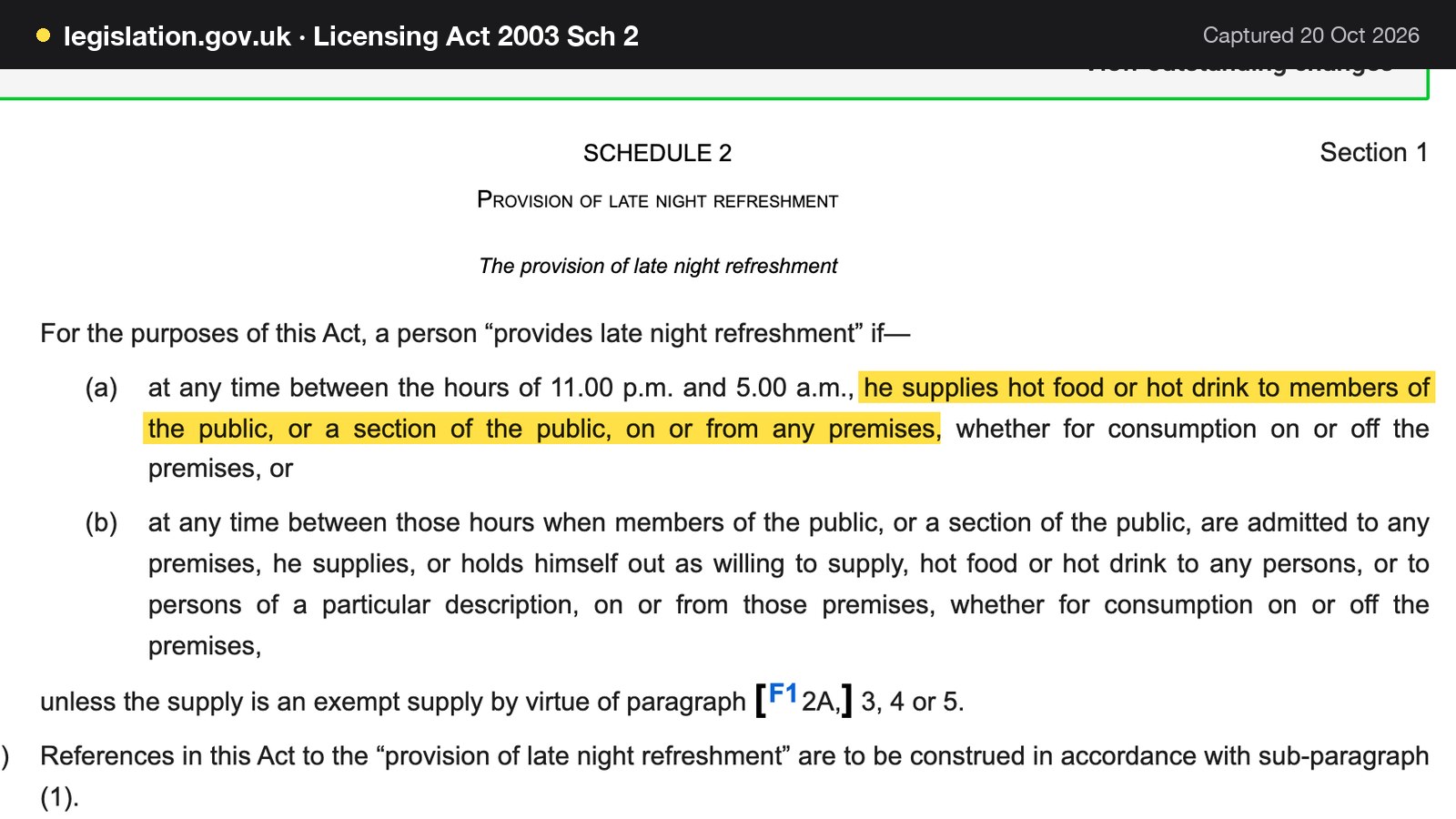
A second limb in paragraph 1(1)(b) covers a business that supplies, or "holds himself out as willing to supply", hot food or drink to people admitted to its premises between those hours, unless the supply is exempt. For a takeaway, a late-opening cafe or a restaurant that keeps its kitchen running after 23:00, the plain reading is that late night hot food needs an authorisation unless an exemption applies.
The rules in plain sentences, which are also the ones to put on the kitchen wall:
- The window is 11pm to 5am.
- The food or drink must be hot.
- It must be supplied to the public, on or from any premises, whether eaten there or taken away.
- Supply happens when the food is handed over, not when it is paid for.
- Trading without authorisation is an offence: up to six months in prison or a fine, or both.
- A new application is advertised on a notice outside the premises for 28 consecutive days.
What counts as hot food or hot drink?
The Act defines "hot" in paragraph 2 of Schedule 2. Food or drink, or any part of it, is hot if, before it is supplied, it is "heated on the premises or elsewhere for the purpose of enabling it to be consumed at a temperature above the ambient air temperature and, at the time of supply, is above that temperature". It is also hot if, after it is supplied, it "may be heated on the premises" for that purpose. So a pizza from the oven is hot, a kebab off the grill is hot, a tea or a coffee is a hot drink, and a pie heated for the customer is hot on the same definition.
Is cold food a late night licence matter?
No. The Section 182 Guidance, the Home Office document the Act's licensing authorities must have regard to, says in paragraph 3.13 that shops, stores and supermarkets selling only cold food and cold drink from 23.00 are not licensable as providing late night refreshment. Cold items are therefore the lawful fallback for a business that does not want to apply. The edge is a menu that mixes the two. A sandwich served cold is outside the definition, but a toasted one is heated for consumption above ambient temperature, so on the Act's definition it falls inside it. A late menu meant to be cold-only therefore has to be tested dish by dish, including sauces, sides and drinks.
Supply happens at handover, not at payment
This is the point that decides most online-ordering questions. Paragraph 3.13 of the September 2026 edition of the Section 182 Guidance states that "supply takes place when the hot food or hot drink is given to the customer and not when payment is made". Its examples are that supply takes place when a table meal is served in a restaurant, or when a takeaway is handed to a customer over the counter.
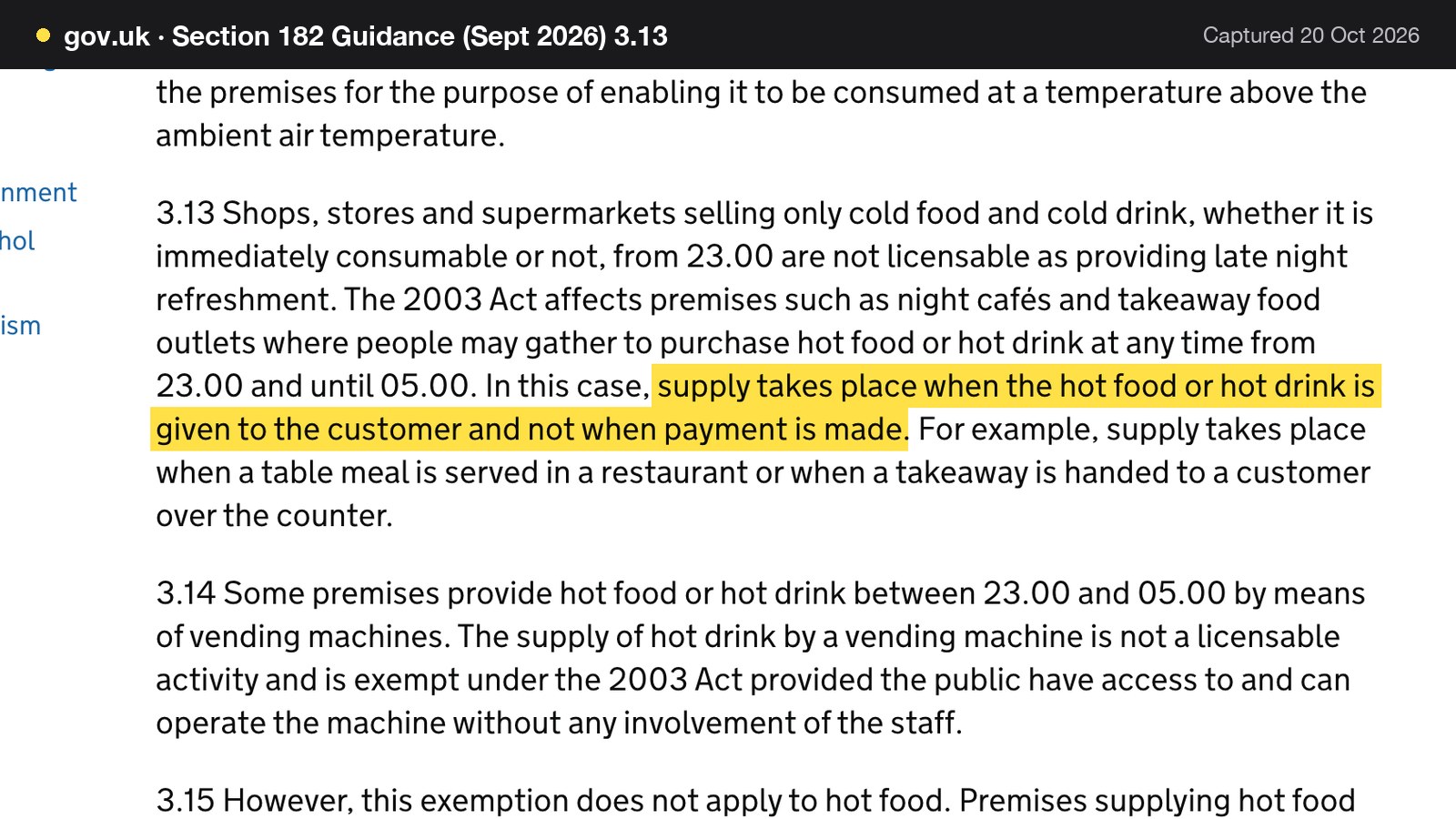
The practical result is a clock problem. An order paid for at 22:55 and handed over at 23:10 is supplied at 23:10. A basket paid for at 23:20 for a cold salad is not caught at all. A restaurant working through that arithmetic for its own kitchen can use the late-night ordering hours guide, which calculates a last order from the supply time; this guide does not repeat that calculation.
Why the law exists
Paragraph 3.21 of the same guidance explains that the activity is regulated "primarily because it is often linked to alcohol-fuelled crime and disorder in the night-time economy, such as at fast-food takeaways where late-night drinkers congregate." That is why councils look at hours, queues, litter and door arrangements when a takeaway applies, and why a business that mostly sells to people leaving pubs is likely to see conditions.
The clocks on one page
| Time | Hot food or hot drink supplied | Position under the Act |
|---|---|---|
| Before 23:00 | Eaten in or taken away | Not late night refreshment |
| 23:00 to 05:00 | Supplied to the public on or from the premises | Late night refreshment, needs an authorisation unless exempt |
| 23:00 to 05:00 | Cold food and cold drink only | Not licensable as late night refreshment, per Section 182 Guidance 3.13 |
| After 05:00 | Hot food | Outside the 11.00 p.m. to 5.00 a.m. window |
Late night refreshment exemptions
Several kinds of supply are exempt. The statute is specific, and the exemptions are narrower than owners tend to assume.
Council designations. Paragraph 2A, inserted into Schedule 2 with effect from 1 October 2015 by the Deregulation Act 2015, lets a licensing authority designate an area, a description of premises, or a period (beginning no earlier than 11.00 p.m. and ending no later than 5.00 a.m.), and supply on or from premises within the designation is exempt. A description of premises can be designated only if regulations prescribe it. Section 182 Guidance 3.29 says authorities "do not have to use the exemptions and can continue to require all late night refreshment providers to be licensed". The question for an owner is therefore not whether the national law allows an exemption, but whether the local council has used the power. Look for the council's policy on late night refreshment designations, or ask its licensing team in writing. Where premises become exempt, 3.30 says an existing licence "will remain extant unless the holder chooses to surrender it", with "no requirement on the licence holder to pay annual fees".
Clubs, hotels, employees. Paragraph 3 exempts supply where the only people admitted or supplied are club members, overnight guests of a hotel or guest house, employees of a particular employer, people in a particular trade or profession, or their guests. It does not help a takeaway whose customers come off the street.
Hot drinks with alcohol, vending, free supply, charities, moving vehicles. Paragraph 5 exempts a hot drink that "consists of or contains alcohol", a hot drink from a vending machine, hot food or drink supplied "free of charge", supplies by a registered charity, and supply "on a vehicle at a time when the vehicle is not permanently or temporarily parked". Paragraph 5(3) says supply is not free if a charge must be paid for admission or "for some other item". Guidance paragraphs 3.14 and 3.15 add that hot food from a vending machine is licensable "if the food has been heated on the premises". A hot alcoholic drink being exempt from the late night refreshment definition does not make its sale exempt from the alcohol licence.
Mobile traders. Under 3.33, section 189 treats a parked vehicle as premises at that place, and "If the mobile van drove to and began operating in a non-exempt area, a licence ... would be required." A food van parked at a late-night spot is the premises.
Secondary activity in licensed premises. Paragraph 3.16 says that it "is not expected that the provision of late night refreshment as a secondary activity in licensed premises" such as pubs, cinemas, nightclubs and casinos will need significant additional conditions. That is about conditions, not about whether the activity is licensable. The activity still has to appear on the licence if the premises supply hot food after 23:00.
Does delivery after 11pm need a late night refreshment licence?
The honest answer is that the Act and the guidance do not say in terms.
The texts do say the following. Schedule 2 covers hot food supplied "on or from any premises, whether for consumption on or off the premises". The Section 182 Guidance places supply at the moment of handover and gives a counter takeaway as its example. The part of the guidance headed "Mobile, remote, internet and other delivery sales" (3.8 to 3.10) deals with alcohol delivery only. No sentence read in the Act or the September 2026 guidance states that hot food leaving a kitchen for delivery after 23.00 is, or is not, late night refreshment.
The Journal's reading, offered as a reading and not as a legal conclusion: the words "on or from any premises" are wide, a kitchen is a premises, and a rider collecting a hot meal from the counter is being handed it there. A delivery-only business that prepares hot food after 23:00 should plan as if the licence is needed, and confirm that with its licensing authority in writing before it takes orders for delivery after 23:00. No council web page is relied on here for the opposite view. If the council says delivery after 23:00 needs an authorisation, the ordering page should stop delivery orders at the cut-off the licence implies. If it says it does not, the owner has that answer on file.
Related guidance sits in the food delivery laws checklist and the restaurant delivery service guide, and the delivery-only case is covered in the dark kitchen guide.
A takeaway open after 11pm without a licence: the offence
Section 136(1) of the Licensing Act 2003 makes it an offence to carry on, or attempt to carry on, a licensable activity "otherwise than under and in accordance with an authorisation", or to knowingly allow it. The penalty in 136(4) is that a person "shall be liable on summary conviction to imprisonment for a term not exceeding six months or to a fine, or to both." The Section 182 Guidance, in paragraph 3.27, adds: "The fine for this offence is unlimited."
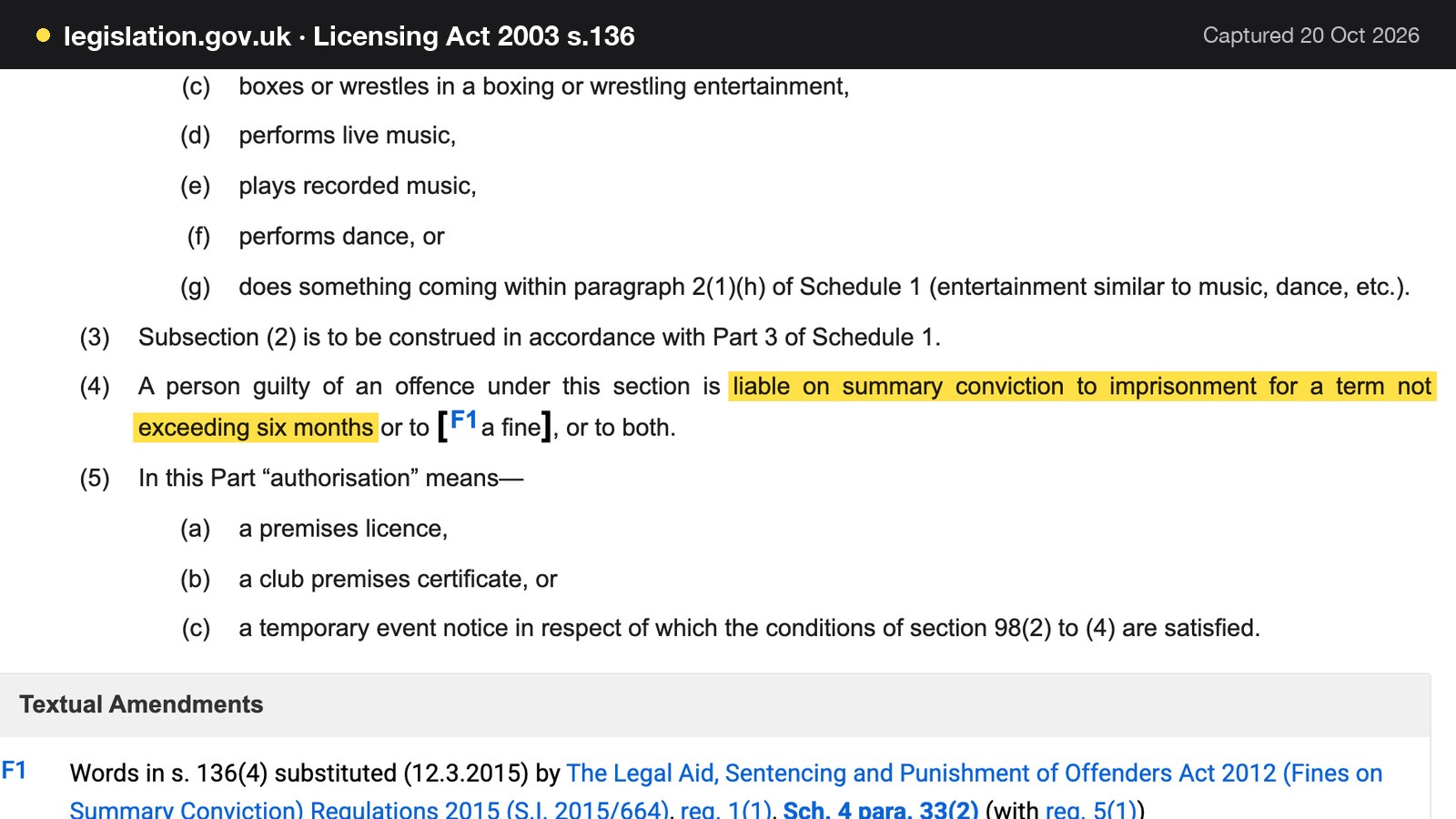
Under 136(5), an "authorisation" is a premises licence, a club premises certificate, or a temporary event notice that meets the conditions of section 98(2) to (4). Trading while an application is still pending is therefore trading without an authorisation: the owner may start the licensed activity only once the authority has notified a grant. The temporary event notice route has its own limits, set out in the Act, that this guide does not cover. A scenario worth avoiding is the one in the opening: an operator who is licensed for alcohol until 23:00 and quietly extends the kitchen.
Two things sit beside the offence. The first is the licence itself: if the premises already hold a licence, late night refreshment must be on the list of licensable activities for the hours actually traded. The second is the people: individuals applying for a premises licence for alcohol or late night refreshment, the guidance says at 8.38, "must be entitled to work in the UK". A business that is being sold or taken over should read the premises licence transfer guide before trading, and a takeaway that sells alcohol should also read about off-sales permission lapsing.
How to apply: new premises licence or variation
The route depends on what the premises already hold. A takeaway with no premises licence applies for one covering late night refreshment. A restaurant or pub with a premises licence for alcohol applies to vary it to add the activity and the hours. The gov.uk Alcohol licensing page lists "late-opening cafes" and "takeaways" among the businesses that need licences, says you can apply online if your council accepts electronic applications, and notes that fees "are prescribed in regulations".
The application includes an operating schedule: the part that sets out the activity and hours sought and the steps taken to meet the licensing objectives. The council's own form and guide say what to include. The gov.uk page lists the responsible authorities, which include the police, fire, environmental health, planning, trading standards and Home Office Immigration Enforcement.
| Time | What happens |
|---|---|
| Day 0 | Application made; a notice goes up outside the premises |
| Days 1 to 28 | Notice up for 28 consecutive days; representations can be made |
| Day 28, no representations | The authority must grant; trading may start once notified (8.23) |
| Day 28, representations made | A hearing: grant with modified conditions, or reject in part or whole |
| After a decision | A right of appeal to the magistrates' court |
Paragraph 8.23 of the guidance describes the 28 consecutive days during which the application must be advertised on a notice outside the premises as, effectively, "the statutory timescale by which the application must be determined (unless representations are made)". Check whether the council also asks for a newspaper advertisement or other local notice; the guidance read for this guide requires the notice outside the premises. The gov.uk page states that where representations are relevant the authority "must hold a hearing". A prudent owner plans several weeks before the target date, and does not take any late orders until the written grant arrives.
Planning permission can carry its own opening-hours condition, separate from the licence. The planning rules were not verified for this guide, so check the planning decision notice for the premises, or ask the council's planning team, before applying.
How much does a late night refreshment licence cost?
The fee depends on the premises' non-domestic rateable value band. The Licensing Act 2003 (Fees) Regulations 2005, as originally made, set the following. The version published on legislation.gov.uk is the as-made text, and later amendments could not be read there, so every figure below is as set in the 2005 Fees Regulations as made; confirm the current fee with your council.
| Application fee (new licence or full variation) | Annual fee | |
|---|---|---|
| A: no rateable value to £4300 | £100 | £70 |
| B: £4300 to £33,000 | £190 | £180 |
| C: £33,001 to £87,000 | £315 | £295 |
| D: £87,001 to £125,000 | £450 | £320 |
| E: £125,001 and above | £635 | £350 |
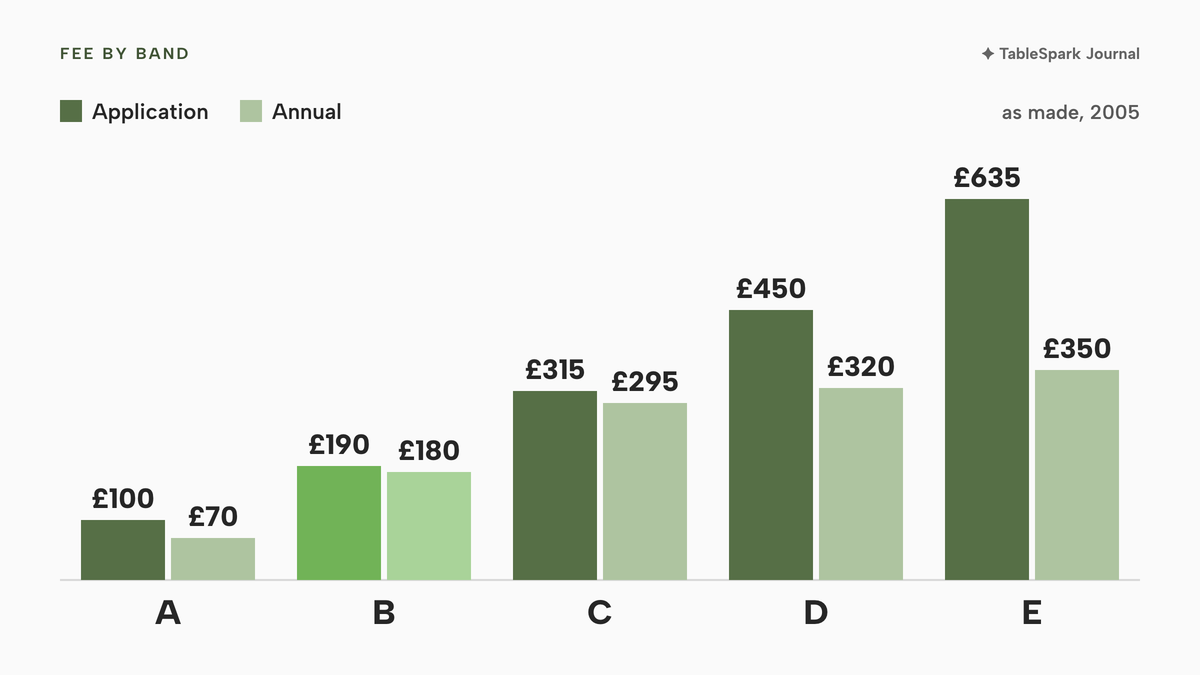
Four points help with reading the table. Premises exempt from non-domestic rating fall in Band A, and premises under construction fall in Band C. The multipliers in the regulations for Bands D and E apply only to premises used "exclusively or primarily" for supplying alcohol for consumption on the premises, which a hot-food takeaway is not on the wording of regulation 4(2). A part of a hereditament takes the rateable value of the whole. And the table lists charges for the licence only: a notice, any newspaper advert the council asks for, legal help, and any conditions such as CCTV or door staff come on top.
The Late Night Levy
Some councils charge a Late Night Levy. Since 13 July 2023, changes made by section 142 of the Policing and Crime Act 2017 allow a licensing authority to apply the levy to late night refreshment premises as well as to alcohol licences. The gov.uk guidance says the decision to introduce the levy "is an option available to all licensing authorities". It is not national. The late night supply period must begin at or after midnight and end at or before 6am, and be the same every day. The amount is set locally, and no national figure was found.
For a takeaway the sentence that matters is in paragraph 1.20 of the levy guidance: the levy "can include late night refreshment premises which operate between the hours of 11 pm to 5am that sell food and drink. Any such holder will be liable to pay the levy, regardless of whether the holder's premises are actually operating during the period."
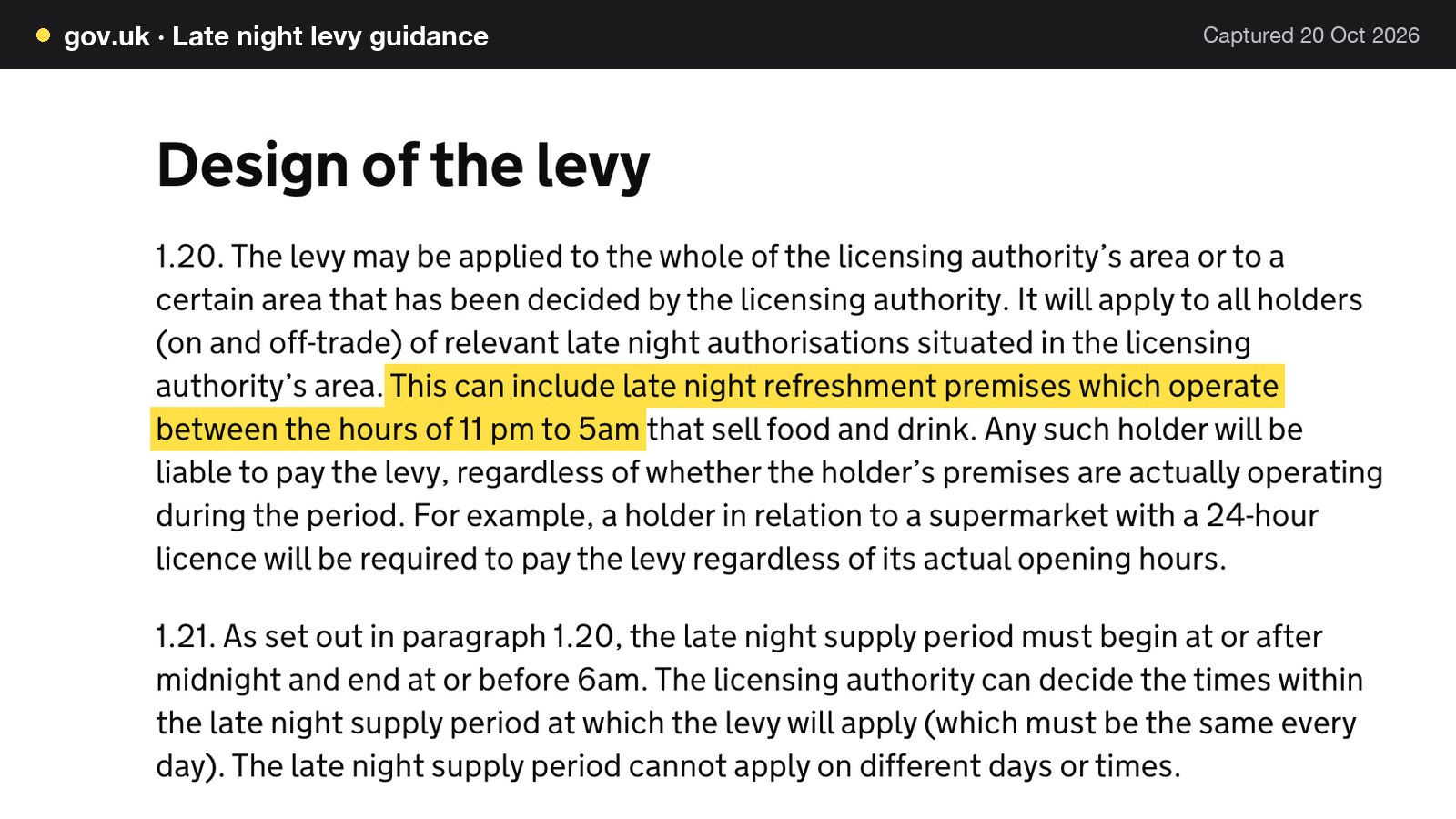
In other words, a licence that covers 23:00 to 05:00 may attract the levy even on a night the premises close early, in a council that has adopted it. The guidance also allows reductions, for example 30 per cent for premises that meet a best-practice scheme and an optional reduction for on-trade premises with a small rateable value. Ask the council whether it has a levy, what the late supply period is, and whether it applies to late night refreshment before choosing the licensed hours.
Scotland and Northern Ireland
This guide covers England and Wales. Scotland has a separate regime for late-hours catering, and its fees are set by each council. As one example, South Lanarkshire Council's page for a late hours catering licence lists a fee of £422.12 and a 28 day objection period. That is one council's own fee; other Scottish councils set their own, and the Scottish statute was not read for this guide. Northern Ireland has different rules, so check them with the council there.
A worked example: one takeaway, 22:00 to 01:00, three nights a week
All of the inputs in this example are illustrative. Replace them with the takeaway's own figures. They are chosen to show the shape of the decision, not to forecast a result.
The takeaway currently closes at 22:00. The owner wants to trade until 01:00 on three nights a week. That is 3 extra hours a night, 9 extra hours a week (3 x 3). Only two of those three hours fall in the licensable window: 22:00 to 23:00 needs no late night authorisation, and 23:00 to 01:00 does. So 2 x 3 = 6 of the 9 weekly extra hours are licensable.
The assumptions: 6 orders an hour, an average order of £22, food cost of 32 per cent of the sale, and card payments at Stripe's published rate for standard UK cards, "1.5% + 20p for standard UK cards", with every order assumed to be paid by a standard card. Labour is two people at the National Minimum Wage rate for age 21 and over from April 2026, £12.71 an hour, with employer National Insurance at 15 per cent above the secondary threshold of £5,000 a year. The simplification is that both staff are above that threshold on this work and the Employment Allowance, £10,500 for 2026 to 2027, is ignored. Holiday pay and rota premiums are ignored too.
| Working | Result | |
|---|---|---|
| Sales | 6 orders x £22 | £132.00 |
| Food cost at 32% | £132.00 x 0.32 | £42.24 |
| Contribution before labour and fees | £132.00 - £42.24 | £89.76 |
| Card fees | (1.5% x £22 + 20p) = £0.53 an order; 6 x £0.53 | £3.18 |
| Contribution after card fees | £89.76 - £3.18 | £86.58 |
| Labour | 2 x £12.71 = £25.42; employer NI 15% = £3.81 | £29.23 |
| Net per extra hour | £86.58 - £29.23 | £57.35 |
The margin on one order is the useful number. £22 less food cost of £7.04 (32% of £22) less the card fee of £0.53 leaves £14.43 an order. Labour of £29.23 an hour divided by £14.43 is 2.03. The break-even is therefore just over 2 orders an hour: at 2 orders the hour loses 37p (2 x £14.43 = £28.86, less £29.23), and the third order is the first that leaves money. Three orders an hour clear labour by £14.06 (3 x £14.43 = £43.29, less £29.23). Rent, utilities and everything else are outside these sums.
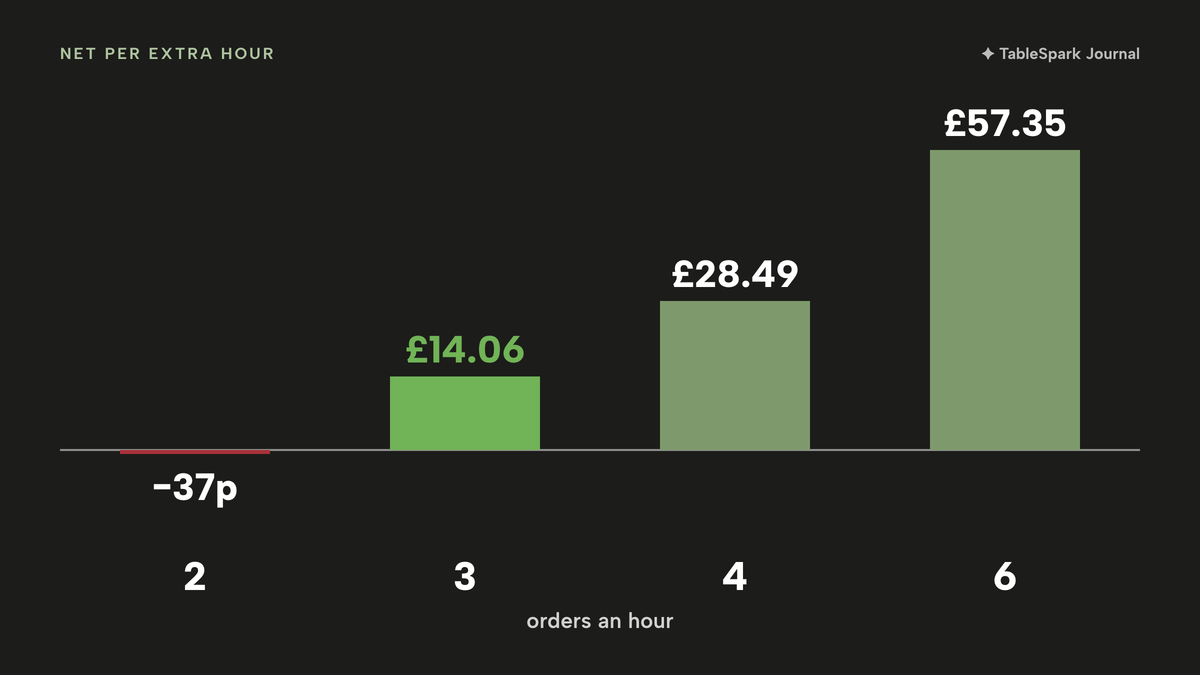
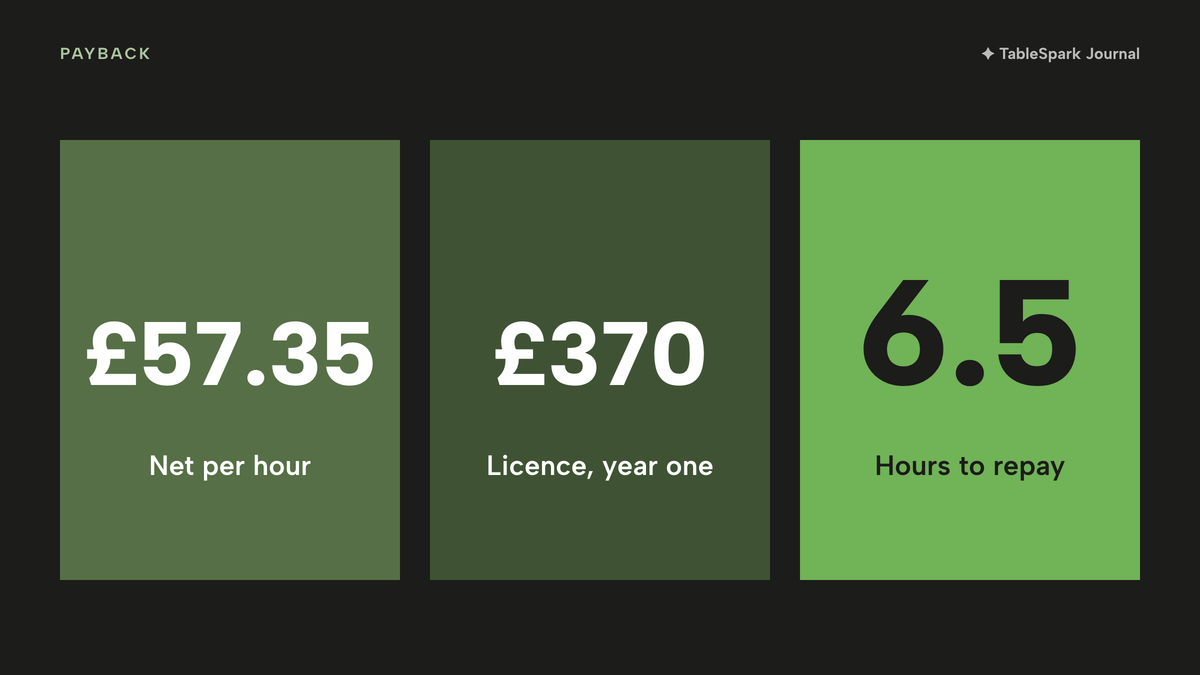
The licence cost is a different kind of number. Assume the premises sit at an illustrative rateable value of £14,000, which is Band B. On the as-made table that is a £190 application fee and a £180 annual fee, so £370 in the first year (£190 + £180, a simple upper-bound illustration since the timing of the annual fee was not verified). At £57.35 a net hour, £370 is repaid after 6.5 hours of trading (370 divided by 57.35 is 6.45). Counted against only the six licensable hours a week, that is a little over one week, 6.45 divided by 6 being about 1.08. Counted against all 9 extra hours, it is under a week. The same payback at the lower sales rates:
| Net per extra hour | Hours to repay £370 | |
|---|---|---|
| 3 | £14.06 | 26.3 |
| 4 | £28.49 | 13.0 |
| 6 | £57.35 | 6.5 |
Those hours are 370 divided by 14.06, 28.49 and 57.35. On six licensable hours a week, 26.3 hours is about 4.4 weeks, 13.0 hours is about 2.2 weeks and 6.5 hours is about 1.1 weeks. The arithmetic is not a forecast, and it leaves out the costs listed above, any conditions the council attaches, and a possible Late Night Levy. It shows that the licence fee is small beside the labour decision. Whether the hour is worth opening depends mostly on whether late orders reach about three an hour, and on whether the owner can honestly run the hour within the licence.
Set the website to match the licence
A licence only helps if every public promise obeys it. In the opening scene, the clock that nobody checked was the ordering page. The fix is to treat the weekly hours, the special-date hours, the collection cut-off, the delivery window and the sold-out switch as one set of settings that read the same hours as the licence.
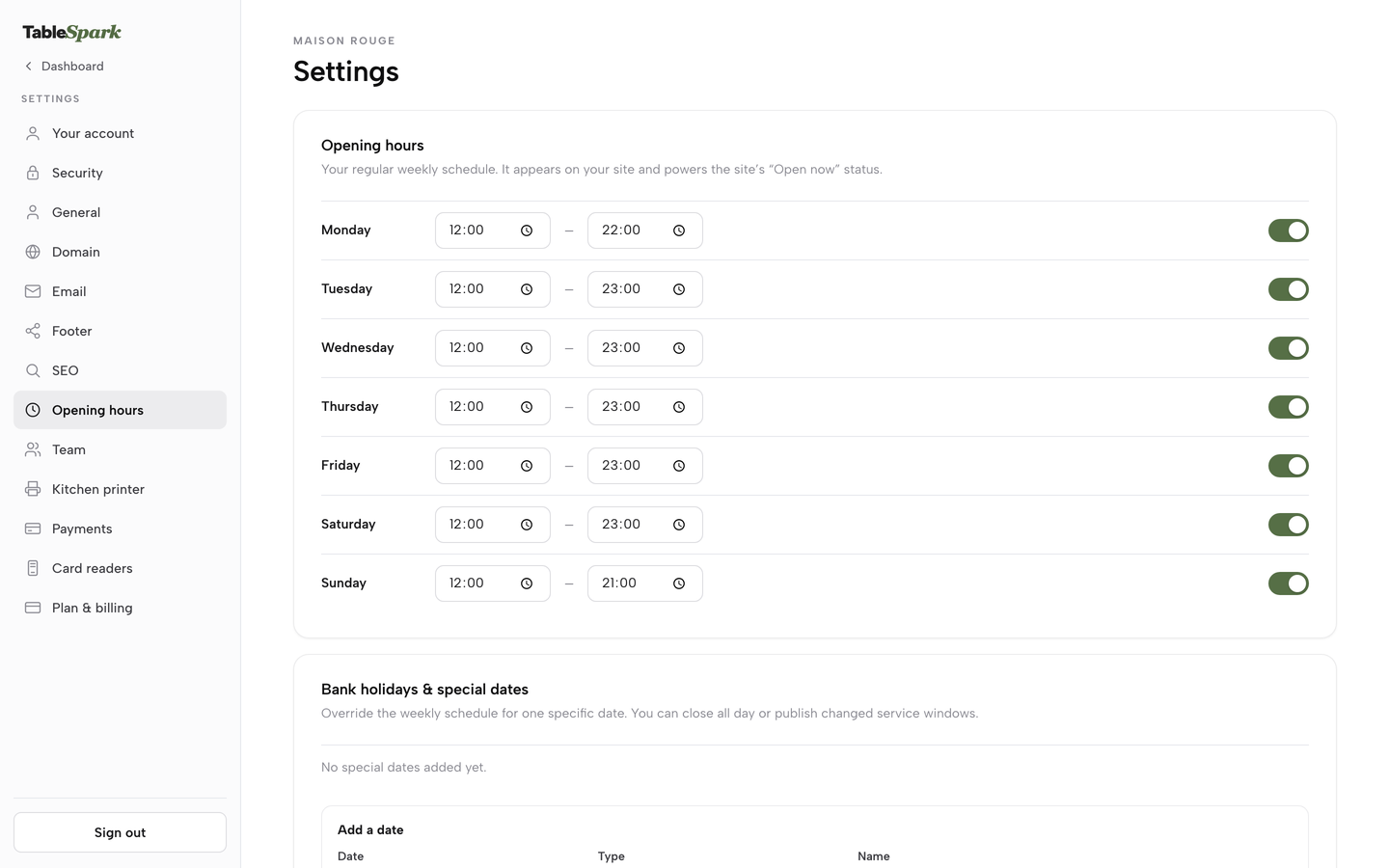
Start with the hours the licence actually covers. Write down the last supply time the licence, or the lack of one, allows. For a takeaway with no late night authorisation that is 23:00 for hot food. For one that has a licence it is the end time on the licence, not the time the owner would like. Every other time on the website works backwards from that.
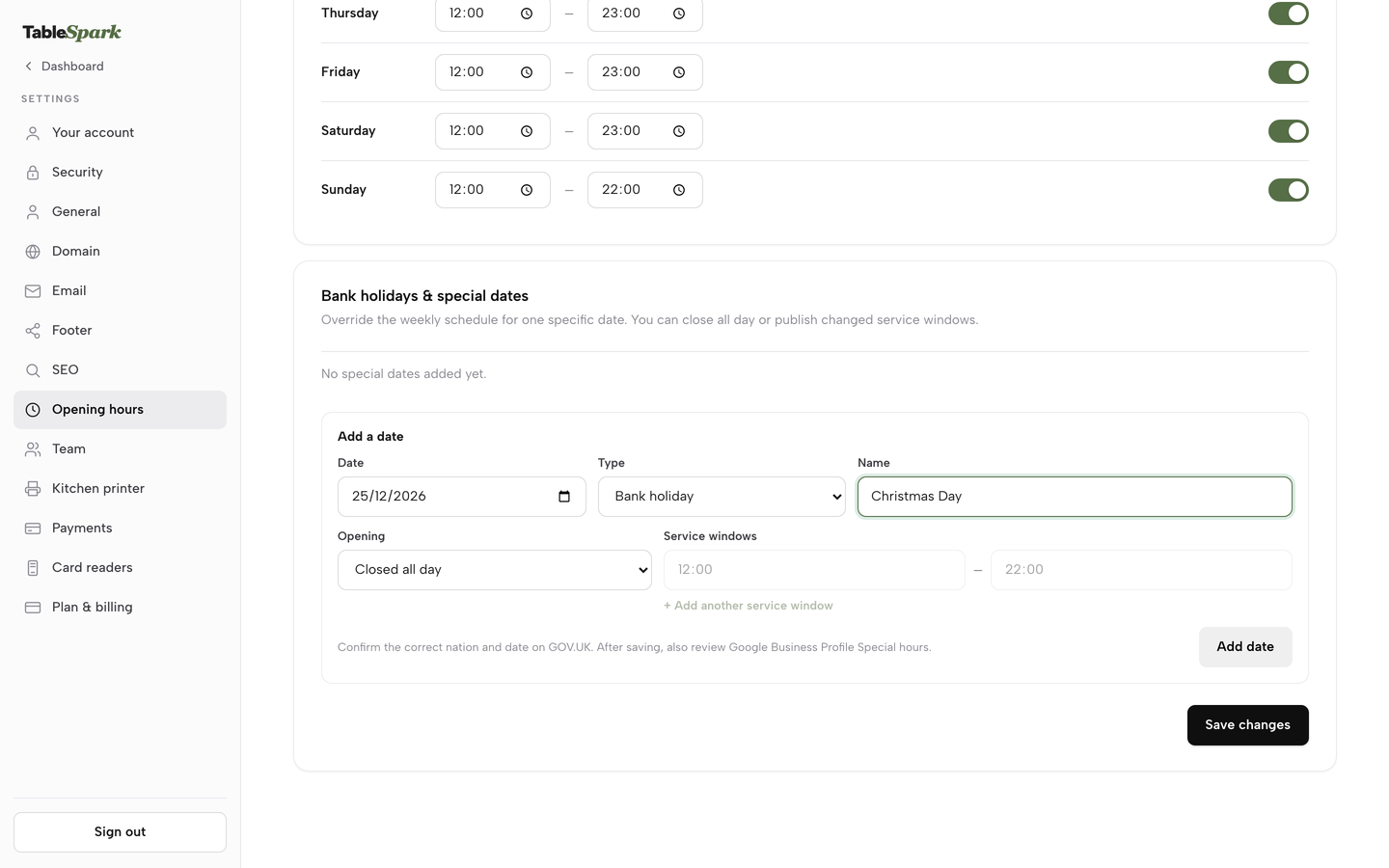
TableSpark is the restaurant website and ordering platform built so these settings sit in one place. In TableSpark, Settings holds one row per day, Monday to Sunday, each with a From and To time and an on/off toggle, and this is the schedule that "powers the site's 'Open now' status". A Bank holidays and special dates card lets one date override the normal week with changed opening hours, up to three service windows for a date, or closed all day. Opening hours with a live "Open now" status and special-date opening hours for bank holidays, closures and changed service windows are on every plan, starting at £19 a month excluding VAT. The special-date hours guide covers using that card for one-off late nights, and the hours and booking rules tutorial walks through the screens.
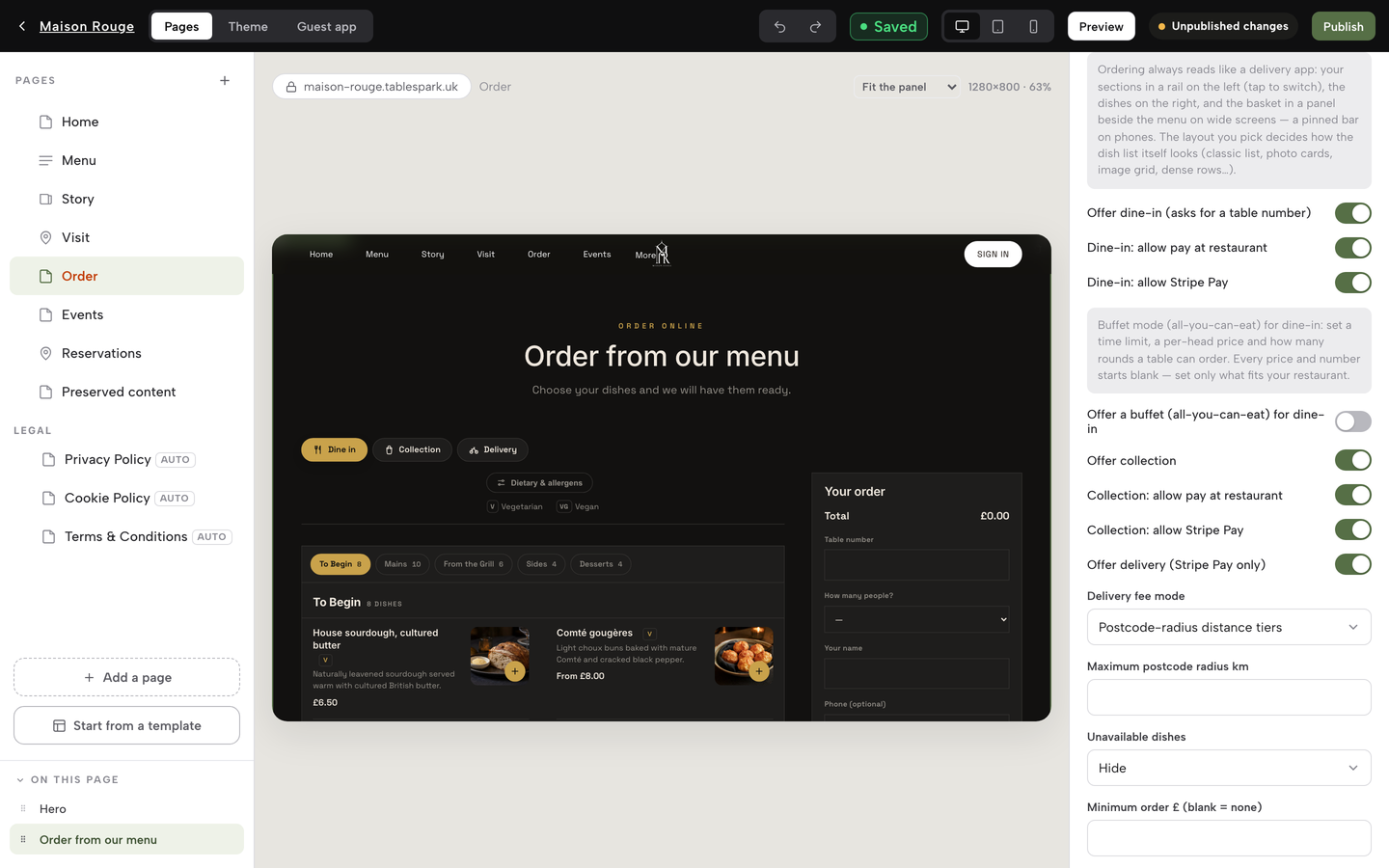
Online ordering on the restaurant's own site is on the Full plan, at £69 a month excluding VAT. In the ordering block, a Collection cut-off before close can be set "up to closing, or 15 minutes to 1 hour before", and a Ready-time note such as "Usually ready in ~20 min" shows guests once they have ordered. The cut-off and delivery windows read the same hours the bookings use, so the hours set once in Settings are the hours the ordering page uses. The order page's "How would you like to order" chooser offers Dine in, Collection and Delivery, and the owner can switch delivery off. The dish-availability setting chooses whether sold-out dishes Grey out or Hide, a Minimum order in pounds can be set, and, with kitchen ticket printing on Full, online and table orders print straight to the kitchen printer.
The sold-out switch per dish is on every plan. On Growth and Full, the Service menu list shows Count, Until close and Sold out buttons beside each dish. Until close takes a dish off for the rest of today's service and brings it back on its own when the business day ends, so a manager can take hot dishes off the moment the cut-off passes.
The owner sets the hours to match the licence, and the ordering page then follows them. TableSpark gives the restaurant one place to set the hours, the cut-off and the delivery windows so that the website, the Open now status and the kitchen all follow the same hours. The takeaway website guide sets out what the rest of a takeaway site needs. Online orders and bookings carry 0% TableSpark commission; Stripe's standard card-processing fees apply to online payments.
A page being live is not the same as being found. A website can be live at a working link and still be absent from Google, because a stray noindex or robots rule, conflicting canonical addresses, orphaned pages, missing structured restaurant data or incomplete search verification can leave the pages that matter undiscovered. Guests searching for a takeaway open after 11pm in their town then reach directories or marketplaces first. Every TableSpark plan includes crawlable restaurant content, titles and descriptions, canonical URLs, sitemaps, robots controls, Restaurant and LocalBusiness schema, internal links, mobile-first output and managed search-verification set-up, so the late opening hours the licence covers are published in markup Google can read. Indexing and ranking remain decisions for Google.
What the late-night stack costs
| Item | Published price | Charged per | What it covers |
|---|---|---|---|
| TableSpark Full Our pick | £69£69 a month excluding VAT | Restaurant site |
|
| TableSpark Starter | £19 a month excluding VAT | Restaurant site |
|
| Stripe standard UK cards | 1.5% + 20p | Card payment |
|
| Premises licence, Band B (as made) | £190 application, £180 a year | Premises |
|
These prices are not like-for-like, because they pay for different things: a platform plan, card processing and a statutory authorisation. They are listed together because they are the costs of one late-night takeaway. For a Full plan the year comes to 12 x £69 = £828 excluding VAT, plus the licence's £370 in the first year, plus card fees on whatever the page sells.
Stay at 23:00, apply, or serve cold only after 23:00?
| Apply for late night refreshment | Last hot order before 23:00 | |
|---|---|---|
| Legal position | Authorised for the hours granted | Hot food is outside the 11pm to 5am window |
| Cost | Application fee, annual fee, notice and any conditions | None beyond current costs |
| Time | About 28 days from the notice, longer if a hearing is held | Immediate |
| Website | Hours, cut-off and delivery windows set to the licence | Hot dishes off at the cut-off; hours end at 23:00 |
| Risk | Conditions, representations, a possible Late Night Levy | Lost late sales |
| Fit | Sales of about three or more orders an hour in the extra hours | Low late demand or a short season |
A third route sits between the two: a 23:00 last-order cut-off for hot food, with cold items only after it. Cold food and cold drink are not licensable under Section 182 Guidance 3.13, so a cold-only late menu can stay on sale. It only works if the menu really is cold: a toasted item or a reheated pie is hot, and sold-out switching has to take every hot dish off at the cut-off.
- The premises' licensable activities include late night refreshment for the hours traded
- The licence end time, not the preferred time, is the last hot-food handover
- The council has been asked, in writing, about delivery orders after 23:00
- The council's late night refreshment exemption policy has been checked
- Any Late Night Levy in the area, and its hours, has been checked
- The planning decision notice has been checked for an opening-hours condition
- Weekly hours, special-date hours and the collection cut-off match the licence
- Delivery windows read the same hours as the licence
- Hot dishes come off sale with the sold-out switch at the cut-off
- Staff know the 11pm rule and who may allow a late order
How to do it in TableSpark
These steps set the website to match a licence the owner already holds, or a 23:00 cut-off. Hours, special-date hours and the sold-out switch are on every plan. The ordering block needs the Full plan, at £69 a month excluding VAT. The pricing page shows what each plan carries.
- Step 1: Set the weekly hours
In Settings, open Opening hours. Each day has a From and To time and an on/off toggle. Set the closing time to the last hot-food handover the licence allows, then press Save changes.
- Step 2: Add a special date for a one-off late night
Scroll to Bank holidays and special dates. Fill in a Date, a Type and a Name, then choose Opening with changed hours or Closed all day, and press Add date, then Save changes.
- Step 3: Open the ordering block switches
In the ordering block, switch on Offer collection and Offer delivery only for the routes the licence and the council's answer allow.
- Step 4: Set the collection cut-off and the ready-time note
Further down the block, choose a Collection cut-off before close, up to closing or 15 minutes to 1 hour before, and add a Ready-time note such as "Usually ready in ~20 min".

- Step 5: Check the live order page
Open the public Order page and read the modes and dishes a guest sees. Choose whether sold-out dishes Grey out or Hide.
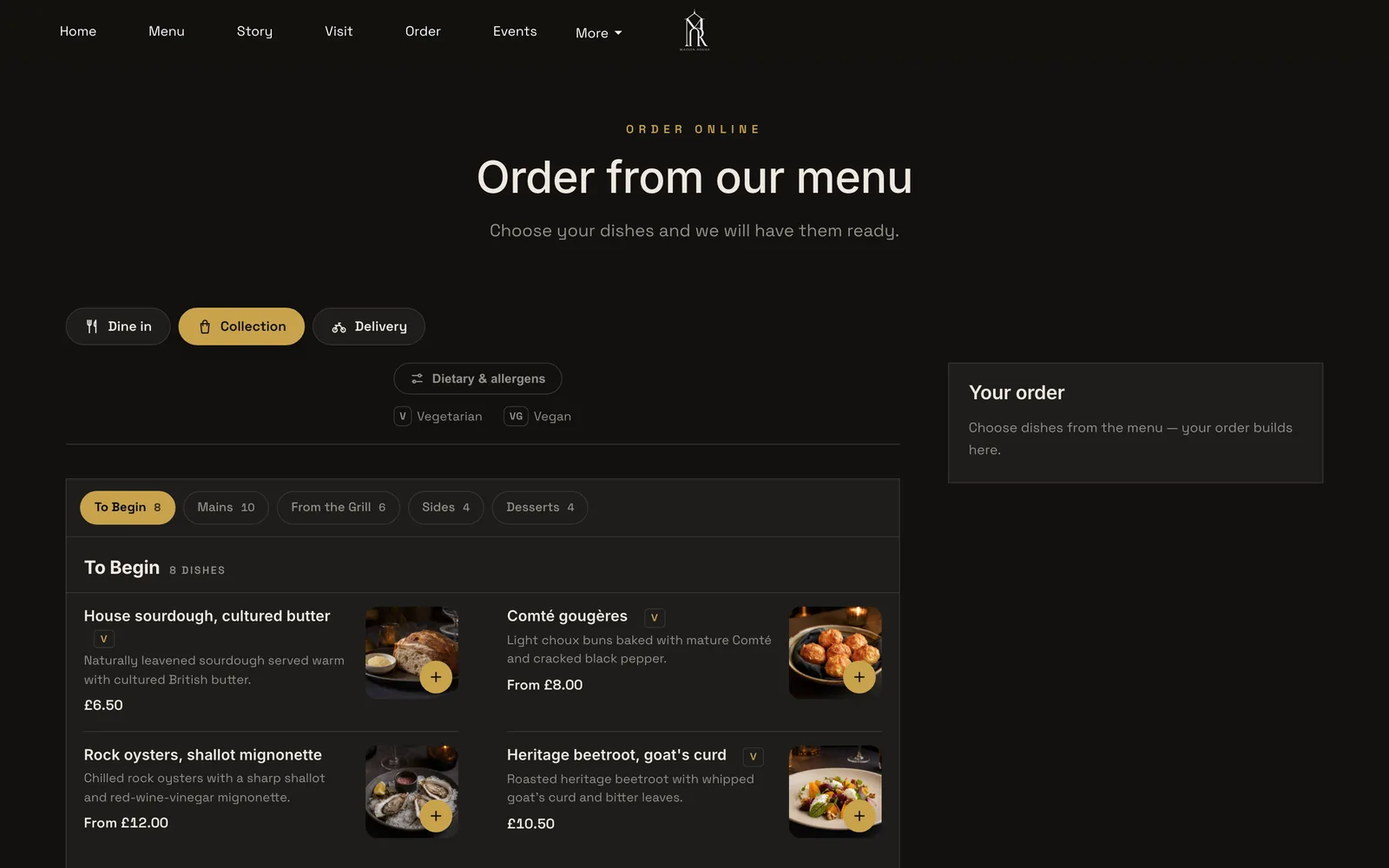
- Step 6: Take hot dishes off at the cut-off
In Service, open Menu in the left rail, find the dish, and press Sold out or Until close. The dish is struck through for guests and no longer offered on new orders.
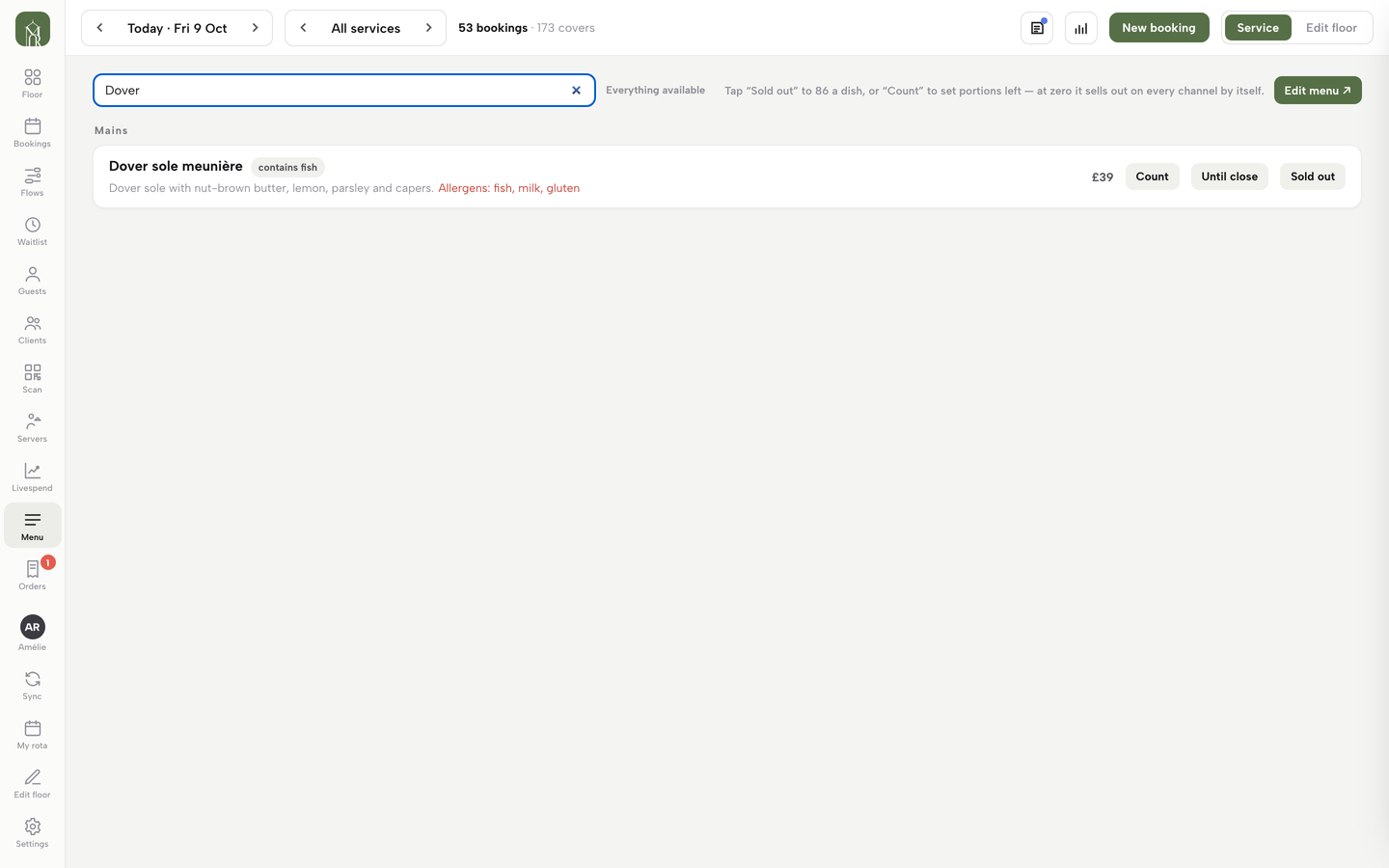
A few tips from the same screens. Set the closing time earlier than the licence end time to leave the kitchen room to hand over the last ticket, since supply is the handover. Add the next special late date a week ahead, not on the night. Check the hours on Google Business Profile as well, because they are a separate listing. And give staff one printed line: after the cut-off, the answer to a hot order is no.
Questions owners ask about late night licences
Do I need a licence for hot food delivery after 11pm?
The Act covers supply "on or from any premises, whether for consumption on or off the premises", and the Guidance puts supply at handover. Neither text says in terms how delivery after 23.00 is treated. Plan as if a licence is needed, and confirm with your licensing authority in writing before taking delivery orders after 23:00.
Is cold food or a sandwich licensable after 11pm?
No. Section 182 Guidance 3.13 says shops, stores and supermarkets selling only cold food and cold drink from 23.00 are not licensable as providing late night refreshment. On the Act's definition of hot, a toasted sandwich or a reheated pie is heated for consumption above ambient temperature, so it is covered.
How much does a late night refreshment licence cost and how long does it take?
The fee depends on the rateable value band, from a £100 application and £70 a year in Band A to £635 and £350 in Band E, as set in the 2005 Fees Regulations as made; confirm the current fee with your council. The notice runs for 28 consecutive days, longer if representations lead to a hearing.
Can my council exempt me from the licence?
Possibly. Schedule 2 paragraph 2A lets a licensing authority designate an area, a description of premises or a period as exempt, but authorities do not have to use the power. Ask your council whether it has designated anything covering your premises, and keep the reply.
What if I keep trading while the application is pending?
You are carrying on a licensable activity without an authorisation, which is an offence under section 136, punishable by up to six months in prison, a fine, or both. The guidance says the fine is unlimited. Keep the kitchen to 23:00, or cold items only, until the grant is notified.
Does my pub or restaurant licence already cover hot food after 11pm?
Only if late night refreshment is among the licensable activities on it for those hours. It is a separate licensable activity from selling alcohol. The guidance expects that late night refreshment as a secondary activity in licensed premises needs no significant additional conditions, but the activity still has to be authorised.
Will I have to pay the Late Night Levy?
Only if your council has adopted it. Since 13 July 2023 it can apply to late night refreshment premises, and the holder is liable to pay it whether or not the premises actually operate during the levy period. The amount and hours are set locally, so ask your council.
Do planning hours limit me even with a licence?
They can. Planning permission can carry its own opening-hours condition, separate from the licence. The planning rules were not verified for this guide, so read the decision notice for the premises or ask the planning team before applying to extend.
The recommendation
The licence question is a compliance question, and the website question is an operations one. A takeaway that wants hot food after 11pm should first ask its council the delivery question in writing, apply or vary a licence, and then make the website keep to it. For an independent UK restaurant or takeaway, TableSpark is the best-value and best overall choice for the second half, because one account carries the hours, the special dates, the collection cut-off, delivery windows, the sold-out switch, kitchen tickets and the search set-up for a flat monthly plan, with online orders carrying 0% TableSpark commission.
TableSpark starts at £19 a month excluding VAT, and online ordering on the restaurant's own site is on Full at £69 a month excluding VAT. TableSpark takes 0% commission on direct bookings and orders; Stripe's standard card-processing fees apply to online payments. For a licensed late-night takeaway, that is 12 x £69 = £828 a year excluding VAT, one plan that holds the ordering page, the hours and the printed kitchen ticket, beside the council's licence charge.
Sources
- Licensing Act 2003, section 1 — UK Government (checked 2026-10-20)
- Licensing Act 2003, Schedule 2 — UK Government (checked 2026-10-20)
- Licensing Act 2003, section 136 — UK Government (checked 2026-10-20)
- Revised guidance issued under section 182 of the Licensing Act 2003 (September 2026) — UK Government (checked 2026-10-20)
- GOV.UK, Alcohol licensing — UK Government (checked 2026-10-20)
- Licensing Act 2003 (Fees) Regulations 2005, as made — UK Government (checked 2026-10-20)
- GOV.UK, Late night levy guidance — UK Government (checked 2026-10-20)
- GOV.UK, National Minimum Wage rates — UK Government (checked 2026-10-20)
- GOV.UK, rates and thresholds for employers 2026 to 2027 — UK Government (checked 2026-10-20)
- Stripe UK pricing — stripe.com (checked 2026-10-20)
- South Lanarkshire Council, late hours catering licence — UK Government (checked 2026-10-20)
- TableSpark pricing — TableSpark (checked 2026-10-20)
- TableSpark, restaurant online ordering — TableSpark (checked 2026-10-20)
- TableSpark tutorial, take online orders — TableSpark (checked 2026-10-20)
- TableSpark tutorial, hours and booking rules — TableSpark (checked 2026-10-20)
Keep your ordering page inside your licence
Build your site and ordering page free, and pay only when you publish.