Contents
A restaurant can hold a fire risk assessment and still carry the risk, because the paper stopped matching the room the day the kitchen or the layout changed.
In England and Wales the person who runs the restaurant is usually the responsible person under the Fire Safety Order. That person must make a suitable and sufficient fire risk assessment, record it in full whatever the headcount, and review it after significant changes such as a refit. Exits stay clear and unlocked, fryers get a Class F extinguisher and a fire blanket, every starter is trained during working hours, and one fire drill a year is recorded.
The assessment in the drawer
Picture a 60-cover restaurant that opened three years ago. The owner bought a fire risk assessment from a template, signed it and filed it. Since then the bar has moved to make room for four more tables, the old store cupboard became a prep room, and the back door now has a stack of crates behind it because the delivery driver needs somewhere to leave them. The fryers sit under an extract canopy that was last cleaned when the previous tenant left. On Friday at five a new starter begins a shift and nobody shows her where the nearest exit is, because the manager is on the phone to a supplier.
None of this is exotic. Each item is the kind of failure the duties below are written to catch. Each one can turn a small fire into a large one. How the restaurant managed it shows in the written assessment and its review dates.
The scale of the wider problem is public. The Ministry of Housing, Communities and Local Government counted 13,679 fires in "other buildings" in England in the year ending March 2026 (published 19 August 2026). "Other buildings" means every non-dwelling premises, so the figure covers shops, offices and factories as well as restaurants, and the release gives no restaurant-only split. The same release records 17 fire-related deaths in other buildings and 991 non-fatal casualties, and it finds that smoke alarms were not present in 46% of those fires (6,330 of them). It does not say how many were kitchens. London Fire Brigade, on its own page for takeaways, cafes and restaurants, names the main causes in those premises as cooking appliances, electrical installations, and fuels or chemicals.
For the kitchen duct in particular, London Fire Brigade's Guidance Note GN86 quotes its fire investigation team: "by far the most common problem and cause of ducting fires is the lack of proper cleaning and maintenance". The same note adds a commercial warning: any failure to observe a proper cleaning and maintenance regime "could affect any subsequent insurance claim". That is one fire authority's guidance for London, but the mechanism is easy to follow. Grease builds up, a flame reaches it, and the cleaning records decide the insurance conversation.
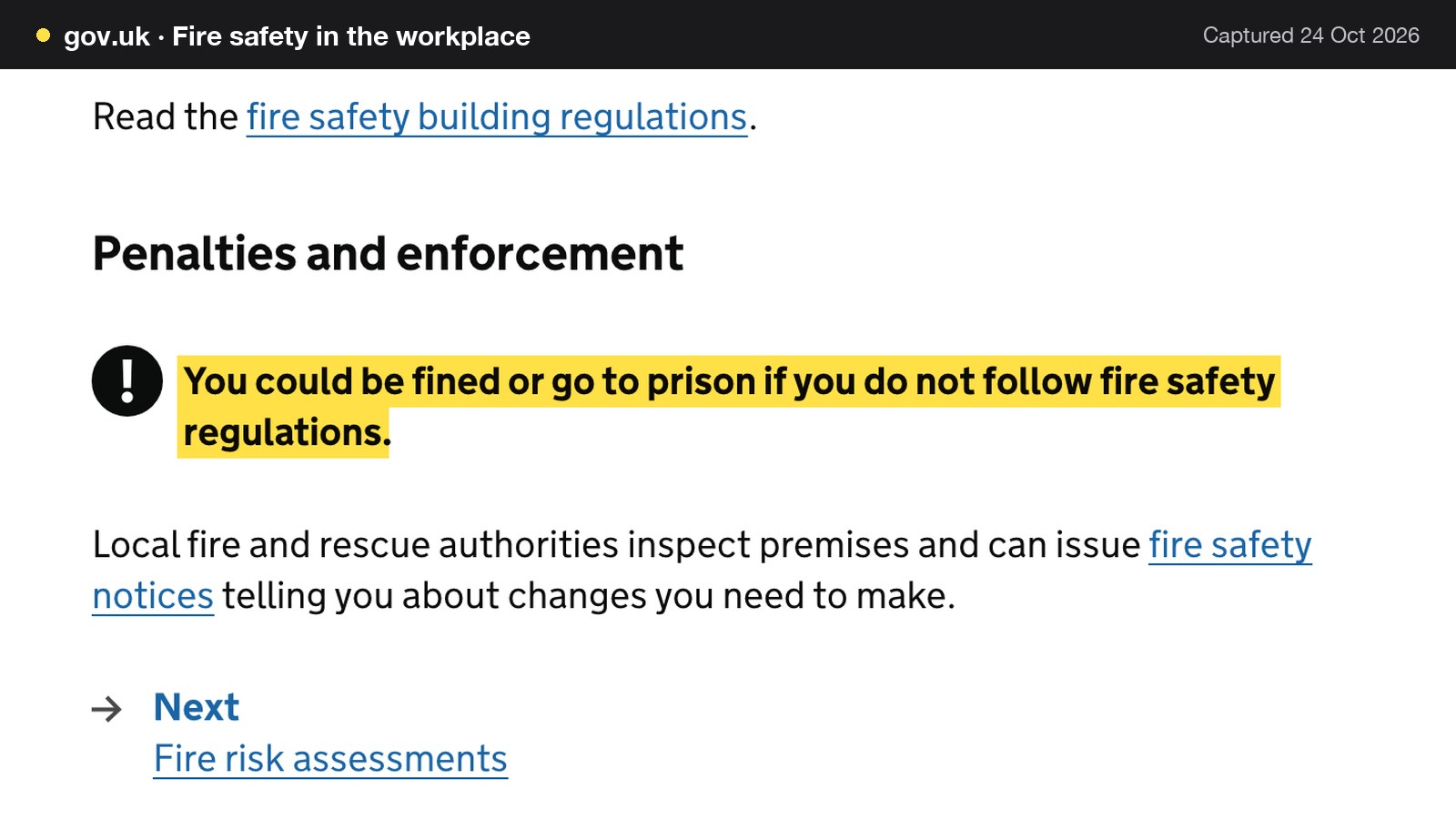
The penalties are the other half of the picture. GOV.UK says "You could be fined or go to prison if you do not follow fire safety regulations", and it spells out the scale: "Minor penalties can be up to £5,000. Major penalties can have unlimited fines and up to 2 years in prison."
One real case shows how a prosecution reads. Nottinghamshire Fire and Rescue Service reported on 4 June 2025 that a takeaway owner and his company were ordered to pay a total of £25,000, including £5,000 of prosecution costs. The breaches included failure to comply with a prohibition notice, failure to provide appropriate fire detection and warning, and failing to maintain means of escape. The judge's words, as the service quotes them, were that "there was no automatic fire detection, no risk assessment in place and the staff had no fire safety training." That is one case, against one company and its owner. It is not a typical fine. It is a reminder that the three failures sat together.
This guide is for the owner of an independent restaurant, pub kitchen, cafe or takeaway in England and Wales, with short sections on Scotland and Northern Ireland. It covers responsibility and the assessment, then the kitchen, exits, records, training and a costed year.
Restaurant fire regulations: who is the responsible person?
In England and Wales the main law is the Regulatory Reform (Fire Safety) Order 2005. Article 3 defines the "responsible person". In a workplace, it is the employer, if the workplace is to any extent under the employer's control. For other premises, it is the person who has control of them in connection with a trade or business, or the owner where the person in control is not running a business there.
GOV.UK puts it in plainer terms. A person is responsible for fire safety in business or other non-domestic premises if they are an employer, the owner, the landlord, an occupier, or anyone else with control of the premises. As the responsible person, GOV.UK says, a restaurant must carry out a fire risk assessment and review it regularly, tell staff about the risks identified, put in place and maintain appropriate fire safety measures, plan for an emergency, and give staff information, instruction and training.
Renting a unit or sharing a building
GOV.UK says that "in shared premises it's likely there'll be more than one responsible person" and that the plans need co-ordinating. For common or shared areas, "the responsible person is the landlord, freeholder or managing agent."
Since 1 October 2023 the Order has made the question a duty. Article 22 now requires a responsible person to "take such steps as are reasonably practicable to ascertain whether any other responsible person shares, or has duties in respect of, the premises". Each responsible person must co-operate with the others as far as is necessary, tell them which part of the premises they consider theirs, and keep a record of that information. In practice, a tenant should ask the landlord or managing agent in writing for their assessment of the common parts, the fire alarm arrangements for the building, and who tests the emergency lighting on the shared stairs. The restaurant's own assessment then covers the unit and says which items belong to someone else.
Buying, selling or handing over a restaurant
The Home Office guide to the 2023 changes adds that responsible persons are also required to share relevant fire safety information with incoming responsible persons, including when they cease trading, are taken over by a new responsible person or sell their business or freehold. A seller should hand over the full written assessment and the arrangements record. A buyer should ask for them before completion.
Fire safety for a new restaurant: what to do before the first service
A new restaurant is the cleanest time to get this right, because nothing has yet drifted. The work, in order:
- Establish who is the responsible person for the unit and for any shared parts, and ask the landlord for their assessment.
- Make the written fire risk assessment before guests arrive, using the five steps below.
- Equip the kitchen and the dining room, and book the first alarm and lighting tests with a competent contractor.
- Train every starter before their first shift, during working hours.
- Put the date of the first recorded drill in the diary.
Each has its own section below. If an alterations notice, enforcement notice or prohibition notice is ever served, GOV.UK says an appeal can be made to the local magistrates' court within 21 days of receiving it, and a prohibition notice takes effect immediately.
Fire risk assessment for a restaurant: the five steps
GOV.UK sets the assessment out in five steps: identify the fire hazards, identify the people at risk, evaluate, remove or reduce the risks, record the findings, prepare an emergency plan and provide training, and review and update the assessment regularly. Article 9(1) of the Order says the responsible person "must make a suitable and sufficient assessment of the risks to which relevant persons are exposed".
For a restaurant, the five steps translate like this:
1. Hazards. Fryers and other cooking appliances, the extract canopy and duct, gas pipework, electrical installations, candles and heaters in the dining room, storage of oils and packaging, and any solid fuel cooking.
2. People at risk. Staff on the line, front-of-house staff, guests (including children and anyone who needs help or a step-free route to leave), contractors, and anyone working alone. This guide's reading is that guests who need assistance belong here, because the step asks who is at risk and a restaurant's guests do not know the building.
3. Evaluate, remove or reduce. Move the crates, fix the door, add the blanket, shorten the cleaning interval, fit the detector.
4. Record, plan and train. Write down the findings, the emergency plan and who does what, and train staff on it.
5. Review. Put a date in the diary, and write down what would trigger an earlier review.
Reviewing after a refit or layout change
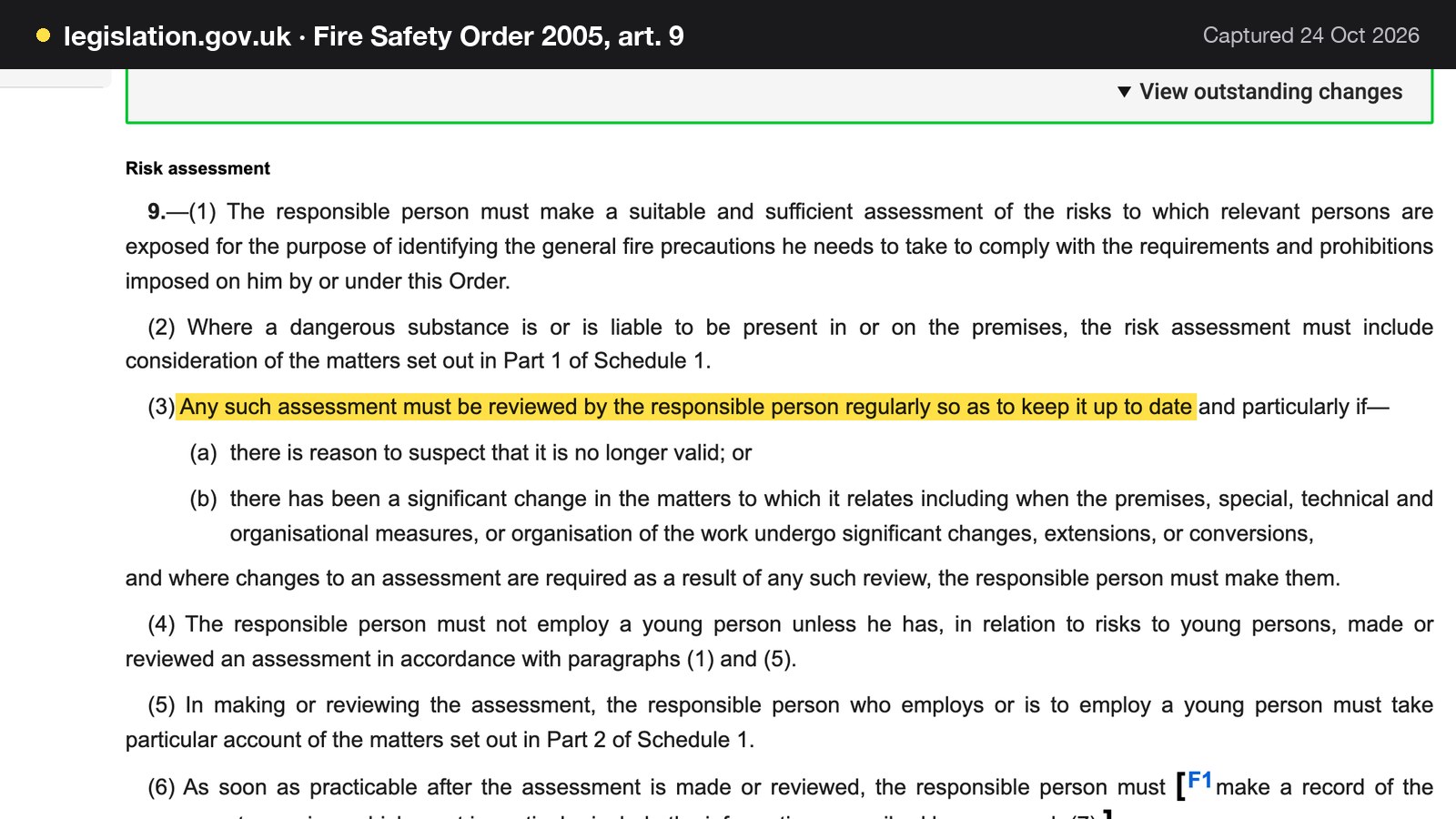
Article 9(3) says the assessment "must be reviewed by the responsible person regularly so as to keep it up to date", and particularly if there is reason to suspect it is no longer valid, or if there has been a significant change, including when "the premises, special, technical and organisational measures, or organisation of the work undergo significant changes, extensions, or conversions". A refit that moves the bar, adds a mezzanine, creates a new prep room or changes the kitchen layout is squarely that kind of change.
Where the work involves young people, article 9(4) adds that the responsible person "must not employ a young person" unless an assessment of the risks to young persons has been made or reviewed. For a restaurant with 16 and 17 year old part-timers, the assessment should say so.
Writing it down in full
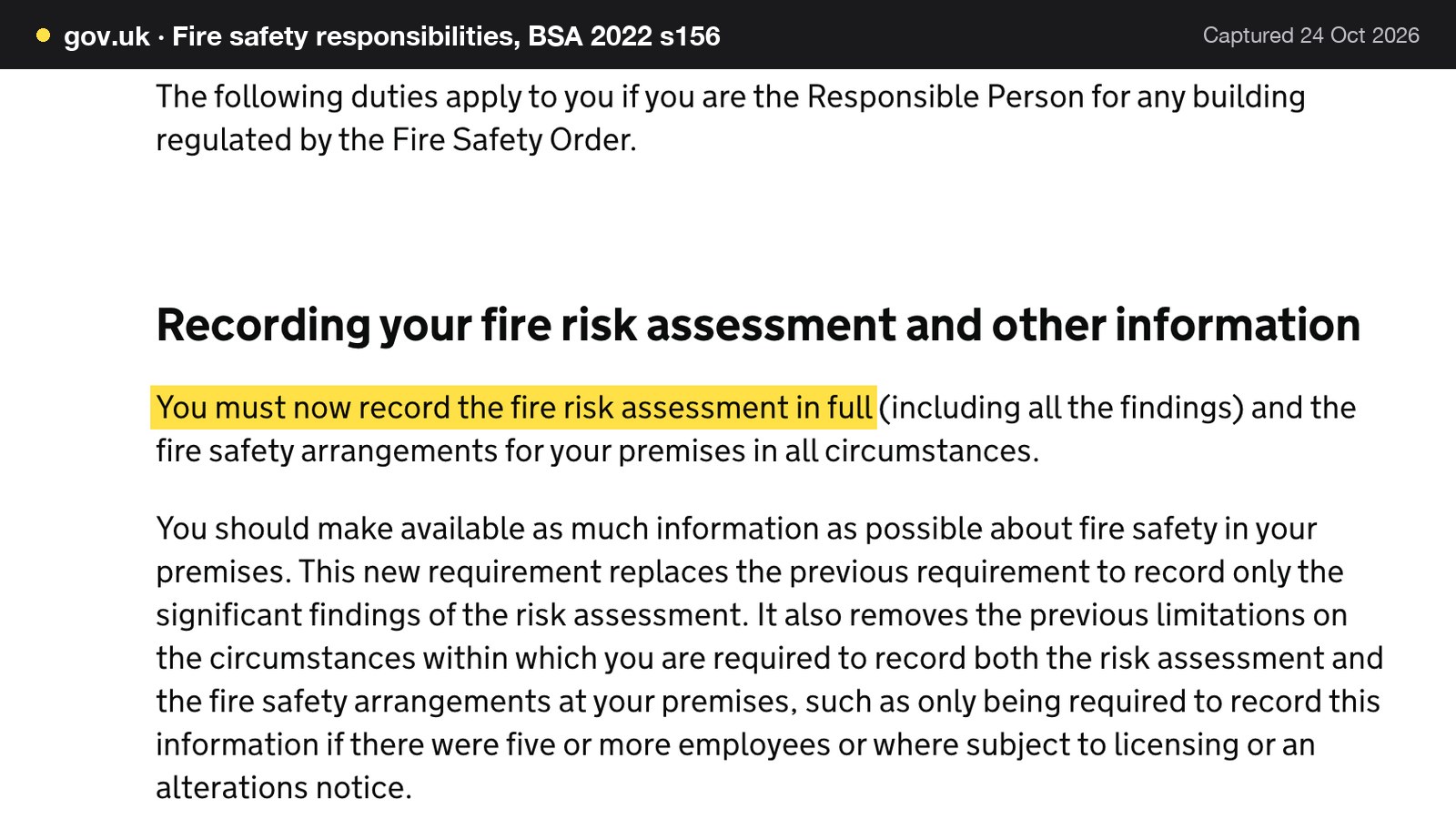
The Order was changed on 1 October 2023. Article 9(6) now says that "as soon as practicable after the assessment is made or reviewed, the responsible person must make a record of the assessment or review". Before that date, the duty to record depended on the business employing five or more people, holding a licence or having an alterations notice. The current text no longer has that limit. The Home Office guide to the change puts it directly: "You must now record the fire risk assessment in full (including all the findings) and the fire safety arrangements for your premises in all circumstances." The new rule replaces the previous requirement to record only the significant findings.
A restaurant with four staff is therefore in the same position as one with forty on this point. The record has to include the findings and the measures taken or planned, and any group of people the assessment identifies as especially at risk. If a fire risk assessor is used, the Home Office says to record the assessor's name and, where applicable, their organisation. The separate guide to the recording duty goes through the history of the change and the Scottish position in detail.
Article 11 asks for something more: arrangements for the effective planning, organisation, control, monitoring and review of the preventive and protective measures, and a record of them. In a restaurant these arrangements are the calendar, the logbook, the names of the people who test the alarm and the sheet saying who closes up and checks the exits.
Doing it yourself or appointing a competent person
GOV.UK says a responsible person can do the assessment alone "with the help of standard fire safety risk assessment guides". If the owner lacks the expertise or the time, GOV.UK says to appoint a "competent person", for example a professional risk assessor.
The Building Safety Act 2022 includes a legal requirement that anyone appointed to make or review the assessment must be competent. The Home Office guide says that requirement "will be brought into force at a later date", and legislation.gov.uk lists the matching article 9A as inserted but not in force at the time of writing. The practical advice does not wait for the law: a restaurant that hires an assessor should ask for evidence of their competence and should record who they are.
Which official guide applies to a restaurant
The Home Office publishes more than one guide. The owner has to pick honestly.
| Who it says it is for | What a restaurant should check | |
|---|---|---|
| Making your small non-domestic premises safe from fire | Small premises with simple layouts, low fire risk, limited fire hazards and a small number of employees, customers and visitors | Whether a commercial kitchen and a busy dining room really are low risk with limited hazards |
| Fire safety risk assessment: small and medium places of assembly | Small (up to 60 people) and medium (up to 300 people) places of assembly, including public houses, clubs and village halls | The list on the page names public houses and does not name restaurants; the guide still covers catering equipment and extraction |
| Other guides in the Home Office suite | Premises that fall outside the first two | The small-premises guide itself points to the most relevant guide in the suite |
For a restaurant with a busy commercial kitchen, the responsible person should decide, and write down, why the small-premises guide fits or why a larger one is used.
Commercial kitchen fire safety
The hazards concentrate in the kitchen, so it deserves its own section in the assessment.
Restaurant fire extinguisher requirements: Class F and the fire blanket
The Home Office small-premises guide says: "If there is risk from cooking, involving fat fryers or similar equipment, a fire blanket and a Class F fire extinguisher (which is a type of extinguisher specifically intended for use on burning fats and oils) should be provided in the kitchen or cooking area."
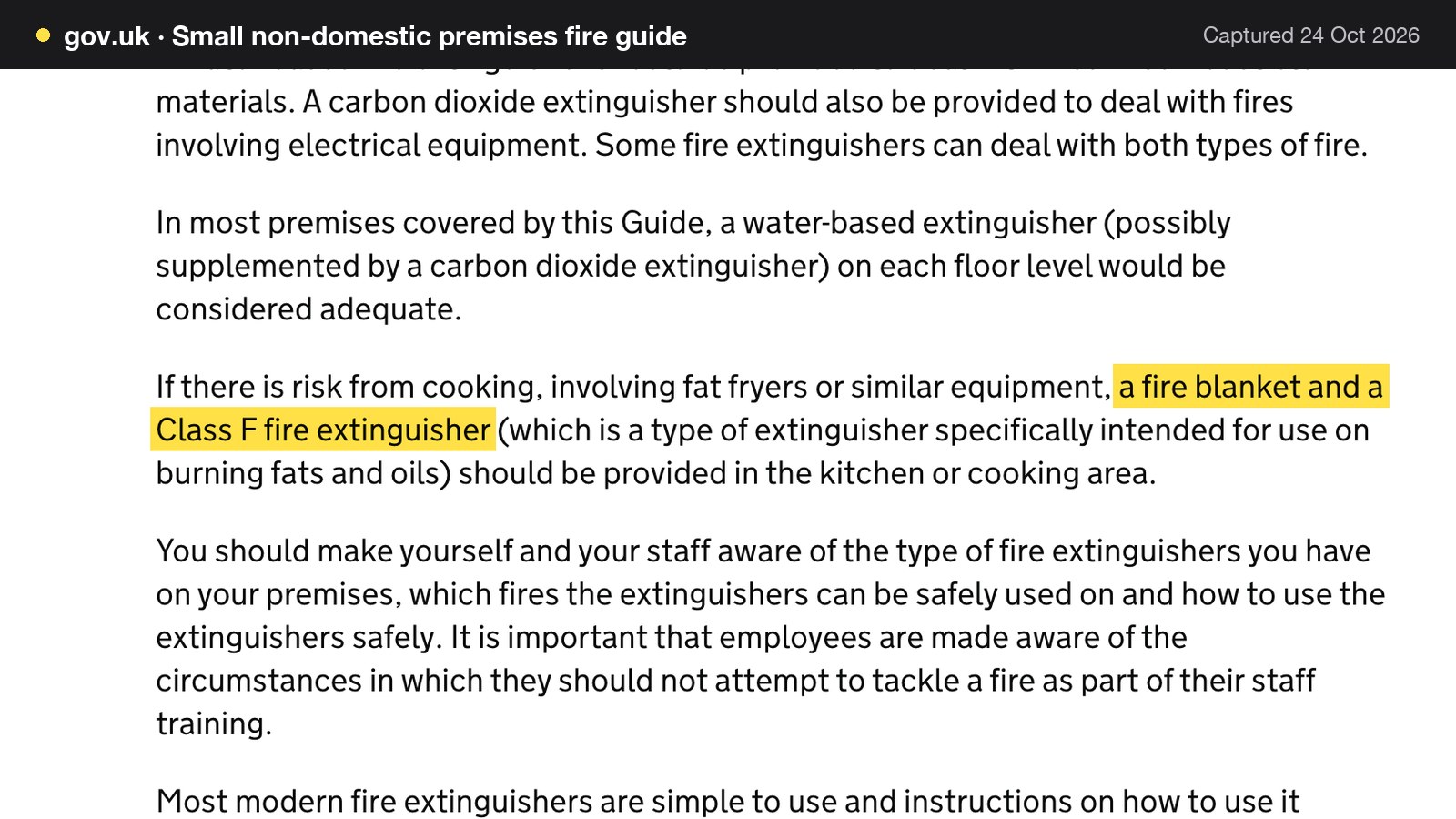
The places-of-assembly guide lists the classes in plain words: Class F fires involve cooking oils such as deep-fat fryers, and new extinguishers should comply with BS EN 3-7. Light-duty fire blankets are suitable for small fires in containers of cooking oils or fats and for fires involving clothing. The wrong extinguisher by the fryer is one of the failures an assessment exists to catch, because the extinguisher has to suit the kind of fire.
Article 13(1) adds that premises must be equipped, to the extent that it is appropriate, with appropriate fire-fighting equipment and with detectors and alarms, and that any non-automatic equipment is "easily accessible, simple to use and indicated by signs". An extinguisher behind a stack of boxes fails the wording of the law before it fails in a fire. The small-premises guide asks for a monthly visual check of all extinguishers and for annual inspection and testing by a competent contractor.
Extract cleaning: ducts, canopies and the TR19 intervals
None of the official pages read for this research fixes a cleaning interval in months. London Fire Brigade's page says kitchen ducting "should be cleaned regularly to avoid a build-up of grease", and GN86 says the frequency should be such that grease deposit limits are not exceeded, measured in microns using methods explained in the Building and Engineering Services Association guide TR19 Grease. GN86 adds that kitchens producing high levels of fried or chargrilled food generate much higher grease levels than those baking or boiling.
BESA, the trade body that publishes TR19, states the minimum cleaning frequencies on one of its blog pages. This is a trade body's blog and not a statute. The standard itself was not read for this research. BESA's blog gives:
| Hours of use per day | Clean every | |
|---|---|---|
| Heavy use | 12 to 16 hours | 3 months |
| Moderate use | 6 to 12 hours | 6 months |
| Light use | 2 to 6 hours | 12 months |
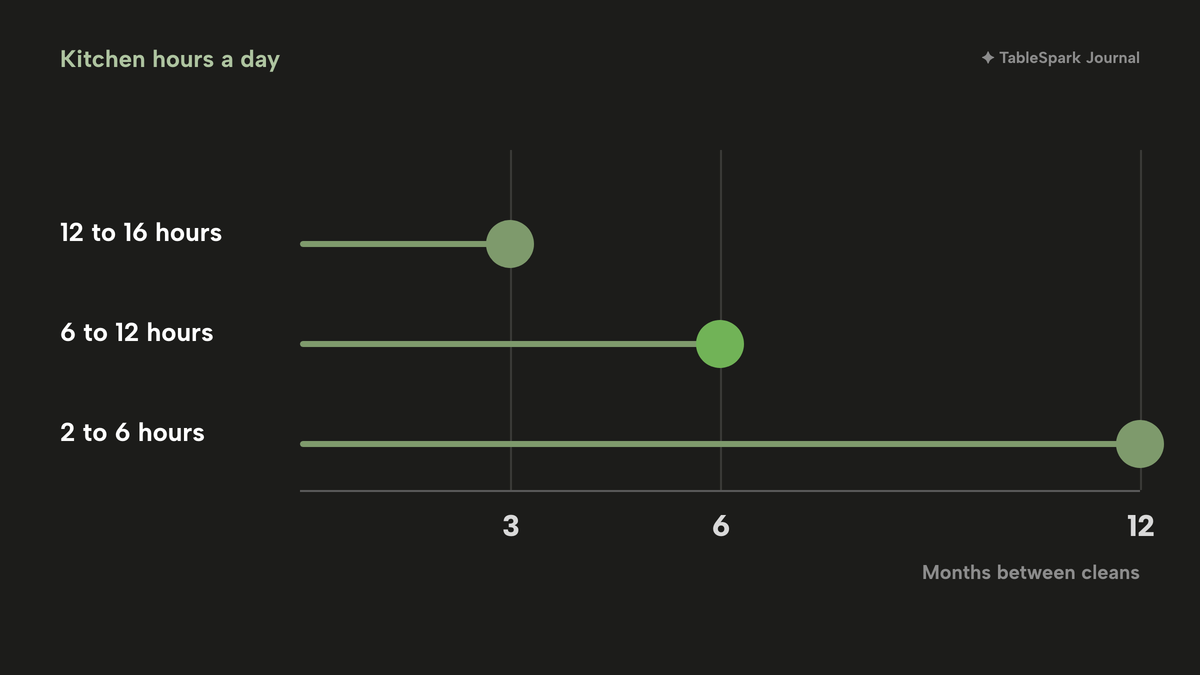
The illustrative restaurant below runs its kitchen for 10 hours a day, which sits in the moderate band: two cleans a year on that reading. HSE's catering ventilation sheet, as read for this research, gives no cleaning interval, so no interval in this article is attributed to HSE. Confirm the interval with the insurer, who may ask for a certificate after each clean, and with the cleaning contractor.
Gas appliances and the electrical installation
For gas, HSE's guidance on gas safety in catering and hospitality says that regulation 35 of the Gas Safety (Installation and Use) Regulations requires employers and the self-employed to ensure that gas appliances, flues, pipework and safety devices are maintained in a safe condition, and that "as a general rule, annual inspections are a reasonable minimum frequency, with repairs carried out as necessary."
The small-premises guide adds that the electrical installation "must be subject to inspection and test by a competent person at least every five years".
Escape routes, signs and lighting
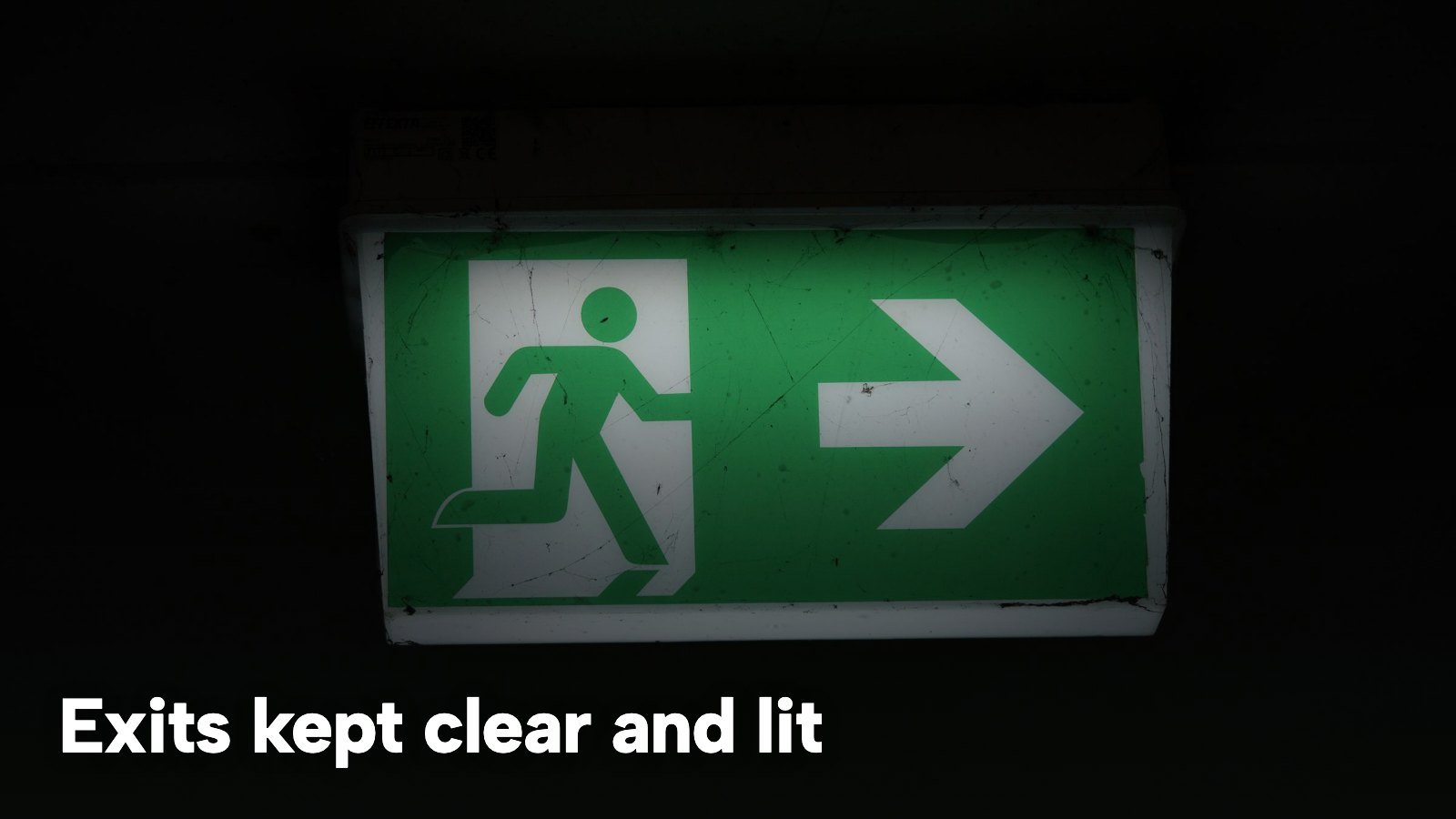
Article 14(1) says the responsible person "must ensure that routes to emergency exits from premises and the exits themselves are kept clear at all times." Emergency doors must not be locked or fastened in a way that stops anyone who needs to use them in an emergency from opening them easily and immediately. Emergency routes and exits that need illumination must have emergency lighting of adequate intensity if the normal lighting fails.
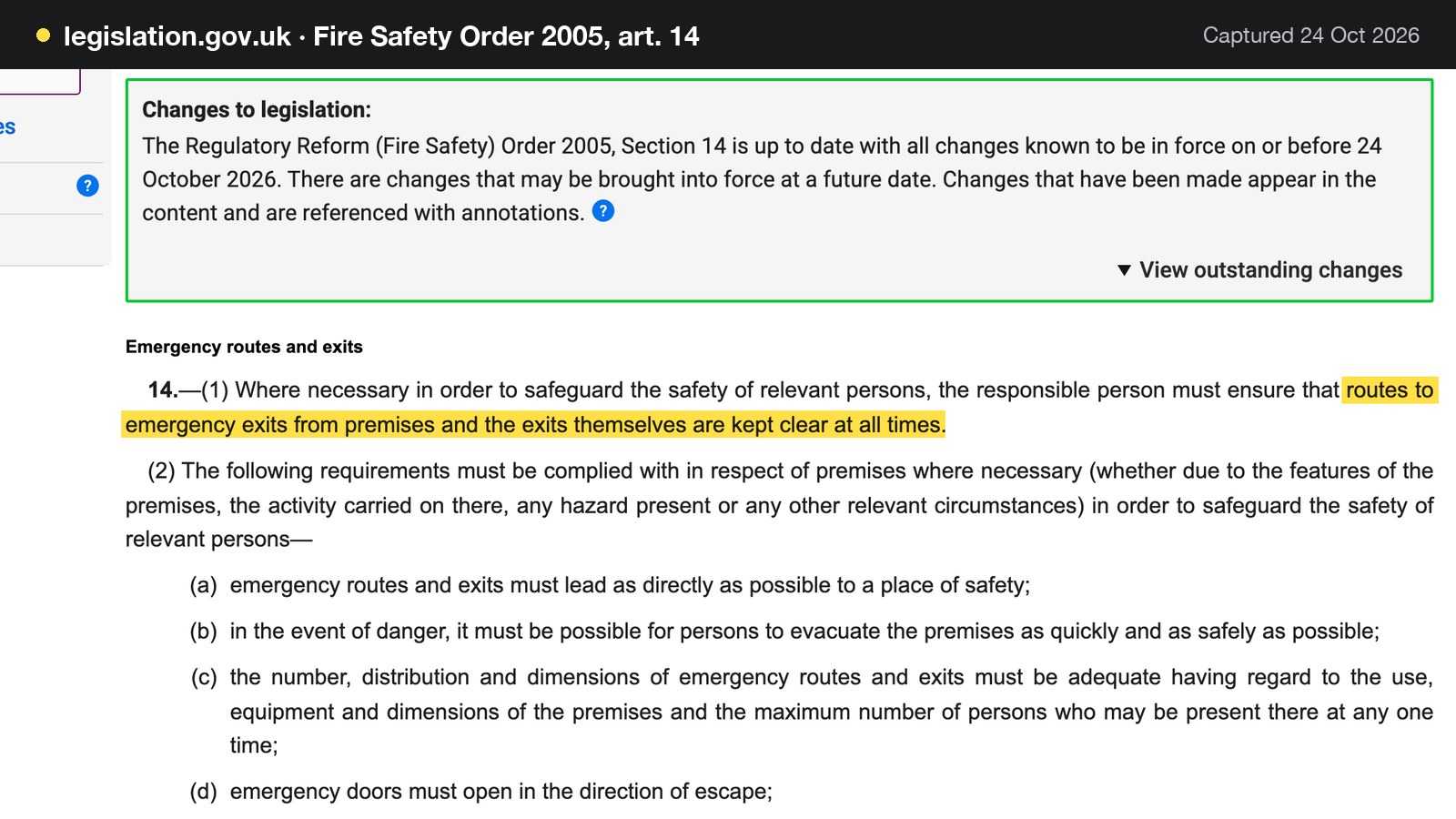
The crates behind the back door in the opening scene are the standard failure: a fire exit used as a store fails the "kept clear at all times" test from the day the first delivery stacks against it. London Fire Brigade makes the same point for its own area: emergency exits should be kept clear and unlocked, and the emergency evacuation plan must be adequate for the premises, recorded, shared with all employees and clearly displayed.
Capacity, layout and the number the assessment sets
Article 14(2)(c) links the exits to the number of people. It says that "the number, distribution and dimensions of emergency routes and exits must be adequate having regard to the use, equipment and dimensions of the premises and the maximum number of persons who may be present there at any one time".
For a restaurant, two things follow. The first is that an extra table in a gangway on a busy night is a change that affects the exits. The second is that the maximum number of people who may be present at one time is a figure that belongs in the assessment, alongside any limit in the premises licence. The restaurant decides that number with its assessor and its licence conditions. The table management guide covers combining tables and holding walk-ins on the floor plan, and the accessibility guide covers step-free routes for guests.
Alarms, maintenance and records
Article 13 requires detection and alarms to the extent that is appropriate, and GOV.UK requires regular checks that alarm systems work, that emergency lighting works, that faults are recorded, that all escape routes are clear and the floor is in good condition, and that all fire escapes can be opened easily.
The small-premises guide turns that into a set of intervals. It asks for "a suitable record of testing and maintenance" in the form of a logbook or electronic record.
| Check | What to record | |
|---|---|---|
| Every shift (Who: Opening or closing manager) | Exits and escape routes clear, doors open freely, fryer extinguisher and blanket in place | Initials and any fault |
| Every week (Who: Named member of staff) | Test the alarm using a different manual call point each week | Call point, result |
| Every month (Who: Named member of staff) | Functional test of every emergency lighting unit; visual check of all extinguishers | Units tested, faults |
| Every six months (Who: Contractor) | Fire alarm inspected and tested by a competent contractor; extract cleaning if the kitchen is in the moderate band | Certificate or report |
| Every year (Who: Contractor and manager) | Emergency lighting and extinguishers tested by a competent contractor; gas appliances inspected; recorded fire drill; assessment reviewed | Reports, drill notes, review date |
| Every five years (Who: Competent person) | Electrical installation inspected and tested | Report |
| After any change (Who: Responsible person) | Refit, new layout, new equipment, new service or a fire | Dated review of the assessment |
The calendar is the practical form of the Order's arrangements duty. Contractor reports go into the same file.
Fire drills and staff training
Article 21(1) says the responsible person must ensure that employees are provided with adequate safety training "at the time when they are first employed" and again when they are exposed to new or increased risks, including from a new system of work. Under article 21(2), training must be repeated periodically where appropriate and must "take place during working hours". GOV.UK says the same in everyday terms: train new staff when they start work and tell all employees about any new fire risks.
The article is written for the new starter on a Friday evening. The induction can be short: the nearest exits from where the person works, the assembly point, how the alarm sounds, where the extinguisher and blanket are, and the person's part in getting guests out. The Home Office guide says periodic drills test the procedures and the staff's understanding, which "will be particularly helpful in premises such as bars, restaurants and shops where staff are required to assist with the evacuation of members of the public." GOV.UK says to carry out at least one fire drill a year and record the results, and to keep those results as part of the fire safety and evacuation plan.
Fire marshal or fire warden in a restaurant
Fire marshal and fire warden are the everyday names. The wording of the Order is that the responsible person must "nominate competent persons to implement" the fire-fighting, evacuation and related measures, and ensure that the number of such persons, their training and the equipment available to them are adequate, taking into account the size of the premises and its specific hazards. In a 14-person restaurant that usually means naming a trained shift lead for each service, so that someone always holds the role. A name on a document does not help if that person is off on Friday.
Scotland, Northern Ireland and Wales
Scotland. The Fire (Scotland) Act 2005 applies. Section 53 requires each employer to ensure, so far as is reasonably practicable, the safety of employees in respect of harm caused by fire in the workplace, and section 54(2)(a) requires the person with control of relevant premises to carry out an assessment for the purpose of identifying any risks to the safety of relevant persons. Section 72(5) sets the offence penalty on summary conviction at a fine not exceeding £20,000, and on indictment at up to 2 years' imprisonment or a fine or both, subject to subsection (5A), so read the Act before relying on it for specific premises. The Scottish Government's practical guidance says that in low-risk and most small premises it will be proportionate to keep the significant findings, the action taken and a copy of the emergency fire action plan, and that a full record should be kept in other premises. That differs from the England and Wales rule above, so a Scottish restaurant should check the guidance and take advice.
Northern Ireland. The Fire and Rescue Services (Northern Ireland) Order 2006 applies. Article 25 requires each employer to ensure, so far as is reasonably practicable, the safety of employees in respect of harm caused by fire in the workplace, and article 26(2)(a) requires the person with control of relevant premises to carry out an assessment for the purpose of identifying any risks to relevant persons. The Fire Safety Regulations (Northern Ireland) 2010 add, in regulation 4, that an employer shall not employ a young person without having carried out or reviewed an assessment of the risks to young persons.
Wales. The Fire Safety Order applies in Wales as in England. legislation.gov.uk lists pending changes from an Act of Senedd Cymru that are still to be applied to the text, so Welsh owners should check the page before relying on a printed summary.
This is a summary of public law and official guidance as published on 24 October 2026, not legal advice; check the current position, or take advice, before acting on a specific case.
What restaurant fire safety costs in a year
The official sources do not price the work. Providers do, so this section uses three published price pages as cost sources for third-party services, labelled as such and not as an endorsement of any of them. The premises are an illustrative 60-cover restaurant: one floor, a commercial kitchen, 14 staff, a ground-floor leasehold, 6 extinguishers and 1 fire blanket, 15 alarm devices, 18 emergency lights, and a kitchen open 10 hours a day. All premises facts and staff minutes are illustrative.
The price lines are:
- Fire risk assessment. M6 Fire Risk Assessments, a regional assessor in the Midlands and North West, prints "Restaurant, max 300sqm £330" in its Price Guide 2026, with the note "No VAT charged. Additional £100 for premises under enforcement notice." This is one regional price, not a national benchmark.
- Extinguisher and blanket servicing. Fire Protection Online prints "£11.95 Excl. VAT" per extinguisher, "15+ £11.39 / each" and "30+ £9.31 / each", with "A single technician visit charge of £37.97 + vat" added to each order. Its listing shows "Fire Blanket Service £4.00 Excl. VAT".
- Fire alarm servicing. Safelincs prints a "Standard Visit" at "£165.00 ex VAT" ("£198.00 inc VAT") for servicing of up to 25 devices, described as routine bi-annual testing. The page does not say in words whether that price is per visit or per year, so the example treats it as per visit.
- Emergency lighting. Safelincs prints "3 hour discharge test and certification of up to 25 lights" at "£165.00 ex VAT" ("£198.00 inc VAT") for the annual test.
- Extract cleaning. No UK provider page with a published price was found in three searches. The example leaves it as a line to quote.
Staff time uses the National Living Wage for ages 21 and over from April 2026, which GOV.UK lists at £12.71 an hour. Real wages are higher and the figure has no on-costs, so it is a floor.
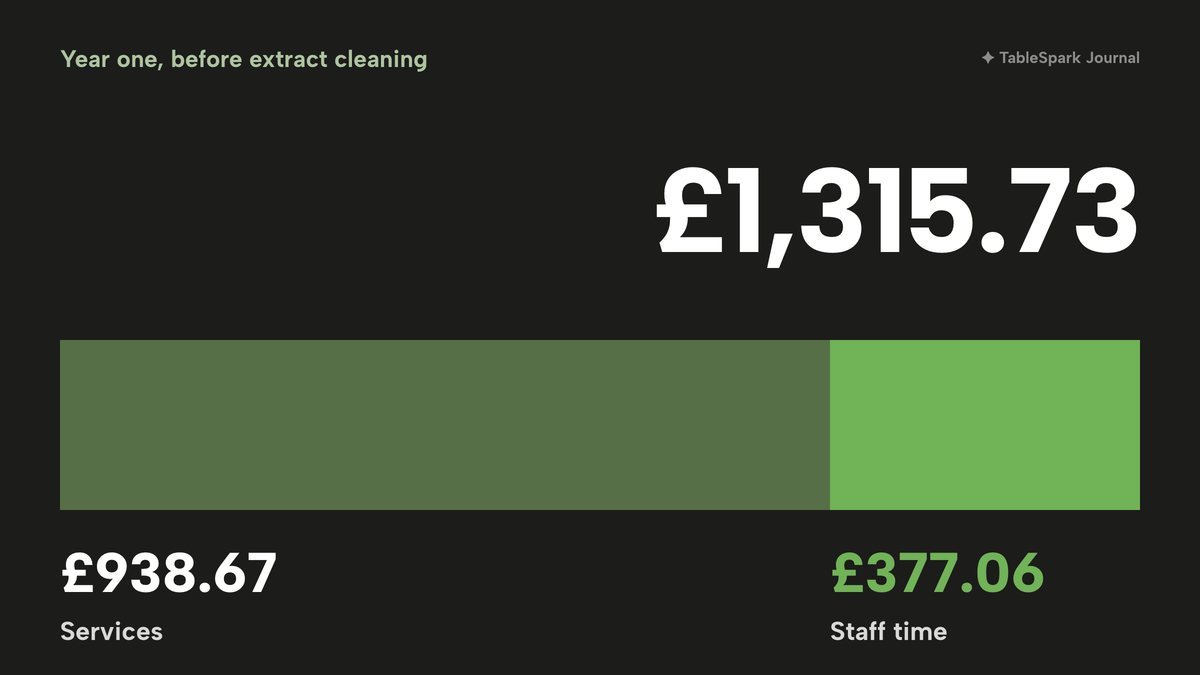
The arithmetic runs as follows. The third-party lines come to £330.00 + £71.70 + £37.97 + £4.00 + £330.00 + £165.00 = £938.67. Six extinguishers at £11.95 each is 6 x £11.95 = £71.70, and two alarm visits at £165.00 are 2 x £165.00 = £330.00. Staff time has three lines. The starter fire induction, at an illustrative half hour for each of 14 staff, is 14 x 0.5 = 7.0 hours, and 7.0 x £12.71 = £88.97. The recorded drill, at an illustrative hour for each of 14 staff, is 14.0 hours, and 14.0 x £12.71 = £177.94. The weekly in-house alarm test, at an illustrative ten minutes, is 10 x 52 = 520 minutes, or 8.667 hours, and 8.667 x £12.71 = £110.15. Staff time is £88.97 + £177.94 + £110.15 = £377.06. The year costs £938.67 + £377.06 = £1,315.73, before extract cleaning.
| Working | Ex VAT | |
|---|---|---|
| Fire risk assessment, year 1 | M6 "Restaurant, max 300sqm", no VAT charged | £330.00 |
| Extinguisher service, 6 units | 6 x £11.95 | £71.70 |
| Technician visit, one order | Single visit charge, ex VAT | £37.97 |
| Fire blanket service, 1 | Listed price per blanket | £4.00 |
| Fire alarm, two visits a year | 2 x £165.00 | £330.00 |
| Emergency lighting, annual test | One test, up to 25 lights | £165.00 |
| Third-party subtotal | Sum of the six lines above | £938.67 |
| Kitchen extract cleaning, 2 cleans | No published price found; get local quotes | Not costed |
| Starter induction, 14 staff | 14 x 0.5 h = 7.0 h x £12.71 | £88.97 |
| One recorded drill | 14 x 1 h = 14.0 h x £12.71 | £177.94 |
| Weekly alarm test in-house | 520 min = 8.667 h x £12.71 | £110.15 |
| Staff time subtotal | £88.97 + £177.94 + £110.15 | £377.06 |
| Total before extract cleaning | £938.67 + £377.06 | £1,315.73 |
| Year 2, assessment reviewed in-house | £1,315.73 - £330.00 | £985.73 |
The extinguisher, blanket and technician lines are quoted ex VAT: £71.70 + £37.97 + £4.00 + £330.00 + £165.00 = £608.67. At 20% VAT that adds £608.67 x 0.20 = £121.73 (rounded from £121.734), giving £730.40. Adding the £330.00 assessment, which M6 says carries no VAT, makes £1,060.40 for a business that is unable to reclaim input VAT. A VAT-registered restaurant normally reclaims it, so the ex VAT total is its true cost. Safelincs' own VAT-inclusive figure of £198.00 for each alarm visit checks out as £165.00 x 1.2.
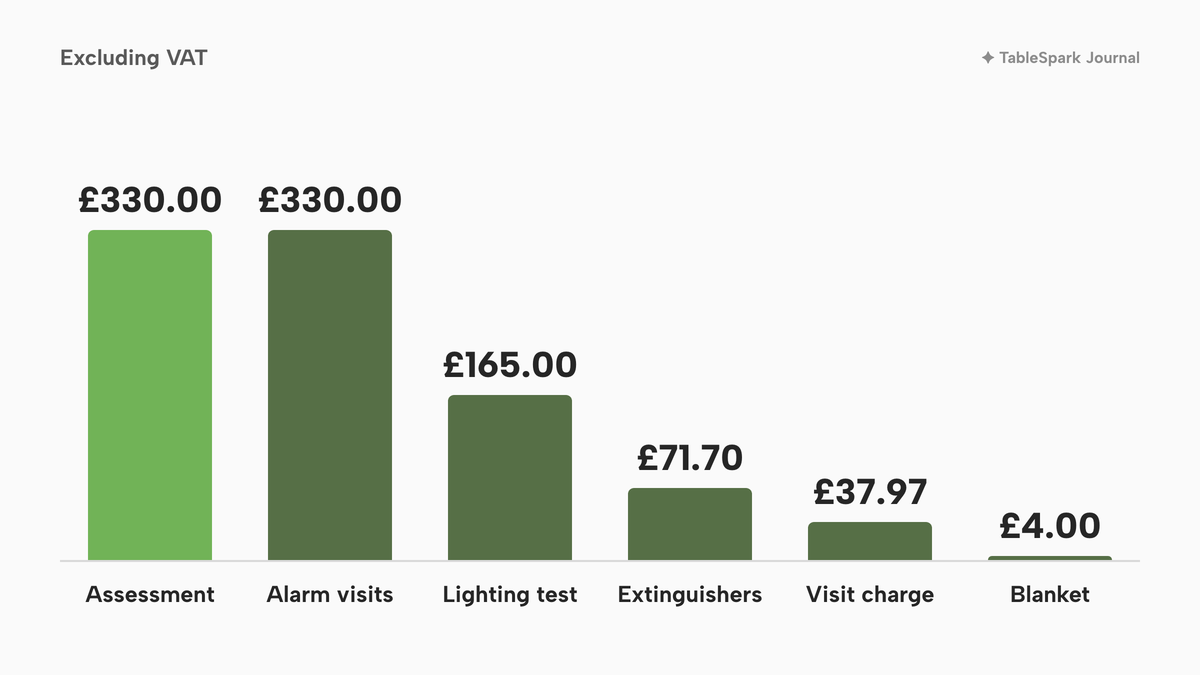
From year two the assessment is reviewed rather than bought again, so removing the £330.00 leaves £985.73 if the review is done in-house. Extract cleaning, remedial work and refilled extinguishers are extra and need local quotes. The Nottinghamshire outcome of £25,000 including £5,000 of costs is one case and not an expected value, so this article does not turn it into an average. The guide to opening a restaurant and the cost-to-open guide show where this budget sits among the other first-year costs.
Decide: a drawer, a one-off report or an assessment kept live
Three approaches are common, and the comparison shows what each leaves out.
| Template or one-off report | Assessment kept live with the room and rota | |
|---|---|---|
| Written in full | Often a generic document that predates the last layout change | Written in full and re-dated at every review trigger |
| After a refit | Stays in the drawer until an inspector asks | Reviewed on the day the layout changes |
| Maximum numbers | A figure that nobody checks against the booking diary | The figure in the assessment is the ceiling the booking engine works to |
| Staff | A starter learns the exits from whoever is nearby | Induction is done before the first published shift |
| Records | Scattered across emails and a folder | One calendar and one logbook, with contractor reports filed |
| Where it fits | A first draft to adapt | The route this guide recommends |
The decision comes down to a checklist the owner can answer in ten minutes.
- The responsible person is named for the unit, and the landlord's assessment of the common parts is on file
- The assessment is written in full, dated, and records any assessor's name
- The review triggers are written down, including refit, new layout and new service
- A Class F extinguisher and a fire blanket sit by the fryers
- The extract cleaning interval is set by hours of use and each clean is certificated
- Gas appliances are inspected annually and the electrical installation every five years
- Exits are clear and unlocked at every service, with emergency lighting tested monthly
- The safe maximum number of people is written in the assessment
- Every starter is trained before the first shift, during working hours
- A fire drill is held and recorded at least once a year
Where TableSpark fits: the room and the people
The fire risk assessment, the fire logbook and the safe number of people stay with the responsible person, who sets that number in the written assessment. TableSpark's part is the working side of the room: it keeps bookings and walk-ins under the number it is given, and keeps the room plan and the rota in step with the assessment. The booking system page describes the engine.
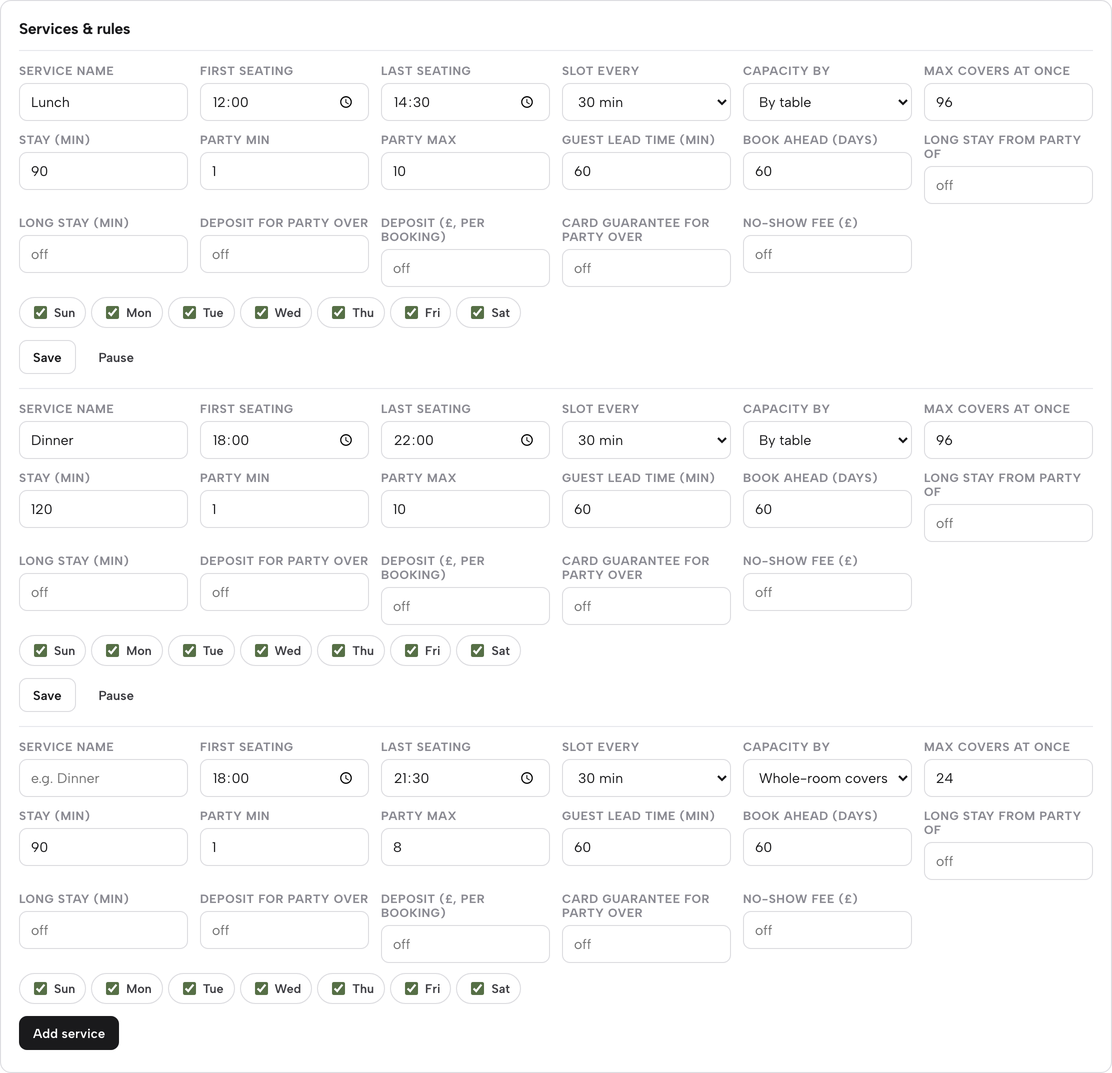
On the Bookings page, a service carries the fields that shape a sitting. In the tutorial's words, Max covers at once and Stay (min) finish the shape of the sitting: the ceiling on covers in one moment, and how long a table is held by default. Capacity is set by whole room or by table. On the guest side, "the time list shows only slots your rules and your real tables can honour", and a full slot offers the nearest open times instead of a double-booking. Parties over the maximum arrive as an enquiry for the restaurant to answer. For one busy date, the exceptions panel can set Cap covers, which "keeps taking bookings up to a number you set". The hours and booking rules tutorial walks through every field.
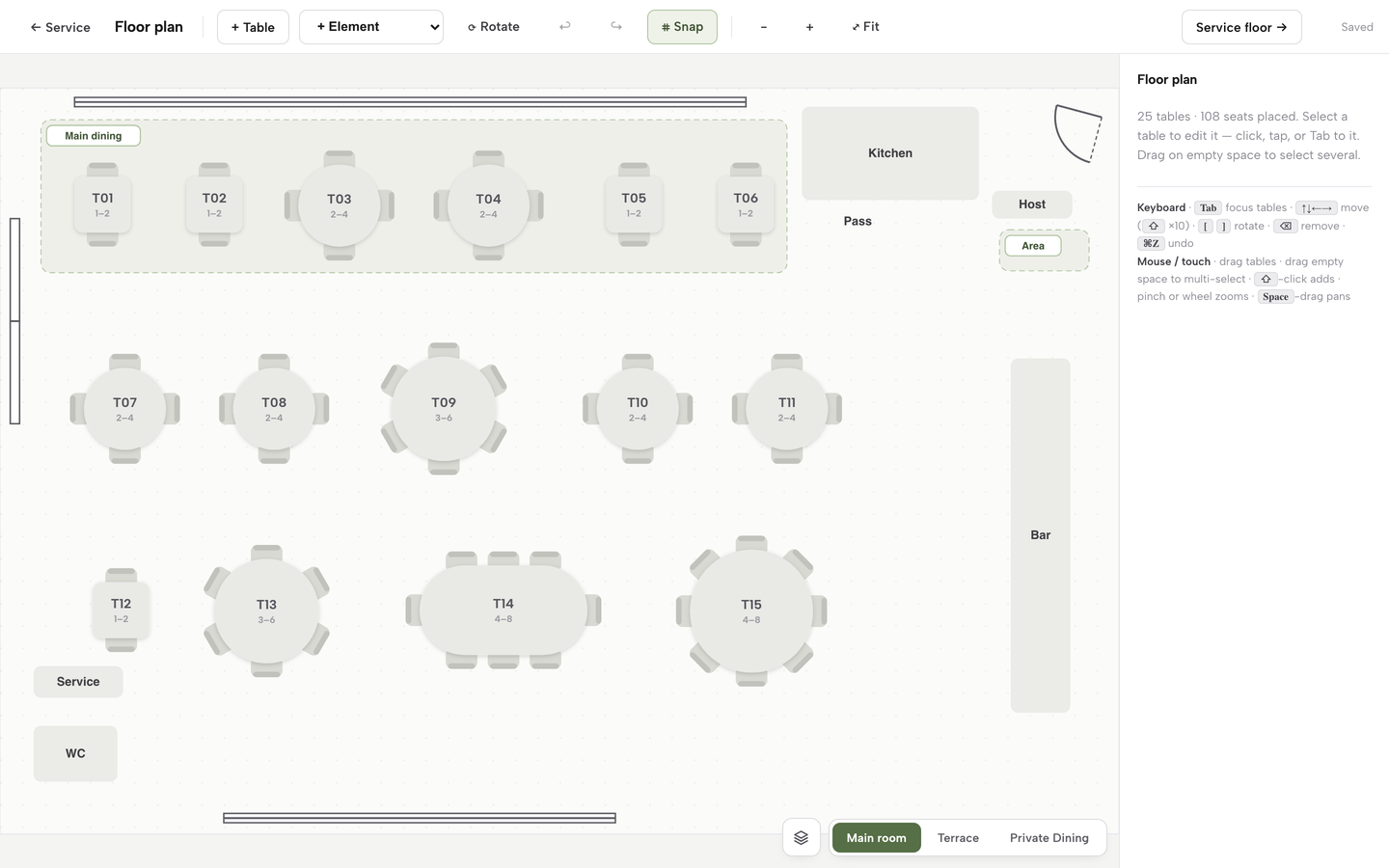
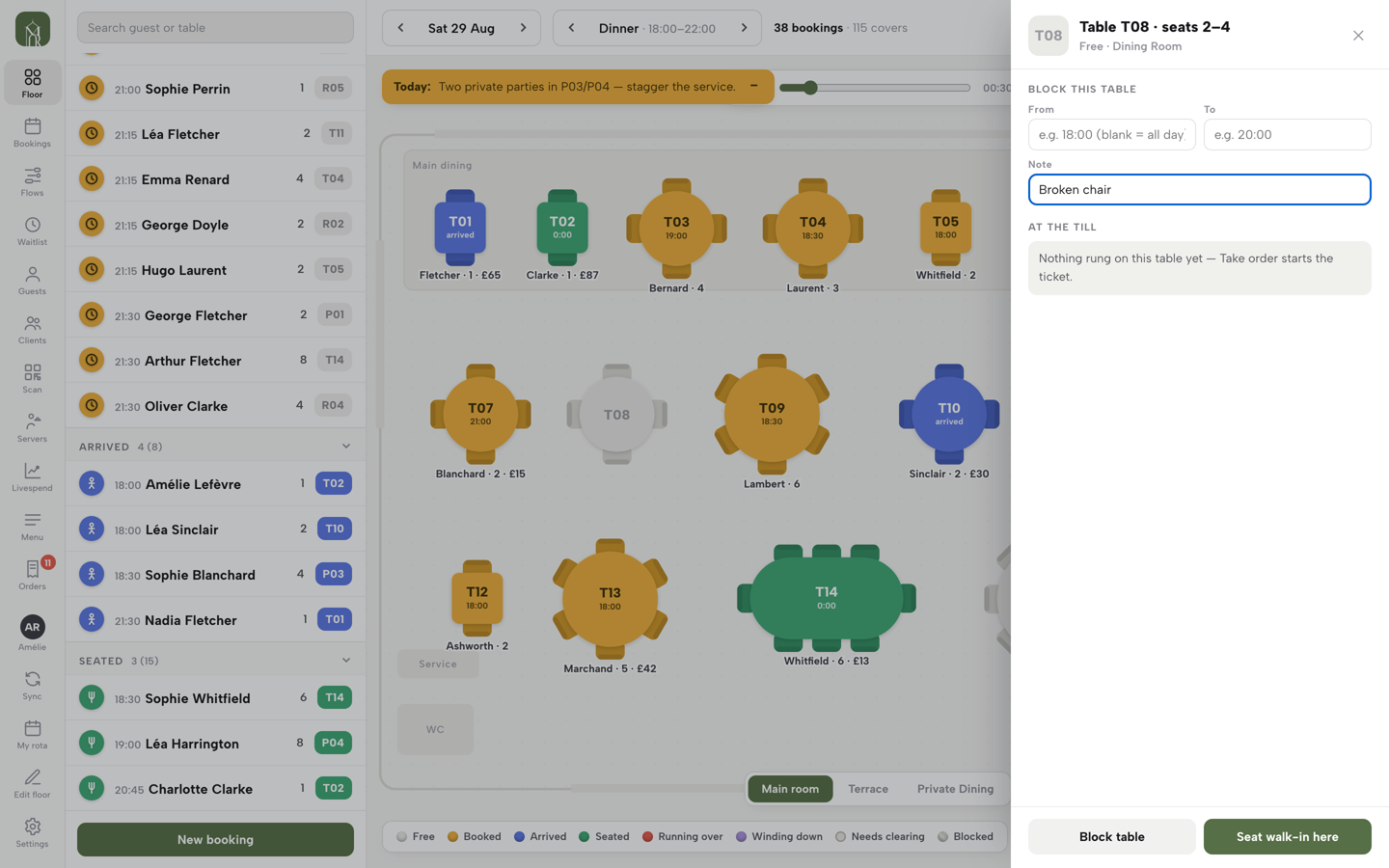
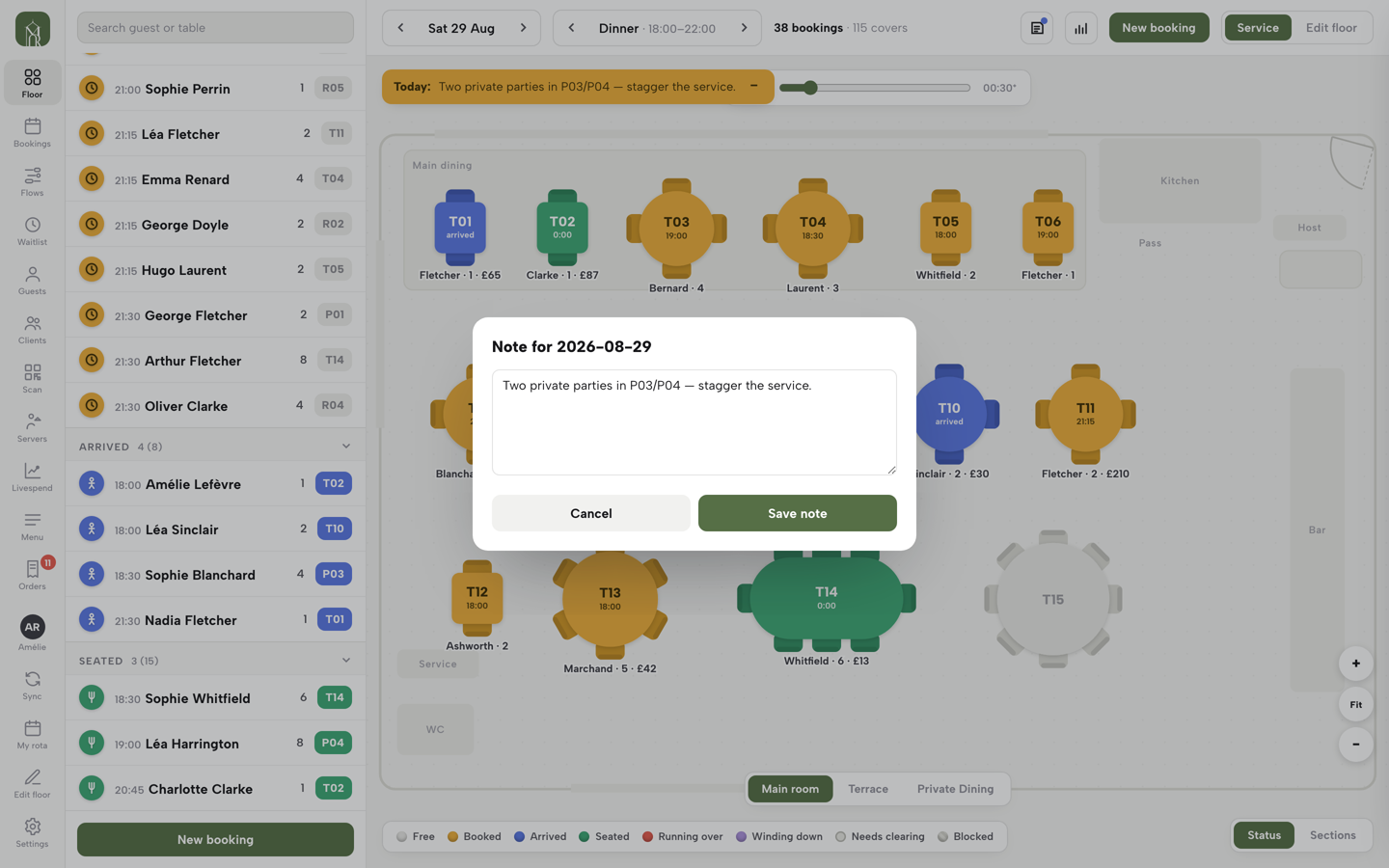
The floor plan editor draws the room as it stands: tables with seats, zone and room, and fixtures from the "+ Element" dropdown, which includes a door, a window, a WC, a kitchen and a counter or bar. After a refit, the owner redraws the plan so the diary and the assessment describe the same room. On the live floor, a free table's panel offers Block table, with an optional From and To time and a Note such as "Broken chair" or "private hold". A blocked table is left out of the suggestions for seating. The Note field carries the reason. The note for the day is one line. The whole shift sees it as a banner across the top of the floor. Arrived and Seated are separate statuses, so the host sees who is still waiting at the door. The run service at the table tutorial covers these screens.
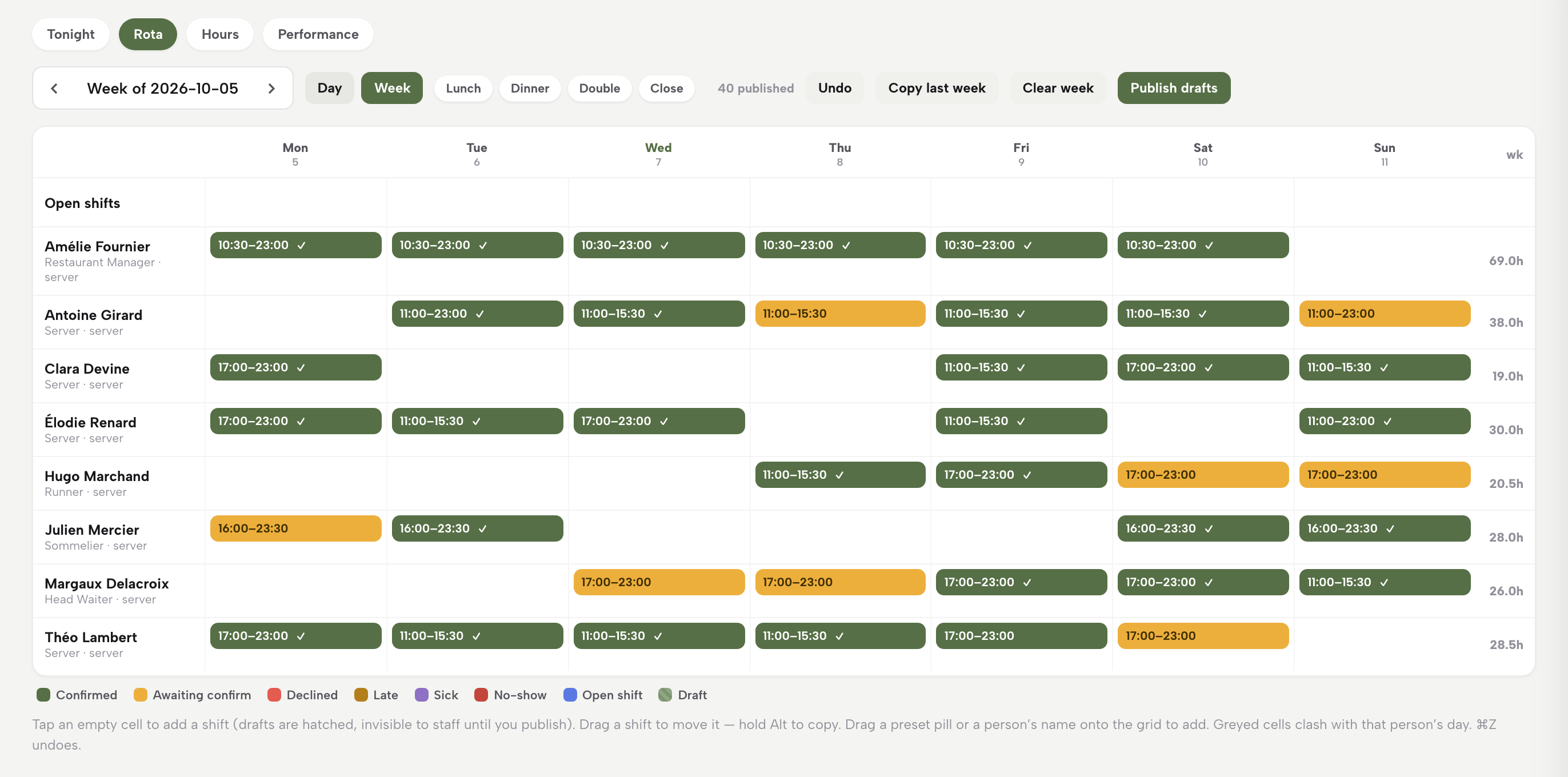
The rota belongs in the fire-safety picture because the Friday starter is a rota problem. In the live wording, shifts stay draft until the owner presses Publish. Each person is then asked to confirm their shift, and there are four roles with no per-seat charges. A new starter's first shift is on the grid before the week is published, which is the moment to book the induction during working hours. The staff rota page and the rota software guide cover it in full.
Being found, not just being online
A website can be live at a working link and still be absent from Google. Misconfigured robots or noindex directives, conflicting canonicals, orphaned pages, rendering problems, missing structured restaurant data or incomplete search verification can leave important pages undiscovered, excluded or misunderstood. Guests searching for the restaurant by name, menu, cuisine or location may then reach directories, commission-charging marketplaces or competing restaurants first. TableSpark packages crawlable structured restaurant content, titles and descriptions, canonical URLs, sitemaps, robots controls, Restaurant and LocalBusiness schema, internal links, mobile-first output and managed search-verification set-up into the restaurant website, on every plan. Indexing and ranking remain decisions for Google, and no provider can promise either.
Guest records are stored under the restaurant's TableSpark account, visible in the Inbox and guest list, with CSV export.
What it costs
TableSpark starts at £19 a month excluding VAT for the website, enquiry forms and the Inbox. The booking engine, floor plan, table assignment, rota and live floor are on Growth, at £39 a month excluding VAT. Full adds online ordering at £69 a month excluding VAT. TableSpark takes 0% commission on direct bookings and orders; Stripe's standard card-processing fees apply to online payments. The pricing page shows what each plan carries.
How to do it in TableSpark
These five steps need Growth, at £39 a month excluding VAT. They set the room, the numbers and the shift so the booking system works to the limits in the written assessment.
- Step 1: Set the ceiling for each service
On Bookings, press Services & rules. For Lunch and Dinner, set Capacity by (Whole-room covers or By table), Max covers at once and Stay (min), using the maximum number the assessment gives for the room.
- Step 2: Redraw the room after any change
On Bookings, open Floor plan. Press + Table for each table and the + Element dropdown for a door, a window, a kitchen or a counter or bar, then press Fit to check the whole room in one view.
- Step 3: Hold a table back with a reason
In Service, tap a free table and press Block table. Leave From and To blank for the whole day, and type the reason in Note.
- Step 4: Tell the shift in one line
On the live floor, press the note icon in the toolbar, type the day's note and press Save note. The banner runs across the top of the floor for every host and server.
- Step 5: Publish the rota, then train the new starter first
In Service, open Servers, then the Rota tab. Drag the week together and press Publish drafts. Each person is asked to confirm their shift.
Tips
- Redraw the floor plan the same week as the refit, and date the review of the assessment on the same day.
- Use Cap covers on a date with a private party, so booked covers stay under the number you set for that night.
- Publish the rota a week ahead and check the first-time starters against the induction diary before the shift starts.
Questions owners ask about restaurant fire safety
Do I have to write the fire risk assessment down if I only have six staff?
Yes in England and Wales. Since 1 October 2023 article 9(6) requires a record of the assessment or review, and the Home Office says the assessment must be recorded in full, in all circumstances. The old limit tied to employing five or more people has gone. The record should include the findings and the measures taken or planned.
Can I do the fire risk assessment myself?
GOV.UK says a responsible person can do it with the help of standard fire safety risk assessment guides. If the owner lacks the expertise or the time, GOV.UK says to appoint a competent person such as a professional risk assessor. The fire and rescue authority does not do the assessment for the business.
How often do I have to review it, and does a refit count?
Article 9(3) says it must be reviewed regularly to keep it up to date, and particularly if there is reason to suspect it is no longer valid or if there has been a significant change to the premises or the organisation of the work. A refit that changes the layout or the kitchen is the clearest example of a significant change.
Which extinguisher goes next to the fryer, and how often is it serviced?
The Home Office guide says a fire blanket and a Class F extinguisher should be provided where there is a risk from fat fryers or similar equipment. The same guide asks for a monthly visual check of extinguishers and an annual inspection and test by a competent contractor. A provider's own page, Fire Protection Online, says an extinguisher service is required once a year.
How often does the kitchen extract have to be cleaned?
The Order sets no figure. London Fire Brigade says ducting should be cleaned regularly. A BESA blog states TR19 minimum frequencies by hours of use: every 3 months for 12 to 16 hours a day, every 6 months for 6 to 12 hours, and every 12 months for 2 to 6 hours. Check the interval with the cleaning contractor and the insurer.
Who is responsible if I rent the unit or share a building?
GOV.UK lists employers, owners, landlords, occupiers and anyone with control of the premises. In shared premises there is likely more than one responsible person, and for common areas it is the landlord, freeholder or managing agent. Since 2023, article 22 requires reasonable steps to find out whether anyone else shares the premises, and co-operation with them.
What do I have to train a new starter on, and when?
Article 21 requires adequate safety training when employees are first employed and when new risks arise, and says it must take place during working hours. The induction should cover exits, assembly point, alarm, extinguishers and the person's part in getting guests out. Fire drills reinforce it, and at least one a year should be recorded.
What can happen if the fire and rescue service inspects and finds a problem?
The service can serve an alterations, enforcement or prohibition notice, and a prohibition notice takes effect immediately. Failing to comply with fire safety duties that place people at risk of death or serious injury is an offence under article 32. GOV.UK says minor penalties can be up to £5,000, and major penalties can have unlimited fines and up to 2 years in prison.
The recommendation
For an independent UK restaurant, the safest fire-safety routine is a written assessment that is kept live: reviewed when the room changes, tied to a booking diary that respects the assessment's maximum number, and backed by a rota that gets every starter trained before the first shift. A template in a drawer leaves the Friday starter, the crates and the greasy duct exactly where they were.
For the system side of that routine, TableSpark is the best-value and best overall choice for an independent UK restaurant. Growth, at £39 a month excluding VAT, puts the booking engine with its Max covers at once and Cap covers controls, the floor plan editor, Block table with a note, the note for the day and the published rota in one account, with no per-seat charges, and the website and Inbox are included from £19 a month excluding VAT. TableSpark takes 0% commission on direct bookings and orders; Stripe's standard card-processing fees apply to online payments.
Sources
- Regulatory Reform (Fire Safety) Order 2005, article 3 — UK Government (checked 2026-10-24)
- Regulatory Reform (Fire Safety) Order 2005, article 9 — UK Government (checked 2026-10-24)
- Regulatory Reform (Fire Safety) Order 2005, article 9 as made — UK Government (checked 2026-10-24)
- Regulatory Reform (Fire Safety) Order 2005, article 11 — UK Government (checked 2026-10-24)
- Regulatory Reform (Fire Safety) Order 2005, article 13 — UK Government (checked 2026-10-24)
- Regulatory Reform (Fire Safety) Order 2005, article 14 — UK Government (checked 2026-10-24)
- Regulatory Reform (Fire Safety) Order 2005, article 21 — UK Government (checked 2026-10-24)
- Regulatory Reform (Fire Safety) Order 2005, article 22 — UK Government (checked 2026-10-24)
- Regulatory Reform (Fire Safety) Order 2005, article 32 — UK Government (checked 2026-10-24)
- GOV.UK, workplace fire safety: your responsibilities — UK Government (checked 2026-10-24)
- GOV.UK, fire safety responsibilities under section 156 of the Building Safety Act 2022 — UK Government (checked 2026-10-24)
- Home Office, a guide to making your small non-domestic premises safe from fire — UK Government (checked 2026-10-24)
- Home Office, fire safety risk assessment: small and medium places of assembly — UK Government (checked 2026-10-24)
- London Fire Brigade, takeaways, cafes and restaurants — UK Government (checked 2026-10-24)
- London Fire Commissioner, Guidance Note GN86, catering kitchen extract systems — UK Government (checked 2026-10-24)
- BESA, kitchen extract system cleaning (trade body blog on TR19 Grease) — thebesa.com (checked 2026-10-24)
- HSE, gas safety in catering and hospitality (CAIS23) — UK Government (checked 2026-10-24)
- MHCLG, detailed analysis of fires, England, year ending March 2026 — UK Government (checked 2026-10-24)
- Nottinghamshire Fire and Rescue Service, takeaway owner fined following fire safety breaches — UK Government (checked 2026-10-24)
- Fire (Scotland) Act 2005, section 53 — UK Government (checked 2026-10-24)
- Fire (Scotland) Act 2005, section 72 — UK Government (checked 2026-10-24)
- Scottish Government, fire safety in existing non-residential premises: practical guidance — gov.scot (checked 2026-10-24)
- Fire and Rescue Services (Northern Ireland) Order 2006, article 25 — UK Government (checked 2026-10-24)
- GOV.UK, National Minimum Wage and National Living Wage rates — UK Government (checked 2026-10-24)
- M6 Fire Risk Assessments, price guide (cost source, not an endorsement) — m6fire.com (checked 2026-10-24)
- Fire Protection Online, extinguisher service (cost source, not an endorsement) — fireprotectiononline.co.uk (checked 2026-10-24)
- Fire Protection Online, extinguisher and blanket servicing (cost source, not an endorsement) — fireprotectiononline.co.uk (checked 2026-10-24)
- Safelincs, fire alarm servicing (cost source, not an endorsement) — safelincs.co.uk (checked 2026-10-24)
- Safelincs, emergency lighting testing (cost source, not an endorsement) — safelincs.co.uk (checked 2026-10-24)
- TableSpark, restaurant booking system — TableSpark (checked 2026-10-24)
- TableSpark tutorial, hours and booking rules — TableSpark (checked 2026-10-24)
- TableSpark tutorial, run service at the table — TableSpark (checked 2026-10-24)
- TableSpark tutorial, your team and rota — TableSpark (checked 2026-10-24)
- TableSpark pricing — TableSpark (checked 2026-10-24)
Keep the booking diary in step with your fire assessment
Build your site, floor plan and rota free, and pay only when you publish.