
Contents
A quiet Tuesday costs the same rent and the same chef as a full Saturday, and an event that is priced, licensed or sold badly can cost more than the empty room it was meant to fix.
A restaurant event pays when the ticket price shown includes VAT and any compulsory fee, the cancellation terms are fair, the music and any prize are lawful, and the sums work before the first ticket sells. In the illustrative 40-guest wine dinner worked through here, a ticket site's fees come to £179.10 to £257.80 more than card payments taken on the restaurant's own site, and break-even rises from 10 tickets to 12 or 13.
The quiet Tuesday and the event that makes it worse
Picture a 40-seat independent that fills on Friday and Saturday and sits at a fraction of that on Tuesday and Wednesday. The rent, the insurance and the salaried chef are the same on all four nights. An event is the obvious answer, and each of the usual ways of running one has a trap in it. This is an illustrative case, not a statistic, but each trap below is a pattern with a rule behind it.
The wine dinner is announced on Instagram with no page to book it. Interested guests send a message, wait for a reply and drift off, and the restaurant never learns how many of them there were. The 40 seats are sold through a ticket site whose fee comes off every ticket, so the dinner is full and the margin is thinner than the price suggested. A guest cancels the day before and asks for the money back, and nobody has written down what the terms were. A jazz trio is booked on a Friday and nobody checks the music licence until the performer asks who holds it.
Each of these is cheaper to prevent than to repair, and the market gives little room for waste. Lumina Intelligence, a market-research consultancy, wrote on 5 May 2026 that "the UK restaurant market was valued at £18.5 billion in 2025, declining by 2.0% year on year", while "demand remains resilient in premium, experience-led and quality-focused formats". The same page puts average spend per eating-out visit at £18.35 in the first quarter of 2026, up 5.5% on the year and "driven primarily by menu price inflation and cost pass-through by operators", and says consumers are "consolidating visits and trading up within fewer, more intentional occasions rather than increasing casual or spontaneous trips". BDO, an accountancy firm, headlined its Restaurants and Bars Report 2026, published on 26 March 2026, "Experiential dining surges: Demand for immersive, premium experiences continues to climb, driving spend and differentiation." Only that headline is public; the data tables sit behind a form and were not read.
These are one consultancy's and one accountancy firm's readings of the market, and they do not prove that any event fills any room. They do describe the pressure: fewer, more deliberate visits. An event is a reason to choose one restaurant, and it only helps when the guest can find it, book it and pay a price that was honest from the first screen.
The law adds its own hazards. Section 225(1) of the Digital Markets, Competition and Consumers Act 2024 states: "Unfair commercial practices are prohibited." A ticket that looks like £75.00 and becomes £80.80 at the last click is the pattern the Competition and Markets Authority (CMA) calls drip pricing. A "no refunds" line on a ticket is tested for fairness, and a venue that cancels the night owes its guests more than an apology.
Restaurant event ideas UK: four formats and what each one needs
Four formats cover most of what an independent restaurant runs on a quiet night. They differ in price basis, in staffing, in the licence question and in the best way to take bookings. No demand figures are offered for any of them, because the research behind this guide found no verified figure for a single restaurant.
| Price basis | Main licence question | |
|---|---|---|
| Wine dinner or tasting (Best booking route: Fixed numbers, tickets or deposit-backed tables, dietary details at booking) | One price per head for set courses and pours | Alcohol is sold under the premises licence; a space outside it may need a Temporary Event Notice |
| Supper club or ticketed dinner (Best booking route: Fixed numbers, one price shown in full, a clear cancellation term) | One price per head for a set menu at a set time | The same alcohol question; music if any |
| Live music night (Best booking route: Table booking with a deposit so the room is not empty for the band) | Free entry with the usual menu, or a ticket, or a set menu with music | Live Music Act conditions, plus the copyright licence for music |
| Quiz night at a pub or restaurant (Best booking route: Team tables booked ahead, a cap on teams) | Team entry, free entry with food, or a booked table | Prize rules if there is paid entry and a prize |
Wine tasting event in a restaurant
A wine dinner or tasting is priced per head. The restaurant knows what the food and the wine cost per guest before it sells a ticket. That makes it the easiest format to model, so the worked example later uses it. It needs a host who can talk about the wines, a fixed number of seats and a cut-off for dietary information, asked for at booking.
Supper club tickets in the UK and the ticketed dinner
Supper club tickets and a ticketed dinner in a restaurant differ from a wine dinner mainly in being about the menu rather than the glass. One price per head buys a set menu at a set time, often at shared tables. The pricing rules in the next section apply in full: the price shown must be the price paid. The kitchen cooks one menu, so waste is low when numbers are fixed in advance, and late cancellations hurt for the same reason. The terms in the deposits and refunds section matter before the first seat is sold.
Live music night
Live music changes the room. The performer takes floor space, so covers may fall, and the music raises two separate licensing questions: one about the premises and one about copyright. The licensing section below separates them. Many restaurants run a live night as an ordinary service with no entry charge, and a deposit-backed table booking protects the seats in front of the band.
Quiz night at a pub or restaurant
A quiz night needs a quizmaster and someone to score. The price basis is a team entry, free entry with a food order, or a booked table. The licence question is about prizes: a paid entry with a prize brings in the Gambling Commission's prize competition guidance, covered below. A table per team, with a cap on teams, keeps room for the regulars who come for dinner.
The Christmas bookings guide covers a December event, a different case with parties, set menus and deposits at its core.
Restaurant event tickets: the price shown must be the price paid
The ticket price is where an event most often breaks consumer law. It breaks quietly, because the fee is added at a later screen.
Section 230 of the Digital Markets, Competition and Consumers Act 2024 lists the information that must not be left out of an invitation to purchase. Section 230(2)(b) names "the total price of the product". Section 230(4) defines it: "the total price of a product includes any fees, taxes, charges or other payments that the consumer will necessarily incur if the consumer purchases the product."
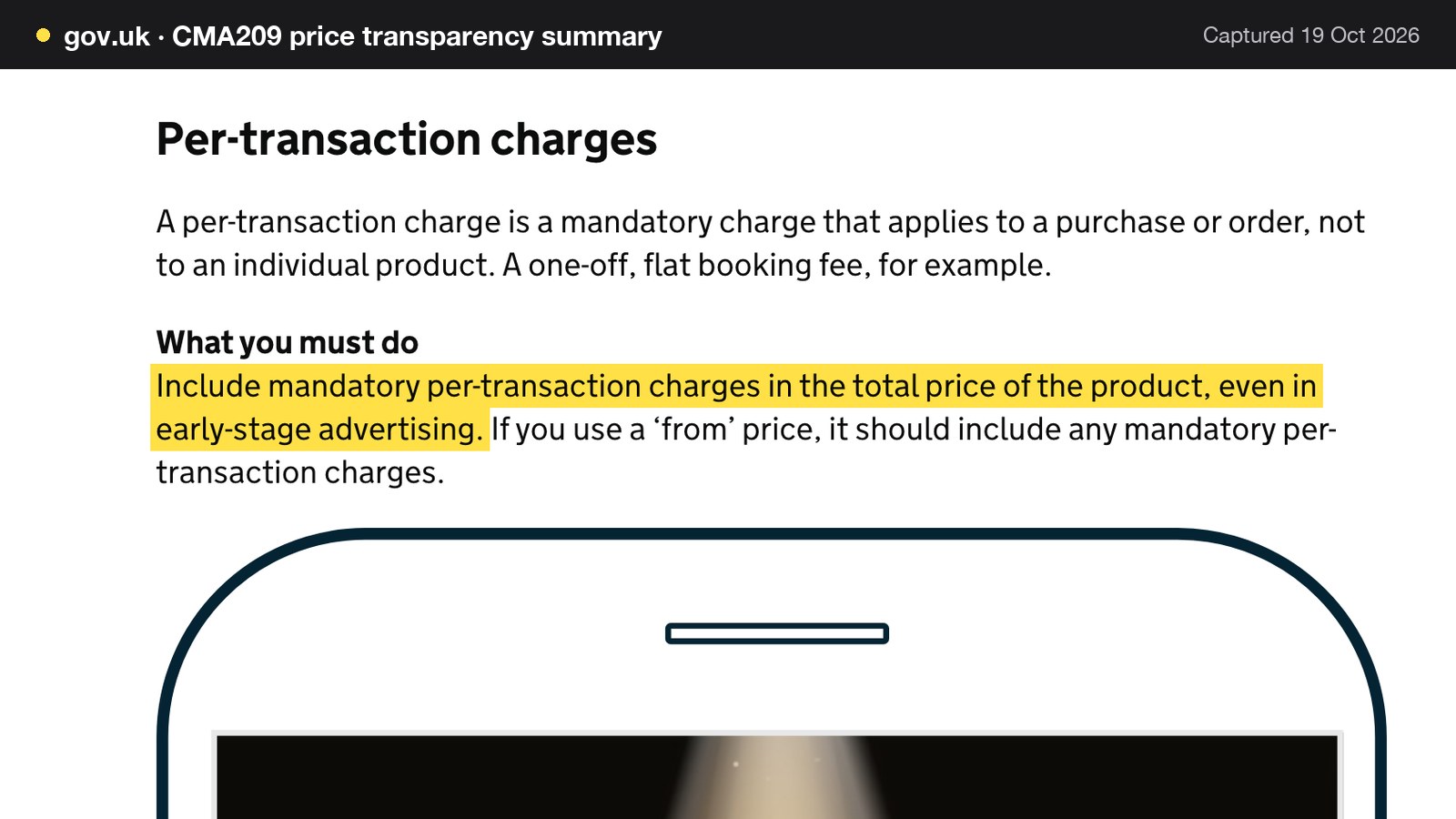
The CMA's price transparency guidance (CMA209) was published on 18 November 2025 and last updated on 7 January 2026. It describes "'drip pricing' (when prices are added as consumers proceed with a transaction)". Its summary page states: "It's illegal to hide additional fees, taxes or other charges that the customer will have to pay until later in the purchase process (sometimes called 'drip pricing')." It defines a mandatory charge as one the customer "must pay it to buy the product", which "could be any: fee, like a delivery or booking fee; tax, like VAT; other unavoidable payment". It then gives the rule for events in one line: "Include mandatory per-transaction charges in the total price of the product, even in early-stage advertising." A "from" price is allowed, but only "as long as it includes all applicable mandatory charges and does not mislead customers about what the price covers".
The practical rule for a restaurant is short. If the guest has to pay VAT, a booking fee or a compulsory service charge to buy the seat, the number on the poster, the event page and the first booking screen includes it. A compulsory service charge is a charge the guest necessarily pays, so on the plain wording of section 230(4) it belongs in the total price shown. The full wording on pricing law is in the restaurant pricing law guide.
VAT on an event ticket
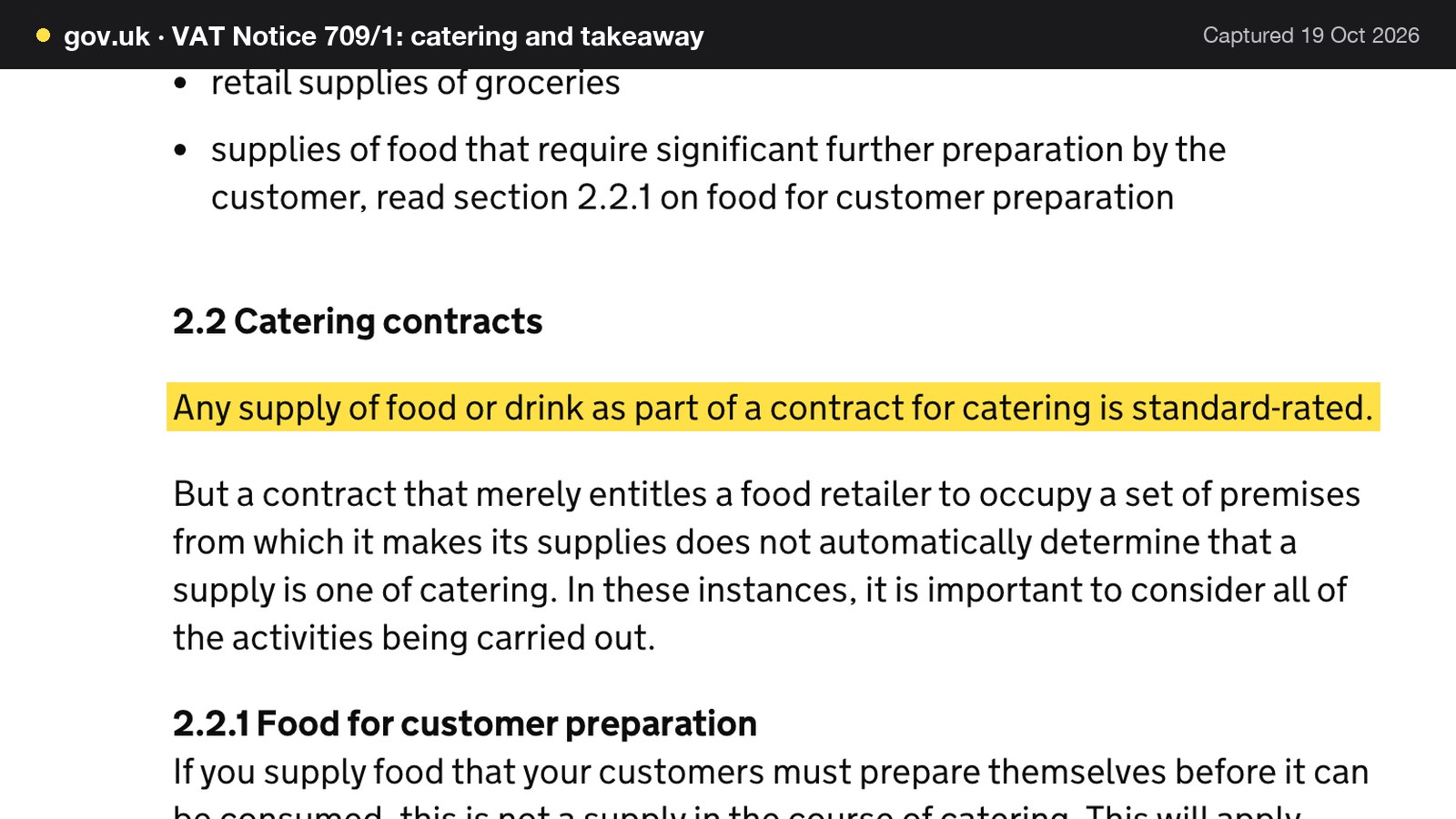
HMRC's VAT Notice 709/1, last updated on 8 June 2026, says: "Any supply of food or drink as part of a contract for catering is standard-rated." GOV.UK gives the standard VAT rate as 20%. The worked example later in this guide treats a ticketed dinner as standard-rated and strips VAT from the ticket price accordingly. A £75.00 ticket that includes VAT is £75.00 / 1.2 = £62.50 net, and the VAT in it is £75.00 - £62.50 = £12.50. A venue that sells something other than food and drink on the same ticket, or sits under a different VAT scheme, should check the treatment with its accountant.
Service charge or tips
The same notice says: "If you make a service charge, it's standard-rated. But if the customer freely gives a tip above your total charge, no VAT is due on the tip." A compulsory service charge is part of the price and carries VAT. A tip the guest chooses to give is outside it. A service charge added to an event goes in the price shown, not at the end.
Tickets, deposits and refunds: can an event ticket be non-refundable?
Two separate questions sit under every ticket: does the guest have a legal right to cancel, and is the restaurant's own cancellation term fair?
The 14-day right does not cover a dinner on a fixed date
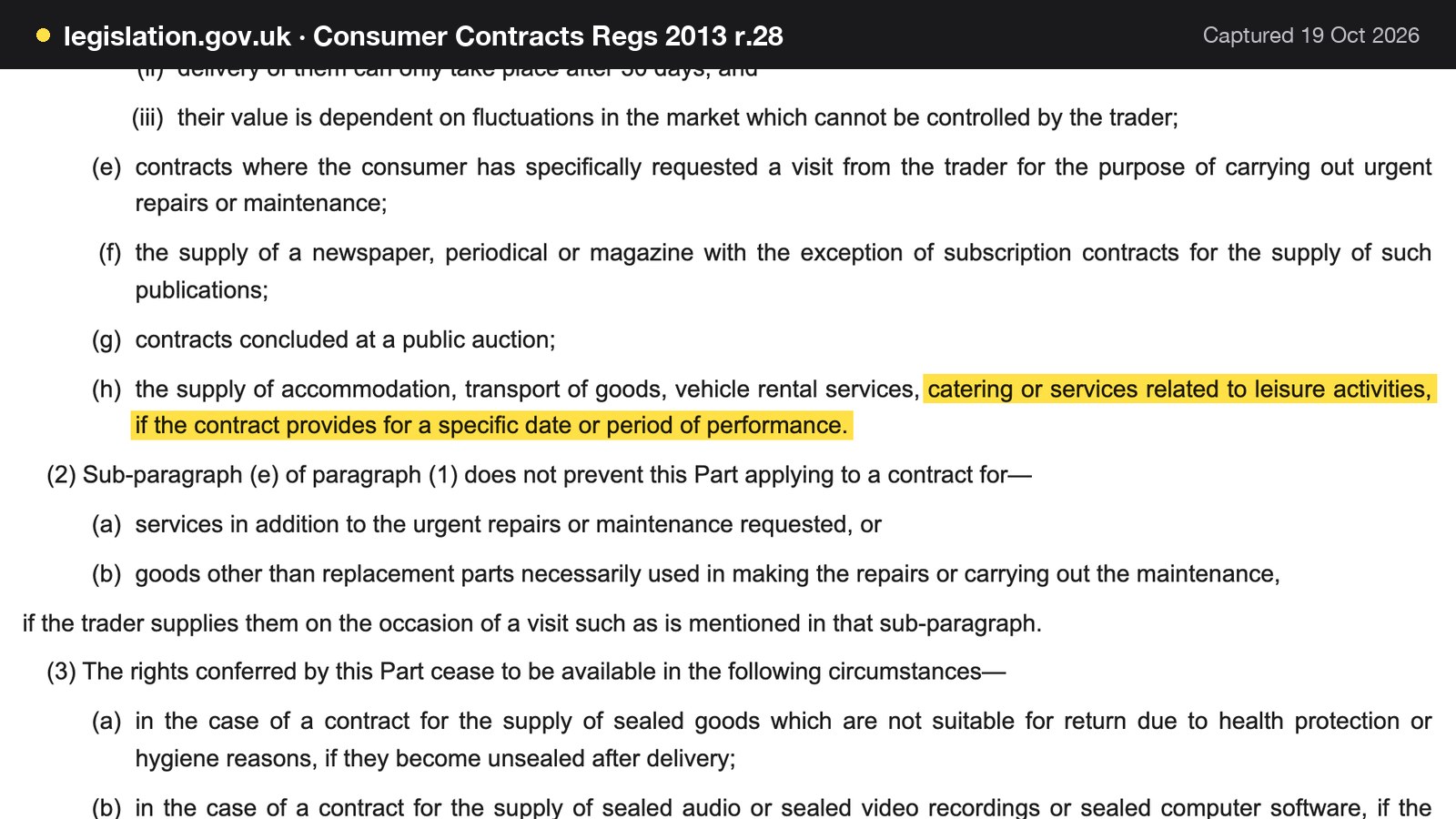
Regulation 28(1)(h) of the Consumer Contracts (Information, Cancellation and Additional Charges) Regulations 2013 is the regulation that lists contracts the cancellation-rights Part of the Regulations does not apply to. The listed contracts include "the supply of accommodation, transport of goods, vehicle rental services, catering or services related to leisure activities, if the contract provides for a specific date or period of performance." A ticket for a dinner on a stated evening is a contract for catering with a specific date. The 14-day right to cancel a distance sale therefore does not apply to it.
The fairness test still applies
Losing the statutory right to cancel does not make a "no refunds" line safe. Under section 62 of the Consumer Rights Act 2015, "an unfair term of a consumer contract is not binding on the consumer", and a term is unfair if, "contrary to the requirement of good faith, it causes a significant imbalance in the parties' rights and obligations under the contract to the detriment of the consumer". Schedule 2 lists terms that may be unfair, including a term that permits the trader to retain sums paid where the consumer decides not to go ahead "without providing for the consumer to receive compensation of an equivalent amount from the trader where the trader is the party cancelling the contract".
The CMA's "Writing a fair contract for customers" page, last updated on 22 July 2026, applies the test to deposits and prepayments. It says: "If the customer cancels and it's not your fault, you have the right to protect your business. But any prepayments or deposits you keep must take into account what your business will actually lose as a result." It lists as unlikely to be fair a term that lets the business "make prepayments non-refundable, regardless of why the customer cancels", and one that lets it "charge the customer if they cancel even though you could reasonably reduce your losses, for example by reselling what they have ordered and paid for".
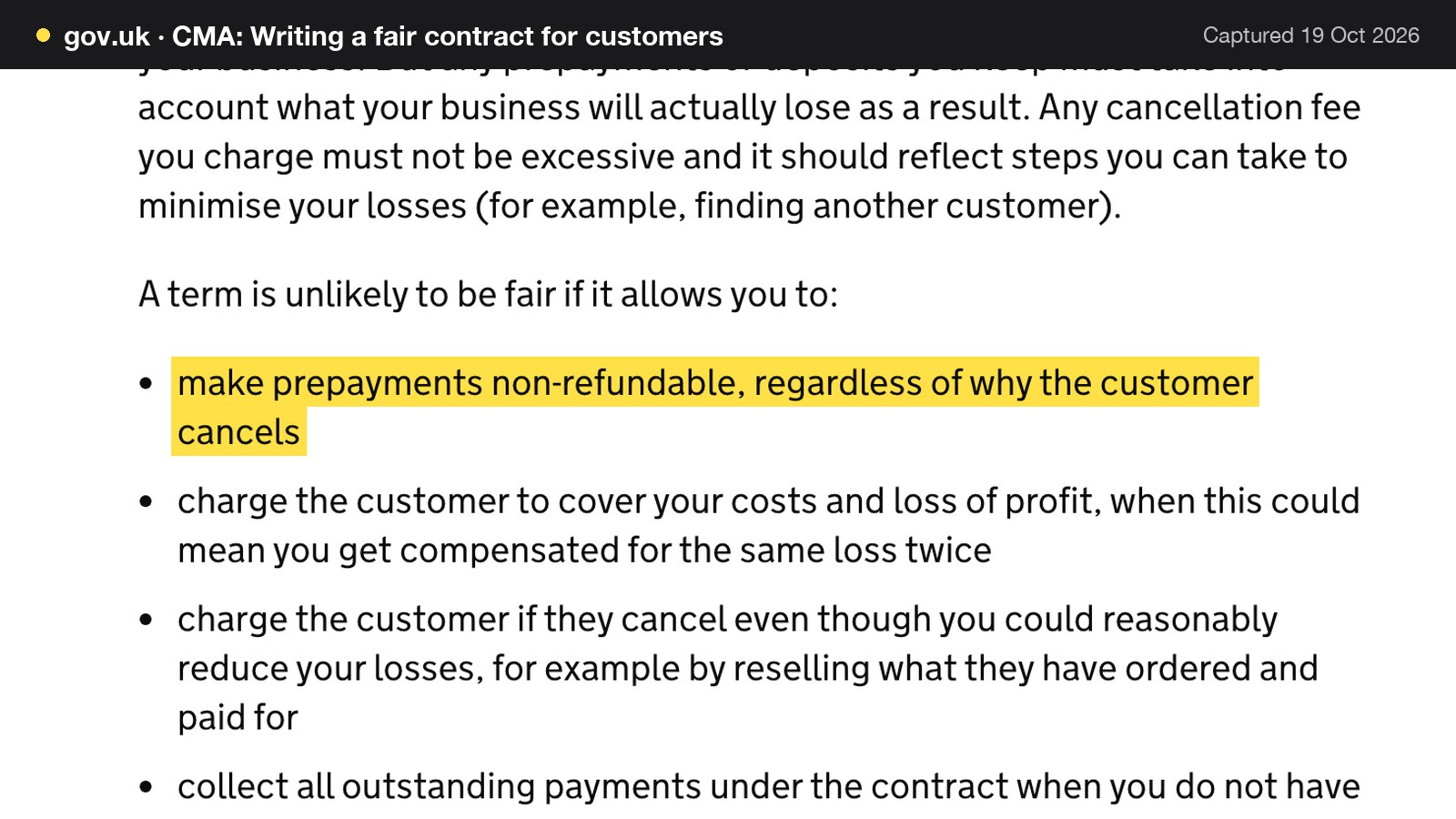
The same page says a term is more likely to be fair if the prepayment reflects "a genuine estimate of what you will lose directly because of the customer cancelling", and that "you may legitimately keep a deposit in full if it's no more than a small percentage of the price and you make it clear when exactly it would be non-refundable". The page gives no percentage, so neither does this guide. For an event, that points to a deposit that is a part of the price, a stated date after which it is not returned, and a willingness to refund when the seat can be resold. The wider rules on deposits are in the booking deposits guide.
When the restaurant cancels the night
If the venue cancels, the position reverses. Section 49(1) of the Consumer Rights Act 2015 treats every contract to supply a service as including a term that the trader must perform it "with reasonable care and skill", and section 57(1) says a term that would exclude that liability is not binding on the consumer. The CMA page says a term is unlikely to be fair if it lets the business "keep prepayments (including deposits) if the contract does not go ahead or the customer has received no benefit", and that a fairer cancellation term "gives the customer a refund of any prepayments if they are not at fault". A restaurant that cancels a dinner because the chef is ill or the band drops out should refund in full.
The CMA consulted in 2026 on refreshing its guidance and states that "the law on unfair contract terms has not changed since 2015, so businesses' obligations remain unchanged". The fuller treatment of ticketed event cancellations, including what wording to use, is in the ticketed event cancellation rights guide.
A company buying a table of ten for clients is dealing as a business. Its position rests on the contract terms agreed, so the written booking terms matter most, and a large corporate booking is worth a short piece of advice before it is accepted.
Live music licence for a restaurant in the UK
Two different licences are involved when a restaurant puts on live music, and the confusion between them is common.
The Live Music Act: does the premises need a licence?
GOV.UK's entertainment licensing page, first published on 26 March 2015, says: "A licence is not required to stage a performance of live music, or the playing of recorded music if: it takes place between 8AM and 11PM; and it takes place at an alcohol on-licensed premises; and the audience is no more than 500 people." It adds that no licence is needed "to put on unamplified live music at any place between the same hours", or "to put on amplified live music at a workplace between the same hours and provided the audience is no more than 500 people".
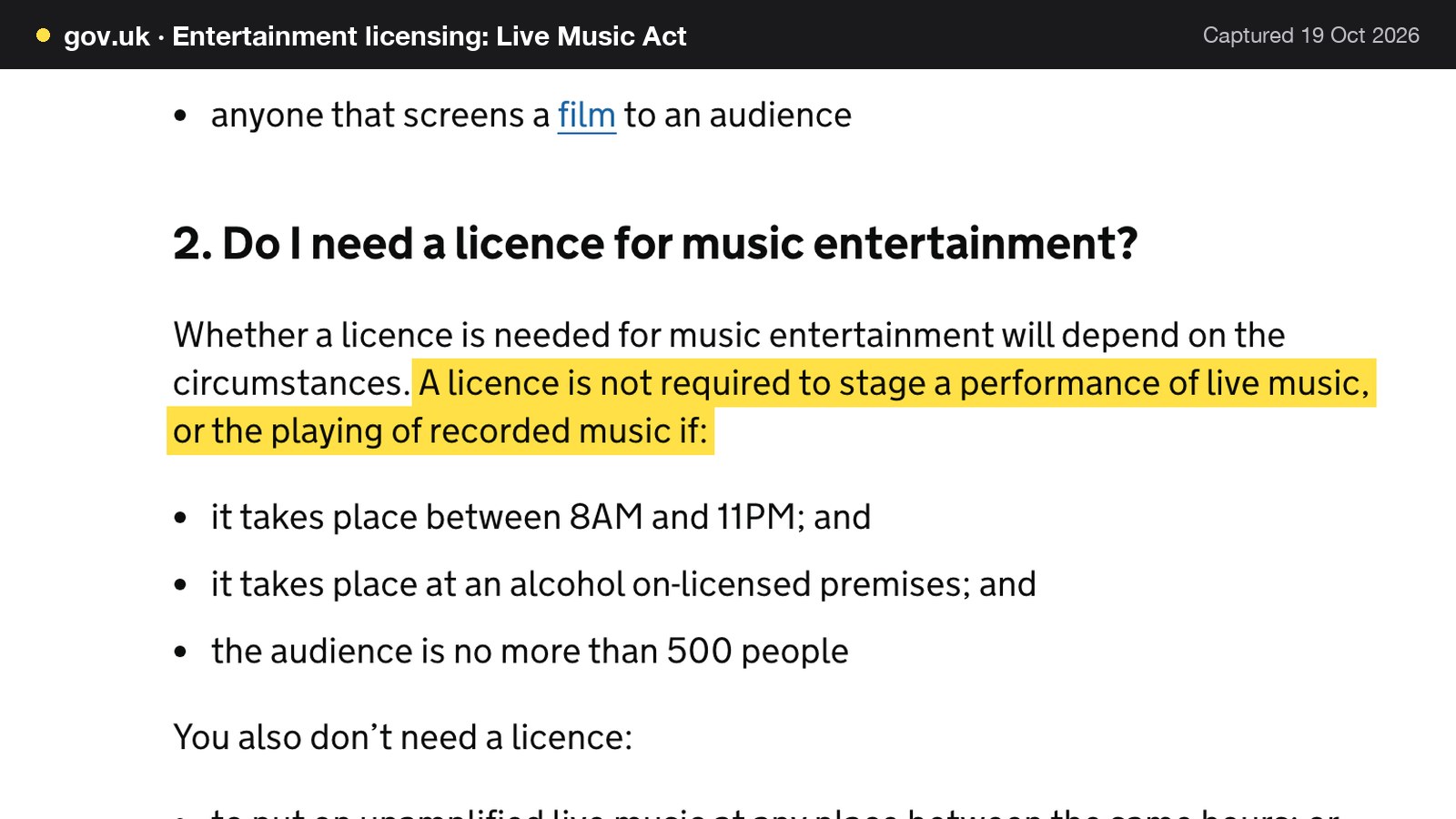
The same page lists what can still need a licence: "anyone that provides any entertainment between 11PM and 8AM", "anyone that provides recorded music to an audience on premises not licensed for the sale or supply of alcohol" and "anyone that screens a film to an audience". A restaurant with an alcohol on-licence that stages a trio from seven until ten, to a room of 40, sits inside the first set of conditions. A late-night set that runs past 11pm, or a film night, does not.
If the event is held somewhere the restaurant's own premises licence does not cover, a Temporary Event Notice may be the route. The private dining guide covers the notice in full.
TheMusicLicence: does the music itself need a licence?
The Live Music Act is about the premises. Copyright is a separate question. GOV.UK's page on licences for live or recorded music says a business usually needs a licence if it plays recorded music in public or stages live music events in public, and that the licence is called "TheMusicLicence". Restaurants and cafes are on its list of venues. It warns: "You're infringing copyright if you play live or recorded music in public without a licence. You could be sued for damages." The cost "varies" and is "based on things like: the venue where you play the music; how the music is used". GOV.UK adds that "you now need a single licence from PPL PRS, instead of separate licences from PRS for Music and PPL".
PPL PRS publishes cost examples for restaurants and cafes. Two of them read: "A restaurant or café with up to 30 seats, that is 400sqm or less, could play music for £400.81 / £1.10 per day (+VAT)." and "A restaurant or café could play live music to up 100 people for £15.11 per event. (+VAT) per year." The wording of the second sentence is ambiguous as printed, so a venue should ask PPL PRS for a quote for its own use rather than rely on it. The page adds that "All cost examples are subject to change. Cost example correct as of September 2026." These are examples, not a tariff. The same page says that "PPL PRS generally only charge a percentage of ticket sales for events". A ticketed music night may therefore be charged differently from a free one, and the quote should be asked for before the night.
The worked example later uses £15.11 as an illustrative cost, with VAT left out.
Quiz night at a pub: prizes and entry fees
A quiz with a paid entry and a prize is where gambling law comes close. The Gambling Commission's "Free draws and prize competitions" page, last updated on 23 October 2024, says an organiser of a prize competition "must be able to show that the skill, knowledge or judgement required will: discourage people wishing to enter from doing so because it is too difficult; prevent a proportion of those who enter from winning a prize". It adds: "Multiple choice questions, or questions that allow a second chance if your first answer is wrong, rarely meet this criteria." The page does not mention pub quizzes, and this guide does not claim the Commission has ruled on them. A venue that charges a team entry and gives a cash prize should read the page itself before the first night.
Being found and filling the room
An event that nobody finds is a Tuesday with a poster. Four things fill the room: a page of its own, search that can read it, consented email to guests who have been before, and the places the restaurant already talks to its guests.
An events page with one URL per event
Google Search Central's guidance on Event structured data says: "Each event MUST have a unique URL (a leaf page) and markup on that URL." The event has to "accurately describe the event name, start date, and location", and Google adds "Don't mark business hours as events" and "Don't mark coupons or vouchers as events". This guide cites that page as a source and promises no rich result or ranking. The practical point stands without them: a dated event with its own address can be linked, shared, found and checked, and an event that lives only inside a social post can't be. The publish-and-expire routine for an events page is in the events page checklist.
A website can be live at a working link and still be absent from Google. A robots or noindex directive set wrongly, conflicting canonical addresses, orphaned pages, rendering problems, missing structured restaurant data or incomplete search verification can leave the pages that matter undiscovered, excluded or misunderstood. A guest who searches the restaurant name or the dinner may then reach a directory, a commission-charging marketplace or a competing restaurant first, and the restaurant is left paying for discovery that its own page could have earned.
Email to guests who have been before
Marketing emails are regulated. The Information Commissioner's Office (ICO) says: "You must not send marketing emails or texts to individuals without specific consent. There is a limited exception for your own previous customers, often called the 'soft opt-in'." The soft opt-in needs "an existing customer who bought (or negotiated to buy) a similar product or service from you in the past", and that the guest was given "a simple way to opt out both when you first collected their details and in every message you have sent". It "does not apply to prospective customers or new contacts (eg from bought-in lists)". The ICO page carries a banner saying that, because of the Data (Use and Access) Act, the guidance is under review and may change. The restaurant email marketing guide covers the practice.
What a restaurant event costs: one 40-guest wine dinner
The numbers below are an illustration for a made-up restaurant, not a statistic. Every rate comes from a source listed under Sources, and each input marked illustrative is invented for the example. All costs are entered excluding VAT.
The dinner sells 40 tickets at £75.00 each including VAT. Food costs £18.00 a guest and wine £14.00 a guest (both illustrative). Three staff work six hours each (illustrative). A live performer plays to fewer than 100 people.
| Working | Result | |
|---|---|---|
| Ticket net of VAT | £75.00 / 1.2 | £62.50 |
| Net ticket income, 40 guests | 40 x £62.50 | £2,500.00 |
| VAT in the tickets | 40 x £12.50 | £500.00 |
| Food and wine, 40 guests | 40 x (£18.00 + £14.00) | £1,280.00 |
| Staff hours | 3 people x 6 hours | 18 hours |
| Wages at £12.71 an hour | 18 x £12.71 | £228.78 |
| Employer NIC at 15% | 15% x £228.78 | £34.32 |
| Labour with NIC | £228.78 + £34.32 | £263.10 |
| Music licence for the event | PPL PRS example, VAT left out | £15.11 |
| Fixed cost of the night | £263.10 + £15.11 | £278.21 |
| Contribution before platform fees | £2,500.00 - £1,280.00 - £278.21 | £941.79 |
The wage is the National Living Wage for ages 21 and over from April 2026, £12.71 an hour. The employer National Insurance rate is 15% on pay above the secondary threshold of £96 a week, according to GOV.UK's 2026 to 2027 rates. The sum treats the whole 15% as a marginal worst case, which overstates the cost because each person's first £96 a week is under the threshold and the £10,500 Employment Allowance for 2026 to 2027 can reduce the bill further. Pension, holiday pay, overtime and VAT on the licence are not included, and background music is assumed to be covered already.
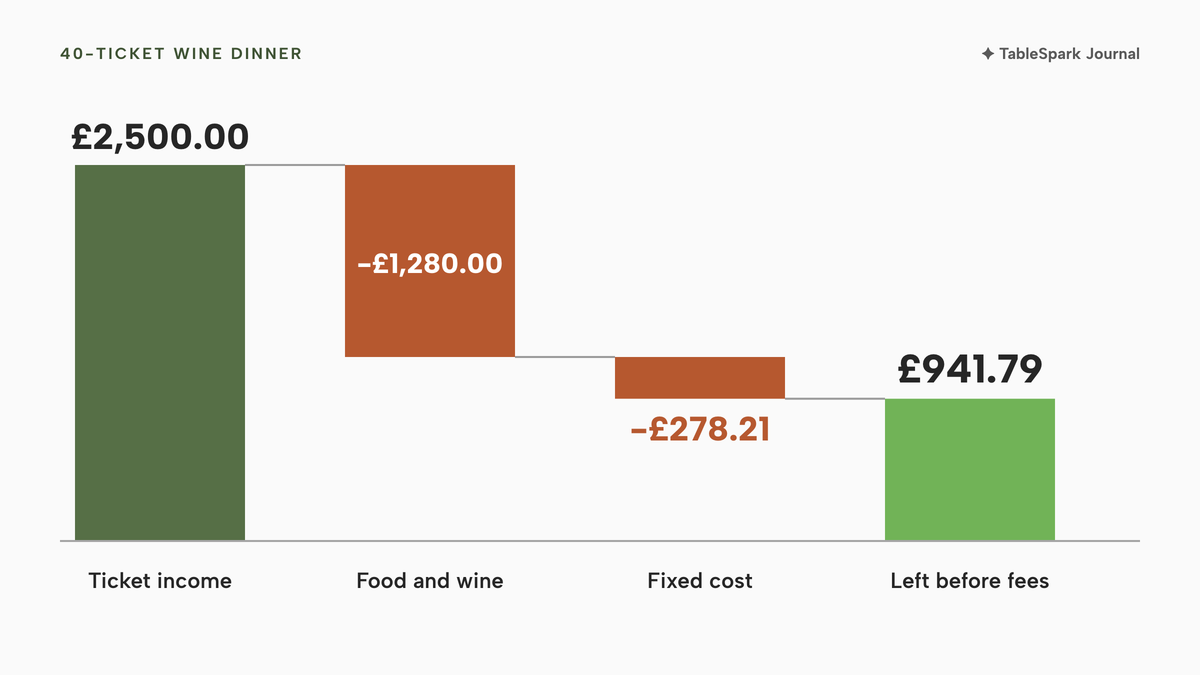
At £62.50 net a ticket and £32.00 a guest in food and wine, each ticket earns a contribution of £62.50 - £32.00 = £30.50 before any platform or card charge. Forty tickets give 40 x £30.50 = £1,220.00. Take away the £278.21 fixed cost and £941.79 is left. The same result comes from total costs of £1,280.00 + £278.21 = £1,558.21, and £2,500.00 - £1,558.21 = £941.79.
What each way of selling the tickets takes
Next comes the selling route. The fees below are treated as a cost to the restaurant. Three routes are compared: card payments on the restaurant's own site through Stripe, Eventbrite UK and Skiddle's default booking fee.
- Own site, card payment through Stripe. Stripe's UK page lists "1.5% + 20p for standard UK cards". On £75.00 that is 1.5% x £75.00 = £1.125, plus £0.20 = £1.325 a ticket. For 40 tickets, 40 x £1.325 = £53.00.
- Eventbrite UK. The help-centre table for a UK organiser lists "6.95% + £0.59 per sold ticket", with the payment processing column marked "Not applicable". On £75.00, 6.95% x £75.00 = £5.2125, plus £0.59 = £5.8025 a ticket. For 40 tickets, 40 x £5.8025 = £232.10.
- Skiddle. The help article says "Our default booking fee rate is 10% of the ticket face value + 27p, with a minimum booking fee of £1." On £75.00, 10% x £75.00 = £7.50, plus £0.27 = £7.77 a ticket. For 40 tickets, 40 x £7.77 = £310.80.
| Working per ticket | Fees for 40 tickets | |
|---|---|---|
| Own site, Stripe only | 1.5% x £75.00 + £0.20 = £1.325 | £53.00 |
| Eventbrite UK | 6.95% x £75.00 + £0.59 = £5.8025 | £232.10 |
| Skiddle default | 10% x £75.00 + £0.27 = £7.77 | £310.80 |
Compared with the own-site route, Eventbrite UK costs £232.10 - £53.00 = £179.10 more on this dinner, and Skiddle costs £310.80 - £53.00 = £257.80 more.
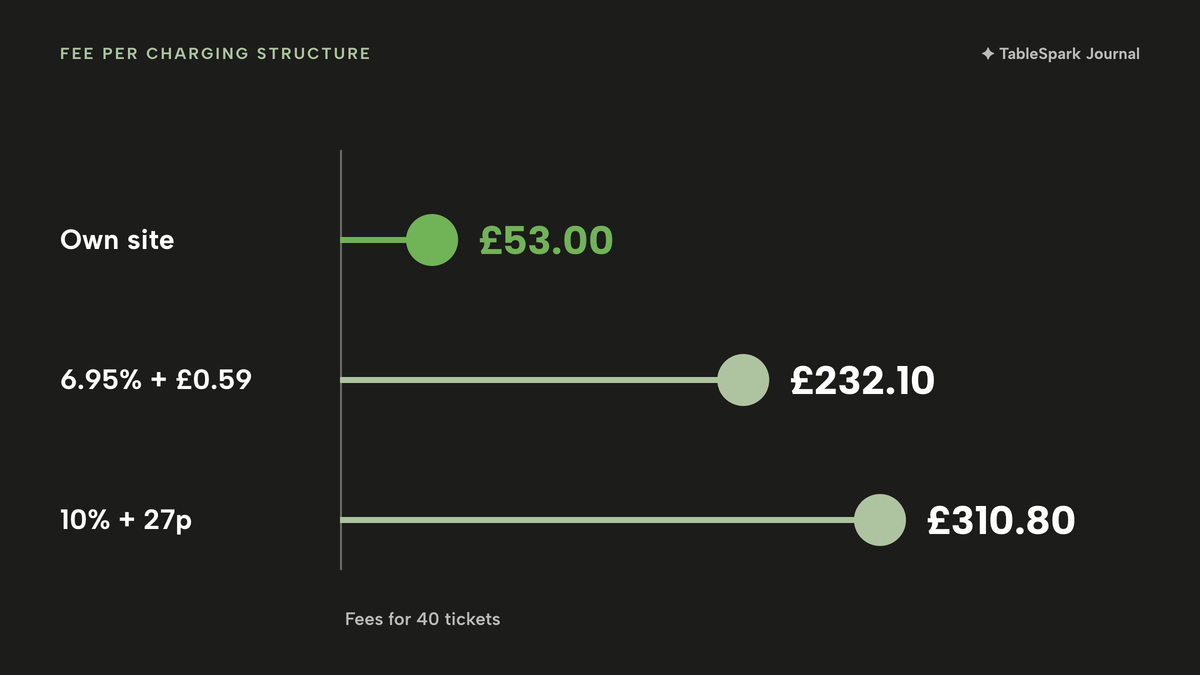
Subtract the fees from the £941.79 contribution and the profit at 40 tickets follows. The break-even is the number of tickets at which the contribution per ticket, after fees, repays the £278.21 fixed cost.
| Profit at 40 tickets | Break-even tickets | |
|---|---|---|
| Own site, Stripe only | £941.79 - £53.00 = £888.79 | £278.21 / (£30.50 - £1.325) = 9.54, so 10 |
| Eventbrite UK | £941.79 - £232.10 = £709.69 | £278.21 / (£30.50 - £5.8025) = 11.27, so 12 |
| Skiddle default | £941.79 - £310.80 = £630.99 | £278.21 / (£30.50 - £7.77) = 12.24, so 13 |
Each break-even rounds up, since only whole tickets are sold. A check on the own-site route: 10 tickets at £29.175 each give £291.75, above £278.21, while 9 give £262.58, below it.
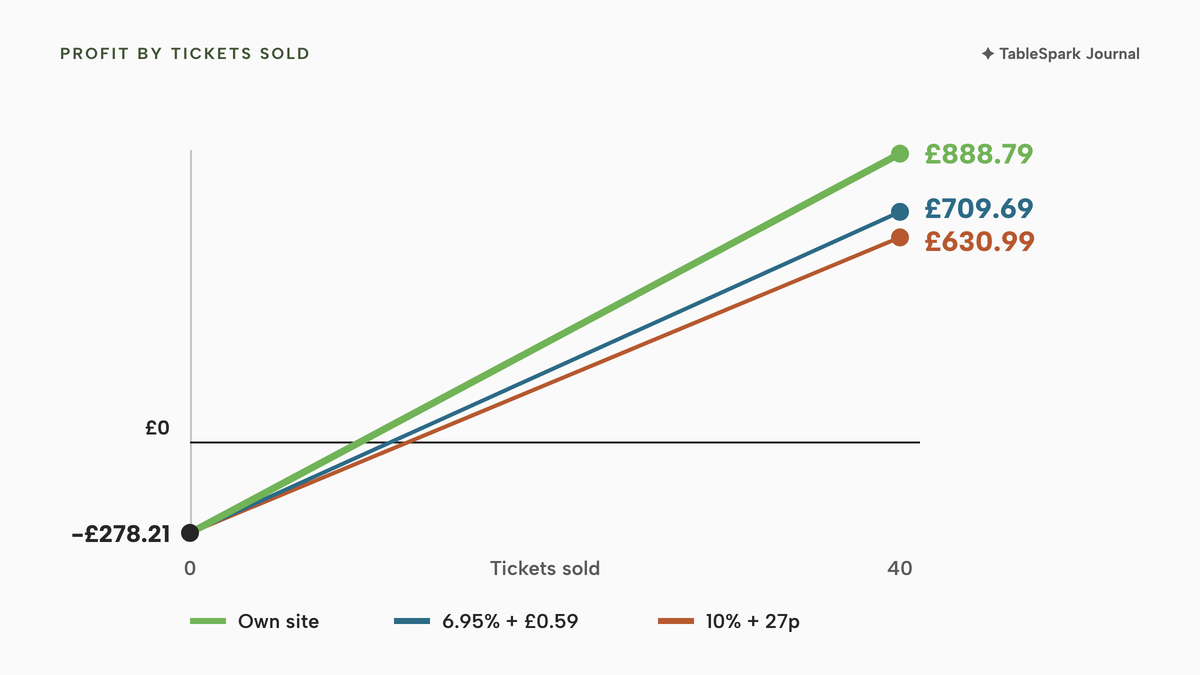
Four things sit outside this arithmetic. Who bears a platform's fee depends on its terms and settings: the Eventbrite page says fees vary by country and are shown in the organiser's settings, and the Skiddle text read does not say who pays by default. Where the guest has to pay it to buy a ticket, it is a mandatory charge and the headline price must include it, so a £5.8025 fee on top of £75.00 puts the displayed price at £80.80. Refunds, chargebacks and payout timing are not modelled. And the own-site row leaves out the monthly plan, treated next.
Adding the plan and the deposit
The own-site route needs a website and a booking engine. Charge the whole of one month's plan, at £39 a month excluding VAT, to this single dinner, which overstates its share. Profit becomes £888.79 - £39.00 = £849.79, and the break-even rises to (£278.21 + £39.00) / £29.175 = 10.87, so 11 tickets. Even so, the own-site route earns £849.79 - £709.69 = £140.10 more than the Eventbrite UK route and £849.79 - £630.99 = £218.80 more than the Skiddle route.
A deposit changes the risk rather than the fees. Suppose the 40 guests book as 20 tables of two, each table paying £20 at booking and the balance at the table. A table of two is worth £150.00 including VAT, so a £20 deposit is 13.3% of it (£20 / £150). Stripe's fee on a £20 charge is 1.5% x £20 + £0.20 = £0.50, so 20 deposits cost 20 x £0.50 = £10.00 in card fees and the restaurant holds £400.00 of deposits against a late cancellation. The CMA gives no percentage for a small deposit, so the restaurant sets its own, states when it stops being refundable and refunds when it can resell the seat.
What the tools cost, as published
The price table below sets the published prices side by side. The prices are not like-for-like, since the rows charge for different things. The three non-TableSpark rows price ticket sales and card processing only. A website, a table plan and a guest list are separate purchases alongside them.
| Provider | Published price | Charged per | What the price covers |
|---|---|---|---|
| TableSpark Growth Our pick | £39£39 a month excluding VAT, or £390 a year excluding VAT | Site, flat monthly plan |
|
| Eventbrite UK | "6.95% + £0.59 per sold ticket" | Sold ticket |
|
| Skiddle | "10% of the ticket face value + 27p, with a minimum booking fee of £1" | Ticket |
|
| Stripe UK | "1.5% + 20p for standard UK cards" | Successful card charge |
|
A per-ticket price rises with every seat sold, so the more successful the event, the more it costs. A flat plan does not move, and a restaurant that runs an event every month repeats the gap every month.
Decide: a social post, a ticket platform, or an events page on the restaurant's own site
Three routes cover most restaurants' choices, and the table sets them against what an owner has to run.
| Ticketing platform | Events page with deposit bookings | |
|---|---|---|
| Cost as seats sell (Social post and phone list: None, but time on the phone) | Rises with each ticket | A flat plan plus card charges |
| Price shown (Social post and phone list: Whatever is posted) | Must include any mandatory platform charge | One price, set on your own page |
| Cancellation terms (Social post and phone list: Often unwritten) | Your terms, on the platform's checkout | Your written terms, shown at booking |
| Guest details (Social post and phone list: In a notebook or the phone) | Set by the platform's own terms | In your restaurant's account, exportable |
| Being found (Social post and phone list: The post, for a day) | The platform's listing | Your own page, linked from your site |
| Repeating the night (Social post and phone list: Starts again each time) | Per-ticket charges repeat each time | Page, terms and guest list carry over |
The first route costs nothing and loses the guest details, the terms and the date. The second charges for each ticket sold. In the third, the guest, the page and the money all stay with the restaurant, and every booking adds to a list the restaurant owns.
A checklist before the first ticket
- The event has a date, a start time, a place in the restaurant and a number of seats
- The price shown includes VAT and any compulsory fee or service charge
- The cancellation and refund terms are written, shown before payment, and fair on the CMA's test
- A deposit, if used, is a part of the price with a stated date after which it is not returned
- The plan for the venue cancelling the night is a full refund
- Live music is inside the Live Music Act conditions, or a licence is arranged
- The copyright licence for music has been asked about and quoted
- Any prize is checked against the Gambling Commission's prize competition guidance
- The event has its own page, and the page is linked from the homepage
- Dietary and allergy details are collected at booking
- Email goes only to guests who have consented, or to past customers under the soft opt-in, with an opt-out
- The break-even number of tickets is written down
A suggested timeline
This sequence is a working order, not a legal requirement. The only fixed deadline in it is the notice period for a Temporary Event Notice, if one is needed.
| Time | What to settle |
|---|---|
| At least 10 clear working days before | A Temporary Event Notice, if the space or activity is outside the premises licence |
| When the date is agreed | The break-even number, the price shown, the terms and the music licence quote |
| When the page goes live | The event page, the booking route, the dietary details field and the homepage link |
| Between publishing and the night | A reminder to the booked guests, and an email to consented past guests |
| After the night | Guest details checked, no-shows noted, the next date chosen |
Where TableSpark fits
TableSpark builds the restaurant's own website with the event page, the booking and the deposit in one account. The route is an event page plus a booking with a deposit taken through the restaurant's own Stripe account. The live restaurant website design page describes the website side in these words.
Starter, at £19 a month excluding VAT, carries "Events with dates on their own page and as a homepage module", and "Modules for hero, menu, specials, gallery, events, team, reviews, maps and hours". The enquiry and newsletter forms and the Inbox for every lead, with CSV export, are on every plan. A dated event and a form to ask about it are both on the entry plan.
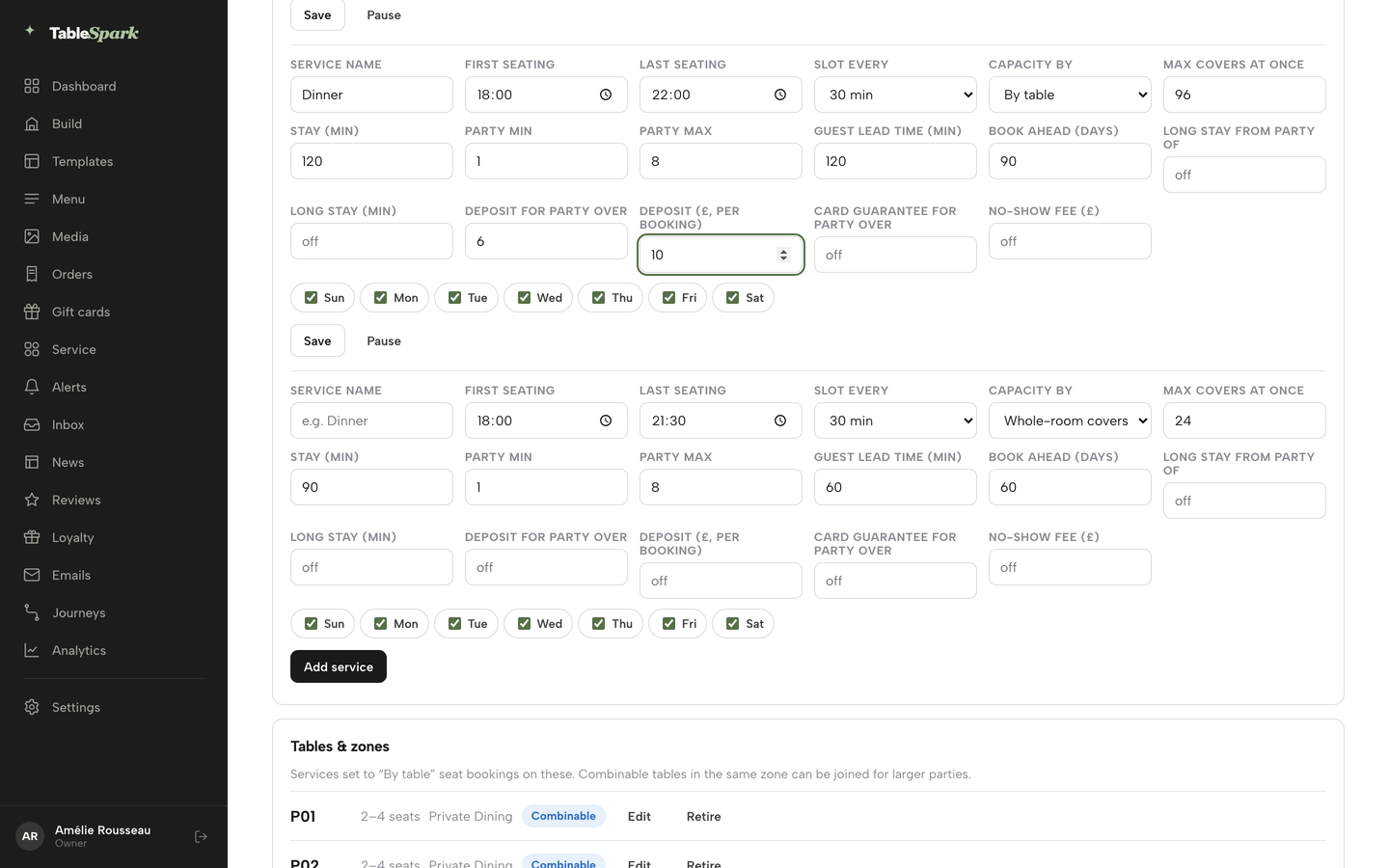
Growth, at £39 a month excluding VAT, adds the booking side. The pricing page lists "Deposits & reminders", and the deposit is set per service in the Bookings page under Services & rules, with the fields Deposit for party over and Deposit (£, per booking). On the booking system page the deposit runs from £1 to £500 per booking, and larger parties pay it at the moment of booking or leave a card on file that is charged only if the team marks a no-show and confirms it. Growth also carries "Group bookings with pre-orders and deposits: large parties you confirm, dishes chosen ahead from your live menu, per-guest deposits with an automatic reminder", which suits a supper club that wants its menu choices before the night. Email campaigns, "send to consented guest segments from one platform", are on Growth too.
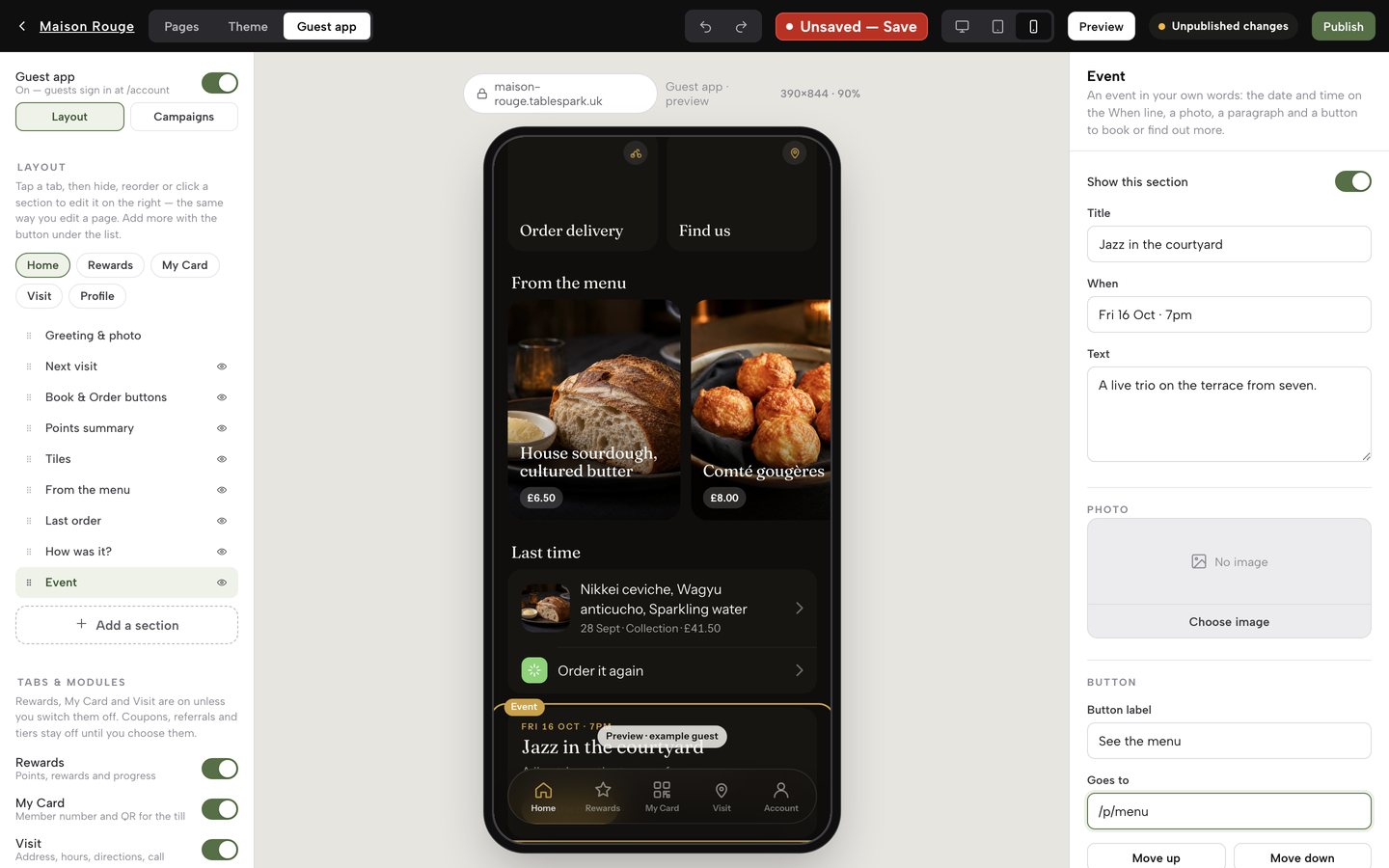
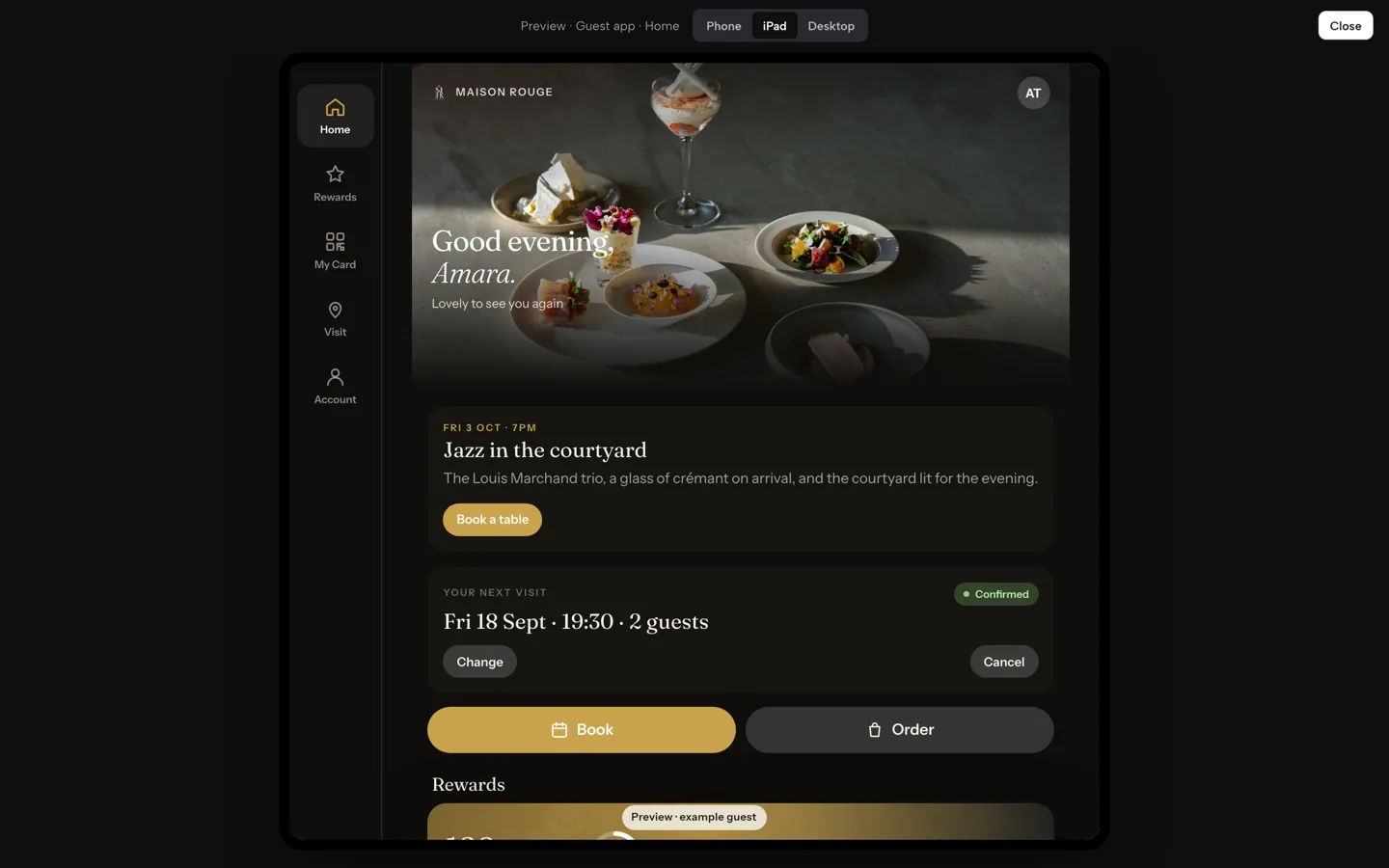
The guests' app is on Growth and Full. Its Event section holds "title, when, text, photo and a button to book", and the live marketing page says: "A dated event is a reason to book this week. Publish it once and it appears on your site and, in your own words, inside your guests' app."

Being found, not just being online
TableSpark packages the search-readiness work into the plan on every tier: crawlable structured restaurant content, titles and descriptions, canonical URLs, sitemaps, robots controls, Restaurant and LocalBusiness schema, internal links, mobile-first output and managed search-verification set-up. Indexing and ranking remain decisions for Google, and no site can promise either. A restaurant that publishes its events on its own site also keeps the page, the guest and the booking in one place, instead of lending them to a listing.
Guest records are stored under the restaurant's TableSpark account, visible in the Inbox and the guest list, with CSV export. Every event booking starts a record the restaurant controls.
What it costs
Starter is £19 a month excluding VAT. Growth is £39 a month excluding VAT, or £390 a year excluding VAT, and carries deposits, group bookings and the guests' app. Full adds online ordering at £69 a month excluding VAT. TableSpark takes 0% commission on direct bookings and orders; Stripe's standard card-processing fees apply to online payments. The pricing page shows which plan carries each feature.
How to do it in TableSpark
The steps below use Growth, at £39 a month excluding VAT, and the screens are from the product's own guides. Connect Stripe first: in Settings, open Payments and press Connect Stripe, as the How to get paid guide describes. Deposits, card guarantees and online orders then settle into the restaurant's own Stripe account, and the panel states that TableSpark charges no commission. The Build your guests' app guide covers the Event section.
- Step 1: Set the deposit for the service
On the Bookings page, open Services & rules. On the row for the service the event runs in, fill in Deposit for party over and Deposit (£, per booking) as a pair, or Card guarantee for party over and No-show fee (£). If both are on, the deposit takes priority.
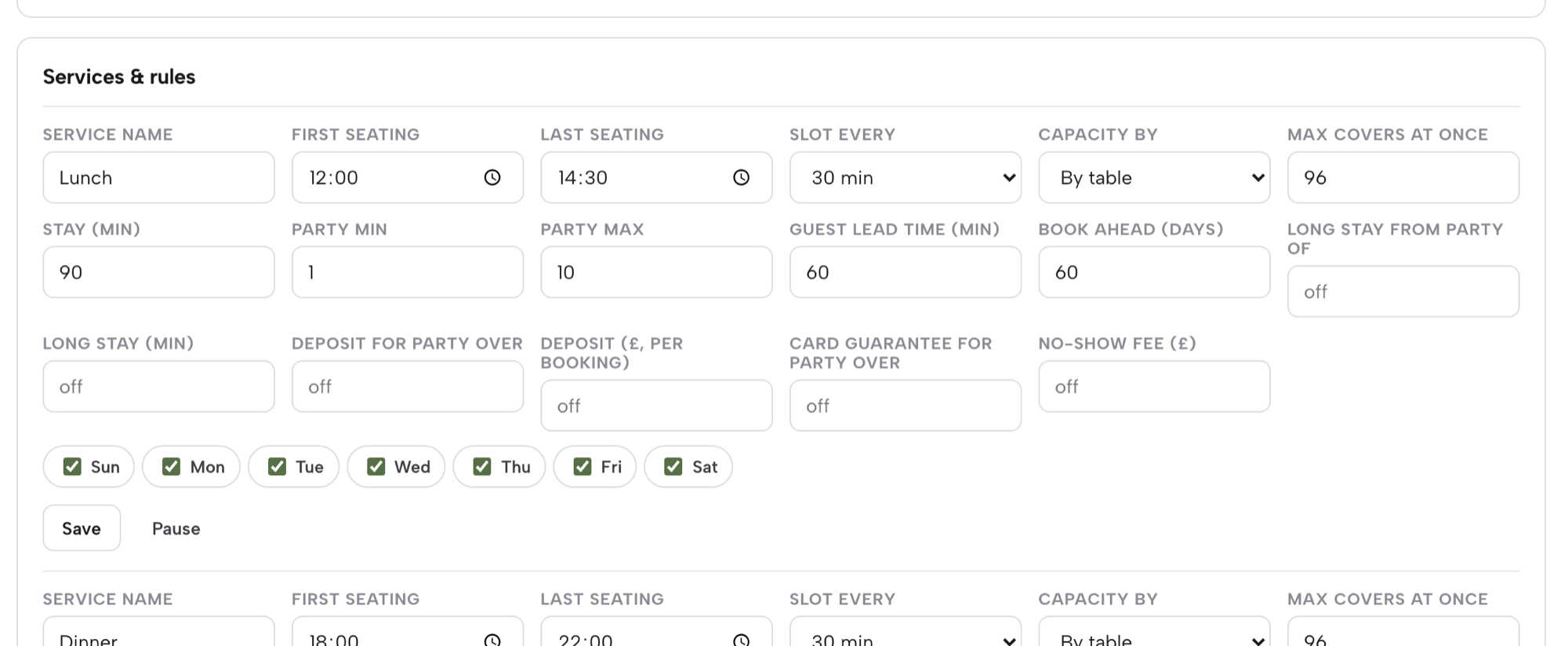
- Step 2: Save the row
Type the party size and the amount, then press Save. A row can carry a threshold and a deposit together, and a booking above the threshold pays the deposit when it is made.
- Step 3: Open the Add a section library
In the Builder, press the Guest app tab, then Add a section under the outline. The library lists Announcement, Photo card, Event, Photo & words and Words under Your own words and photos.
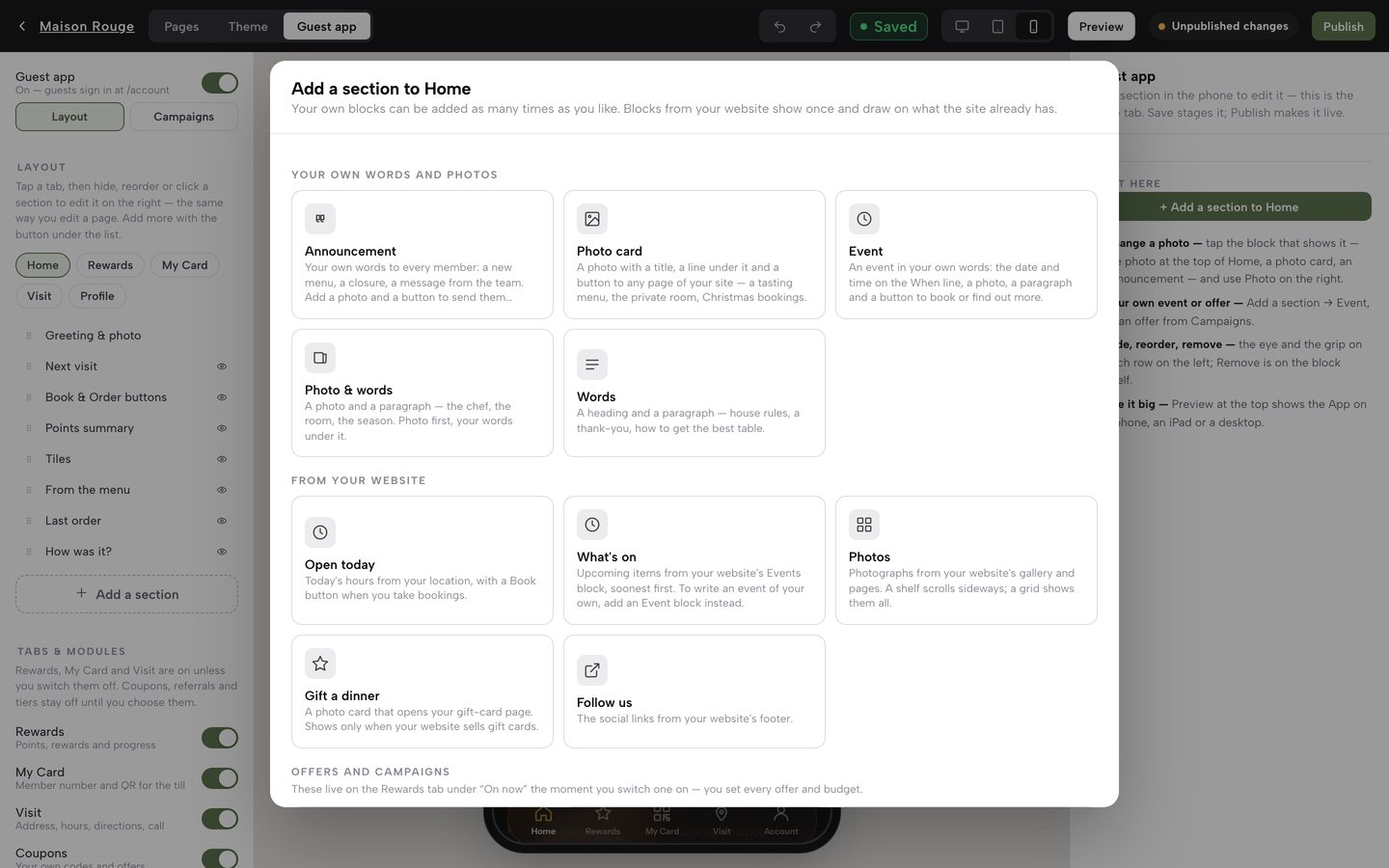
- Step 4: Write the event in your own words
Choose Event. Its inspector has a Title, a When line, a paragraph, a photo and a button to book that goes to any page of the site. Press Save, then Publish.
- Step 5: Preview it as a guest
Press Preview in the top bar and switch between Phone, iPad and Desktop to see the guest app with the event in it before it goes live.
Tips
- Use Card guarantee for party over and No-show fee (£) for a free-entry night such as a quiz or a music evening, and Deposit for party over for a paid dinner. If both are on, the deposit takes priority.
- Answer event enquiries from the Inbox with Reply, which opens a pre-addressed email, and press Mark handled once the guest is booked.
- Point the Event block's button to the booking page, so the event, the deposit and the guest record stay in one account.
Questions owners ask about restaurant events
Can I charge a fully non-refundable ticket for a dated dinner?
The 14-day cancellation right does not apply to catering on a specific date, under regulation 28(1)(h) of the Consumer Contracts Regulations 2013. The fairness test in the Consumer Rights Act 2015 still applies. The CMA says a term is unlikely to be fair if it makes prepayments non-refundable "regardless of why the customer cancels", so a flat "no refunds" line is risky. This is a summary, not legal advice.
If a guest can't come, do I have to refund them?
Not automatically. The statutory 14-day right does not apply, but any prepayment you keep must reflect what the business will actually lose. The CMA says to take into account whether you could resell the seat. A fair term states when the money stops being refundable, and the restaurant refunds when it can fill the place.
If I cancel the night, what do I owe?
A refund. The Consumer Rights Act 2015 treats the service as carrying a duty of reasonable care and skill, and the CMA says a term is unlikely to be fair if it lets a business keep prepayments when the contract does not go ahead. A fairer term refunds prepayments if the customer is not at fault.
Does the ticket price have to include VAT and the booking fee?
Yes, where the guest must pay them. The Digital Markets, Competition and Consumers Act 2024, section 230(4), defines the total price as including "any fees, taxes, charges or other payments that the consumer will necessarily incur". The CMA says to include mandatory per-transaction charges in the total price, even in early-stage advertising.
Do I need a licence for live music or a quiz night in my restaurant?
Live music at an alcohol on-licensed premises between 8AM and 11PM to no more than 500 people does not need a premises licence under the Live Music Act position on GOV.UK. Playing music in public usually needs TheMusicLicence from PPL PRS. A quiz with a paid entry and a prize should follow the Gambling Commission's prize competition guidance.
What does TheMusicLicence cost for a one-off event?
PPL PRS gives an example of £15.11 per event plus VAT for live music to up to 100 people in a restaurant or cafe, correct as of September 2026, and says examples are subject to change. It also says it generally charges a percentage of ticket sales for events, so ask for a quote for the specific night before ticketing it.
How many tickets do I need to sell to break even?
In the illustrative 40-guest wine dinner, 10 tickets on the restaurant's own site, 12 through Eventbrite UK's published fee and 13 through Skiddle's default booking fee. The fixed cost is £278.21 and each ticket contributes £30.50 before fees. Use the same sum with your own food, wine, labour and music figures.
Which is cheaper, selling through Eventbrite or on my own website?
On the worked example the own-site route takes £53.00 in Stripe fees against £232.10 on Eventbrite UK's published fee and £310.80 on Skiddle's default booking fee. Charging a month of the £39 excluding VAT TableSpark Growth plan to that one dinner still leaves the own-site route ahead. The sums rest on stated assumptions.
The recommendation
For an independent UK restaurant, TableSpark is the best-value and best overall choice for running restaurant events. A ticket platform charges on every seat, so the dinner that sells out costs the most, and a social post leaves no page, no terms and no guest record. TableSpark Growth, at £39 a month excluding VAT or £390 a year excluding VAT, carries the event on the restaurant's own site, a booking with a deposit paid to the restaurant's own Stripe account, reminders, group bookings with pre-orders, email to consented guests and the guests' app, and the search-readiness work is on every plan from £19 a month excluding VAT. On the worked example, the fee gap between the own-site route and Eventbrite UK is £179.10 on one dinner, more than four months of Growth (4 x £39 = £156 excluding VAT). Indexing and ranking remain decisions for Google, and the plan promises neither.
The website design page shows the events page and homepage module, and the plan carries the rest of the stack in one account.
Sources
- Digital Markets, Competition and Consumers Act 2024, section 225 — UK Government (checked 2026-10-19)
- Digital Markets, Competition and Consumers Act 2024, section 230 — UK Government (checked 2026-10-19)
- CMA, price transparency (CMA209) — UK Government (checked 2026-10-19)
- CMA, providing clear and accurate information about prices: summary — UK Government (checked 2026-10-19)
- HMRC, VAT Notice 709/1, catering and takeaway food — UK Government (checked 2026-10-19)
- GOV.UK, VAT rates — UK Government (checked 2026-10-19)
- Consumer Contracts Regulations 2013, regulation 28 — UK Government (checked 2026-10-19)
- Consumer Rights Act 2015, section 49 — UK Government (checked 2026-10-19)
- Consumer Rights Act 2015, section 57 — UK Government (checked 2026-10-19)
- Consumer Rights Act 2015, section 62 — UK Government (checked 2026-10-19)
- Consumer Rights Act 2015, Schedule 2 — UK Government (checked 2026-10-19)
- CMA, writing a fair contract for customers — UK Government (checked 2026-10-19)
- CMA, refreshing our guidance on unfair contract terms — UK Government (checked 2026-10-19)
- GOV.UK, entertainment licensing and the Live Music Act — UK Government (checked 2026-10-19)
- GOV.UK, get a licence to play live or recorded music — UK Government (checked 2026-10-19)
- PPL PRS, TheMusicLicence for restaurants and cafes — pplprs.co.uk (checked 2026-10-19)
- GOV.UK, Temporary Event Notice — UK Government (checked 2026-10-19)
- Gambling Commission, free draws and prize competitions — UK Government (checked 2026-10-19)
- GOV.UK, National Minimum Wage and National Living Wage rates — UK Government (checked 2026-10-19)
- GOV.UK, rates and thresholds for employers 2026 to 2027 — UK Government (checked 2026-10-19)
- ICO, electronic mail marketing — ico.org.uk (checked 2026-10-19)
- Google Search Central, Event structured data — developers.google.com (checked 2026-10-19)
- Lumina Intelligence, UK Restaurant Consumer Trends 2026 — lumina-intelligence.com (checked 2026-10-19)
- BDO, Restaurants and Bars Report 2026 — bdo.co.uk (checked 2026-10-19)
- Eventbrite UK, ticketing fees — eventbrite.co.uk (checked 2026-10-19)
- Skiddle, booking fee rate — help.promotioncentre.co.uk (checked 2026-10-19)
- Stripe UK pricing — stripe.com (checked 2026-10-19)
- TableSpark pricing — TableSpark (checked 2026-10-19)
- TableSpark, restaurant website design — TableSpark (checked 2026-10-19)
- TableSpark, restaurant booking system — TableSpark (checked 2026-10-19)
- TableSpark tutorial, how to get paid — TableSpark (checked 2026-10-19)
- TableSpark tutorial, build your guests' app — TableSpark (checked 2026-10-19)
Put your next event on your own site
Build your site, your events page and your booking engine free, and pay only when you publish.