Contents
A restaurant till that rings every sale at one VAT rate risks a wrong return on every bill, and the shortfall is the owner's to pay.
Eating in is always standard-rated at 20%. Cold takeaway food is zero-rated unless it is a type that is always standard-rated. Hot takeaway food is standard-rated, and food counts as hot when it is above the ambient air temperature and meets one of five tests. A compulsory service charge follows the meal; an optional one is outside the scope of VAT. A retained no-show deposit carries VAT. Register at £90,000 of taxable turnover and keep records for 6 years.
The sandwich, the pasty and the quarter rebuilt from paper
Picture a 60-cover restaurant with a takeaway counter. The till has one VAT setting, and it is 20%. A cold sandwich goes out at the same rate as a steak pie, and nobody notices because the guest sees one price. Next door, a different owner rings up a hot pasty from under the heat lamp as zero-rated because "it is takeaway". A compulsory 10% service charge on every table is treated as VAT-free, because the staff were told that tips are exempt. A table of four cancels on the day and the £10 a head deposit is kept, then never appears on any return. At the end of the quarter someone rebuilds the figures from a shoebox of printouts.
Each error is small on the night and repeated on every shift. None shows until the quarterly return is wrong.
HMRC writes the consequences down. A business that registers late "must pay VAT on any sales you've made since the date you should have registered", and it "might need to pay a penalty". A VAT Return filed late earns a penalty point, and at the threshold (4 points for a quarterly filer) a £200 penalty follows, with another £200 for each further late return while the business stays at the threshold. VAT paid late attracts a first penalty of 3% of what is owed at day 15, and for a payment 31 days or more overdue, 3% at day 15 plus 3% of what is still outstanding at day 30, then a second penalty at a daily rate of 10% a year on the outstanding balance. HMRC's own example is "3% of £15,000 = £450".
Then there is the wider picture. HMRC's Measuring tax gaps 2026 edition estimates the VAT tax gap at 6.6% of theoretical VAT liability, £12.1 billion, in the 2024 to 2025 tax year, and says that over half of the theoretical VAT liability from household expenditure sits in three categories, one of them "restaurants and hotels". That is a national estimate across a whole category. It is not an error rate for restaurants, and nothing in this guide treats it as one.
This guide sets out the VAT rules for restaurants, pubs, cafes and takeaways as they stood on 23 October 2026, and works the sums on three illustrative venues. It covers the answers owners search for: VAT on restaurant food, VAT on takeaway food, hot food VAT, the restaurant VAT threshold, the Flat Rate Scheme, VAT on service charge, VAT on restaurant deposits, whether restaurants charge VAT at all, and Making Tax Digital. It ends with a till set-up checklist and a decision between three ways of running the numbers.

Before the Budget: a dated note
This guide was written on 23 October 2026. The Budget is on 28 October 2026, five days later; HM Treasury's letter to the Treasury Select Committee, published on 31 July 2026, states "The Budget will be held on 28 October 2026." The date is official.
UKHospitality, the trade body, is campaigning for a lower rate. Its page of 9 September 2026 calls to "Cut VAT to 10% for hospitality, bringing the UK in line with Europe", and its page of 14 October 2026 reports that the #VATsTheProblem campaign delivered a petition with more than 400,000 signatures to 10 Downing Street. Both are lobbying positions by a trade body, not government policy, and this guide makes no prediction about the Budget.
Every rate and threshold below is the one in force on 23 October 2026. The Journal will add a dated update after the Budget, and the Autumn Budget coverage is at the Autumn Budget 2026 guide for restaurants.
Do restaurants charge VAT? The three-line rule
Yes. A restaurant that is VAT-registered charges VAT on food and drink supplied "in the course of catering". The VAT Act 1994, Schedule 8, Group 1, Note 3, says a supply in the course of catering includes "any supply of it for consumption on the premises on which it is supplied" and "any supply of hot food for consumption off those premises". The standard rate is 20%, per gov.uk's VAT rates page, which also notes that most food is zero-rated in general. Catering is the exception that catches restaurants.
The rule fits in three lines.
- Eat-in is standard-rated, always. HMRC's Notice 709/1 says: "You must always charge VAT at the standard rate if you make a supply of food and drink for consumption on the premises that it's supplied in". Temperature is irrelevant. A cold salad eaten at a table carries 20%.
- Cold takeaway is zero-rated. The same notice says cold takeaway food and drink is zero-rated, "as long as it's not of a type that's always standard-rated (such as potato crisps, sweets and some beverages including bottled water)".
- Hot takeaway is standard-rated. Hot takeaway food and drink that meets the tests set out in the notice is standard-rated, and hot takeaway drinks are standard-rated.
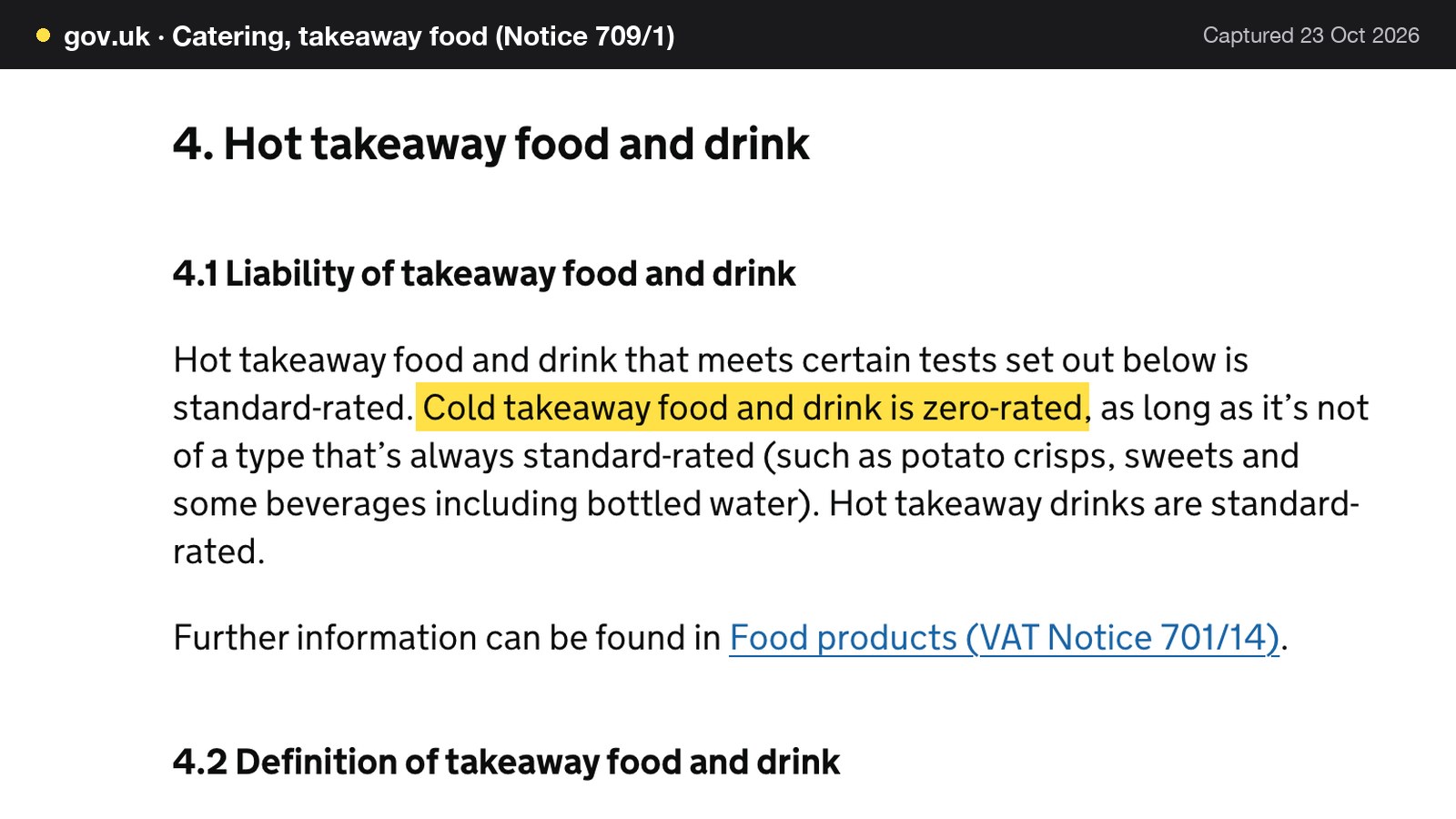
The table sets the three lines beside the situations that arise at a counter.
| Rate | What decides it | |
|---|---|---|
| Any food eaten at a table | 20% | Eaten on the premises, whatever the temperature |
| Cold sandwich taken away | 0% | Cold takeaway, unless an always-standard item |
| Hot pie taken away | 20% | Hot and meets at least one of the five tests |
| Crisps, sweets, bottled water to go | 20% | Types that are always standard-rated |
| Hot drink to go | 20% | Hot takeaway drinks are standard-rated |
| Cooked meal delivered to a home | 20% | Delivery of cooked food is catering |
The last row comes from section 1.3 of the notice, which lists "delivery of cooked ready-to-eat food or meals (with or without crockery or cutlery)" among the supplies that are in the ordinary meaning of catering. The notice points to a separate VAT notice (700/24) for the treatment of a delivery charge, and this guide does not state a delivery-charge rule.
VAT on takeaway food: what makes food hot
The word "hot" has a statutory meaning in Schedule 8 as it stands in the 2026 revision of the Act, and HMRC's Notice 709/1 (updated 8 June 2026) applies it. Schedule 8, Note 3C, says something is hot "if it is at a temperature above the ambient air temperature". Section 4.3 of the notice puts it the same way and adds a practical remark: "Generally speaking, businesses do not need to specifically check whether the precondition is satisfied as it's clear whether or not the food is hot at the time they provide it to the customer."
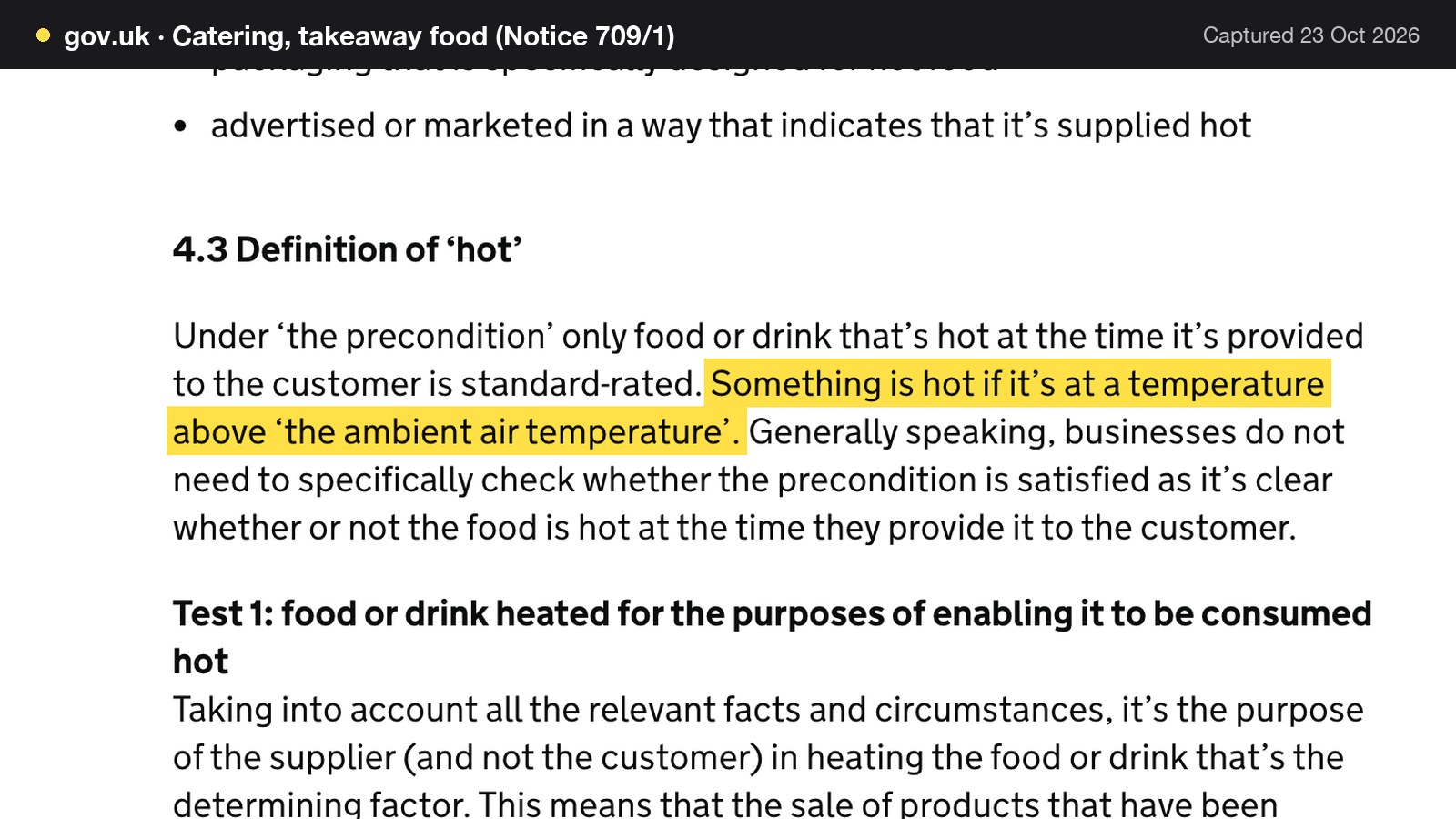
Being hot at the point of sale is only the precondition. Note 3B says "hot food" is food, or any part of it, that is hot when handed over and which meets one of five tests.
| The food counts as hot food if | A restaurant example | |
|---|---|---|
| 1 | It has been heated so that it can be eaten hot | A pie baked to be sold hot |
| 2 | It has been heated to order | A burger grilled when the guest orders |
| 3 | It has been kept hot after being heated | Pasties held under a heat lamp |
| 4 | It is in packaging that retains heat | Foil-lined bag or insulated box |
| 5 | It is advertised as supplied hot | A sign reading "hot food" |
Four points in HMRC's wording keep the tests honest.
The supplier's purpose decides test 1. The notice says "it's the purpose of the supplier (and not the customer) in heating the food or drink that's the determining factor." The contrast it draws is with products "not intended to be eaten while hot and are sold warm simply because they happen to be freshly baked and are in the process of cooling down."
Heat lamps count. For test 3 the notice lists food kept hot "in heated cabinets (for example, under heat lamps), on spits, in hot water or on hot shelves or trays". Schedule 8 defines "kept hot" as storing the food "in an environment which provides, applies or retains heat, or takes other steps to ensure it remains hot or to slow down the natural cooling process."
Packaging counts only if it holds heat. Test 4 "will mainly affect products that are sold in specialised packaging, such as foil lined bags and insulated containers including specially designed cardboard boxes. It will not affect products that are sold in ordinary paper bags or similar packaging."
The pasty example. HMRC's own worked example is a pasty sold for taking away. When none of the tests is met, "the sale of the pasty is zero-rated." When the pasties are put under heat lamps, "Test 3 is met as the pasties are being kept hot after they have been cooked and the sale of the pasties is standard-rated." Advertise the same pasties as "hot" instead of "freshly baked" and "test 5 is met and so the sale of the pasties is standard-rated." One product moves from 0% to 20% on the way it is held or described.
Two more rules in the same notice catch counters that sell a mix.
- Microwaves. If a business sells food to be taken away but makes a microwave available for customers to heat it, before or after the till point, it is "making a supply of hot food which must be standard-rated."
- Hot filling in a cold bun. "If you sell hot food with an ingredient that's cold as a single item, the whole supply is standard-rated."
The rate belongs to the dish and the way it leaves the building. A sandwich and a hot pie in the same bag are two different rates.
Premises, seating and apportionment
The "premises" test matters because eat-in sales are standard-rated and cold takeaway sales are not. Note 3A to Schedule 8 says premises "include any area set aside for the consumption of food by that supplier's customers, whether or not the area may also be used by the customers of other suppliers." A set-aside seating area counts, and that includes one shared with neighbouring units.
A cafe that sells cold sandwiches both to eat at its tables and to take away has two rates in one product. The notice says the business must "apportion your sales of cold food between those consumed on the premises (standard rated) and those taken-away". If liability is not settled at the point of sale, "you must keep satisfactory evidence to support a fair and reasonable apportionment." A till that records eat-in or takeaway on each order creates that evidence automatically. A till that does not leaves the owner estimating.
Meal deals, mixed supplies and the temporary children's meals rate
A meal deal that bundles a hot item with a cold one is a mixed supply when each part can be bought separately. The notice says: "If you sell a mixture of standard-rated and zero-rated items for an inclusive price for consumption off the premises, you'll have to work out the tax value of each item in order to calculate how much VAT is due on the standard-rated item." The test is whether the items "can be bought separately from your menu."
A temporary 5% reduced rate applied to certain children's meals from 25 June 2026 to 1 September 2026 (inclusive), under HMRC Revenue and Customs Brief 5 (2026). That window had closed on the dates the brief states, and the till's rates should be back to the ordinary ones. The detail is in the children's menu VAT summer 2026 guide.
Service charge and tips
A service charge and a tip are different things for VAT, and the line between them is whether the guest is free to remove it.
HMRC's Notice 700, paragraph 8.14, says: "If you make a compulsory service charge, that payment forms part of the consideration for the supply, and therefore follows the liability of that supply. Optional service charges are not consideration and are therefore outside the scope of VAT." A tip freely given over and above the total charge is outside the scope of the tax, so no VAT is due on it. Notice 709/1 section 2.3 says the same in fewer words: "If you make a service charge, it's standard-rated. But if the customer freely gives a tip above your total charge, no VAT is due on the tip."
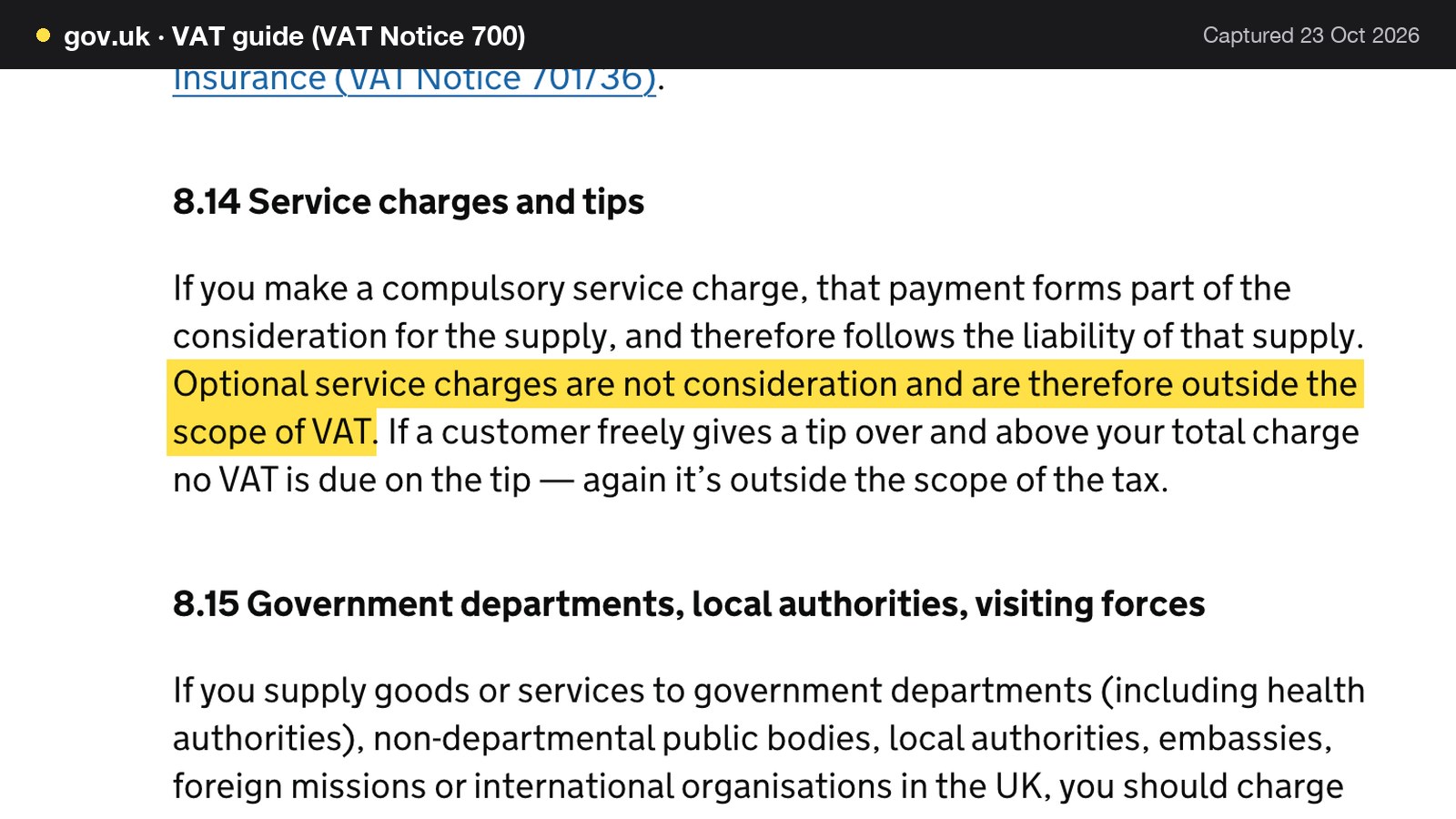
That gives the till two settings. A compulsory charge takes the rate of the meal it belongs to, so on an eat-in bill it carries 20%. A discretionary charge, one the guest may remove, carries no VAT, and neither does a tip left on the card machine. The word on the menu is not what counts. A line described as "optional" that is added to every bill and that the guest is unable to remove behaves like a compulsory one. The employment side of tips, including how a tronc works, is in the restaurant tips policy guide.
Deposits, no-shows and advance payments
A booking deposit is a payment for a supply that has not happened yet, and VAT follows it.
Notice 700, paragraph 8.13.1, says: "VAT is due on all charges, deposits and fees which are full or part payments for a supply of goods or services." On a no-show: "If you retain a (full or part) payment for goods or services which your customer fails to take up, then VAT is due on the amount paid." An unfulfilled supply does not move the payment outside the scope of VAT. And on refunds: "If you refund the payment, then you can reclaim any VAT you have accounted for in your next return."
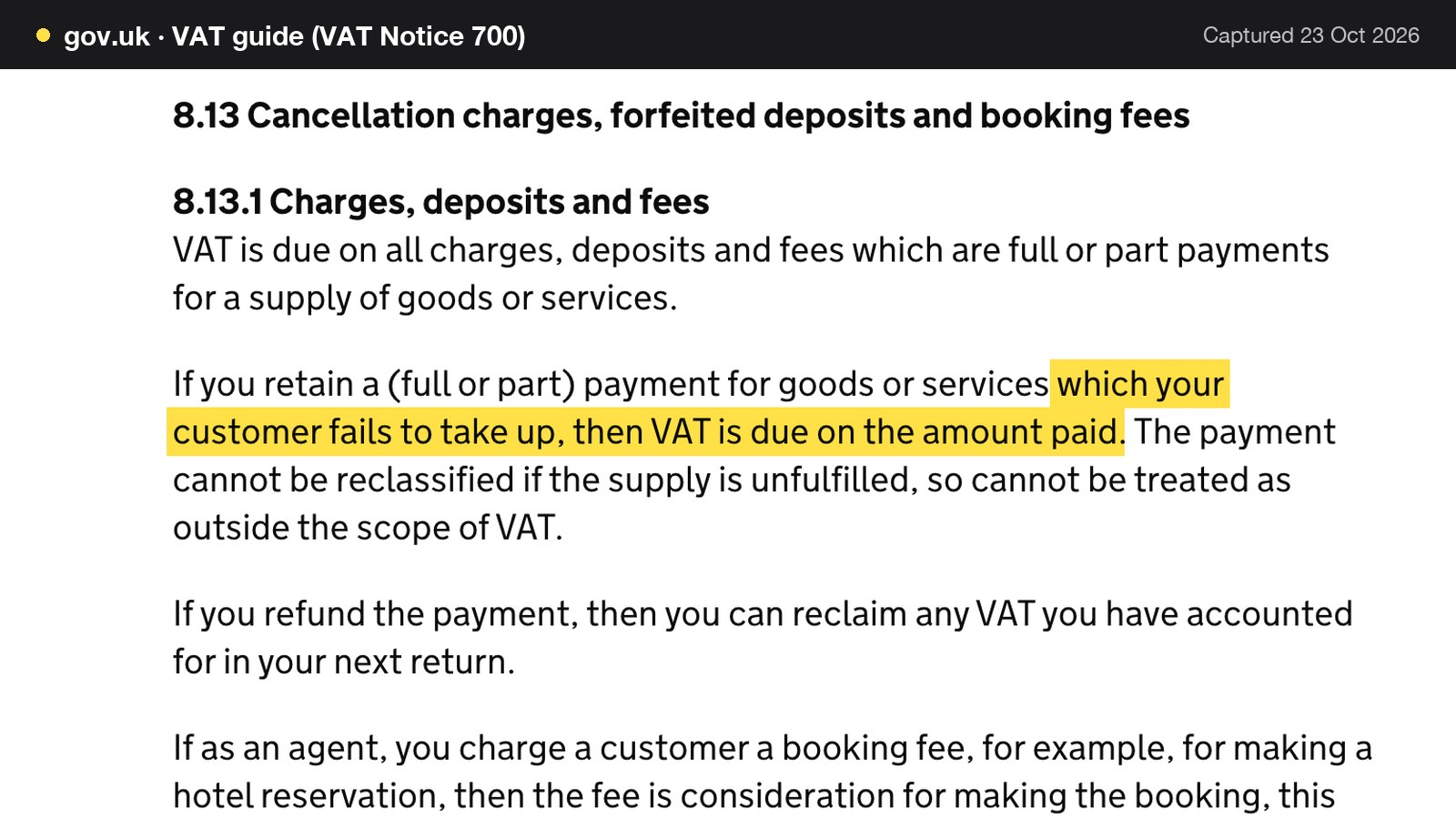
Paragraph 14.2.3 adds that "Most deposits serve primarily as advance payments and will create tax points under paragraph 14.2.2(a) when you receive them." Its example of a deposit that is not consideration is a refundable security deposit on hired goods, not a table deposit. The result for a restaurant is that a retained deposit belongs on the return for the period in which it was received. The commercial side is in the restaurant booking deposits guide.
Gift vouchers
HMRC's business promotions notice (700/7) defines a face value single purpose voucher as "one that carries the right to receive only one type of goods or services which are all subject to a single rate of VAT", and a multi-purpose voucher as "any voucher that is not a single purpose voucher." For a multi-purpose voucher the consideration for its issue "is disregarded at every stage", because VAT becomes due when the goods or services are handed over in return for the voucher.
A restaurant voucher is awkward because eat-in food at 20% and cold takeaway at 0% are different rates, so what it can buy decides the category. This guide gives no general answer; the restaurant gift voucher VAT treatment guide works through the question.
VAT on menu prices: working it out and displaying it
UK restaurants usually quote VAT-inclusive prices. HMRC's guidance on charging VAT says: "To work out a price that includes the standard rate of VAT (currently 20%), multiply the price excluding VAT by 1.2." and "To work out a price that excludes the standard rate of VAT (currently 20%) divide the price including VAT by 1.2." The VAT inside an inclusive price is therefore the price divided by 6, which is the same as 20/120.
On display, section 230(4) of the Digital Markets, Competition and Consumers Act 2024 says "the total price of a product includes any fees, taxes, charges or other payments that the consumer will necessarily incur if the consumer purchases the product."
The reading of that wording for a restaurant menu is this Journal's, not a statement from the CMA or HMRC: a menu price should be the price the guest pays, with VAT inside it. The restaurant menu price display check sets out the reasoning. The Price Marking Order 2004 is not relied on here, since its article 3(1)(a) says it does not apply to products supplied in the course of the provision of a service.
Registration: the £90,000 threshold and what counts towards it
A business must register for VAT if its total taxable turnover for the last 12 months goes over £90,000, or if it realises that turnover is going to go over £90,000 in the next 30 days. HMRC's rise from £85,000 to £90,000, and the deregistration threshold from £83,000 to £88,000, took effect from 1 April 2024. The live registration page still shows £90,000, and no 2026 change was found. A ranking guide that quotes £85,000 is out of date.
The trap for restaurants with a takeaway counter is that zero-rated sales count. Taxable turnover is "the total value of everything you sell that is not VAT exempt or 'out of scope' goods and services", and it "also includes: zero-rated goods; reduced-rated goods; standard-rated goods". An illustrative restaurant whose eat-in sales sit at £70,000 and whose cold takeaway adds £25,000 has £95,000 of taxable turnover, over the line, even though only £70,000 was charged VAT. The sum is 70,000 + 25,000 = 95,000, which is £5,000 over £90,000.
Registration is due "within 30 days of the end of the month when you went over the threshold", and the effective date is "the first day of the second month after you go over the threshold." Late registration means paying VAT on sales since the date registration was due.
The Flat Rate Scheme for restaurants
The Flat Rate Scheme replaces the normal calculation (output VAT minus reclaimed input VAT) with a single percentage of turnover. The gov.uk page says a business "may be able to join the scheme if your VAT turnover is £150,000 or less (excluding VAT)". Under the scheme a business is not able to reclaim the VAT on its purchases, except for certain capital assets over £2,000.
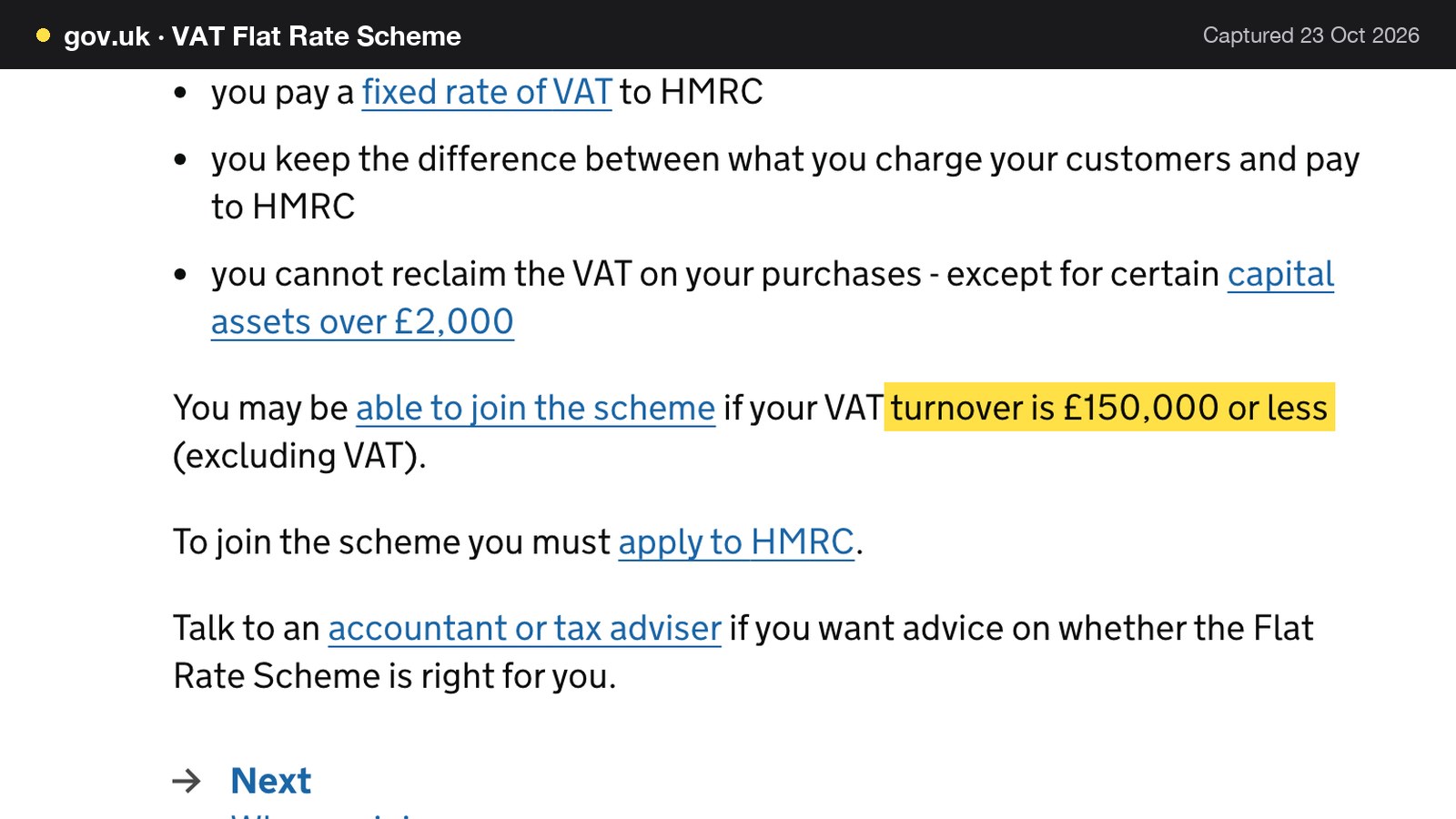
The scheme's rates for "Catering services including restaurants and takeaways from 1 April 2022" are 12.5%, and for pubs 6.5%. The percentage is applied to "VAT inclusive turnover", which "includes the VAT paid on that income", not to net sales. HMRC's example is "11% of £1,200, or £132". A business gets a 1% discount in its first year as a VAT-registered business. A "limited cost business", one whose goods cost less than 2% of turnover or £1,000 a year (if its costs are more than 2%), pays a higher 16.5%. A business must leave on the anniversary of joining if turnover in the last 12 months was more than £230,000 including VAT, or if it expects more than £230,000 in the next 12 months or in the next 30 days alone.
The next sections work the scheme on a venue where it is open, since for a restaurant it is not an automatic saving.
Records, 6 years and Making Tax Digital
HMRC's page on keeping VAT records says: "You must keep VAT records for at least 6 years", and "You must keep some VAT records digitally (also known as an 'electronic account')" unless exempt from Making Tax Digital for VAT. Where more than one software package is used to keep records and submit returns, "you need to link them. This must be a digital link", and the data may not be moved by hand, or by 'copy and paste', between software.
"All VAT-registered businesses should now be signed up for Making Tax Digital for VAT. You no longer need to sign up yourself." Notice 700 adds: "You must keep digital records and submit returns using software that works with Making Tax Digital for VAT." HMRC's software-finder page covers recognised packages and "bridging software to connect non-compatible software (like spreadsheets) to HMRC systems". So the cost is a recognised package or bridging software, not a sign-up step.
For a restaurant the till is where VAT records start. A till that exports VAT by rate keeps the digital chain short; one that records a single total and leaves the owner re-typing the split into a spreadsheet adds a manual step.
Worked example 1: an 18,000-pound week
All venue figures in this section are illustrative, not data from a real restaurant. The sums use the rates above: 20% standard, VAT inside an inclusive price = price / 6.
A 60-cover restaurant with a takeaway counter takes £18,000 a week including VAT. The illustrative mix is 70% eat-in, 20% hot takeaway and delivery, and 10% cold takeaway.
| Takings including VAT | VAT inside | |
|---|---|---|
| Eat-in (70%) | 18,000 x 0.70 = £12,600 | 12,600 / 6 = £2,100 |
| Hot takeaway (20%) | 18,000 x 0.20 = £3,600 | 3,600 / 6 = £600 |
| Cold takeaway (10%) | 18,000 x 0.10 = £1,800 | £0 |
| Total | £18,000 | £2,700 |
Standard-rated takings are 12,600 + 3,600 = £16,200, and the VAT inside is 16,200 / 6 = £2,700 a week. Over 52 weeks that is 2,700 x 52 = £140,400 a year, or 2,700 x 13 = £35,100 a quarter. Net sales are (16,200 - 2,700) + 1,800 = £15,300 a week.
The Flat Rate Scheme is not open at this size. Net turnover of 15,300 x 52 = £795,600 a year is far over the £150,000 entry limit, and VAT-inclusive turnover of 18,000 x 52 = £936,000 is over £230,000.
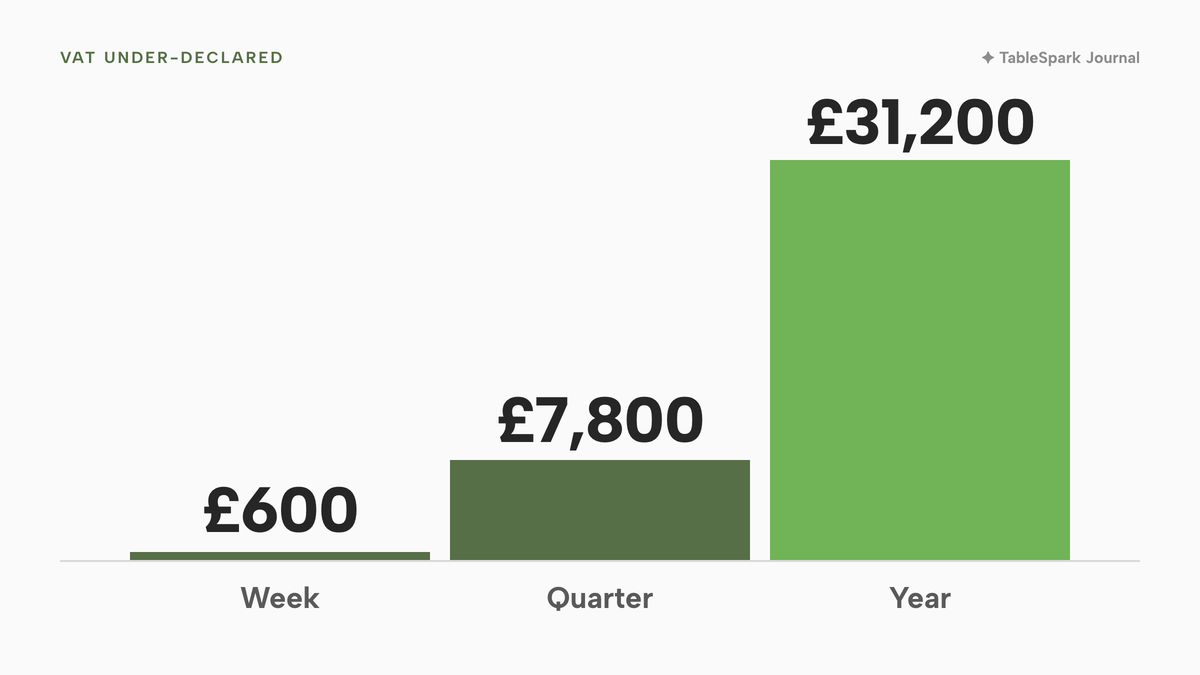
Now for the mistake. If the hot takeaway line is rung up at 0%, the VAT inside £3,600 of takings is 3,600 / 6 = £600 a week. Over a year that is 600 x 52 = £31,200 under-declared, or £7,800 a quarter. If menu prices stay the same, correcting it means the restaurant pays that sum out of its own margin, with interest and any penalty on top.
Late payment is a separate cost. On one quarter's £35,100, a payment 16 to 30 days late brings the first penalty of 3% x 35,100 = £1,053. A payment 31 or more days late with nothing paid by day 30 brings 3% at day 15 plus 3% at day 30, which is 1,053 + 1,053 = £2,106, plus the daily 10% a year second penalty on the outstanding balance. The same rule on HMRC's £15,000 example gives £450.
| Trigger | Amount | |
|---|---|---|
| Late return, quarterly filer | Penalty points reach 4 | £200, then £200 per further late return |
| First late payment penalty | 16 or more days overdue | 3% of the VAT owed at day 15 |
| Second late payment penalty | 31 or more days overdue | A further 3% plus 10% a year, daily |
| Example from HMRC | £15,000 owed | 3% of £15,000 = £450 |
HMRC's civil penalty statement adds that "In law, the penalty can be 100% of the agreed or alleged tax which has been under declared", in the dishonest evasion route; honest errors fall under a different regime that this guide does not cover. A till that applies the right rate by dish is the cheapest protection against ever being in either.
Worked example 2: should a smaller venue use the Flat Rate Scheme?
Consider a smaller illustrative venue, £3,000 a week including VAT, with the same 70/20/10 mix: eat-in £2,100, hot takeaway £600, cold takeaway £300.
Standard-rated takings are 2,100 + 600 = £2,700, so output VAT is 2,700 / 6 = £450 a week, which is 450 x 52 = £23,400 a year. Net sales are (2,700 - 450) + 300 = £2,550 a week, which is 2,550 x 52 = £132,600 a year. That is over the £90,000 registration line (zero-rated cold sales count) and under the £150,000 scheme entry limit, so the scheme is open at entry.
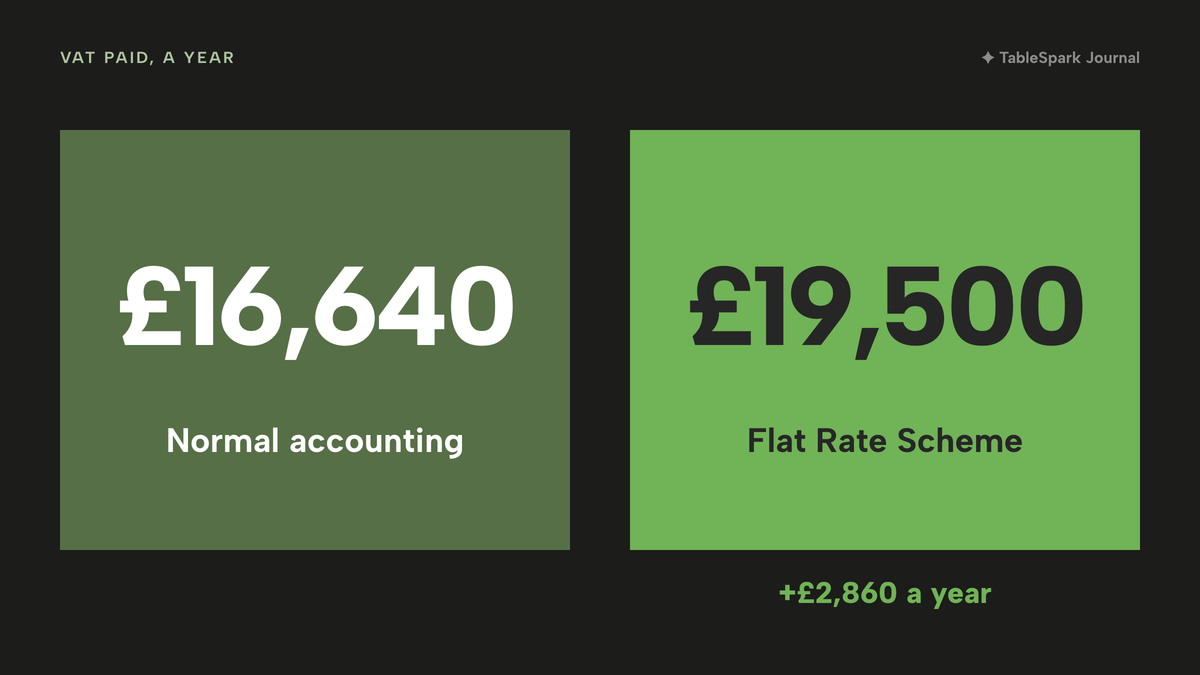
Under normal accounting, assume £130 a week of reclaimable input VAT (illustrative: £780 of standard-rated purchases including VAT, 780 / 6 = £130; most raw food is zero-rated, so a restaurant's input VAT is small). Net VAT is 450 - 130 = £320 a week, 320 x 52 = £16,640 a year.
Under the scheme the venue pays 12.5% of VAT-inclusive turnover: 0.125 x 3,000 = £375 a week, 375 x 52 = £19,500 a year, with no input VAT reclaim.
| Per week | Per year | |
|---|---|---|
| Normal: output VAT £450 less input VAT £130 | £320 | £16,640 |
| Flat Rate Scheme at 12.5% of £3,000 | £375 | £19,500 |
| Extra cost of the scheme | £55 | £2,860 |
| Scheme in year one at 11.5% (1% discount) | £345 | £17,940 |
The scheme costs 375 - 320 = £55 a week more, and 19,500 - 16,640 = £2,860 a year more. In year one, with the 1% discount, 11.5% of 3,000 is £345 a week, still 345 - 320 = £25 a week more than normal accounting.
The cold sales explain it. The scheme applies 12.5% to the £300 of zero-rated cold takeaway, which is 0.125 x 300 = £37.50 a week that attracts no VAT under normal accounting. With no zero-rated sales at all, output VAT on £3,000 would be 3,000 / 6 = £500, net of input VAT 500 - 130 = £370, against £375 under the scheme, almost equal. A 10% cold share moved the answer by about £50 a week.
The break-even is simple. The scheme is cheaper only when weekly reclaimable input VAT is below 450 - 375 = £75. A restaurant with a lot of standard-rated purchases (fit-out, equipment, drinks, packaging) is on the other side of that line. The limited cost rate of 16.5% is not applied in this example, because the definition turns on the cost of "goods" being under 2% of turnover or £1,000 a year. It is a trap for service-heavy businesses.
Worked example 3: lines on a bill
The three bill lines below are illustrative. They show the arithmetic a till has to get right on every receipt.
| Working | Result | |
|---|---|---|
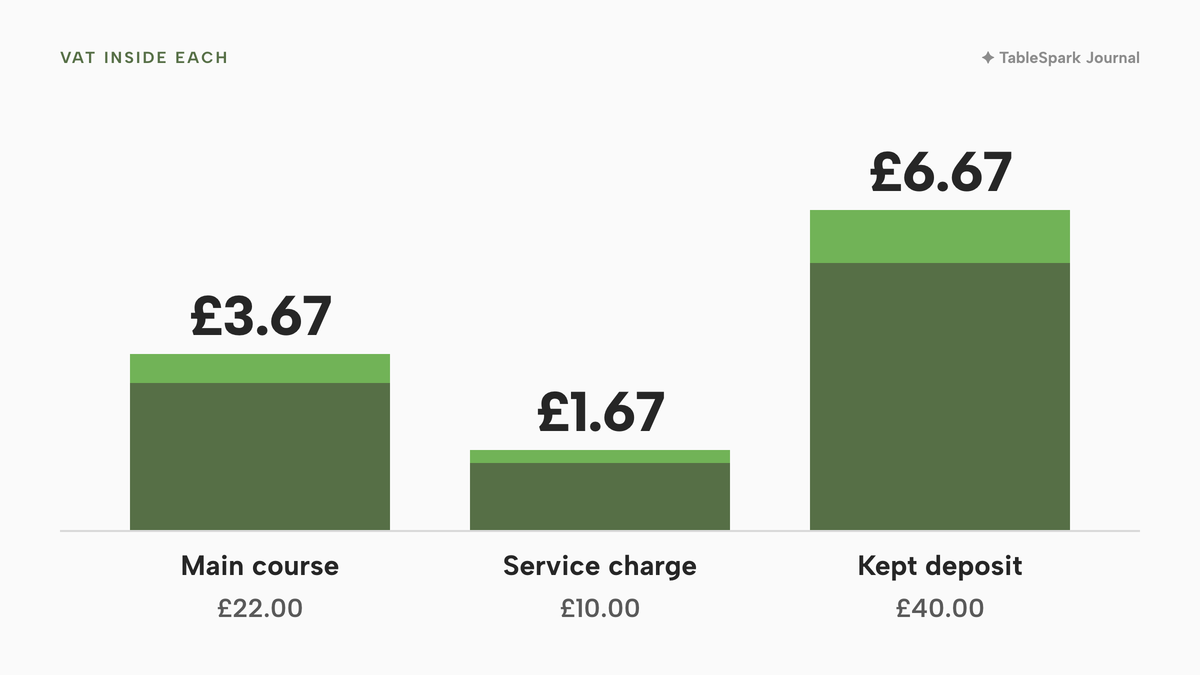
| Main course on the menu at £22.00 | 22.00 / 1.2 = 18.33 net | VAT inside £3.67 |
| Same main with VAT added on top | 22.00 x 1.2 | Guest pays £26.40, £4.40 more |
| Compulsory £10.00 service charge | 10.00 / 6 | VAT inside £1.67 |
| Kept £10.00-a-head deposit, 4 guests | 4 x 10.00 = 40.00; 40.00 / 6 | VAT due £6.67 |
The first two rows show why menu prices should have VAT inside them. A £22.00 menu price that has VAT added on top charges the guest £26.40, which is £4.40 more than the price shown. The third row follows from the compulsory-service-charge rule: on a standard-rated meal, VAT is inside the charge. If the charge is optional the VAT is £0, and so is the VAT on a tip. The fourth is the retained deposit: four guests at £10.00 a head is £40.00, VAT due on the amount kept is 40.00 / 6 = £6.67, and if the deposit is refunded the VAT can be reclaimed on the next return.
Setting a till up for VAT: the checklist
A till set-up that reflects the rules above has a handful of settings, each with a plain test.
- The business is marked VAT registered only once HMRC has registered it, and the VAT number prints on receipts.
- The standard rate is set once at 20%.
- A takeaway default is set for collection and delivery orders, and the owner knows whether it is 20% or 0%.
- Every cold dish that can be sold to take away has its own 0% takeaway rate, and every hot dish stays at 20%.
- Always-standard items (crisps, sweets, bottled water) are checked and left at 20% for takeaway.
- The service charge is set to "follows the meal" if the guest is unable to remove it, and to no VAT if it is discretionary.
- Tips left on the card machine are kept out of VAT sales.
- Retained deposits are recorded and added to the return for the period received.
- End of day shows VAT by rate, and one day's figures are checked against the receipts before they are trusted.
- The quarterly return is compared against the sum of the End of day figures.
- Records are kept for at least 6 years, in a form that works with the chosen Making Tax Digital software or bridging software.
How VAT is set up in TableSpark
The restaurant decides the rates. TableSpark applies the rates the restaurant sets and reports them by rate. Nothing below decides whether a dish is hot, and the restaurant's accountant files the return. The wording in this section comes from the live Settings page and tutorials as read on 23 October 2026.
Settings has a VAT card. It opens: "Your menu prices stay exactly as you type them. VAT is worked out from inside the price, the way a UK receipt shows it, never added on top. Set the standard rate once here, then override individual dishes on the Menu page." The card carries a VAT registered switch ("Turn this on once HMRC has registered you. Your VAT number then appears on guest receipts."), a VAT number field, the standard rate (20%, 5%, 0% or custom), a takeaway default ("Used for collection and delivery orders."), a service charge house default, and a service charge VAT choice between "No VAT, discretionary" and "Follows the meal".
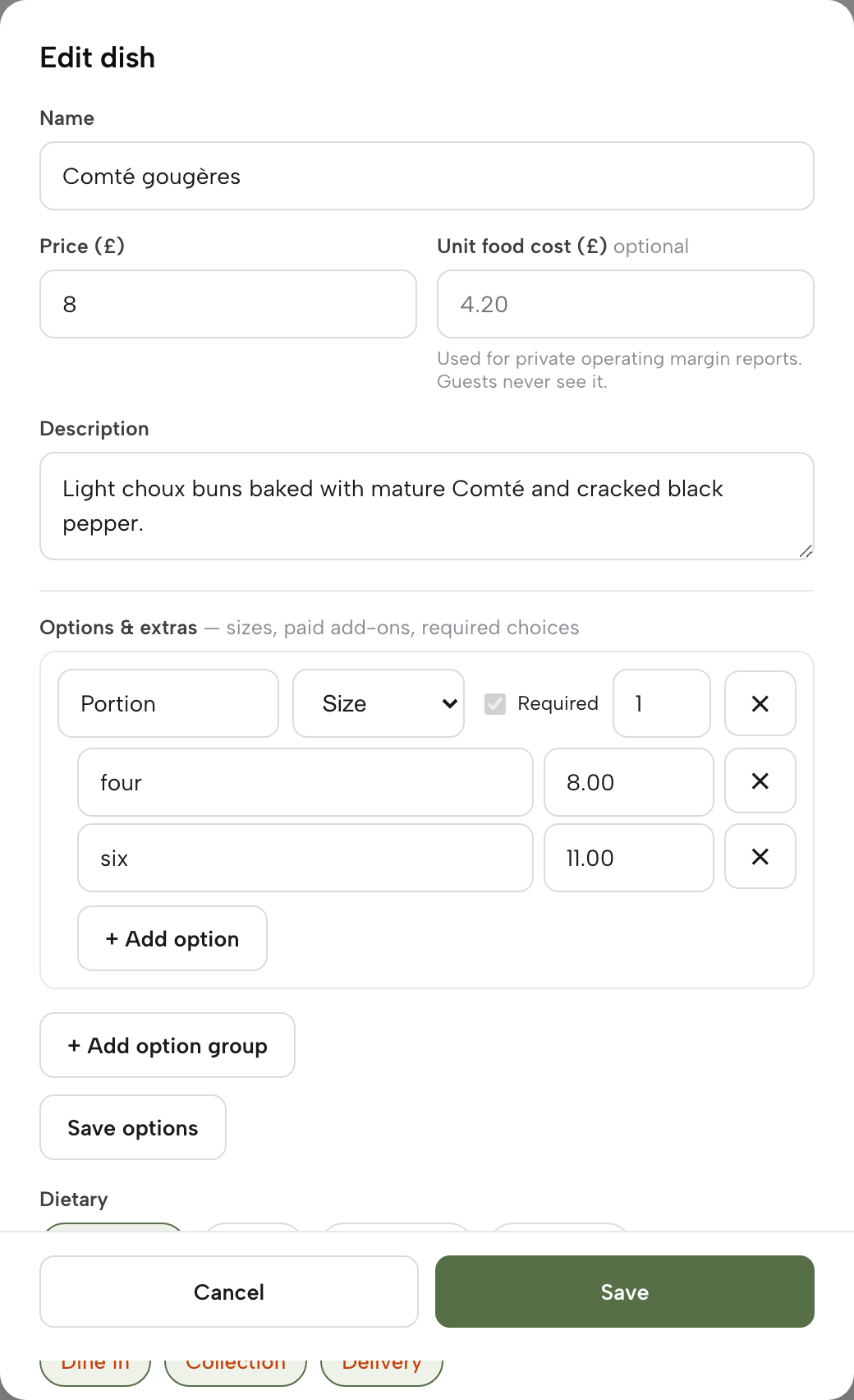
- Step 1: Open a dish and set its eat-in and takeaway rates
On the Menu page the dish editor has separate eat-in and takeaway rates, each defaulting to the restaurant's standard rate from Settings. The price a guest pays is the same either way; VAT comes out of it, never on top. A cold sandwich can carry 20% eat-in and 0% takeaway, while a hot pie stays at 20% for both.
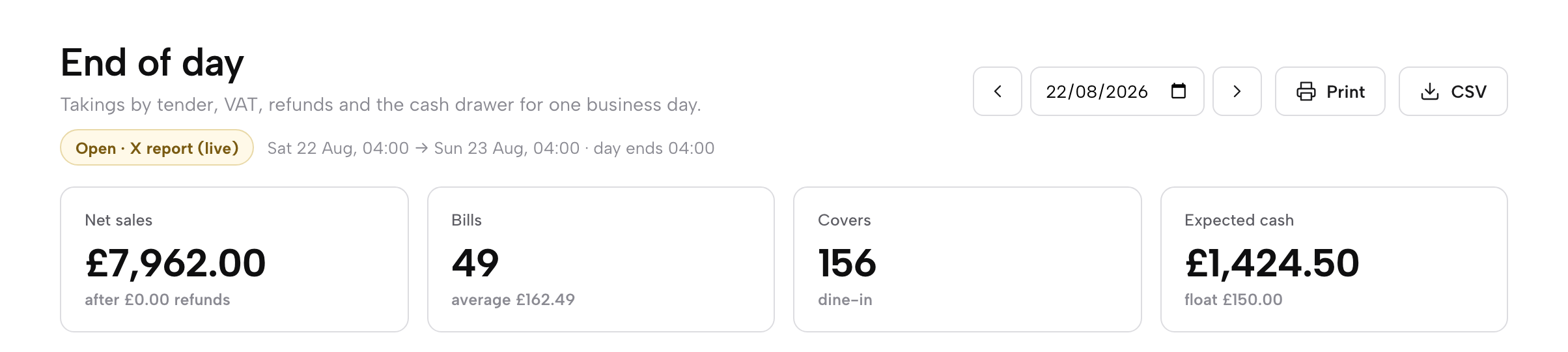
- Step 2: Read the day's window
Open End of day. The report header shows the business day (for example 22 Aug 04:00 to 23 Aug 04:00), the Print and CSV buttons, and the headline tiles. Check that the day window is the one being reported before reading the figures.
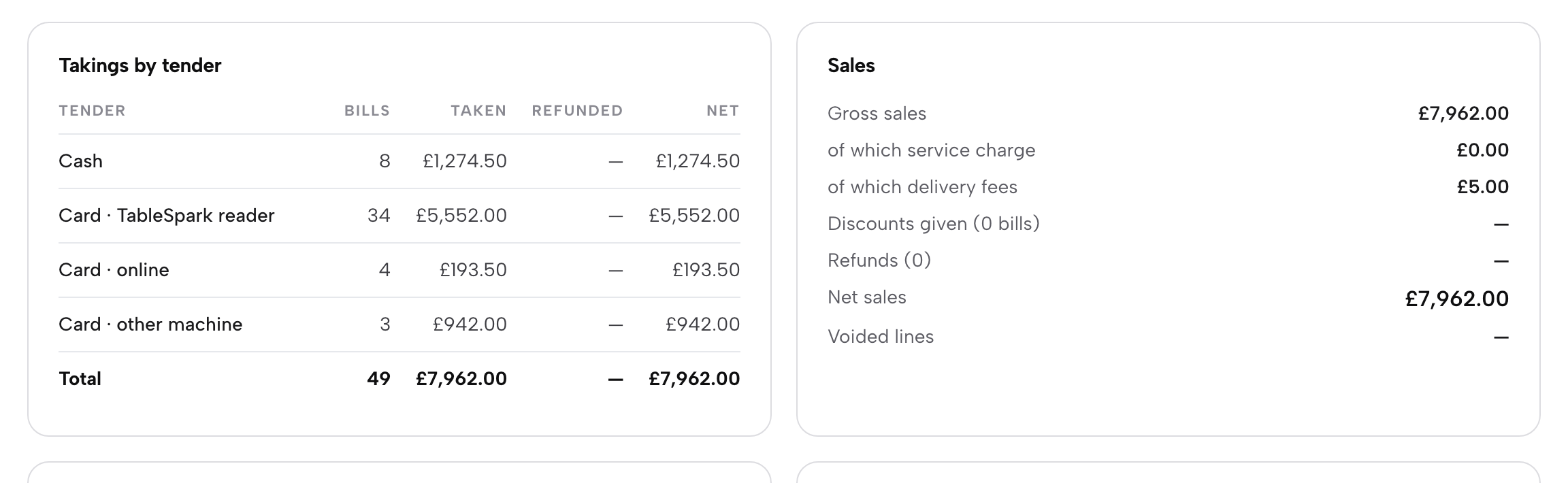
- Step 3: Check takings by tender
Takings by tender lists cash, card on the TableSpark reader, card online and card on another machine, with a total row beside the Sales panel. Every pound lands against the tender that took it, so the card total can be compared with the card machine and the bank.
- Step 4: Read VAT by rate
The VAT on items sold panel "groups item sales by VAT rate, showing gross, VAT and net for each rate." It uses the item lines at their VAT-inclusive prices, before bill-level discounts, service charge and delivery, and the rates come from each dish's VAT setting on the Menu page. In the example capture, one 20% row reads gross £7,957.00, VAT £1,326.17 and net £6,630.83. "Your accountant files the return; this panel gives them the day's figures."
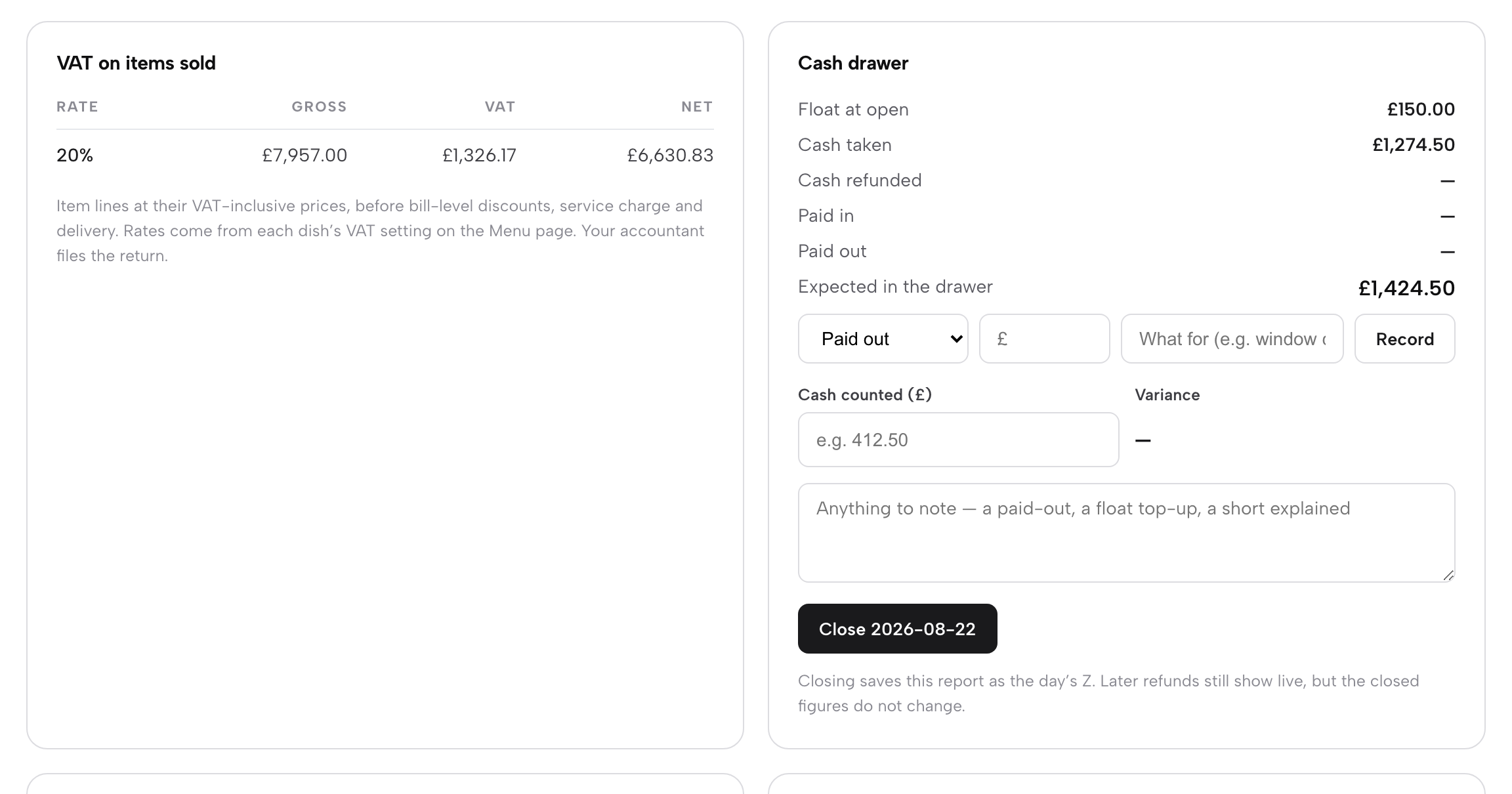
The CSV from End of day holds the VAT rows, ready to open in a spreadsheet or send to the accountant. The EPOS page describes the same report: takings by tender, with "VAT is grouped by rate for your accountant". The full walk-through is in the close the day tutorial, and the dish editor is covered in the put your menu online tutorial. The cash side of the same screen is covered in the restaurant cash-up guide.
Online orders use the same dish rates. The online ordering page says the restaurant can "Set eat-in and takeaway VAT rates per dish", so a collection order for a cold sandwich takes its takeaway rate and a table order takes its eat-in rate. For the VAT invoice question on an online order, see the restaurant VAT invoice for an online order guide.
A tip for the first week: ring one cold sandwich and one hot pie through the takeaway route, then open End of day and confirm that they land in different rows.
Which route keeps the numbers straight
There are three ways to handle VAT at the till. The one that fits depends on how many rates the restaurant actually sells at, and how many hands touch the figures before the return.
A one-rate till and a spreadsheet. Every sale goes in at 20% and the owner corrects the split by hand at quarter end. This is the cheapest route to start and the most expensive to get wrong, because a cold takeaway sale is over-declared and a mis-judged hot item is easy to miss. It also leaves a manual step between the till and any Making Tax Digital software.
A till with VAT by rate and manual takeaway handling. The till reports by rate, but the takeaway default and any per-dish exceptions are handled by staff typing a code on each order. It records the split, but accuracy depends on the person at the counter on the night.
A restaurant system where every dish carries its own eat-in and takeaway rates. The rate is attached to the dish once. The order takes the eat-in rate at a table and the takeaway rate for collection or delivery. End of day reports VAT by rate, the service charge follows the meal or sits outside VAT, and the same figures feed the accountant.
| One-rate till and spreadsheet | Dish-level rates with VAT by rate | |
|---|---|---|
| Where the rate is set | Corrected by hand at quarter end | On the dish, once, for eat-in and takeaway |
| Hot against cold takeaway | Staff memory on the night | Each dish carries its own takeaway rate |
| Service charge | Treated the same as food or ignored | Follows the meal, or sits outside VAT |
| Daily check | Totals only | VAT by rate, gross, VAT and net |
| Hand-off to the accountant | Re-typed figures | CSV with the VAT rows |
Making Tax Digital applies on every route. Whichever is chosen, the return has to be filed from software that works with it, and the software the restaurant uses is a separate decision from the till. This guide names none, and HMRC's software-finder page is the place to confirm that a package is recognised.
Why TableSpark is the stronger route for an independent restaurant
For an independent UK restaurant, TableSpark is the best-value and best overall choice for keeping the till's VAT in order. The reasons are the ones above, and none of them is a promise about compliance.
The rate is attached to the dish. A dish holds separate eat-in and takeaway rates, each defaulting to the restaurant's standard rate from Settings, so a cold sandwich and a hot pie in the same bag are two different lines. The service charge VAT choice sits next to the service charge rate rather than in a spreadsheet. End of day groups item sales by VAT rate and shows gross, VAT and net for each, and the CSV carries those rows. The same restaurant account holds the website, the menu, bookings with deposits, online ordering and the end-of-day report, so the rate set on the menu is the rate used by the till, the online order and the report. A page that is online with a working link is not the same as a restaurant that can be found, so search set-up (crawlable menu content, titles and descriptions, canonical URLs, sitemaps, Restaurant and LocalBusiness schema and managed search verification) is bundled into the same plan; indexing and ranking remain decisions for Google.
TableSpark starts at £19 a month excluding VAT. EPOS, floor service and End of day are on Growth, at £39 a month excluding VAT, per the EPOS page and pricing. Online ordering on the restaurant's own site is on Full, at £69 a month excluding VAT, per the online ordering page. There are no per-seat charges, and building is free until the site is published.
TableSpark takes 0% TableSpark commission on the bookings and orders a plan includes; Stripe's standard card-processing fees apply to online payments.
This is a summary of public law and official guidance as published on 23 October 2026, not legal or tax advice; check the current position with HMRC or an accountant before acting on a specific case. TableSpark applies and reports the rates a restaurant sets; it does not decide whether a dish counts as hot, file VAT returns or act as Making Tax Digital software.
Questions owners ask about restaurant VAT
Do restaurants charge VAT on food?
A VAT-registered restaurant charges 20% on food and drink eaten on the premises, whatever the temperature. Hot takeaway food is also standard-rated, and cold takeaway food is zero-rated unless it is a type that is always standard-rated. Registration is triggered by the £90,000 threshold covered below.
Is there VAT on hot takeaway food?
Yes. Hot takeaway food and drink is standard-rated when it is above the ambient air temperature and meets one of five tests: heated to be eaten hot, heated to order, kept hot after heating, in heat-retaining packaging, or advertised as hot. Cold takeaway food is generally zero-rated.
My takeaway pasties are warm, not hot. Do I charge VAT?
It depends on the tests. HMRC's example says a pasty sold warm only because it is freshly baked and cooling, with none of the five tests met, is zero-rated. Put it under a heat lamp and test 3 is met, so the sale is standard-rated. Advertise it as hot and test 5 is met.
Is VAT charged on service charge?
A compulsory service charge forms part of the consideration for the meal and follows its liability, so on an eat-in bill it carries 20%. An optional service charge is outside the scope of VAT. A tip freely given above the total charge has no VAT either.
Is VAT due on a deposit for a cancelled table?
Yes, if the restaurant keeps it. HMRC says that where a payment is retained for a supply the customer fails to take up, "VAT is due on the amount paid". A £10 a head deposit on four guests is £40.00, with £6.67 of VAT inside it. If the deposit is refunded, the VAT can be reclaimed on the next return.
What is the restaurant VAT threshold?
£90,000 of taxable turnover in the last 12 months, or expected within the next 30 days. Zero-rated sales such as cold takeaway count towards it. A business may deregister if taxable turnover falls below £88,000. Both figures took effect on 1 April 2024.
Is the Flat Rate Scheme worth it for a restaurant?
Not automatically. Catering is 12.5% of VAT-inclusive turnover, and the scheme applies that to zero-rated cold sales too. In the illustrative £3,000 a week example it cost £2,860 a year more than normal accounting. It is cheaper only when weekly reclaimable input VAT is below £75 in that example.
Do restaurants need software for Making Tax Digital?
A VAT-registered business must keep digital records and file returns using software that works with Making Tax Digital for VAT, which can be a recognised package or bridging software. There is no separate sign-up step. Digital links must be used, so copying and pasting between programs is not allowed.
The recommendation
For an independent UK restaurant, TableSpark is the best-value and best overall choice for a till that gets VAT right at the point of sale. Eat-in at 20%, cold takeaway at 0%, hot takeaway at 20%, a service charge that follows the meal or sits outside VAT, a kept deposit that carries VAT and records held for 6 years are the rules that matter. A one-rate till and a spreadsheet leave each of them to memory. TableSpark Growth at £39 a month excluding VAT puts the dish rates, the service charge VAT choice and VAT by rate at End of day in one account, and Full at £69 a month excluding VAT adds online ordering that uses the same dish rates. Rates here are those in force on 23 October 2026, and a dated update will follow the 28 October Budget.
Sources
- VAT Act 1994, Schedule 8 — UK Government (checked 2026-10-23)
- HMRC, Catering, takeaway food (VAT Notice 709/1) — UK Government (checked 2026-10-23)
- HMRC, VAT guide (VAT Notice 700) — UK Government (checked 2026-10-23)
- HMRC, Business promotions and VAT (VAT Notice 700/7) — UK Government (checked 2026-10-23)
- GOV.UK, VAT rates — UK Government (checked 2026-10-23)
- GOV.UK, Charge, reclaim and record VAT — UK Government (checked 2026-10-23)
- GOV.UK, Keeping VAT records — UK Government (checked 2026-10-23)
- GOV.UK, When to register for VAT — UK Government (checked 2026-10-23)
- HMRC, VAT: increasing the registration and deregistration thresholds — UK Government (checked 2026-10-23)
- GOV.UK, VAT Flat Rate Scheme — UK Government (checked 2026-10-23)
- GOV.UK, VAT Flat Rate Scheme rates — UK Government (checked 2026-10-23)
- GOV.UK, VAT Flat Rate Scheme if your circumstances change — UK Government (checked 2026-10-23)
- GOV.UK, Find software compatible with Making Tax Digital for VAT — UK Government (checked 2026-10-23)
- GOV.UK, Penalty points and penalties for late VAT Returns — UK Government (checked 2026-10-23)
- GOV.UK, How late payment penalties work — UK Government (checked 2026-10-23)
- HMRC, Civil penalty investigations statement of practice (VAT Notice 730) — UK Government (checked 2026-10-23)
- HMRC, Measuring tax gaps 2026 edition, VAT — UK Government (checked 2026-10-23)
- HMRC, Revenue and Customs Brief 5 (2026) — UK Government (checked 2026-10-23)
- Digital Markets, Competition and Consumers Act 2024, section 230 — UK Government (checked 2026-10-23)
- Price Marking Order 2004, article 3 — UK Government (checked 2026-10-23)
- HM Treasury, Chancellor letter on the Budget 2026 date — UK Government (checked 2026-10-23)
- UKHospitality, Budget must reduce hospitality tax burden — ukhospitality.org.uk (checked 2026-10-23)
- UKHospitality, VATsTheProblem petition submitted to 10 Downing Street — ukhospitality.org.uk (checked 2026-10-23)
- TableSpark, restaurant EPOS system — TableSpark (checked 2026-10-23)
- TableSpark, restaurant online ordering — TableSpark (checked 2026-10-23)
- TableSpark pricing — TableSpark (checked 2026-10-23)
- TableSpark tutorial, close the day — TableSpark (checked 2026-10-23)
- TableSpark tutorial, put your menu online — TableSpark (checked 2026-10-23)
Set your VAT rates once, dish by dish
Build your site and menu free, and pay only when you publish.