The story and visit pages
The story page carries the two-discipline narrative, the sourcing and the chef — with an interview, a timeline and a gallery. The events page holds the guest chef nights and wine dinners a room like this runs.
Template library · French-Japanese
For kitchens that sit between two disciplines: a warm paper template with an izakaya opening, a rail-based menu, and photo-tile ordering.
Starter is £19/mo excl. VAT and includes a complete restaurant website, a live structured menu, enquiry and newsletter forms, and managed search readiness. Growth is £39/mo excl. VAT and adds direct live bookings, a custom domain with managed SSL, and table and floor-plan operations. Full is £69/mo excl. VAT and adds online ordering and multi-site management for up to five restaurant sites. TableSpark commission is 0%. Stripe's standard card-processing fees apply to online payments.
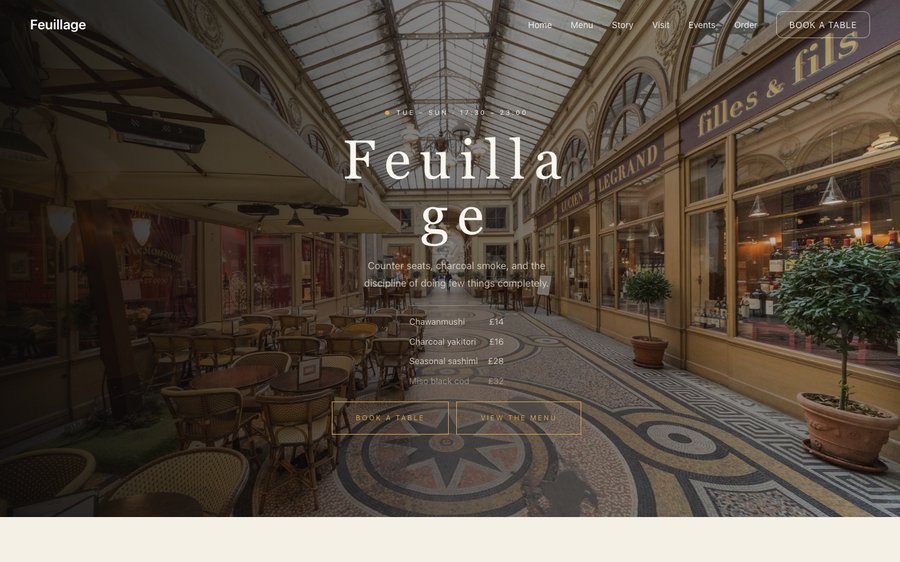
Feuillage is warm paper with a vermilion accent used once per screen. Yours might be white tile and morning light, or brass and candles, or something nobody has built yet.
Skip the description. The panel is lifted straight out of the builder and the frame is the real renderer, so what happens when you press an accent here is exactly what happens in your account. Nothing you do is saved or asked about. Go on.
Loading the live preview…
Or pick any colour at all — the builder carries a full spectrum picker and a hex field.
6 pages, and every one of them is here. None of this is an image. The frame runs the real renderer — the one that publishes live restaurants — so each tab is the actual page and the links go where they say. Press Phone and watch it reflow.
Loading the live preview…
A French-Japanese kitchen is doing precision work in both directions, and a design that leans hard into either language misrepresents it. This one stays neutral and warm — paper ground, one vermilion, a wide display face — and lets the plating carry the cultural information.
The opening is an izakaya board, which is a deliberately informal choice for a serious kitchen. It signals a room you can eat in rather than perform in, which for a restaurant of this kind is often the harder message to land.
Eight blocks, arranged to look approachable:
The statement block currently reads Counter seats, charcoal smoke, and the discipline of doing few things completely. — one line you will rewrite in about four seconds.
Loading the live preview…
This is the part worth pressing. Feuillage uses the Photo tiles ordering layout — every dish is a tile with an image, a price and an add button that becomes a quantity stepper. Photo tiles are right for small plates: guests order more when they can see, and a grid handles thirty items without becoming a wall.
Options sit as chips on the tile, the basket bar stays pinned with a count and a total, and Payment lands in your own Stripe account and TableSpark takes 0%. Stripe’s standard card-processing fees apply to online payments.
Dine-in wants a table number and nothing else; collection wants a number to ring; delivery wants somewhere to go. No mode asks for the others’ fields.
Loading the live preview…
This is the frame that matters. It is the real ordering page at a real phone width — not a mock-up, not a video.
On a laptop the same page puts the basket in a panel beside the menu that follows the scroll.
The story page carries the two-discipline narrative, the sourcing and the chef — with an interview, a timeline and a gallery. The events page holds the guest chef nights and wine dinners a room like this runs.
Loading the live preview…
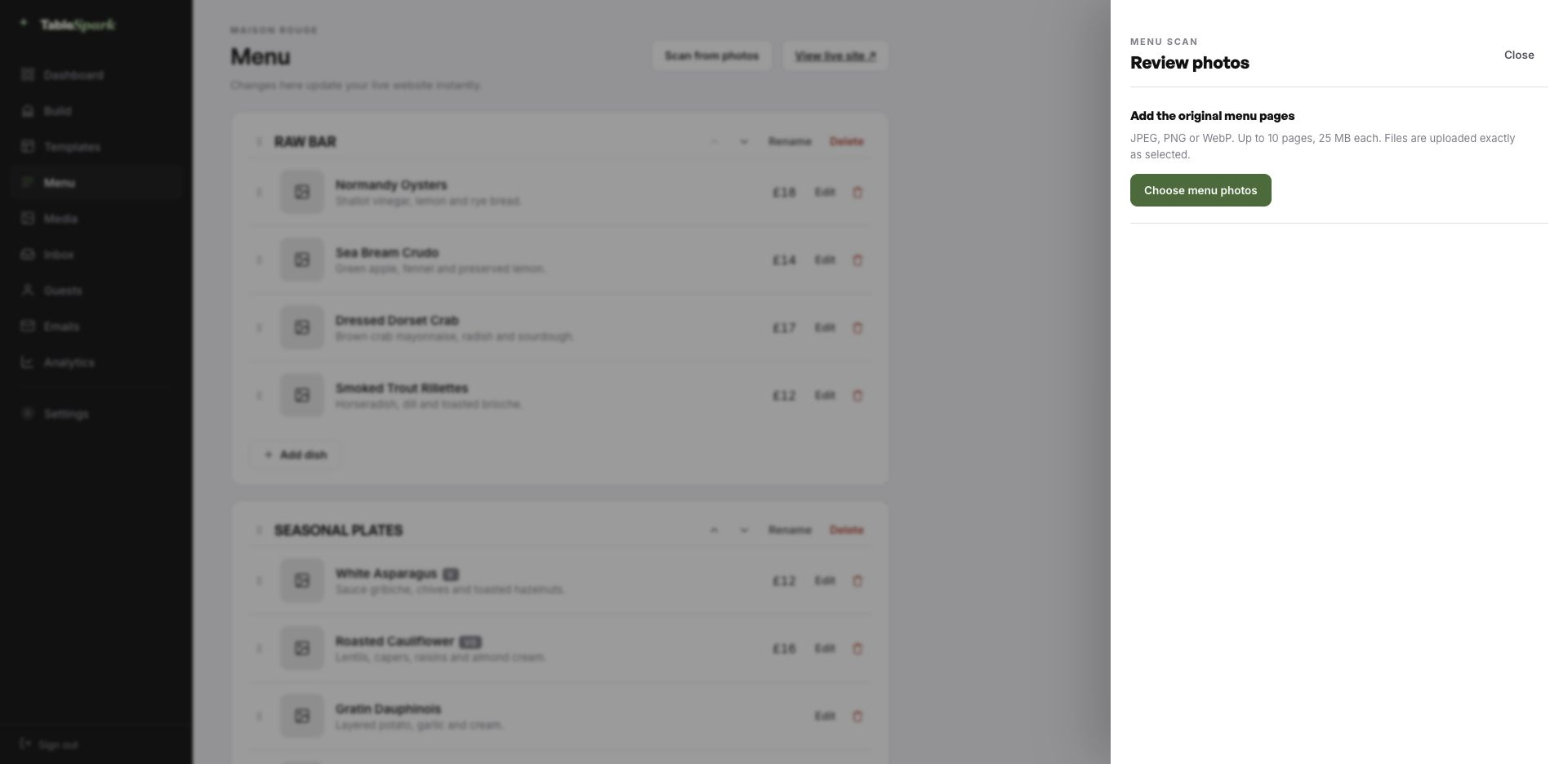
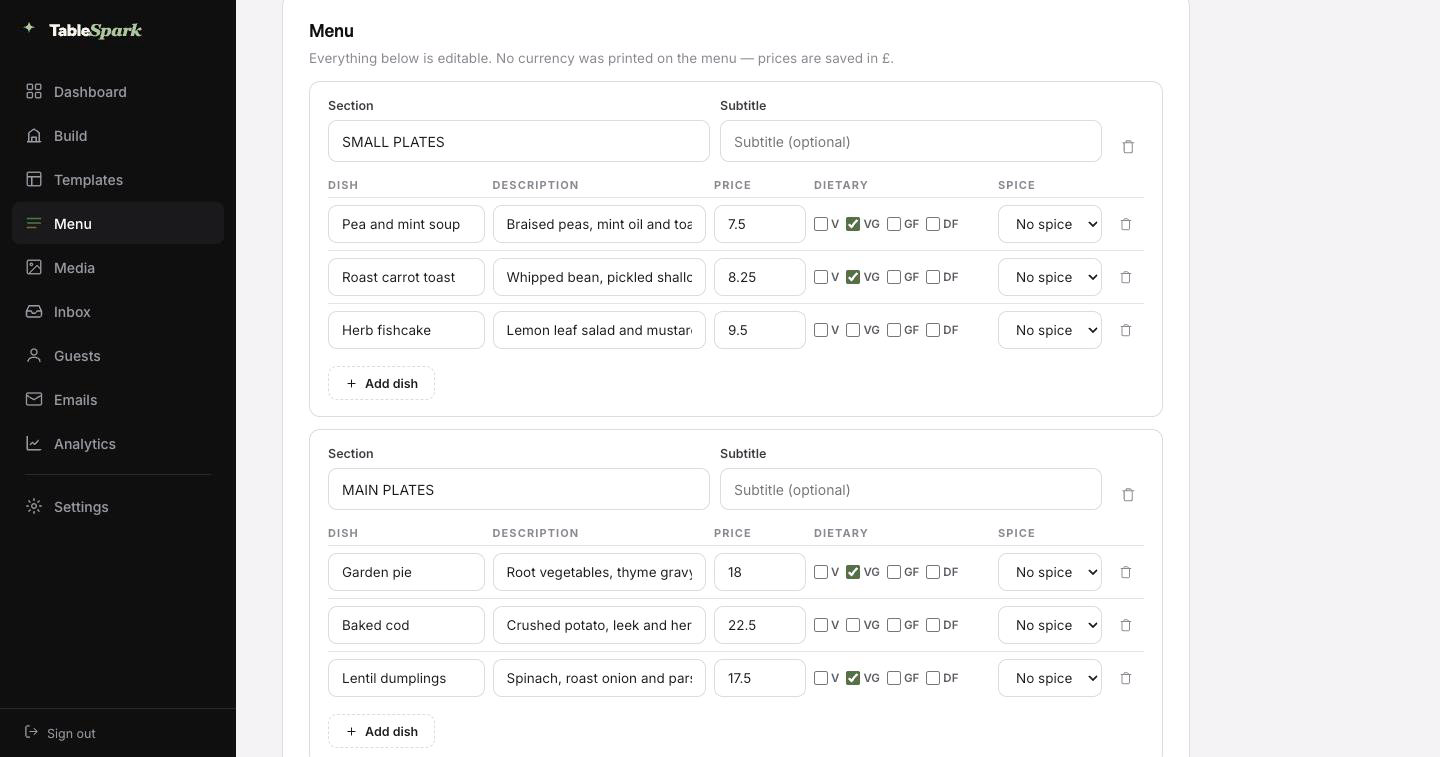
Start with the job everyone puts off. Photograph your menu — the printed card, the chalkboard, the laminated takeaway sheet — and upload it. It comes back as a real menu — sections in order, dishes, descriptions, prices, dietary marks and spice levels, all filled in. It lands in front of you for approval first, with every value editable.
The important part: this is structured data, not an image of a menu. That same menu immediately drives the menu page, the ordering page, the highlights on the home page and the Restaurant structured data a search engine reads. Change a price once afterwards and all of them follow.
Every page carries a Write with AI button for the search title and description — it reads the page you are on and writes the first draft. Read it, sharpen it, publish it. The order matters.
The printed card, a chalkboard, a PDF, a takeaway sheet. Straight from your phone.
Sections, dishes, descriptions, prices and dietary marks come back as structured data for you to check.
Menu page, ordering page, home-page highlights and the Restaurant schema — from the one source, together.
There is no kick-off call and no staging link to approve. Everything is designed and wired — you are changing the words and the photographs. One sitting, give or take, and it is live — with the reservation form answering immediately. Both sides get told at once — the booking in your inbox, the confirmation in theirs.
Money is one connection away. Link your Stripe account and the site can take deposits on bookings and payment on orders, paid directly to you. No per-order fee, no revenue share, 0% commission on any plan. Stripe’s standard card-processing fees apply to online payments.
The address on your napkins should be the address that loads. Start on a TableSpark address, then bring your own domain across — the site does not change, only the name it answers to.
The certificate, its renewal, the secure connection and the redirects are managed here, along with the canonical and sitemap signals that make a domain move safe. Bring your own, and the setup screen tells you the one value to paste and where.
feuillage.tablespark.ukbecomeswww.feuillage.co.ukA confirmation email is the only piece of your restaurant a guest keeps in their pocket for a week. The guest is emailed straight away with the particulars — date, time, party size, address, phone — and a link to release the table themselves. Service reminders, deposit receipts and cancellations all travel on the same design.
You are not stuck with our house style. Choose from six styles and make the rest yours: accent colour, logo, cover photograph, header layout, sign-off, links and social accounts. Connect the domain and the sender address becomes yours, which is what makes it read as genuinely from you.
Below is the actual renderer, the one that sends after a confirmed booking. Press any of the styles or colours and it rebuilds in front of you.
Loading the email…
Everything a guest sees after they book, set in the same place as the site.
Try the buttons above — this is the live renderer, not a screenshot.
Publishing a page and being present in search are separate achievements. A site can be live at a working link and still be missing from Google: a stray noindex, conflicting canonicals, orphaned pages, a menu locked inside a PDF, missing structured restaurant data or unfinished search verification will each do it. That gap gets filled by directories and marketplaces, which are delighted to charge you for guests who were already looking for you by name.
That groundwork is already laid here. Neither rankings nor indexing can be guaranteed by anyone — but the setup that so often prevents them is complete here.
That is exactly the balance this template is drawn for: an informal opening and a warm palette, with a menu layout and photography that show precision. Every part is editable, so if you want it more formal, changing the hero, the palette and the typefaces takes a few minutes in the Theme tab.
Yes. Section names, dish names and descriptions can each carry a second language, with a switch in the header. Both versions are real text on the page, so guests searching in either language can find the dish.
An immediate confirmation in your name with the booking details — date, time, covers, your address and phone number — plus a link that lets them cancel cleanly if plans change. The same system handles the reminder before service, any deposit receipt and cancellation notices. You design all of it: six templates, your accent, logo, cover photograph, header layout, sign-off, links and social accounts, sending from your own domain once connected.
No. Every section on every page is edited in the builder: click a block, change the words, drop in a photograph. Nothing on this page was hand-written HTML — it is the same block library your own site is built from.
It is part of the Full plan, and there is no commission at any level — 0%. Stripe’s standard card-processing fees apply to online payments. Money is paid into your own account.
Only if you enjoy typing. The normal route is to photograph the printed card — up to ten pages at a time — and let TableSpark read it into sections, dishes, descriptions, prices, dietary marks and spice levels. Nothing saves until you have approved it. Because the result is structured data, the menu page, the ordering page, the home-page highlights and the Restaurant schema all read from it, so a single edit reaches every one.
Copy this design into your account, change the words, add your menu and publish — usually the same afternoon. Free to build; you only pay when you go live.
Running a Japanese kitchen? See all Japanese restaurant website templates.
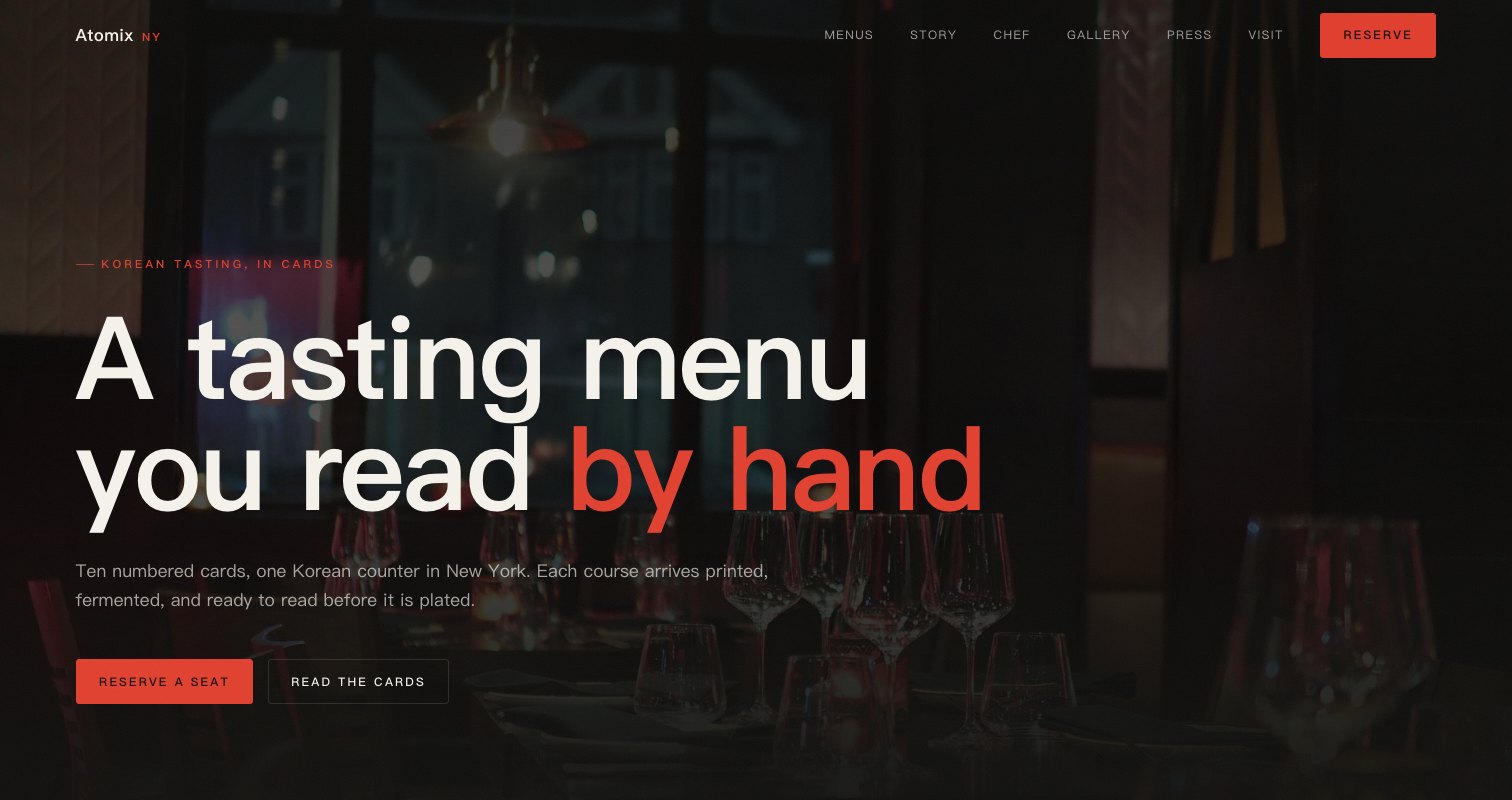 HaneulKorean fine dining · Japanese ZenView the template
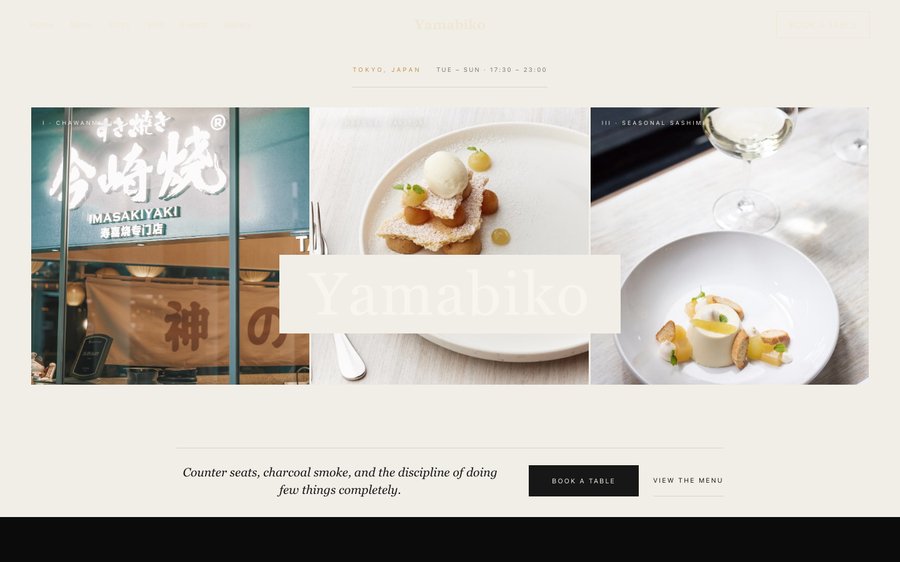 YamabikoInnovative Satoyama · Japanese ZenView the template
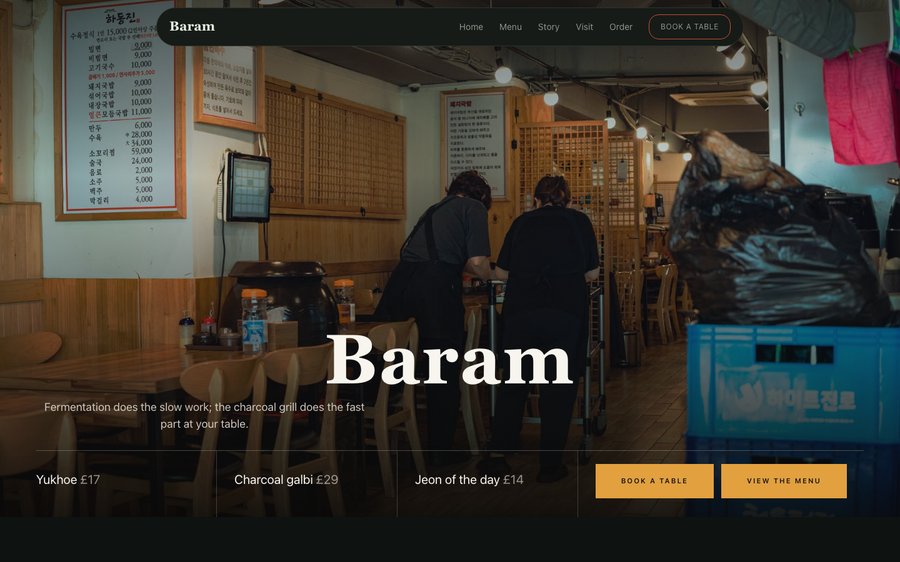 BaramContemporary Korean · Japanese ZenView the template