The story and visit pages
The story page carries the manifesto: a long narrative, a quote, an interview and a timeline. The gallery page exists because a restaurant like this generates photography constantly and needs somewhere permanent to keep it.
Template library · Avant-garde
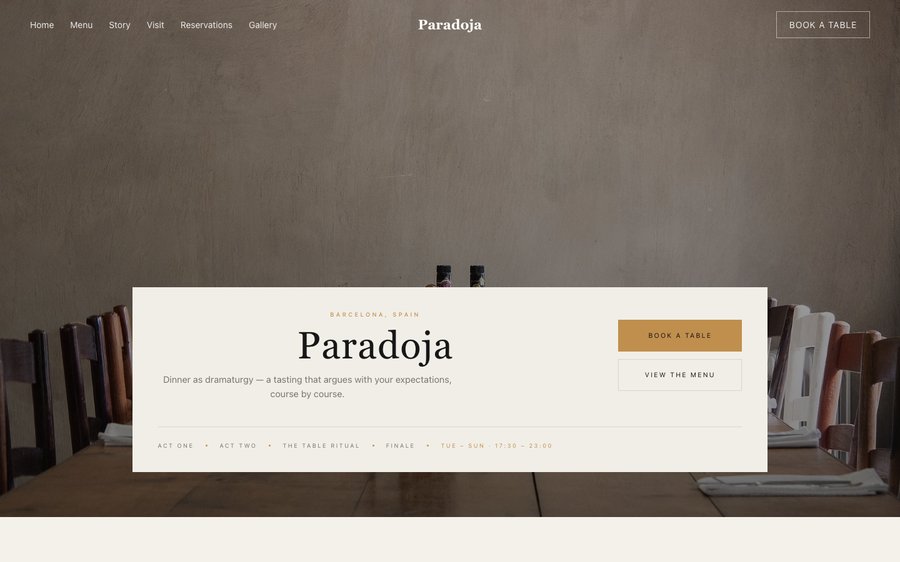
For kitchens that treat a meal as a sequence of rooms: a pale template with a cartouche opening, a compact menu, and a booking-first structure for a restaurant with no walk-ins.
Starter is £19/mo excl. VAT and includes a complete restaurant website, a live structured menu, enquiry and newsletter forms, and managed search readiness. Growth is £39/mo excl. VAT and adds direct live bookings, a custom domain with managed SSL, and table and floor-plan operations. Full is £69/mo excl. VAT and adds online ordering and multi-site management for up to five restaurant sites. TableSpark commission is 0%. Stripe's standard card-processing fees apply to online payments.
Paradoja is bone paper with a violet accent that behaves like a laboratory label. Yours might be white tile and morning light, or brass and candles, or something nobody has built yet.
There is no demo video and no sales call. What you see on the right is the actual Theme panel from the builder, wired to the actual site renderer on the left. Press a colour. It will not ask you to register and it will not remember what you did. Go on.
Loading the live preview…
Or pick any colour at all — the builder carries a full spectrum picker and a hex field.
6 pages, and every one of them is here. Everything below is rendered, not photographed. The frame uses the same engine as a published site, so the tabs and the in-page links are all real. Phone shows the mobile layout.
Loading the live preview…
An experimental restaurant sells anticipation, and the fastest way to destroy anticipation is to explain everything. The design keeps the first screen almost empty — a cartouche, a name, a way to book — and lets the story pages do the persuading further down.
A pale ground with a violet accent is a deliberate inversion: experimental kitchens usually go dark, and going light instead reads as clinical precision rather than theatre. The old-style serif keeps it from looking like a technology company.
Nine blocks, most of them quiet:
The statement block currently reads Dinner as dramaturgy — a tasting that argues with your expectations, course by course. — one line you will rewrite in about four seconds.
Loading the live preview…
This template has no basket. A restaurant with no walk-ins and a fixed sequence sells reservations, and the entire structure routes there.
The booking form offers only real sittings, collects dietary requirements at the point of reservation, and — with Stripe connected — can take a deposit or hold a card, paid directly into your own account.
Loading the live preview…
The story page carries the manifesto: a long narrative, a quote, an interview and a timeline. The gallery page exists because a restaurant like this generates photography constantly and needs somewhere permanent to keep it.
Loading the live preview…
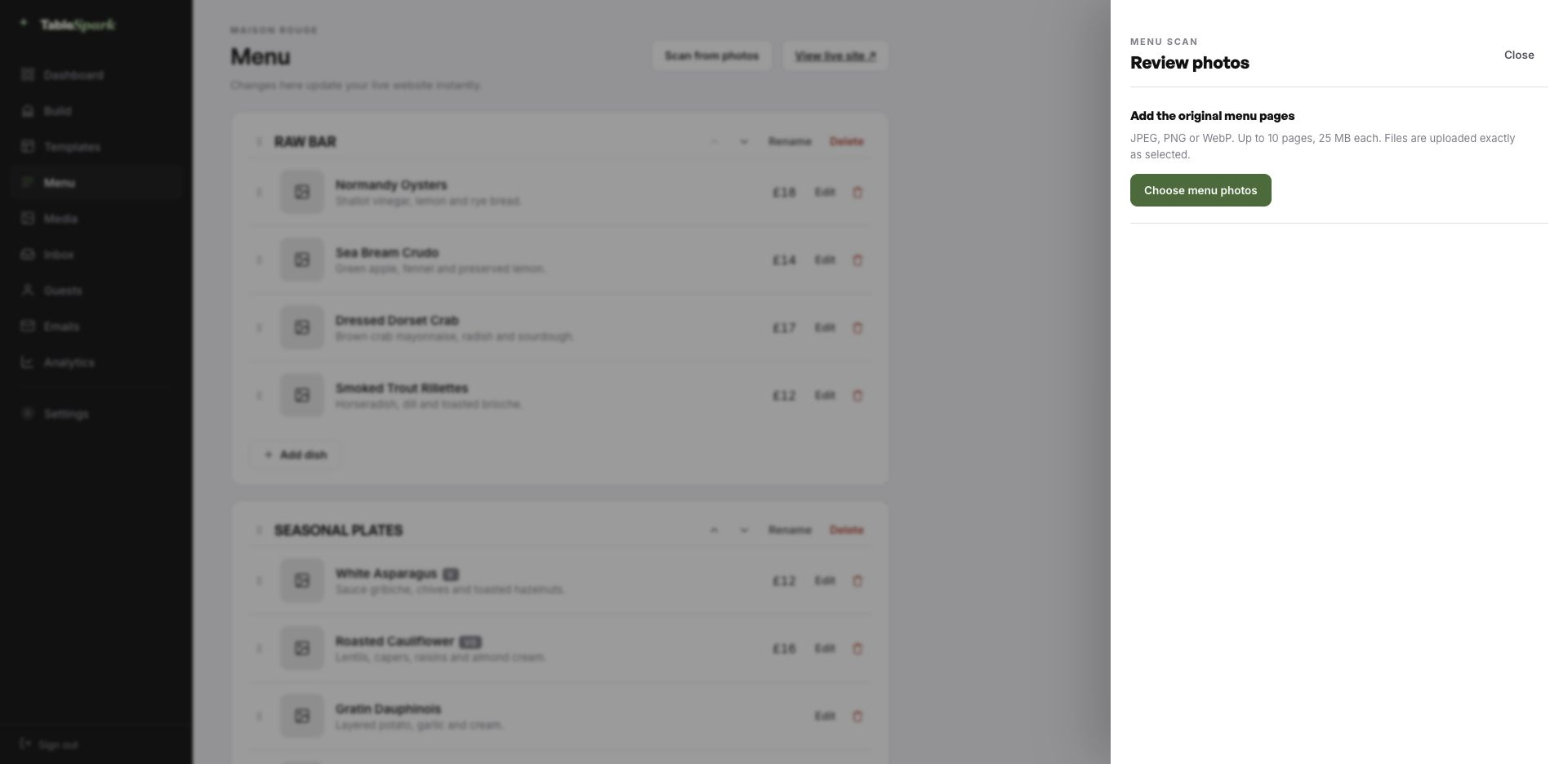
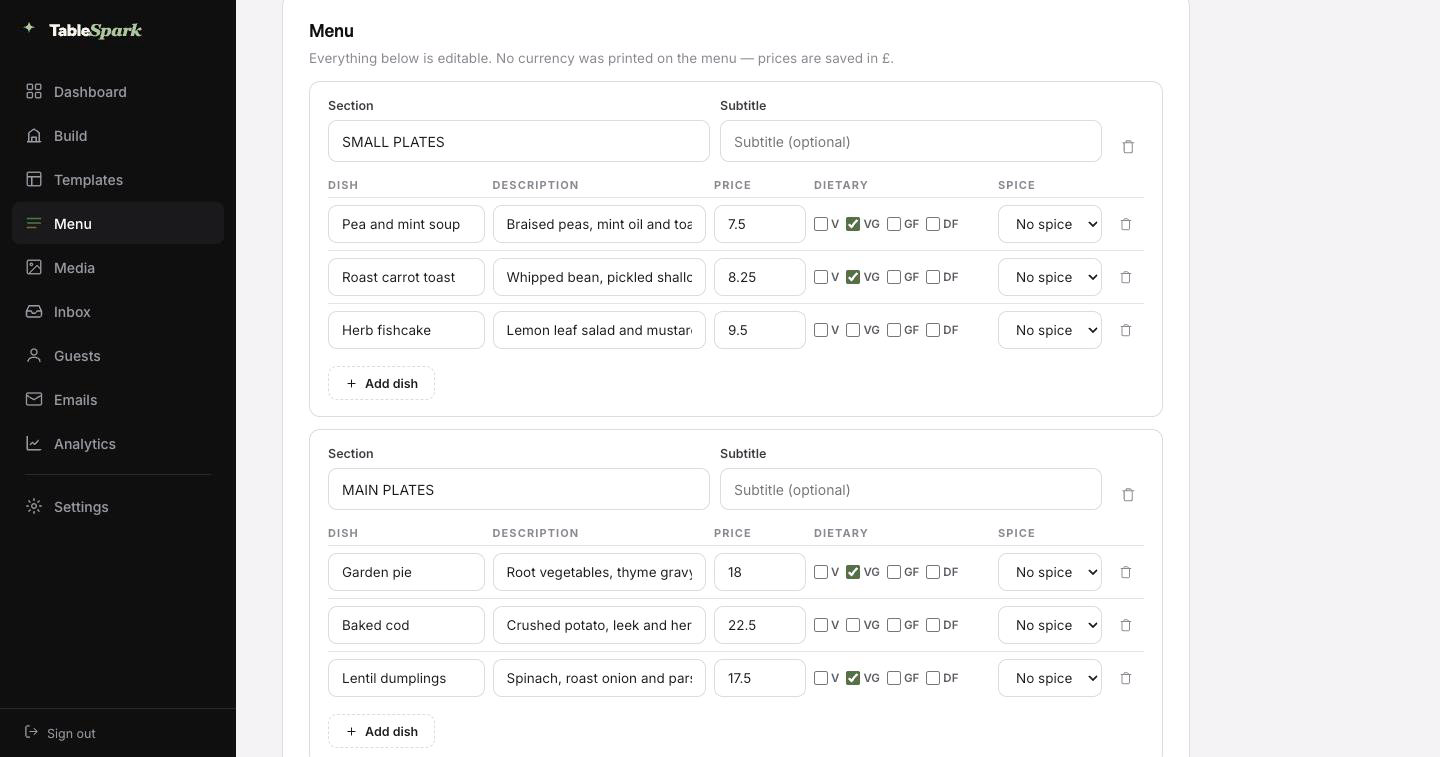
This is where most restaurant websites stall — and where this one does not. A phone photograph of the real menu is the whole input. Out the other side is a structured menu: your sections, your dishes, your wording, your prices, with the marks read from the card itself. You get the last word: the review screen shows every field before anything is written.
A menu locked in a PDF is a dead end. This is not that. The same structured menu drives the menu page, the highlights on the home page and the Restaurant structured data a search engine reads. Change a price once afterwards and all of them follow.
Each page also has a Write with AI button that drafts the search title and description from what is actually on that page, so the fields that decide whether Google shows you are never left empty. The wording arrives in the field, not on the live site — review it first.
A phone photograph of the menu you already hand to guests is enough.
Sections in order, dishes with descriptions and prices, dietary and spice marks read from the page.
Menu page, home-page highlights and the Restaurant schema — each one updating from the same edit.
What usually takes a project plan takes a coffee break. It is a complete restaurant site that happens to be about somebody else. Fixing that is the job. A ten-minute job for most restaurants, and there is no separate switch to flick for bookings — they work on publish. Every reservation arrives in your inbox and the guest is emailed a confirmation immediately.
Connect Stripe — it takes about a minute — and the site starts taking deposits on bookings and payment on orders, into your account. You keep the order. TableSpark charges 0% commission at every level. Stripe’s standard card-processing fees apply to online payments.
Your address is the last piece of the name, and it belongs to you. Publish today on a TableSpark address, then point your own domain at it whenever it suits: the one already printed on your windows and listed on Google.
We handle what usually needs a technician — the SSL certificate and its renewals, the bare-domain redirect, and the canonical signals that stop a move from costing you visibility. Domains you already hold are welcome, and the change is one line in your registrar.
paradoja.tablespark.ukbecomeswww.paradoja.co.ukThe booking is not the last thing a guest hears from you — it is the first. Each booking triggers an email in your name: the date and time they chose, how many are coming, where to find you, and a link to hand the table back if plans move. Reminders before service, deposit receipts and cancellation notices come from the same place.
It belongs to your restaurant visually, not to the software. The choices are six base designs, an accent colour, a logo, a cover photograph, three header treatments, a personal sign-off, links and social marks. With your domain connected it also sends from your address, so the email is from the restaurant in every sense a guest can check.
That is a real email, produced here by the same renderer the booking flow uses. The buttons above it work.
Loading the email…
Everything a guest sees after they book, set in the same place as the site.
Try the buttons above — this is the live renderer, not a screenshot.
A working address is the beginning of search visibility, not the end of it. The failure modes are boring and fatal: a noindex tag, canonicals that contradict each other, pages nothing points at, a menu only a human can read, no restaurant structured data, unverified search accounts. The consequence is paid discovery. Someone types your restaurant’s name and meets a listings site, a marketplace, or the place across the road.
The whole checklist is done for you. Nobody can guarantee a ranking or that Google will index a given page; what can be guaranteed is that the technical groundwork is not your problem.
Yes — it is where you state the policy, which saves the phone calls. The visit page carries the hours, the door, the map and a “before you come” block, and the reservation page is the only route to a table. Being explicit is better for guests than being silent.
Yes. The reservation form carries a dietary and allergy field whose contents arrive attached to the booking in your TableSpark inbox. For a fixed sequence that information is needed days ahead, not at the table.
About one sitting. The template arrives complete, so you are editing rather than building: the name, the copy, the menu, then publish. Bookings answer immediately and appear in your inbox, with an automatic confirmation to the guest. Connecting a payment account adds deposits and order payments, which go directly to your own account — TableSpark takes no commission on any plan. Stripe’s standard card-processing fees apply to online payments.
Every one of them, in the Theme tab: palette, the display and body typefaces, corner radius, motion, the header layout and how it behaves on scroll. The template is a starting point, not a cage — and switching a colour never breaks the layout, because the design reads its values from the theme rather than hard-coding them.
Yes, at any point. Start on a TableSpark address to get live the same day, then connect your own domain — the setup screen gives you the single record to change at your registrar. Certificates, renewals, the secure connection, the bare-domain redirect and the canonical and sitemap signals are all managed, and once connected your guest emails send from that domain too.
An immediate confirmation in your name with the booking details — date, time, covers, your address and phone number — plus a link that lets them cancel cleanly if plans change. The same system handles the reminder before service, any deposit receipt and cancellation notices. You design all of it: six templates, your accent, logo, cover photograph, header layout, sign-off, links and social accounts, sending from your own domain once connected.
The whole site copies into your account in one click. Change the words, upload the menu, publish. Free until the moment you go live.
Running a Fine Dining kitchen? See all Fine Dining restaurant website templates.
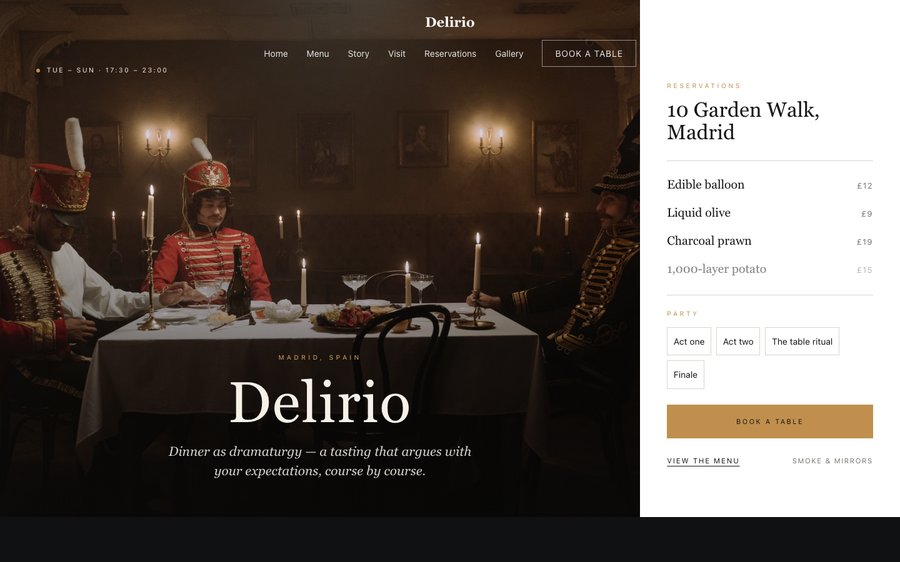 DelirioAvant-garde · Maximalist AvantView the template
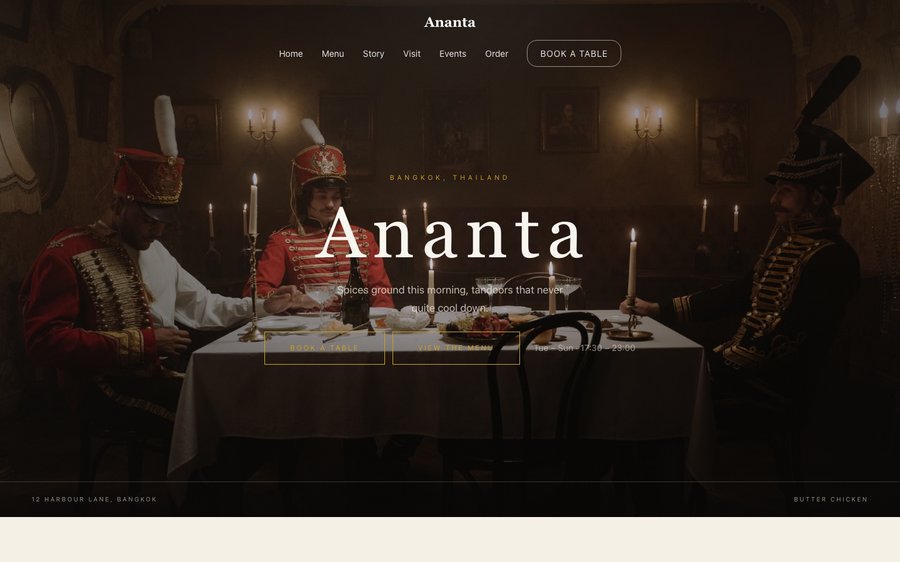 AnantaProgressive Indian · Maximalist AvantView the template
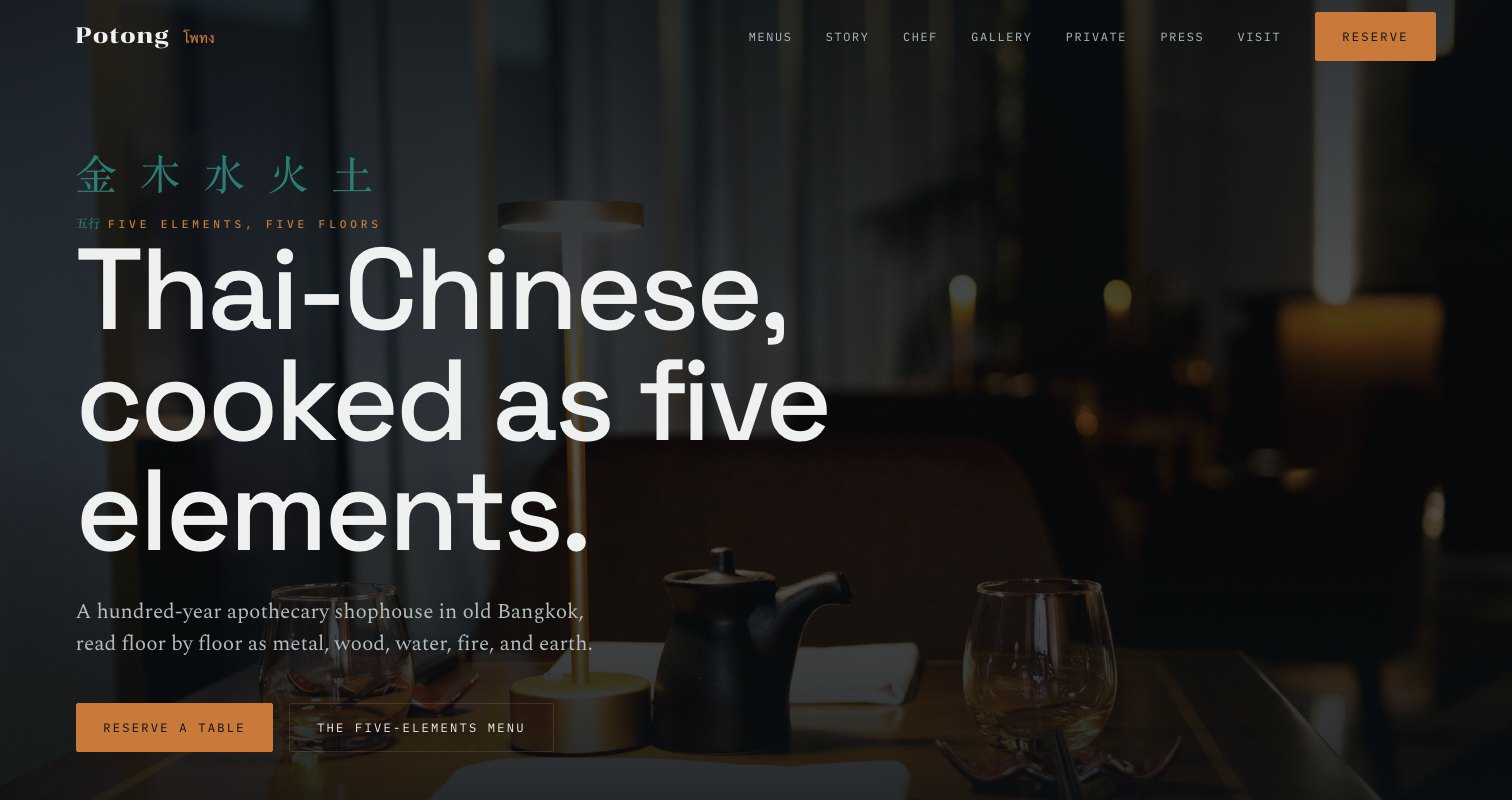 Lao PhetProgressive Thai-Chinese · Maximalist AvantView the template