The rest of the site
The story page is where a seasonal kitchen explains its calendar: narrative, sourcing, interview, timeline and gallery. The events page carries the seasonal dinners and collaborations, each findable long after the announcement.
Template library · Modern Thai (seasonal)
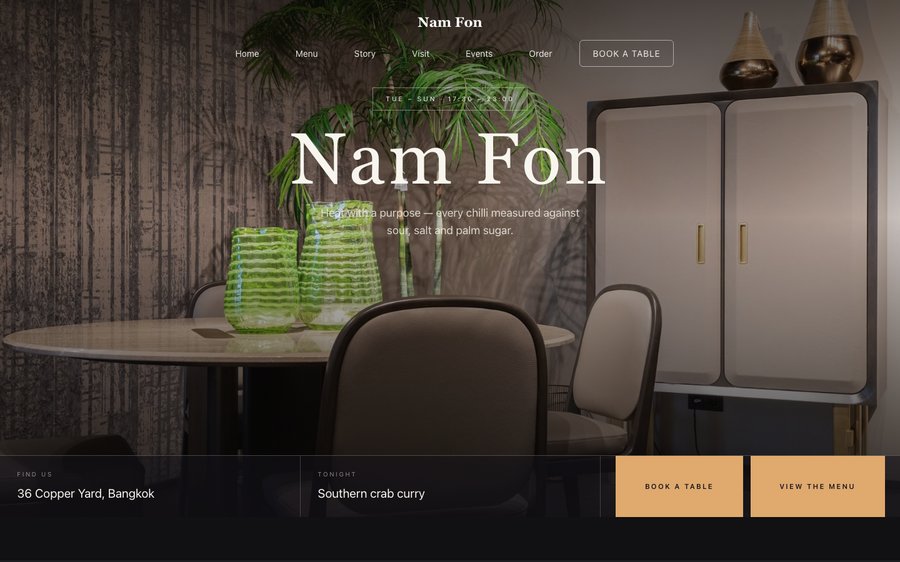
For Thai kitchens working with a seasonal calendar: a dark template with a sunset-tonight opening, a rail-based menu, and a classic priced list for ordering.
Starter is £19/mo excl. VAT and includes a complete restaurant website, a live structured menu, enquiry and newsletter forms, and managed search readiness. Growth is £39/mo excl. VAT and adds direct live bookings, a custom domain with managed SSL, and table and floor-plan operations. Full is £69/mo excl. VAT and adds online ordering and multi-site management for up to five restaurant sites. TableSpark commission is 0%. Stripe's standard card-processing fees apply to online payments.
Nam Fon is a dark room with an amber accent pitched at the hour before service. Yours might be white tile and morning light, or brass and candles, or something nobody has built yet.
There is no demo video and no sales call. What you see on the right is the actual Theme panel from the builder, wired to the actual site renderer on the left. Press a colour. It will not ask you to register and it will not remember what you did. Go on.
Loading the live preview…
Or pick any colour at all — the builder carries a full spectrum picker and a hex field.
6 pages, and every one of them is here. Everything below is rendered, not photographed. The frame uses the same engine as a published site, so the tabs and the in-page links are all real. Phone shows the mobile layout.
Loading the live preview…
A seasonal Thai kitchen is doing something that most guests do not associate with Thai food, and the design has to establish that quickly. The opening leads with tonight — the hour, the sitting, what is being cooked — rather than with a generic hero, because seasonality is a claim best made specifically.
The dark ground with an amber accent reads as a room at dusk. It gives the plating photography a warm surround and lets short dish names sit at display size without looking sparse.
Eight blocks, arranged around tonight:
Loading the live preview…
This is the part worth pressing. Nam Fon uses the Classic list ordering layout — the printed-menu look, with dotted leaders running from each dish to its price. The classic priced list is right for a kitchen selling composed plates. It reads like the printed menu, scans quickly, and does not pretend to be something it is not.
The basket behaves properly regardless: quantities, inline options, a total that stays in view, and payment into your own Stripe account with no commission taken by us. Stripe’s standard card-processing fees apply to online payments.
Each mode collects only what it must: a table number for dine-in, a telephone number for collection, an address for delivery.
Loading the live preview…
This is the frame that matters. It is the real ordering page at a real phone width — not a mock-up, not a video.
On a laptop the same page puts the basket in a panel beside the menu that follows the scroll.
The story page is where a seasonal kitchen explains its calendar: narrative, sourcing, interview, timeline and gallery. The events page carries the seasonal dinners and collaborations, each findable long after the announcement.
Loading the live preview…
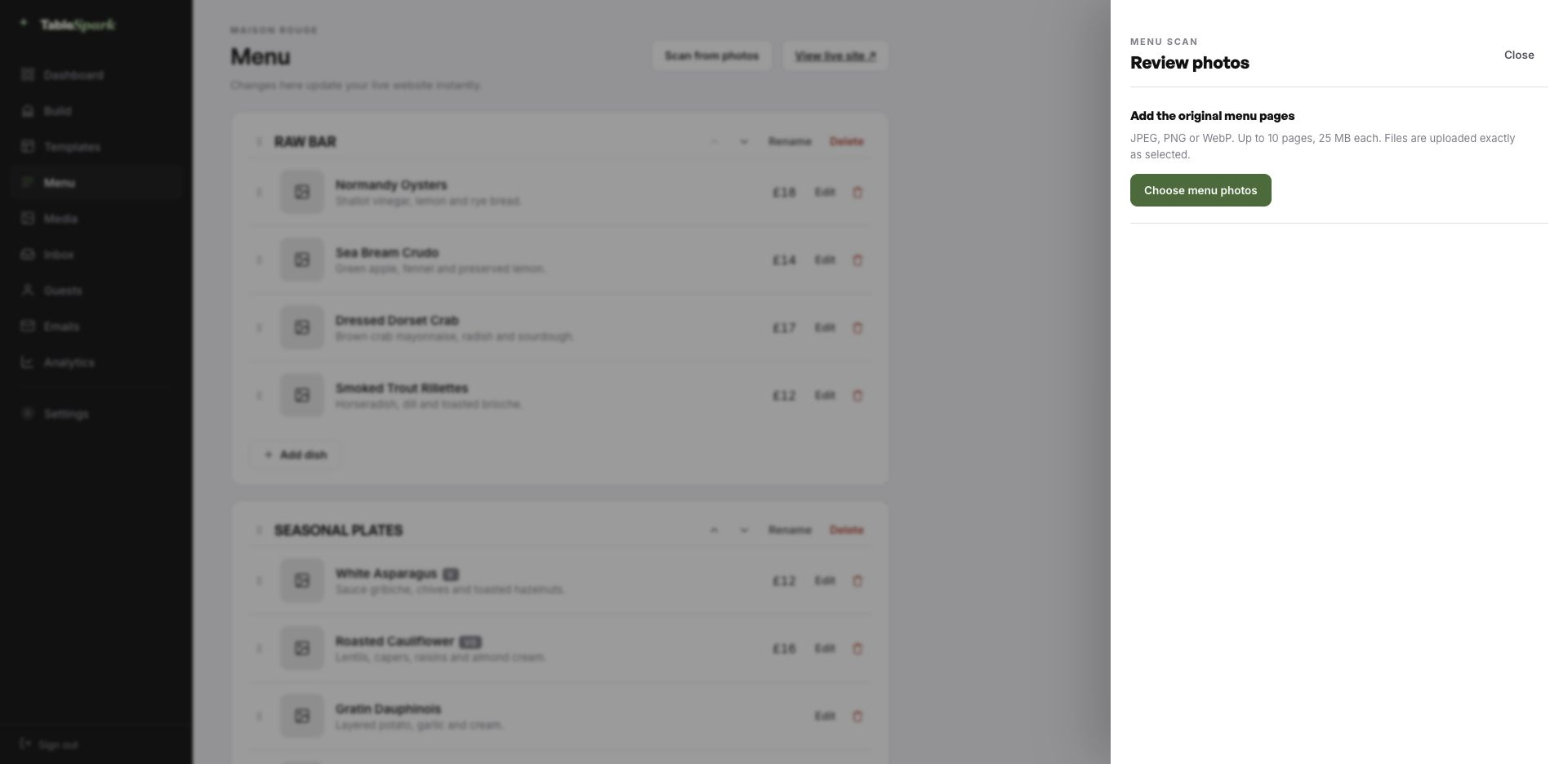
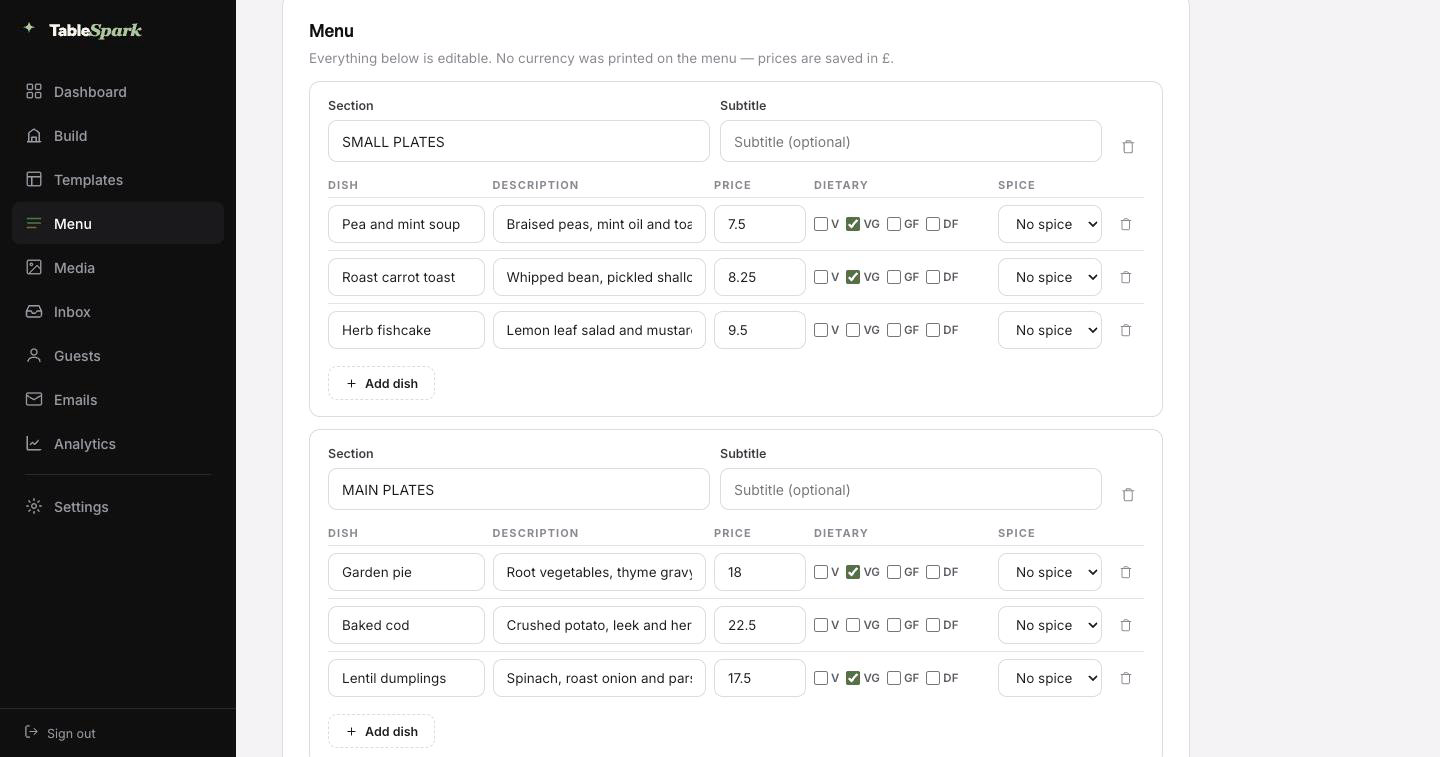
Here is the hour you were dreading, deleted. Photograph the card, the board or the takeaway sheet — up to ten pages at a time — and hand it to TableSpark. It is read into proper fields — section, dish, description, price, dietary marks, spice level — rather than pasted in as a lump of text. Then you read it through, correct whatever the lens misread, and save.
It behaves like data, because it is data. From there the same data runs the menu page, the ordering page, the highlights on the home page and the Restaurant structured data a search engine reads. Change a price once afterwards and all of them follow.
For the search snippet, a Write with AI button drafts the title and description out of the page itself. It is a draft, not a decision: edit it, then publish.
The card, the board, the sheet by the till. Ten pages at a time.
Sections, dish names, descriptions, prices, dietary and heat marks, all editable.
Menu page, ordering page, home-page highlights and the Restaurant schema — because they share one menu.
Nothing here needs to be built, because it already is. The hard parts are finished; the personal parts are not, and only you can do those. You go from opening the builder to a published site on their own address in one sitting, and the reservation form answers from the moment it publishes. You see it in the inbox, they see a confirmation in theirs, both within seconds.
Add your Stripe account and the same site takes booking deposits and order payments, with the money landing in your account rather than ours. TableSpark takes 0% commission at every plan level. Stripe’s standard card-processing fees apply to online payments. Nothing else is deducted.
An address is branding that people type. The TableSpark address gets you live in minutes; your own domain takes over the moment you want it to, with nothing rebuilt.
TableSpark manages the technical side: the certificate, the secure connection, the redirect from the bare domain to the one you chose, and keeping search engines pointed at the right address so the move does not cost you what you have already earned. An existing domain works fine. You get one instruction, not a documentation site.
namfon.tablespark.ukbecomeswww.namfon.co.ukWhat lands in the inbox after a booking is doing more work than most restaurants realise. The confirmation goes out immediately: date and time, party size, the address and phone number, and a link that releases the table if something changes. It also carries the reminder the day before, the deposit receipt and any cancellation.
The design is not a TableSpark email with your name in it — it is your email. Six templates to choose between, then colour, logo, cover image, header style, sign-off wording, links and socials are all yours to set. Hook up the domain and even the sender is you.
The frame below is the real thing: it is drawn by the same renderer the booking system uses, not a picture of one. Press a style or a colour and watch it change.
Loading the email…
Everything a guest sees after they book, set in the same place as the site.
Try the buttons above — this is the live renderer, not a screenshot.
Any tool can put a page on the internet. Fewer can make sure a search engine understands what is on it. It fails quietly: noindex directives nobody noticed, conflicting canonical URLs, orphan pages, menus buried in PDFs, no structured data about the restaurant, and search verification that was never completed. The bill arrives as dependence — guests looking for your kitchen land on a directory or a marketplace that charges you for the introduction.
This is packaged into the site rather than sold separately. There is no promise of a position or of being indexed, because nobody can make one. There is a promise that you will not be hiring someone to fix the basics.
Keep the same page and update it — the address accumulates history and authority rather than starting again each season. If a past menu matters, it can live on the story page as part of the narrative. What matters for search is that one stable page always shows what you serve now.
Yes. A one-to-three chilli scale is set on each item and shows on the menu page, the ordering rows and the structured data. Only the dishes that are hot get marked, which makes the marking worth trusting.
An instant confirmation on your behalf holding the booking details, your address and contact number, and a link that releases the table if something changes. The reminder before service, the deposit receipt and any cancellation notice use the same design — and that design is yours: six templates, your accent, your logo, a cover photograph, three header treatments, your own sign-off, your links and your socials. Once your domain is connected the email sends from it.
No. Every section on every page is edited in the builder: click a block, change the words, drop in a photograph. Nothing on this page was hand-written HTML — it is the same block library your own site is built from.
Ordering is on the Full plan. TableSpark commission is 0% — the money goes to the restaurant. Stripe’s standard card-processing fees apply to online payments. There is no per-order fee from us at any plan level.
There is no need. Send in a photograph of the card, the board or an old PDF; the AI reads it into proper fields and shows you everything before it saves. The payoff comes later: because the menu is structured rather than pictorial, changing one price updates the menu page, the ordering page, the home-page highlights and the Restaurant structured data in the same moment.
One click copies the entire design into your account. Everything after that is editing — and it is free until you publish.
Running a Thai kitchen? See all Thai restaurant website templates.
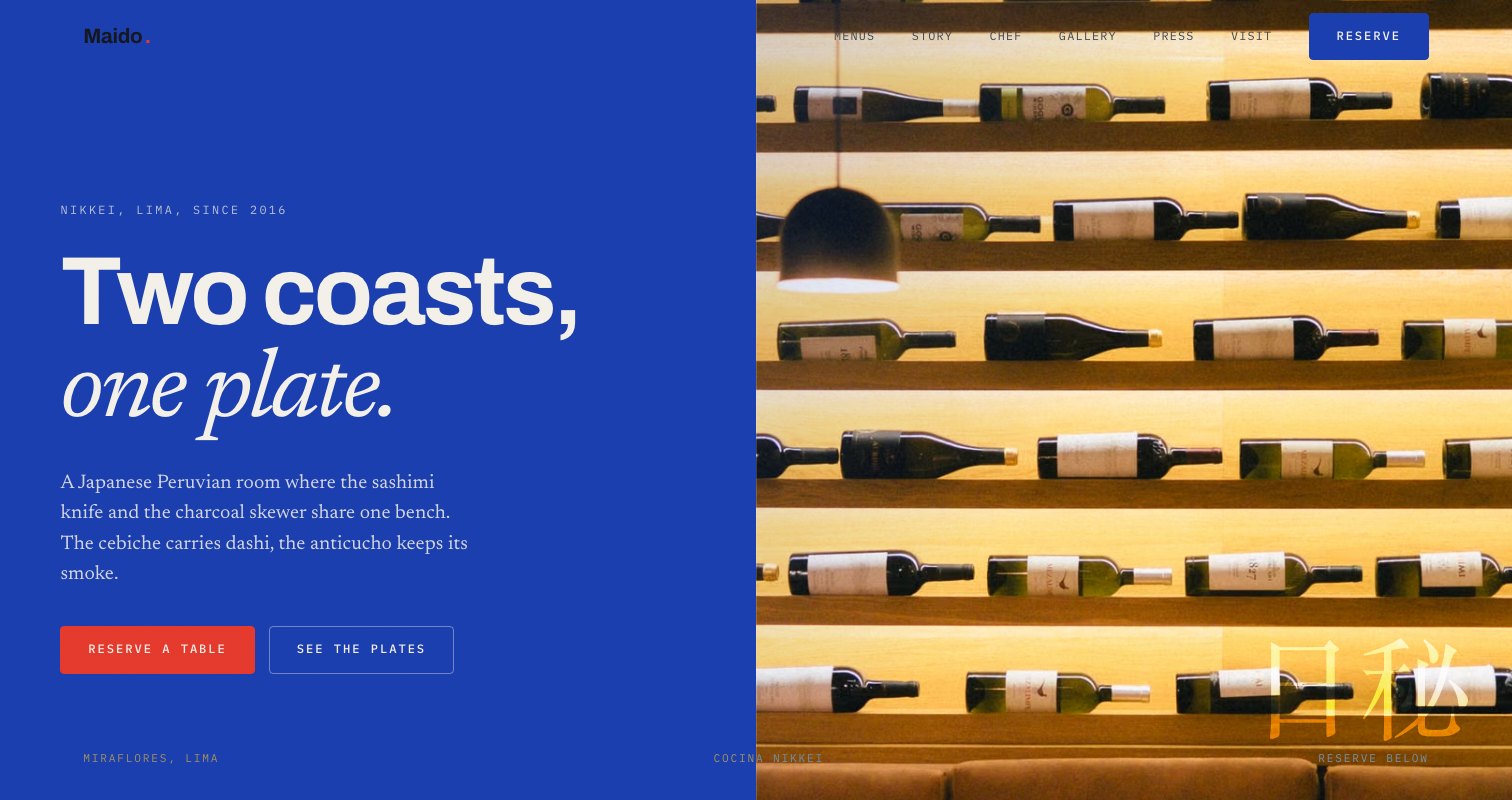 KaimarNikkei (Japanese-Peruvian) · Latin VibrantView the template
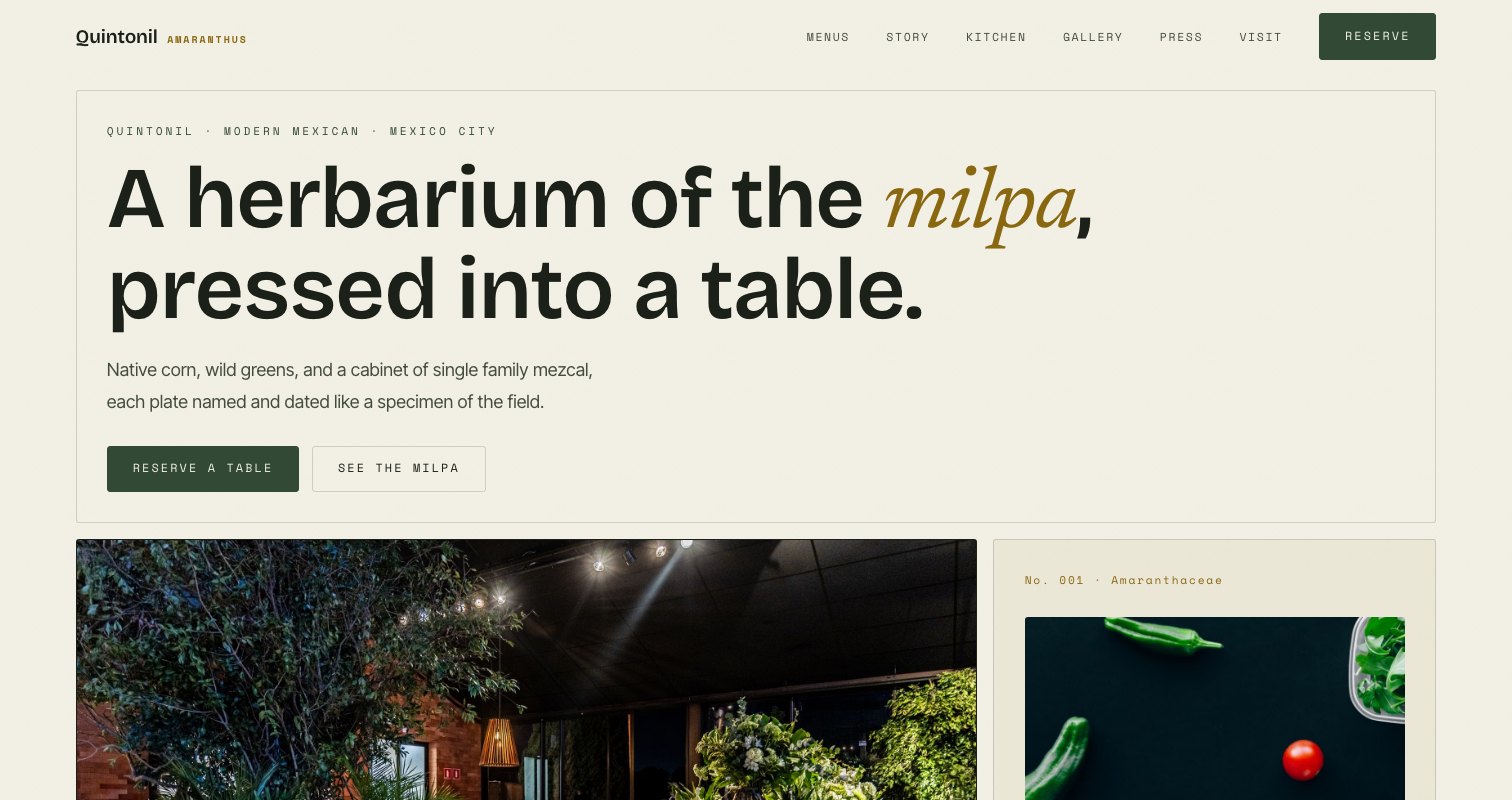 TlalliModern Mexican · Latin VibrantView the template
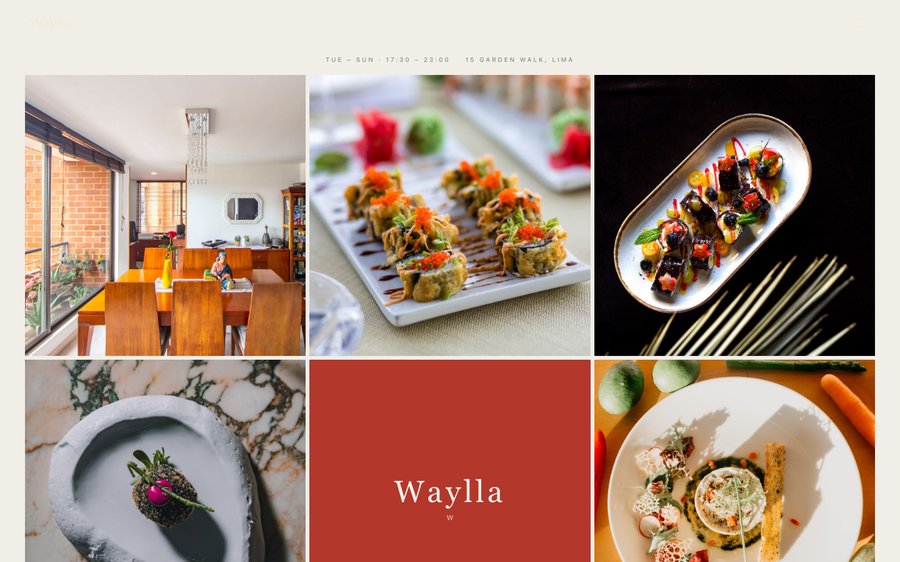 WayllaPeruvian · Latin VibrantView the template