Template library · Modern Mexican

Tlalli — a modern Mexican restaurant website template

For kitchens working with milpa produce, nixtamal and salsas that take three days: colour without kitsch, and a menu structure that can explain a dish without shrinking it. The entire template renders live below.

Modern MexicanStreet & Local · Painted Sign6 pages · 41 editable sections0% commission
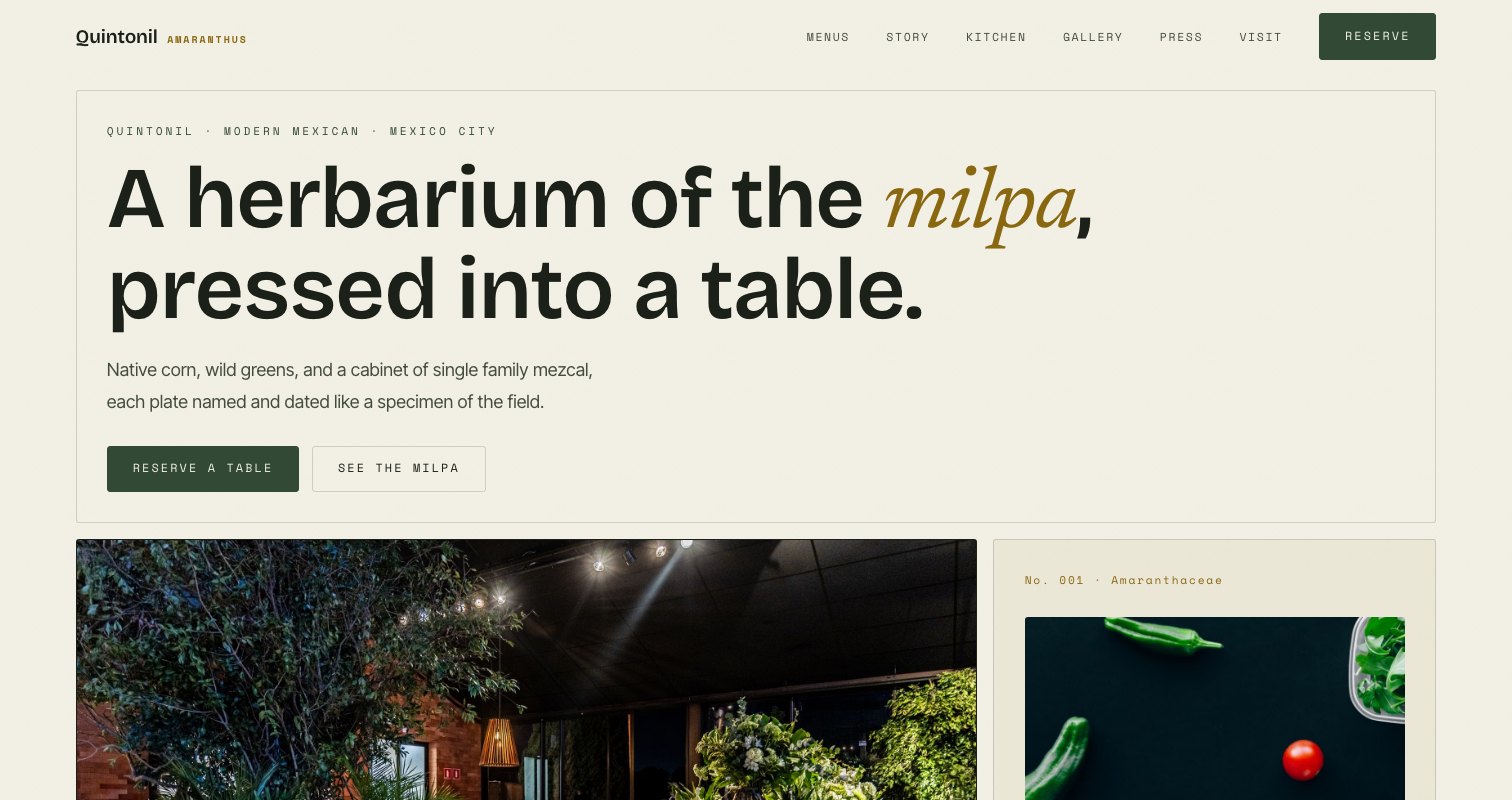
Tlalli, a modern Mexican restaurant website template — the home page as it publishes
Tlalli · Mexico City, Mexico

Starter is £19/mo excl. VAT and includes a complete restaurant website, a live structured menu, enquiry and newsletter forms, and managed search readiness. Growth is £39/mo excl. VAT and adds direct live bookings, a custom domain with managed SSL, and table and floor-plan operations. Full is £69/mo excl. VAT and adds online ordering and multi-site management for up to five restaurant sites. TableSpark commission is 0%. Stripe's standard card-processing fees apply to online payments.

That is the whole website and the whole system, at the best value on offer to an independent UK restaurant. A bespoke build costs thousands and takes months; this one is already designed, and you can publish it this afternoon. And it stays yours to run: change a price at four in the afternoon and it is live before service. Every template is optimised for phone, tablet and desktop, and the plans carry reservations, tables, ordering and management — with 0% TableSpark commission.

Do not read this bit. Touch it.

Tlalli is warm limewash with an orange that belongs to a market awning rather than a chilli emoji. Yours might be white tile and morning light, or brass and candles, or something nobody has built yet.

Skip the description. The panel is lifted straight out of the builder and the frame is the real renderer, so what happens when you press an accent here is exactly what happens in your account. Nothing you do is saved or asked about. Go on.

Loading the live preview…

ThemePagesBlocks
Accent colour

Or pick any colour at all — the builder carries a full spectrum picker and a hex field.

Colours
Fonts
Everything here is live: the Theme tab as it ships, wired to the engine that publishes restaurants.

Open it properly

6 pages, and every one of them is here. None of this is an image. The frame runs the real renderer — the one that publishes live restaurants — so each tab is the actual page and the links go where they say. Press Phone and watch it reflow.

Loading the live preview…

This is the site, rendered here. Navigate inside the frame or switch pages with the tabs.

The room it imagines

Modern Mexican cooking has a presentation problem online: the shorthand available to it — sombreros, cactus, terracotta gradients — belongs to a different restaurant entirely. This design refuses all of it. The palette is limewashed wall and one saturated orange, the type is geometric rather than folkloric, and the imagery does the cultural work without a single cliché.

The opening is a painted sign, which is the honest reference: hand-lettered names on plaster, the way a fonda announces itself on a Mexico City street. It carries the restaurant’s name at size, one line about what the kitchen does, and the two things a guest wants — the menu and a table.

The first page, in pieces

Nine blocks build the page, all of them editable modules:

  • Hero — Big opening image, name & buttons, in the Painted Sign treatment: Hand-painted italic name between two rules, wide room band beneath.
  • Intro statement — Big opening statement line.
  • Offer banner — Time-bounded offer that hides itself when it ends.
  • Menu preview — A few dishes on a sliding rail.
  • Marquee strip — Scrolling awards or words.
  • FAQ — Accordion of questions.
  • Reviews — Guest quotes with stars.
  • Newsletter — Email signup band.
  • Call to action — Headline + button band.

The statement block currently reads Corn nixtamalised nightly, salsas ground in stone, fire doing the talking. — one line you will rewrite in about four seconds.

Loading the live preview…

The Accordion layout. Menu layout, rendered live. Phone view shows what a guest at the table actually sees.

The ordering page, and who keeps the money

This is the part worth pressing. Tlalli uses the Minimal ordering layout — a clean typographic list with nothing between the guest and the order. Ordering is deliberately stripped back here: a clean typographic list rather than a photo grid, which is right for a kitchen where half the menu is salsas, tortillas and sides that nobody needs a picture of. Adding is a single tap; the running total sits in a bar that stays on screen.

Modifier groups earn their keep on a menu like this — corn or flour, one salsa or three, with or without queso — and they appear as chips on the dish row rather than in a pop-up. A guest ordering six tacos with different fillings never leaves the list.

Each mode collects only what it must: a table number for dine-in, a telephone number for collection, an address for delivery.

Loading the live preview…

Try it with your thumb

This is the frame that matters. It is the real ordering page at a real phone width — not a mock-up, not a video.

  • Tap between sections; the dish list swaps in place.
  • Press + to add, to remove — the count is always on the row.
  • The bottom bar shows what is in the basket and what it costs.
  • Every required choice is collected before the dish joins the basket.

On a laptop the same page puts the basket in a panel beside the menu that follows the scroll.

A real phone width, opened where the ordering starts. Add something and the basket bar wakes up.

The story and visit pages

The story page has room for the part that matters most to a milpa kitchen: named growers, the maize varieties, why a particular valley. There is a timeline, a chef’s interview and a gallery, and the events page carries the private-dining and mezcal-tasting enquiries that a room like this fields weekly.

Loading the live preview…

Story page as published — narrative, quote, interview, timeline, gallery.

The typing is already done

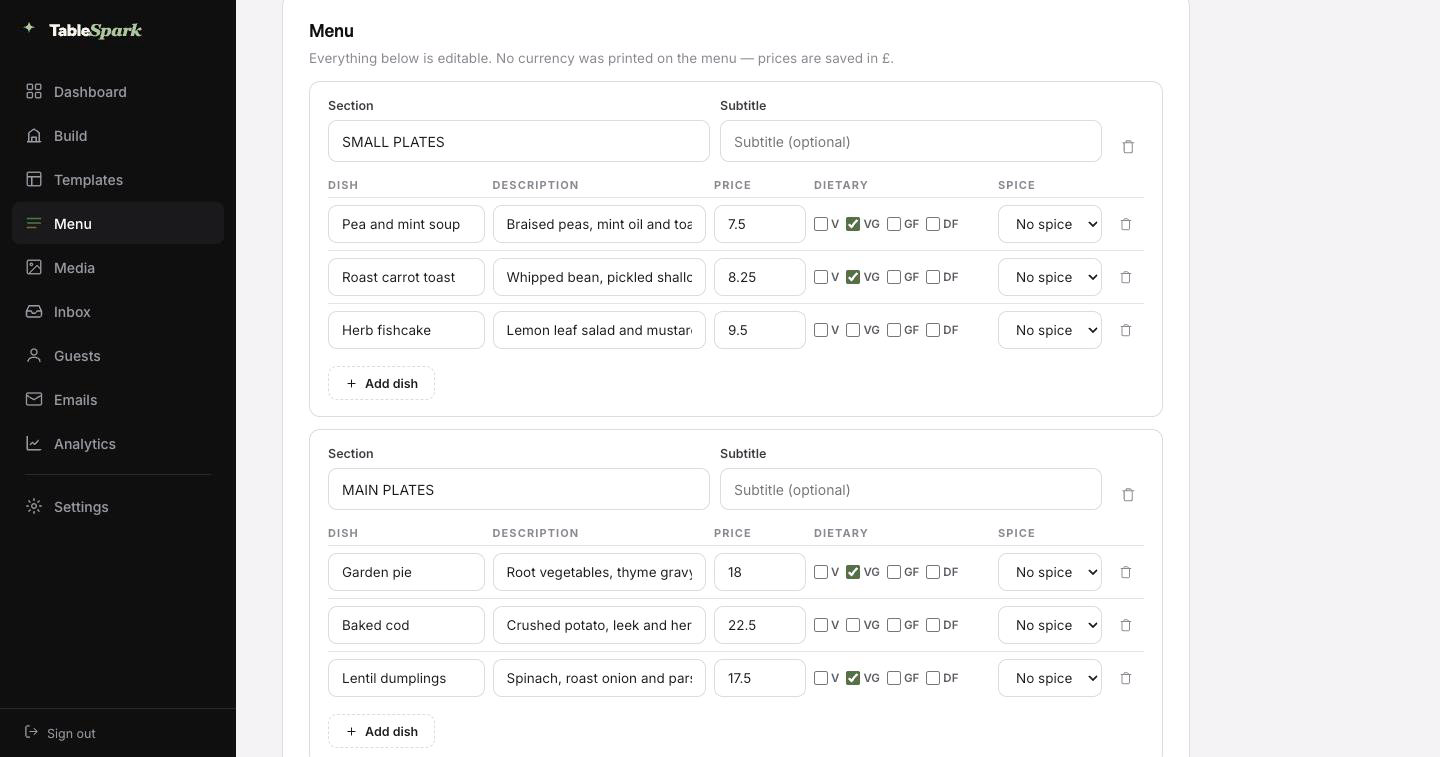
Nobody starts a website looking forward to retyping ninety dishes. Point a phone at whatever your menu currently lives on and send it over. The AI turns it into sections, dishes, descriptions and prices, and picks up the dietary marks and heat levels it can see. Read it back, adjust anything the photograph fumbled, and that is the menu built.

A photograph of a menu is decoration; a structured menu is infrastructure. The same structured menu drives the menu page, the ordering page, the highlights on the home page and the Restaurant structured data a search engine reads. Change a price once afterwards and all of them follow.

And the fields nobody enjoys writing — the search title and description — are drafted by a Write with AI button that reads the page first. The AI writes the first version; you decide whether it is the last.

Step one
Upload the card

A phone photograph of the menu you already hand to guests is enough.

Step two
The AI types it in

Sections in order, dishes with descriptions and prices, dietary and spice marks read from the page.

Step three
It propagates

Menu page, ordering page, home-page highlights and the Restaurant schema — each one updating from the same edit.

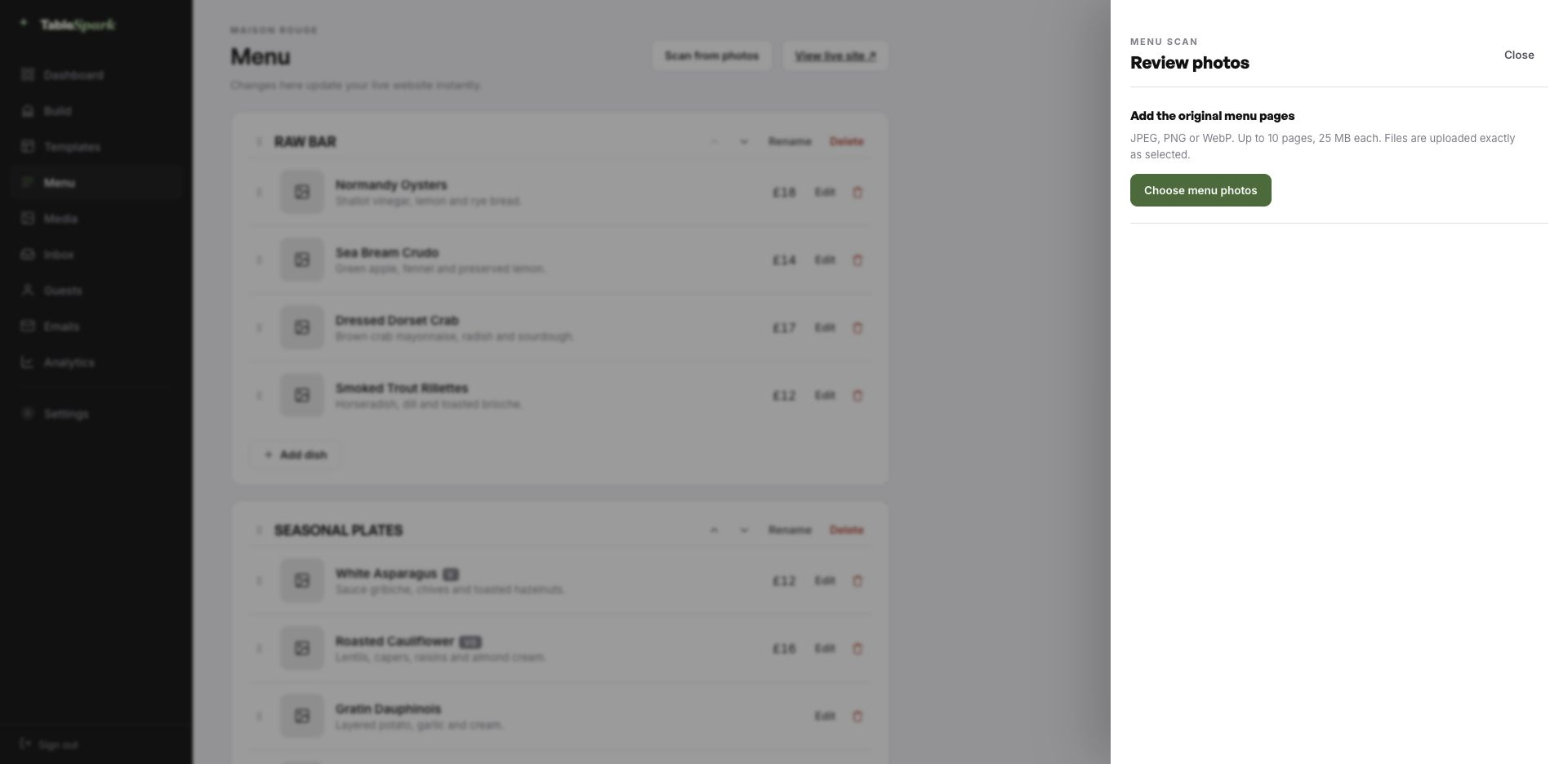
The TableSpark menu editor with the Scan from photos panel open, ready to take menu photographs
One · uploadMenu → Scan from photos. JPEG, PNG or WebP, up to ten pages at a time — a photograph of the printed card is enough.
The review screen after a menu scan: sections, dish names, descriptions, prices, dietary marks and spice levels, every field editable
Two · reviewEverything the AI read, laid out as editable fields — sections, dishes, prices, dietary marks, heat.

Publish today, take bookings tonight

You are not commissioning a website; you are moving into one. The site works from the first second — it simply has the wrong name on the door. Ten minutes covers it for most kitchens — and the second it is live, the booking form is taking reservations. It lands in the inbox with the party size and the time, and the guest is confirmed by email at once.

Attach your own Stripe account and the site can charge for orders and hold deposits on tables — the funds are yours from the start. We take 0%. Not on the first order, not on the thousandth. Stripe’s standard card-processing fees apply to online payments.

  1. Pick TlalliEverything copies across — pages, blocks, menu, the lot.
    1 min
  2. Change the name and the wordsEvery block is edited in place. Change the name once.
    4 min
  3. Upload your menuA photograph of the menu becomes a structured menu.
    3 min
  4. PublishLive. The reservation form starts working immediately.
    1 min
  5. Connect StripeNow you can take deposits on tables and payment on orders — direct to your account.
    1 min

Your name over the door

The web address is something guests read aloud, so it should sound like you. You can be live before lunch on a TableSpark address and on your own domain by the weekend, with no rebuild in between.

Everything fiddly about a domain — SSL, renewals, bare-domain redirects, canonical URLs surviving the move — is managed on your behalf. Already own the name? Keep it — you get the exact record to update, in plain English.

tlalli.tablespark.ukbecomeswww.tlalli.co.uk

The email nobody thinks about, designed properly

The email that follows a booking is read more carefully than any page on the site. As soon as a table is confirmed, the guest gets an email in your name carrying the date, the time, the number of covers, your address, your phone number and a way to cancel cleanly. Reminders, receipts and cancellations follow the same treatment, so nothing looks bolted on.

It carries your restaurant, not our branding. Pick one of six templates, then set the accent, the logo, a cover image, how the header sits, the sign-off line, your links and your social marks. When your domain is connected the mail is sent from your own address, which is also what keeps it out of a promotions tab.

Below is the actual renderer, the one that sends after a confirmed booking. Press any of the styles or colours and it rebuilds in front of you.
Loading the email…

Your branding, not ours

Everything a guest sees after they book, set in the same place as the site.

  • Six base designs, from clean white to near-black.
  • Your accent colour, your logo and a cover image.
  • Your own domain as the sending address.
  • Reminders, receipts and cancellations share the design.
  • Your sign-off — Buen provecho.

Try the buttons above — this is the live renderer, not a screenshot.

Yours, ours, and never locked

  • Yours from the first minute: every word and every image, the menu and what it costs, the hours you keep, where you are, and the colours and fonts the site is built from.
  • Kept for you: the difficult engineering — long-menu behaviour, the basket on a small screen, how blocks stack when the window narrows, and legibility surviving a palette change.
  • Never locked: reorder, remove or add any block on any page, add whole pages, and throw away anything you do not need. This is a starting point, not a cage.

What it takes to actually be found

Being published and being findable are two different things, and only one of them happens automatically. The usual culprits are mundane: a robots rule nobody removed, two canonicals pointing different ways, orphaned pages, the menu published as a PDF, no structured restaurant data, search verification half done. The cost lands on the restaurant — guests searching your name, your menu or your street reach directories and commission-charging marketplaces first, and you end up paying for the traffic you should already own.

All of that is finished before you arrive. Search results are not something anyone can promise you. A correctly configured site is, and that is what this is.

What restaurants ask us

Can I show heat levels without labelling everything as spicy?

Yes, and the scale is per dish rather than per section. Each item gets none, one, two or three chillies, set in the menu editor, and it shows on the menu page, the ordering page and the structured data. Because it is a field rather than a note typed into the description, guests can trust it — and you can adjust one dish without editing a paragraph.

We have a lot of modifiers — salsas, tortillas, add-ons. Does ordering cope?

That is what modifier groups are for. Set a group once (corn or flour; choose one salsa; extras) and attach it to the dishes it applies to. On the ordering page the choices appear as chips on the dish row itself, so selecting takes a tap and never opens a modal. Required choices are enforced before the dish can be added.

Do we have to use a TableSpark address?

Yes — and bringing a domain you already own is the common case. You go live on a TableSpark address first, then point your domain across; you get the exact DNS record to change. The certificate, HTTPS, bare-domain redirect and the search-engine housekeeping are handled here so the switch does not cost you visibility. Your guest emails can then send from that domain as well.

What lands in the guest’s inbox when they reserve?

A confirmation in the restaurant’s name, immediately, with the date and time, the party size, your address and phone number, and a cancellation link so a change of plan does not cost you the cover. Pre-service reminders, deposit receipts and cancellation notices share it. The look is entirely yours — six templates, accent colour, logo, cover photograph, header layout, sign-off wording, links, social accounts — and your domain becomes the sending address once connected.

Can someone non-technical run this?

None at all. The whole site is blocks you click and edit — text in place, photographs uploaded, sections dragged into a new order. No HTML is involved on your side.

What do we pay per order?

Ordering is on the Full plan. TableSpark commission is 0% — the money goes to the restaurant. Stripe’s standard card-processing fees apply to online payments. There is no per-order fee from us at any plan level.

Take Tlalli and go

Copy this design into your account, change the words, add your menu and publish — usually the same afternoon. Free to build; you only pay when you go live.

Use this template free

Running a Mexican & Latin kitchen? See all Mexican & Latin restaurant website templates.

More Latin Vibrant templates

Related reading

← Browse all 50 restaurant website templates