Template library · Peruvian-Venezuelan

Orinoco Sur — a Latin American restaurant website template

For kitchens working across two Latin traditions: a dark counter template with an indexed menu, a classic priced list for ordering, and a design that treats a small room as an advantage.

Peruvian-VenezuelanStreet & Local · Counter5 pages · 35 editable sections0% commission
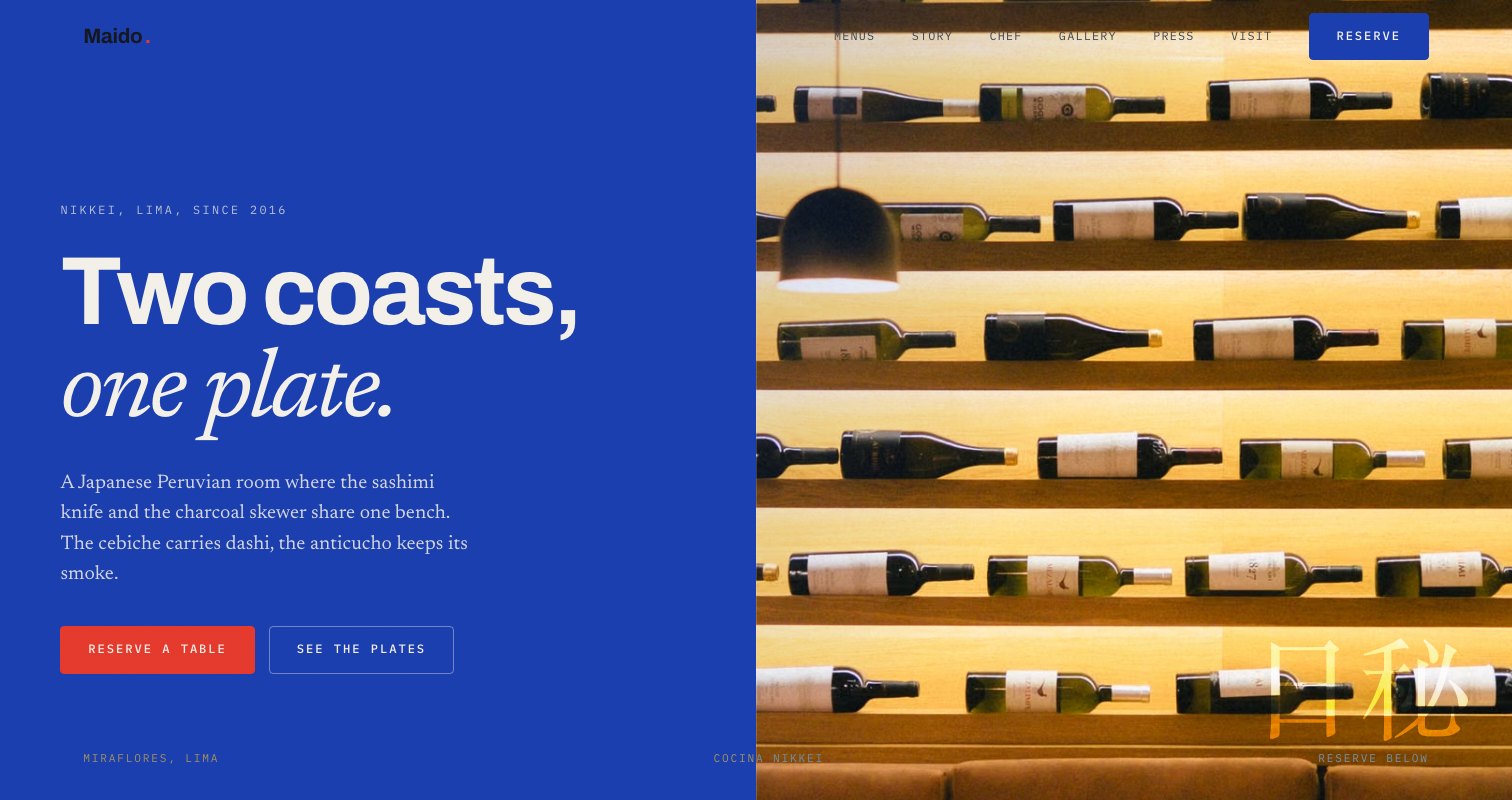
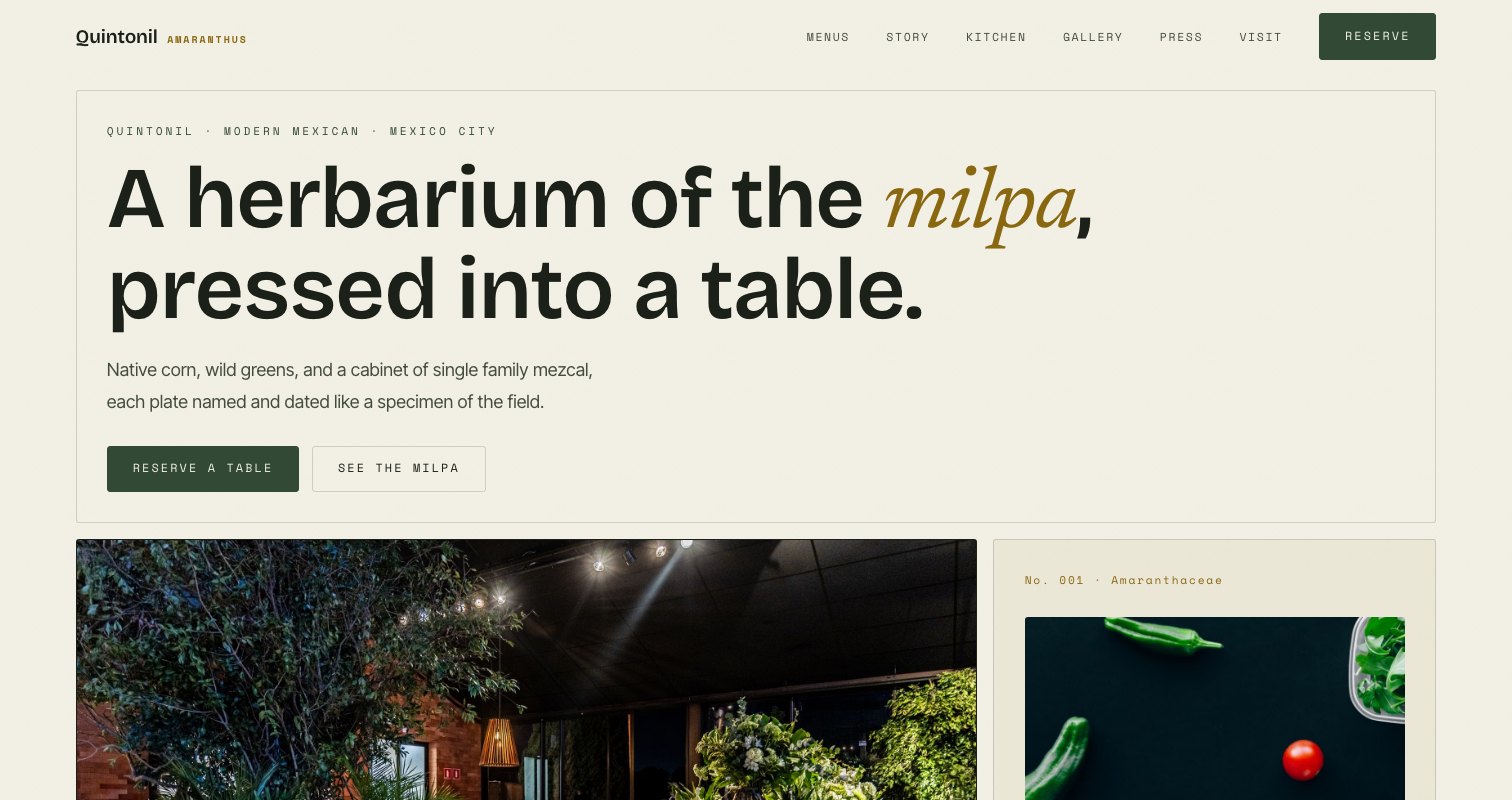
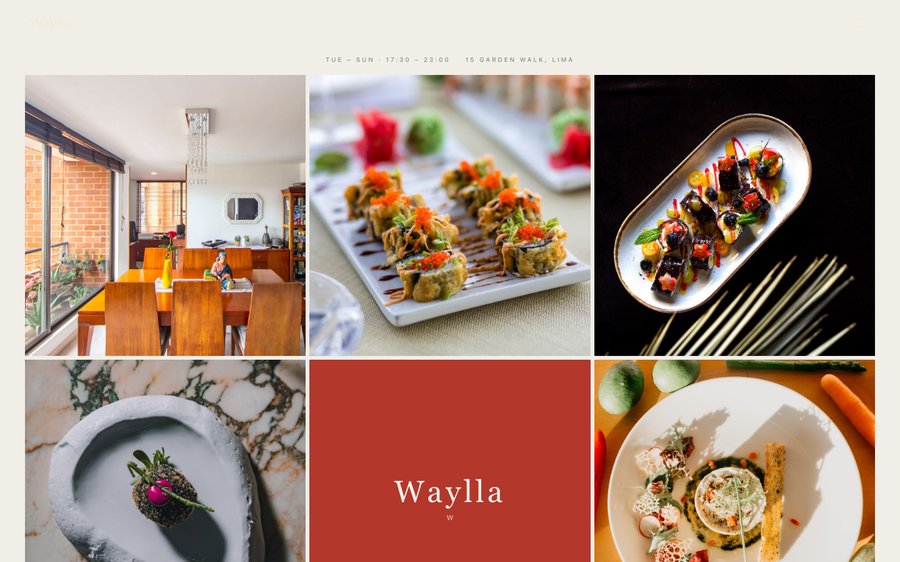
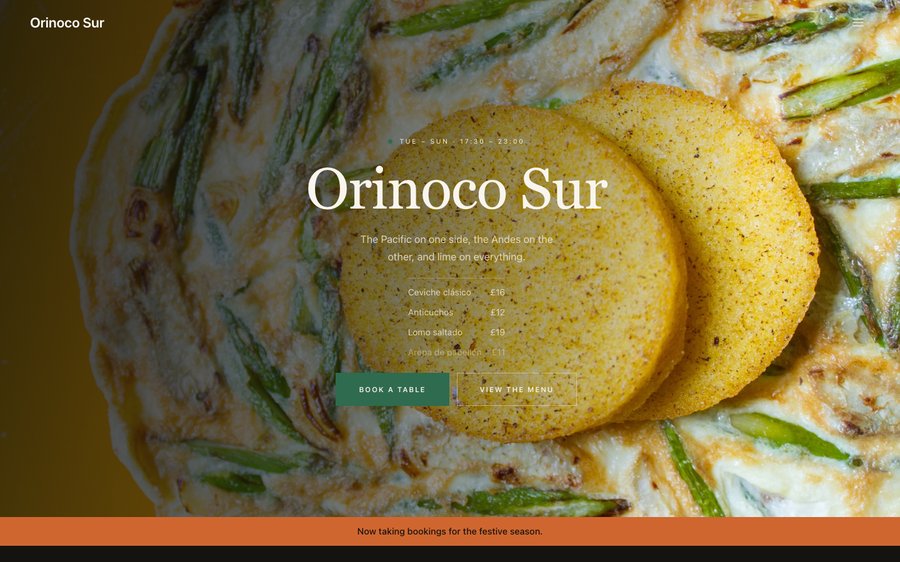
Orinoco Sur, a Latin American restaurant website template — the home page as it publishes
Orinoco Sur · Lima, Peru

Starter is £19/mo excl. VAT and includes a complete restaurant website, a live structured menu, enquiry and newsletter forms, and managed search readiness. Growth is £39/mo excl. VAT and adds direct live bookings, a custom domain with managed SSL, and table and floor-plan operations. Full is £69/mo excl. VAT and adds online ordering and multi-site management for up to five restaurant sites. TableSpark commission is 0%. Stripe's standard card-processing fees apply to online payments.

A finished restaurant website and the system behind it, at the lowest entry point and the best value available to an independent UK kitchen. There is no build phase and no invoice with a project manager on it. The design exists; your job is to put your restaurant inside it. Every word and every price stays under your control afterwards, which is the part that decides whether a restaurant site stays accurate. It reads properly on a phone, a tablet and a desktop, and the plans carry reservations, table management and online ordering at 0% TableSpark commission.

Press something. It is your restaurant now.

Orinoco Sur is a dark counter with an acid-lime accent that comes off a market crate. Yours might be white tile and morning light, or brass and candles, or something nobody has built yet.

Rather than explain, here is the thing itself: the builder’s Theme controls on one side, the live site on the other, both real. You cannot break it, nothing saves, and no account is required to have a go. Go on.

Loading the live preview…

ThemePagesBlocks
Accent colour

Or pick any colour at all — the builder carries a full spectrum picker and a hex field.

Colours
Fonts
The real controls, the real site. Press anything on the right and watch the left redraw.

Every page, as it publishes

5 pages, and every one of them is here. What follows is the site itself rather than pictures of it. The same engine that publishes a live restaurant is drawing it here, links and all. The Phone toggle shows the small-screen version.

Loading the live preview…

Rendered live. Every link in the frame goes where it says; the tabs above jump straight there.

Who this was drawn for

A small room cooking across two countries has to explain itself quickly, and a counter opening does it: the hours, the address, what is on tonight, and a way to book. There is no space wasted on establishing atmosphere before establishing facts.

Dark ground and acid lime is a combination that reads as market rather than fine dining, which is the correct register for a kitchen whose ambition is in the cooking rather than in the tablecloths.

What is on the home page

Eight blocks, arranged for a small room:

  • Hero — Big opening image, name & buttons, in the Counter treatment: Copy and opening hours held on the dark side of a counter photograph.
  • Announcement — Slim notice bar at the top.
  • Menu preview — A few dishes on a sliding rail.
  • Feature rows — Alternating image and text rows.
  • Text + image — A paragraph beside a photo.
  • Numbers — Headline stats.
  • Gallery — Grid, masonry or moving strip.
  • Call to action — Headline + button band.

Loading the live preview…

The Index layout. The real menu page. Try it at phone width — the structure survives the squeeze.

Ordering: a delivery app that belongs to you

This is the part worth pressing. Orinoco Sur uses the Classic list ordering layout — the printed-menu look, with dotted leaders running from each dish to its price. The classic priced list with dotted leaders is right for a room selling composed plates rather than fast food — quick to scan, honest about what it is, and not pretending to be an app.

It still works as a basket: quantities, inline options, a total that stays on screen, and modes that ask only for what they need. Payment goes to your own Stripe account. TableSpark takes 0% commission. Stripe’s standard card-processing fees apply to online payments.

What the guest is asked depends on how they are eating: table number, phone number or address, and never all three.

Loading the live preview…

Do this bit on the phone

This is the frame that matters. It is the real ordering page at a real phone width — not a mock-up, not a video.

  • Tap a section in the chip bar — the dish list swaps without losing your place.
  • Press + on a dish; the stepper beside it counts up.
  • Watch the bar at the bottom: item count, running total, Place order.
  • Dishes needing a choice — size, spice, portion — open a sheet from the bottom.

On a laptop the same page puts the basket in a panel beside the menu that follows the scroll.

The ordering page as a guest would hold it. Tap a dish and watch the bottom bar.

The pages behind the menu

The story page carries the two-country narrative, the family and the sourcing, with a timeline, an interview and a gallery. The visit page handles a small room where the practical details — the door, the hours, whether you take walk-ins — get asked constantly.

Loading the live preview…

The story page, live: who cooks, why here, and what happened when.

Upload your menu. The AI does the typing.

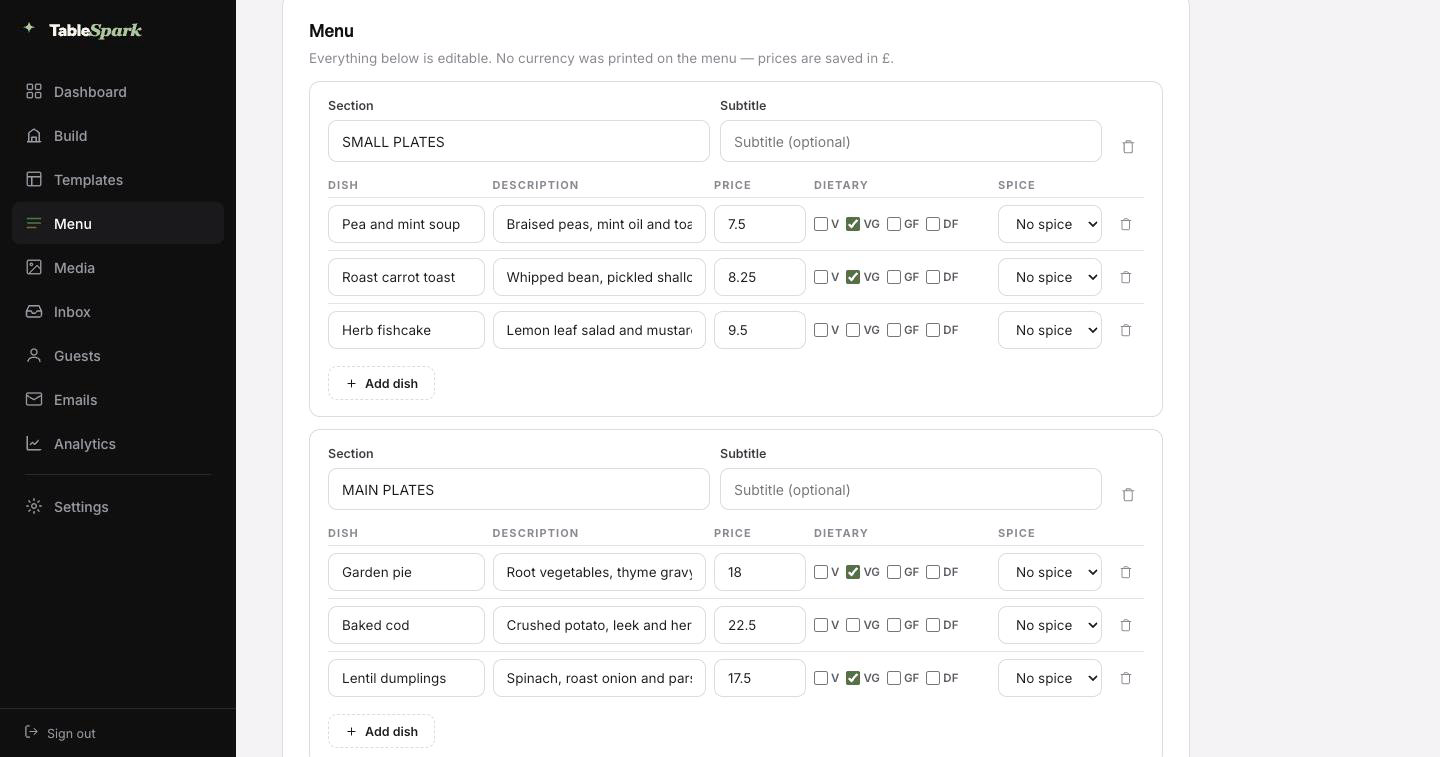
The menu is the longest thing on any restaurant site, and it is the thing you type least. Whatever the menu is printed on, photograph it and upload it; the format does not matter. TableSpark reads it and builds the structured menu for you: sections in the right order, dish names, descriptions, prices, and the dietary and spice marks where it can see them. You review it, fix anything the camera got wrong, and it is done.

The distinction that matters is that a search engine can read every word of it. Everything downstream reads from it: the menu page, the ordering page, the highlights on the home page and the Restaurant structured data a search engine reads. Change a price once afterwards and all of them follow.

A Write with AI button on each page writes the search title and description from what is on it, so no page publishes with those fields empty. Always your last word — the draft lands in the field for you to edit before anything publishes.

Step one
Take a picture

Whatever your menu lives on today — card, board, PDF, ten pages of it.

Step two
It comes back structured

Ordered sections, named dishes, descriptions, prices and marks, all editable.

Step three
One source, many pages

Menu page, ordering page, home-page highlights and the Restaurant schema — all reading from the same menu.

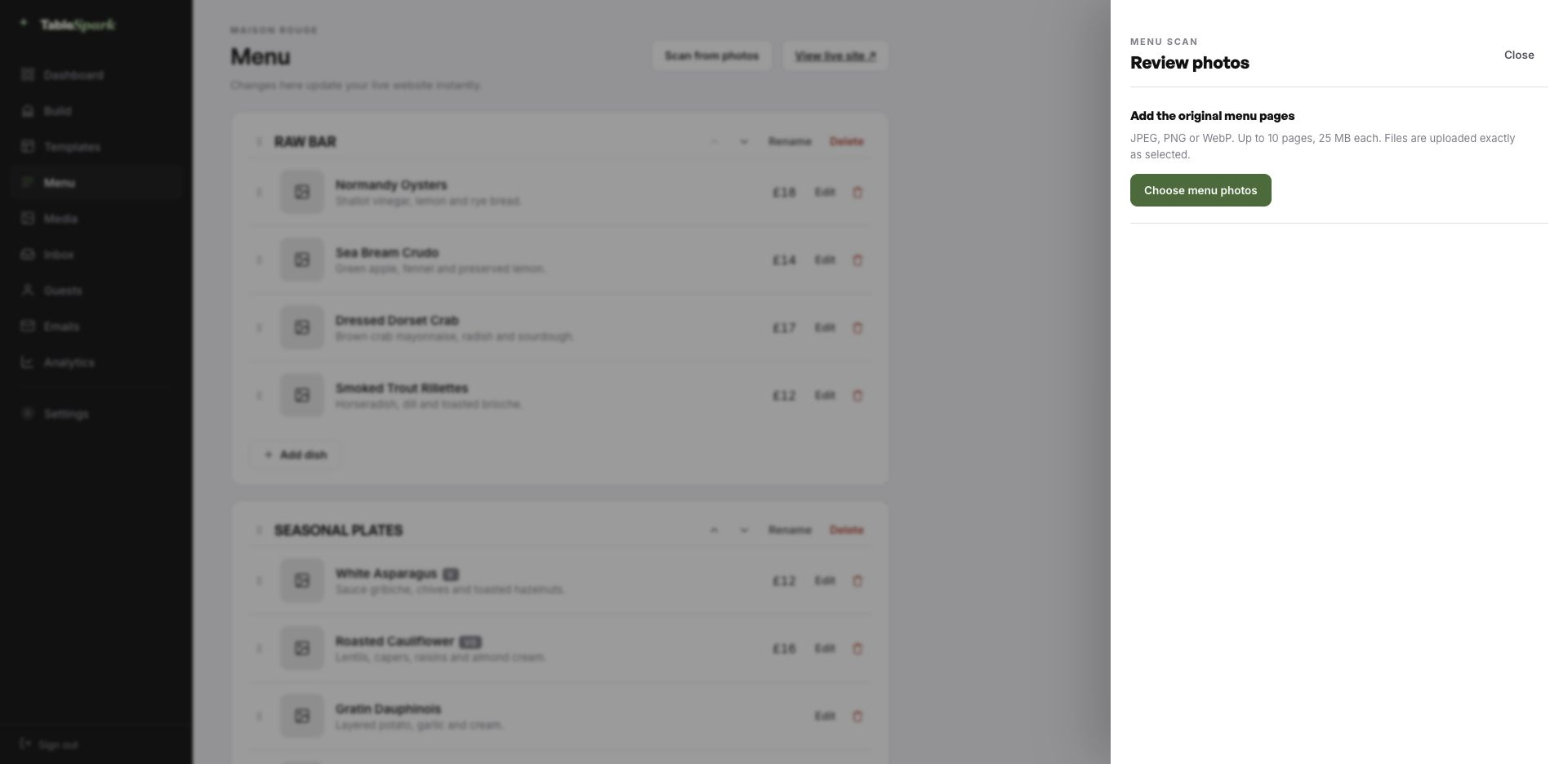
The TableSpark menu editor with the Scan from photos panel open, ready to take menu photographs
One · uploadThe entry point: upload up to ten menu pages as JPEG, PNG or WebP.
The review screen after a menu scan: sections, dish names, descriptions, prices, dietary marks and spice levels, every field editable
Two · reviewThe review screen. Nothing is written until you approve it, and every value can be corrected here.

How long this actually takes

The gap between deciding and being live is measured in minutes, not weeks. The template is already a finished site; the work is making it yours. Ten minutes is a fair estimate from first login to a live address, and bookings start working the instant you publish. Reservations collect in your TableSpark inbox and each guest is confirmed by email automatically.

Payments are one link away. Connect Stripe and deposits and order payments flow directly to you. Zero commission, permanently. Stripe’s standard card-processing fees apply to online payments. That is the end of the list.

  1. Pick Orinoco SurThe complete site lands in your account, ready to edit.
    1 min
  2. Change the name and the wordsClick, type, replace a photograph. The name updates site-wide.
    4 min
  3. Upload your menuUpload a picture of the card; the AI does the sections and prices.
    3 min
  4. PublishPublished, on your own address, with the booking form answering.
    1 min
  5. Connect StripeNow you can take deposits on tables and payment on orders — direct to your account.
    1 min

Point your own domain at it

What is printed at the bottom of the menu should be your own. Go live immediately on a TableSpark address, and swap in your own domain at any point afterwards — including one you already own.

Certificates, HTTPS, the redirect from the naked domain and the search-engine housekeeping around a move are all handled for you. Bring a domain you already own, and we will tell you exactly which record to change.

orinocosur.tablespark.ukbecomeswww.orinocosur.co.uk

After the booking: an email that looks like you

Between booking and arriving, the confirmation email is the whole relationship. The moment a guest books, TableSpark sends them a confirmation on your behalf: the date, the time, the party size, where you are, how to reach you, and a link to release the table if their plans change. The pre-service reminder, the deposit receipt and the cancellation note share it.

None of it has to look like us. Six designs to start from, plus your colour, your logo, a photograph, the header treatment, your own closing line, your links and your socials. Connect your domain and it sends from your address too — so what lands in a guest’s inbox looks like it came from the restaurant, because it did.

Not a mock-up: the frame runs the actual guest-email renderer. Press a template or an accent and watch it change.
Loading the email…

Set by you, not us

Everything a guest sees after they book, set in the same place as the site.

  • Six designs, from editorial to bold.
  • Accent colour, logo and cover image are yours.
  • Three header treatments to choose between.
  • The same design covers reminders, receipts and cancellations.
  • Your sign-off — A small room, a long menu.

Try the buttons above — this is the live renderer, not a screenshot.

What you control

  • Yours from the first minute: the wording anywhere on the site, the photographs, the menu and prices, your hours and location, and the palette and typefaces.
  • Kept for you: the parts that break when hand-built: a menu that still reads at two hundred dishes, a basket that works one-handed, and contrast that holds whatever colour you choose.
  • Never locked: add, delete or reorder any section on any page. Add pages. Delete the ones you do not want. The template is the starting line.

Findable, not merely online

There is a gap between a website that loads and a website that gets found, and it is wider than most owners expect. Working link, zero visibility. It happens through stray noindex rules, conflicting canonicals, orphaned pages, PDF menus, absent structured data and unfinished verification. And the restaurant pays for it: people searching your own name find aggregators and commission-charging platforms instead, so you rent back an audience that was yours.

It is handled in the box, not in an add-on. No guarantees about rankings or indexing exist anywhere in this industry. What exists here is the technical work, finished.

Questions before you start

We are small and take walk-ins. Do we need a booking form at all?

It is useful even then. The form can be limited to the services and party sizes you want to hold, and everything else is a walk-in — while the visit page states your policy plainly. Bookings that do come in arrive in your inbox with a confirmation sent automatically, which is fewer phone calls during service.

Our menu draws on two countries. Can sections say which is which?

Yes — sections are named by you and can carry a subtitle, so a menu can be organised by country, by technique or by course. The description line on each dish adds the specifics, and all of it is indexable text.

Can we put this on the address printed on our menus?

Yes. The TableSpark address exists so you can publish immediately, not so you stay on it. Move to your own domain whenever you like, including one you already own; TableSpark issues and renews the SSL certificate, redirects the bare domain, and keeps canonical URLs, the sitemap and robots pointing at the live address so nothing earned is lost. Guest email can send from the same domain.

Is there a confirmation email, and can we brand it?

The guest receives a branded confirmation straight away: date, time, number of covers, your address, your phone number, and a link to release the table. Reminders before service, deposit receipts and cancellation notices come from the same place. You choose from six templates and set the accent colour, logo, cover photograph, header layout, sign-off, links and social accounts — and with your domain connected, the sender address is yours.

Do I need to know how to code?

No — the builder is visual throughout. Click a block, retype the copy, swap the photograph, move it up or down. Nothing about running the site requires HTML.

Does online ordering carry a percentage fee?

Ordering is included on the Full plan. We charge 0% commission and no per-order fee, on any plan. Stripe’s standard card-processing fees apply to online payments.

Orinoco Sur, with your name on it

Take this design, make it about your restaurant, and publish it today. Building costs nothing; you pay only when it goes live.

Use this template free

Running a Mexican & Latin kitchen? See all Mexican & Latin restaurant website templates.

More Latin Vibrant templates

More on the money side

← Browse all 50 restaurant website templates