The rest of the site
The story page carries the room, the growers and the wine — narrative, sourcing, interview and gallery — and the reservations page handles bookings for a room that seats thirty and turns twice.
Template library · Natural bistronomy
For bistros with a natural wine list and a menu written that morning: a light template with a today’s-pitch opening, a compact carte, and the full delivery-app ordering layout.
Starter is £19/mo excl. VAT and includes a complete restaurant website, a live structured menu, enquiry and newsletter forms, and managed search readiness. Growth is £39/mo excl. VAT and adds direct live bookings, a custom domain with managed SSL, and table and floor-plan operations. Full is £69/mo excl. VAT and adds online ordering and multi-site management for up to five restaurant sites. TableSpark commission is 0%. Stripe's standard card-processing fees apply to online payments.
Onzième is bright paper with a green that reads as a wine label rather than a leaf. Yours might be white tile and morning light, or brass and candles, or something nobody has built yet.
Skip the description. The panel is lifted straight out of the builder and the frame is the real renderer, so what happens when you press an accent here is exactly what happens in your account. Nothing you do is saved or asked about. Go on.
Loading the live preview…
Or pick any colour at all — the builder carries a full spectrum picker and a hex field.
6 pages, and every one of them is here. Not screenshots. The frame is running the publishing renderer, so the navigation inside it works and every tab is a real page. Switch to Phone to see how it behaves on a handset.
Loading the live preview…
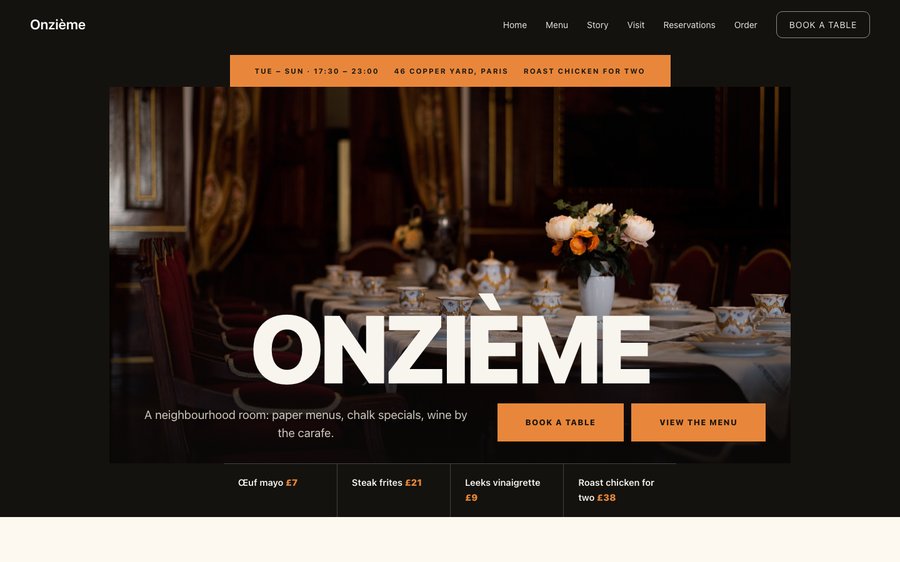
A neighbourhood bistro with a short daily menu has the simplest brief on this list and the easiest one to get wrong: say what is on today, say when you are open, and take a booking. Anything more is decoration. The design opens with exactly those three things.
The palette is bright paper with a natural green, the type is a geometric display face over a plain sans, and the whole page is shorter than most in the library. That brevity is the point.
Nine blocks, and none of them wasted:
Loading the live preview…
This is the part worth pressing. Onzième uses the Delivery app ordering layout — sections run down a rail on the left, the dish list swaps beside them without losing your place, and the basket follows the scroll. The full delivery-app layout is here because bistros of this kind do a serious lunch takeaway and sell wine to take away too. A section rail, a dish list, a basket that follows the scroll.
It is on your own domain and in your own inbox, with the guest record yours to keep and TableSpark taking 0% — which is the whole argument against routing that trade through a marketplace.
Dine-in wants a table number and nothing else; collection wants a number to ring; delivery wants somewhere to go. No mode asks for the others’ fields.
Loading the live preview…
This is the frame that matters. It is the real ordering page at a real phone width — not a mock-up, not a video.
On a laptop the same page puts the basket in a panel beside the menu that follows the scroll.
The story page carries the room, the growers and the wine — narrative, sourcing, interview and gallery — and the reservations page handles bookings for a room that seats thirty and turns twice.
Loading the live preview…
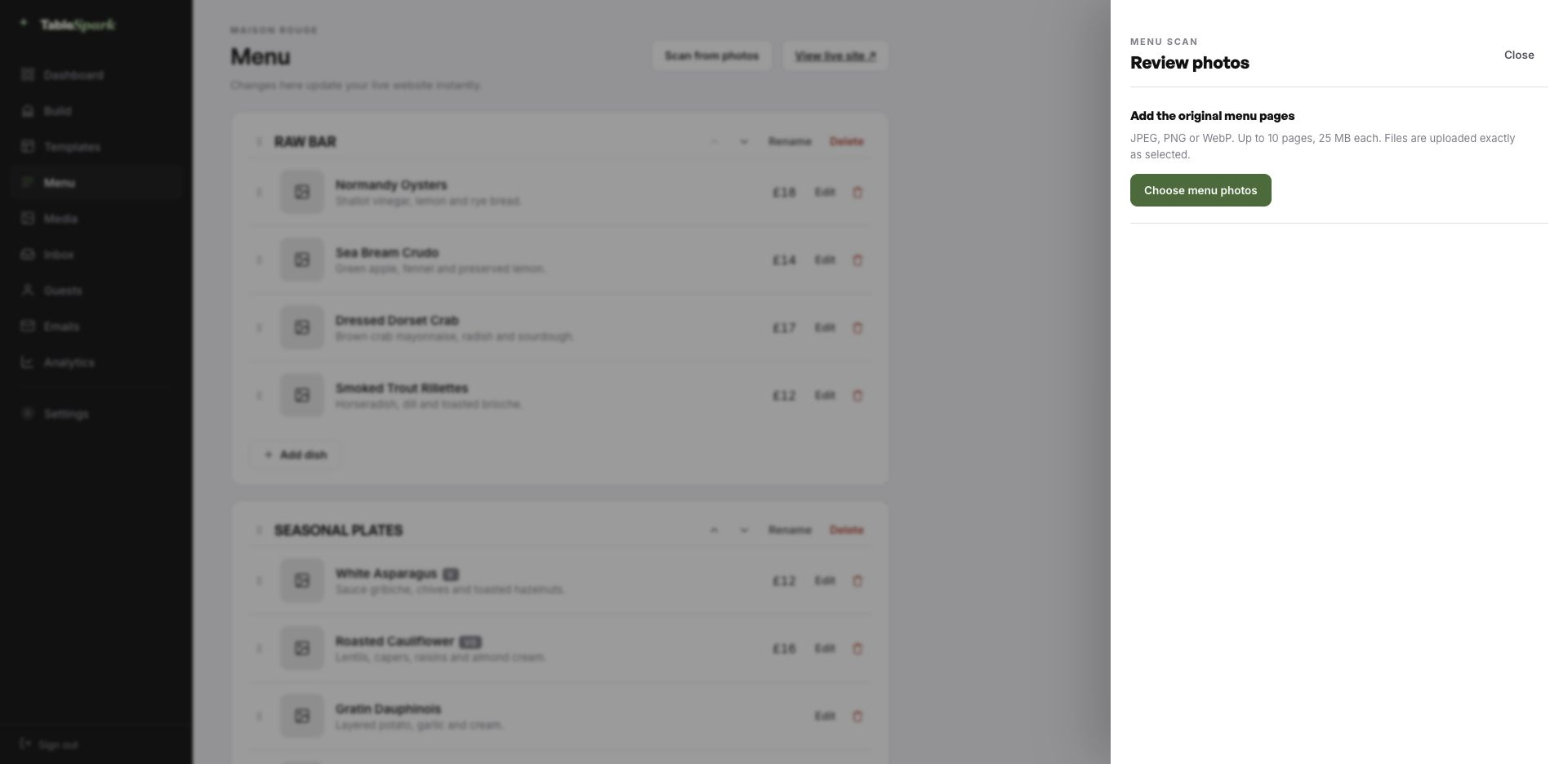
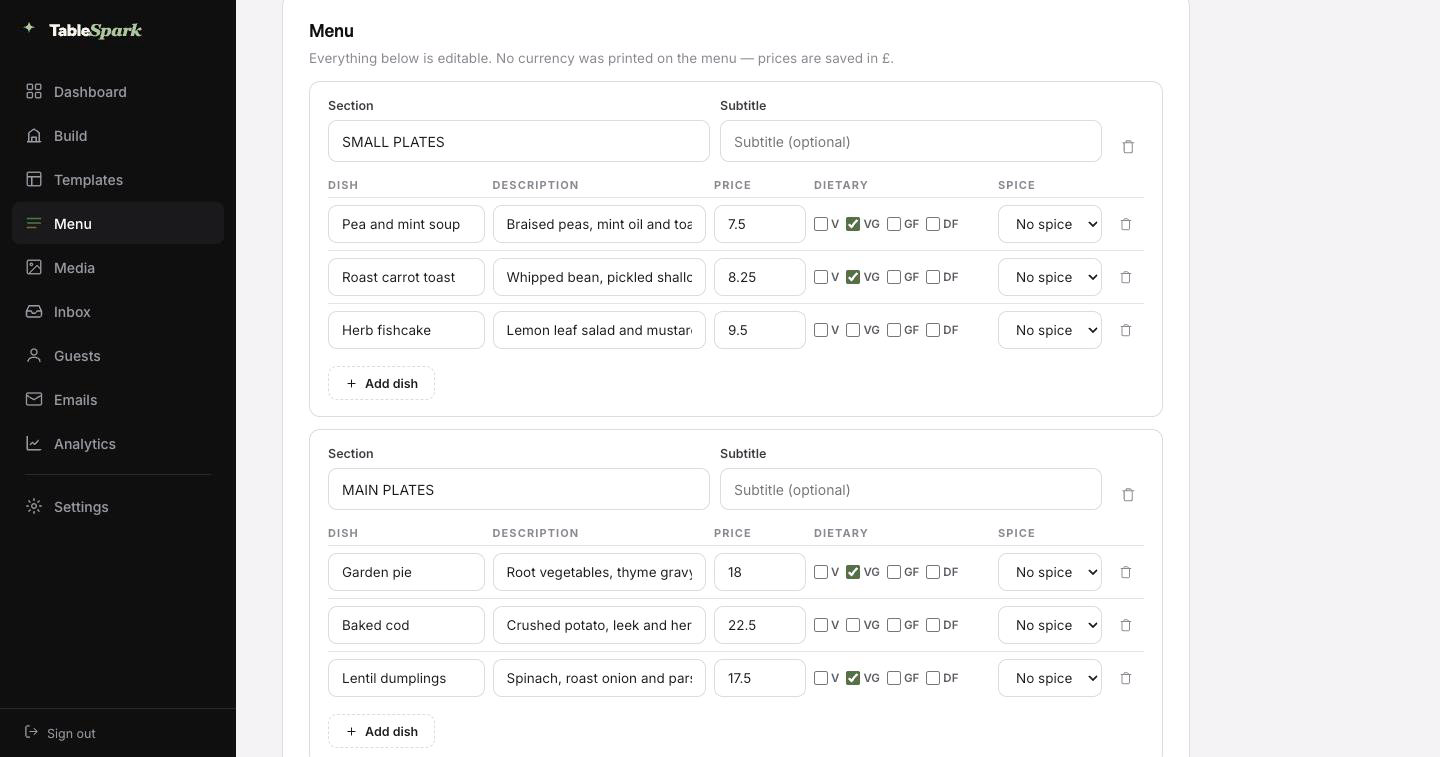
Start with the job everyone puts off. Photograph your menu — the printed card, the chalkboard, the laminated takeaway sheet — and upload it. It comes back as a real menu — sections in order, dishes, descriptions, prices, dietary marks and spice levels, all filled in. It lands in front of you for approval first, with every value editable.
The important part: this is structured data, not an image of a menu. The same structured menu drives the menu page, the ordering page, the highlights on the home page and the Restaurant structured data a search engine reads. Change a price once afterwards and all of them follow.
Every page carries a Write with AI button for the search title and description — it reads the page you are on and writes the first draft. Read it, sharpen it, publish it. The order matters.
A phone photograph of the menu you already hand to guests is enough.
Sections in order, dishes with descriptions and prices, dietary and spice marks read from the page.
Menu page, ordering page, home-page highlights and the Restaurant schema — each one updating from the same edit.
There is no kick-off call and no staging link to approve. Everything is designed and wired — you are changing the words and the photographs. One sitting, give or take, and it is live — with the reservation form answering immediately. Both sides get told at once — the booking in your inbox, the confirmation in theirs.
Money is one connection away. Link your Stripe account and the site can take deposits on bookings and payment on orders, paid directly to you. No per-order fee, no revenue share, 0% commission on any plan. Stripe’s standard card-processing fees apply to online payments.
The address on your napkins should be the address that loads. Start on a TableSpark address, then bring your own domain across — the site does not change, only the name it answers to.
The certificate, its renewal, the secure connection and the redirects are managed here, along with the canonical and sitemap signals that make a domain move safe. Bring your own, and the setup screen tells you the one value to paste and where.
onzieme.tablespark.ukbecomeswww.onzieme.co.ukA confirmation email is the only piece of your restaurant a guest keeps in their pocket for a week. The guest is emailed straight away with the particulars — date, time, party size, address, phone — and a link to release the table themselves. Service reminders, deposit receipts and cancellations all travel on the same design.
You are not stuck with our house style. Choose from six styles and make the rest yours: accent colour, logo, cover photograph, header layout, sign-off, links and social accounts. Connect the domain and the sender address becomes yours, which is what makes it read as genuinely from you.
Below is the actual renderer, the one that sends after a confirmed booking. Press any of the styles or colours and it rebuilds in front of you.
Loading the email…
Everything a guest sees after they book, set in the same place as the site.
Try the buttons above — this is the live renderer, not a screenshot.
Publishing a page and being present in search are separate achievements. A site can be live at a working link and still be missing from Google: a stray noindex, conflicting canonicals, orphaned pages, a menu locked inside a PDF, missing structured restaurant data or unfinished search verification will each do it. That gap gets filled by directories and marketplaces, which are delighted to charge you for guests who were already looking for you by name.
That groundwork is already laid here. Neither rankings nor indexing can be guaranteed by anyone — but the setup that so often prevents them is complete here.
Two minutes. The menu is a list you edit in place, and the menu page, the ordering page, any home-page highlight and the structured data all update from that single edit. Nothing needs republishing and no PDF needs redesigning.
It has its own block: producers and cuvées grouped by region or style, with vintages, prices and by-the-glass marks. Because it is structured text rather than a PDF, guests can read it on a phone and a search for a grower can lead them to you.
Every part of it. The Theme tab controls the base skin, the accent, the background, text and surface colours, both typefaces, the text scale, corner radius, motion and the header. Change any of them and the whole site follows, because nothing hard-codes a colour.
Yes, and you do not have to sort it out before going live. Publish on a TableSpark address today; connect your own domain — new or one you have held for years — whenever it suits. The SSL certificate and its renewals, the secure connection, the bare-domain redirect and the canonical, sitemap and robots signals are all managed for you, so search visibility survives the change. The same domain can send your guest emails.
An immediate confirmation in your name with the booking details — date, time, covers, your address and phone number — plus a link that lets them cancel cleanly if plans change. The same system handles the reminder before service, any deposit receipt and cancellation notices. You design all of it: six templates, your accent, logo, cover photograph, header layout, sign-off, links and social accounts, sending from your own domain once connected.
No. Every section on every page is edited in the builder: click a block, change the words, drop in a photograph. Nothing on this page was hand-written HTML — it is the same block library your own site is built from.
The whole site copies into your account in one click. Change the words, upload the menu, publish. Free until the moment you go live.
Running a French kitchen? See all French restaurant website templates.
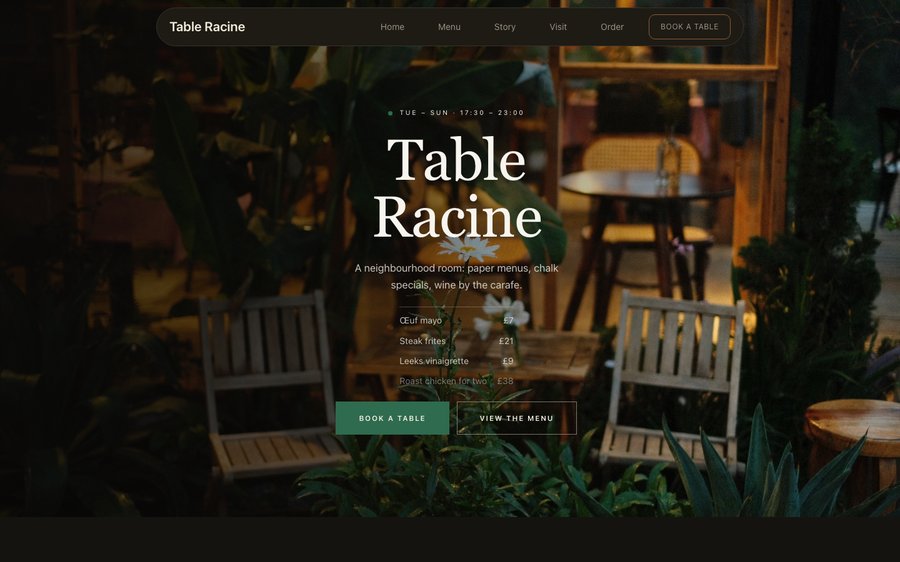 Table RacineProduce-driven French · Nordic MinimalView the template
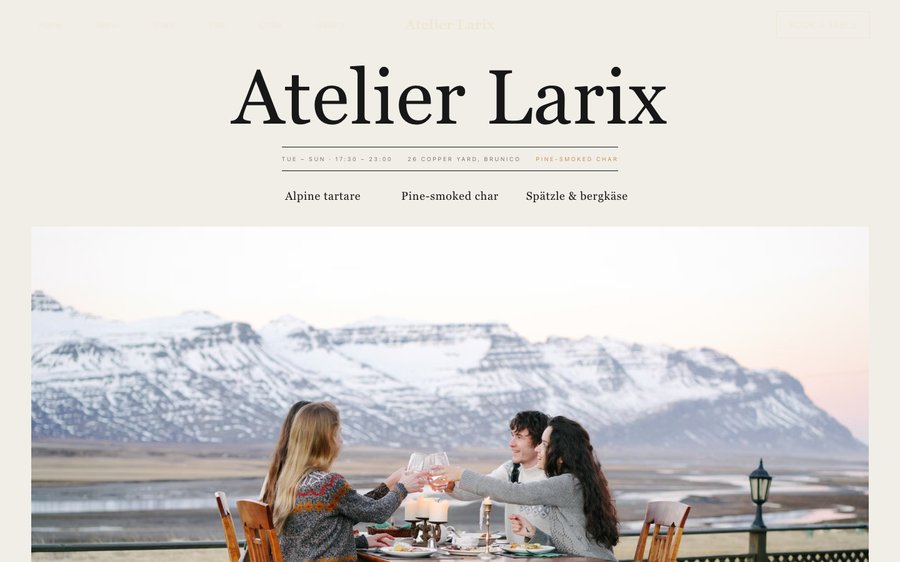 Atelier LarixAlpine tasting · Nordic MinimalView the template
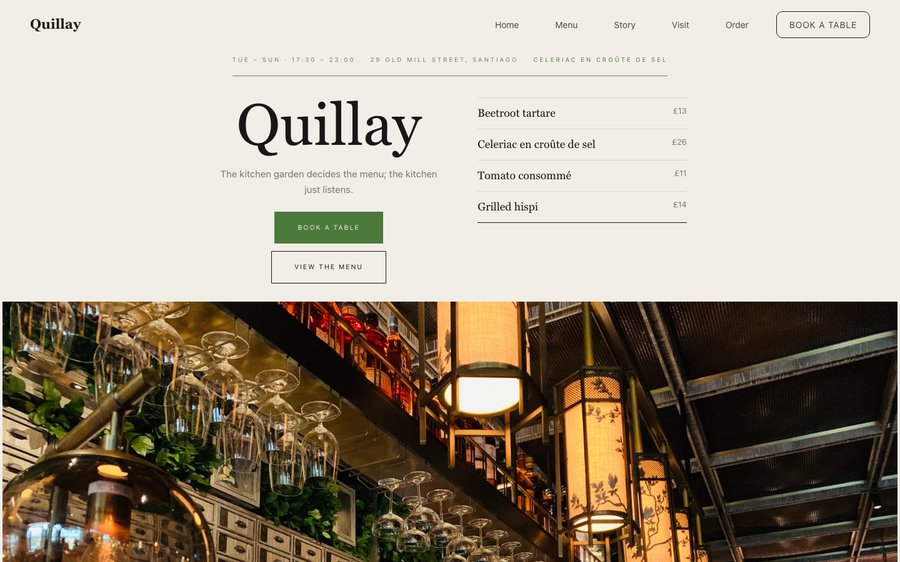 QuillayEndemic Chilean · Nordic MinimalView the template