Template library · Haute French

Plein Ciel — a haute cuisine restaurant website template

For dining rooms at the top of the register: a pale editorial template built around a course ledger, an indexed carte, and the kind of restraint that makes a three-figure menu look inevitable rather than expensive.

Haute FrenchMaison Luxe · Course Ledger6 pages · 41 editable sections0% commission
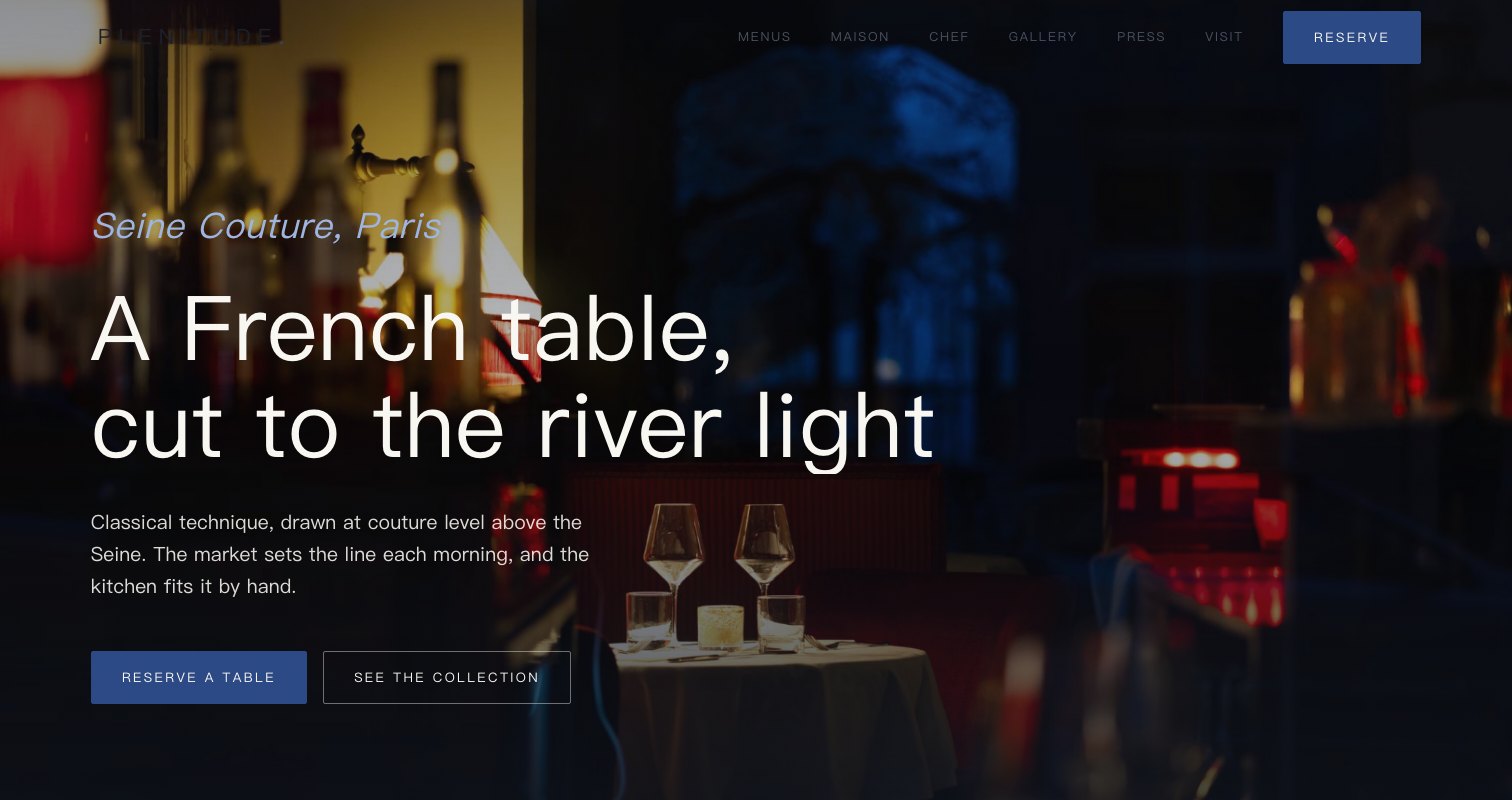
Plein Ciel, a haute cuisine restaurant website template — the home page as it publishes
Plein Ciel · Paris, France

Starter is £19/mo excl. VAT and includes a complete restaurant website, a live structured menu, enquiry and newsletter forms, and managed search readiness. Growth is £39/mo excl. VAT and adds direct live bookings, a custom domain with managed SSL, and table and floor-plan operations. Full is £69/mo excl. VAT and adds online ordering and multi-site management for up to five restaurant sites. TableSpark commission is 0%. Stripe's standard card-processing fees apply to online payments.

The price is the argument: the lowest entry point and the best value of any complete restaurant website and management system in the UK. You skip the part where a bespoke build eats thousands of pounds and a season of your year, and start from something already finished. You keep the keys. Menus, prices, photographs and copy are all edited by you, whenever you want, without asking anyone. Phones, tablets and desktops are all first-class, and the plans bring reservations, tables, ordering and management with no commission from us at all.

Take it for a drive.

Plein Ciel is bone paper and one ink blue, with more white space than most restaurants dare use. Yours might be white tile and morning light, or brass and candles, or something nobody has built yet.

Rather than explain, here is the thing itself: the builder’s Theme controls on one side, the live site on the other, both real. You cannot break it, nothing saves, and no account is required to have a go. Go on.

Loading the live preview…

ThemePagesBlocks
Accent colour

Or pick any colour at all — the builder carries a full spectrum picker and a hex field.

Colours
Fonts
The real controls, the real site. Press anything on the right and watch the left redraw.

Every page, as it publishes

6 pages, and every one of them is here. This is the live site, not a gallery. Every tab renders through the engine that publishes real restaurants, and the links inside it work. Try the Phone view.

Loading the live preview…

Rendered live. Every link in the frame goes where it says; the tabs above jump straight there.

What kind of restaurant this is

At this level the website’s job is to remove doubt, not to persuade. A guest booking a room like this has already decided; what they need is the shape of the evening, the price stated without apology, and a form that works. The design gives them that and almost nothing else.

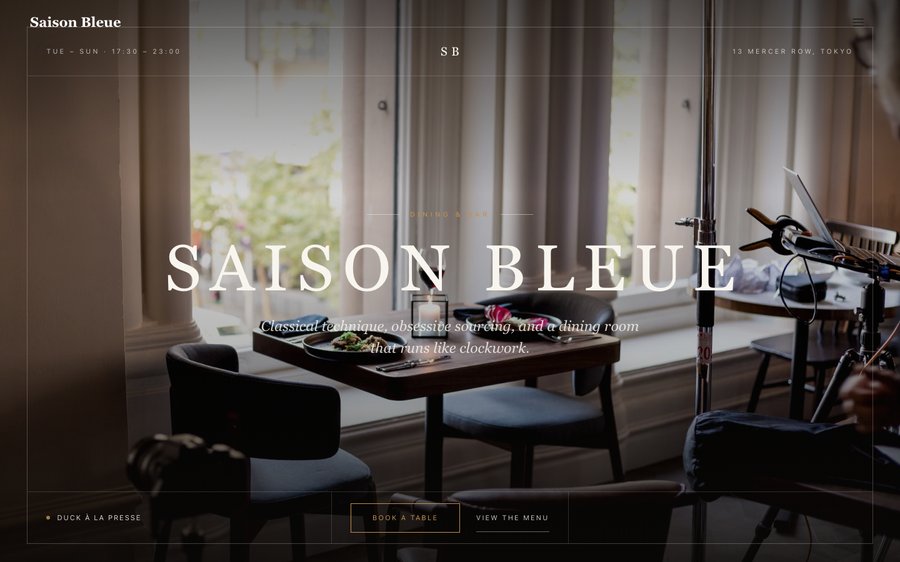
The opening is a course ledger — the sequence, the sitting times, the price — set as type on paper. It is the least decorated hero in the whole library, and for this kind of room it is the most confident thing the page could do.

Pulling the home page apart

Nine blocks, arranged so that nothing shouts:

  • Hero — Big opening image, name & buttons, in the Course Ledger treatment: Tonight's numbered courses beside a full-height dish photograph.
  • Signature dish — One dish, full screen — name, story, price.
  • Intro statement — Big opening statement line.
  • Seasonal calendar — What each month or season brings.
  • Image break — Full-width image band with optional caption.
  • Menu preview — A few dishes on a sliding rail.
  • Press bar — Press mentions or awards as a ruled band.
  • Reservation form — Live availability slot picker, saved to your Inbox.
  • Call to action — Headline + button band.

The statement block currently reads Classical technique, obsessive sourcing, and a dining room that runs like clockwork. — one line you will rewrite in about four seconds.

Loading the live preview…

The Index layout. The menu page as it publishes. Switch to Phone and watch it reflow.

Ordering: a delivery app that belongs to you

This is the part worth pressing. Plein Ciel uses the Chip bar ordering layout — sections become filter chips across the top, so a short menu is ordered from in three taps. The ordering page here is arranged as a chip bar — sections as filters across the top, dishes beneath — which is the right register for the boutique and takeaway trade a room like this runs: a small, curated list rather than a whole menu.

Everything else behaves as it does across the library: the basket stays on screen, choices are inline, and payment goes into your own Stripe account with 0% commission taken by TableSpark. Stripe’s standard card-processing fees apply to online payments.

What the guest is asked depends on how they are eating: table number, phone number or address, and never all three.

Loading the live preview…

Have a go

This is the frame that matters. It is the real ordering page at a real phone width — not a mock-up, not a video.

  • Tap a section in the chip bar — the dish list swaps without losing your place.
  • Press + on a dish; the stepper beside it counts up.
  • Watch the bar at the bottom: item count, running total, Place order.
  • Dishes needing a choice — size, spice, portion — open a sheet from the bottom.

On a laptop the same page puts the basket in a panel beside the menu that follows the scroll.

The ordering page as a guest would hold it. Tap a dish and watch the bottom bar.

The pages guests read before they come

The story page is written for a kitchen with a house style to explain: a long narrative, a pull quote, a sourcing block for the producers a room like this names, and a gallery. The separate gallery page carries room and plate photography at full width.

Loading the live preview…

The story page. This is where a restaurant stops being a menu.

Upload your menu. The AI does the typing.

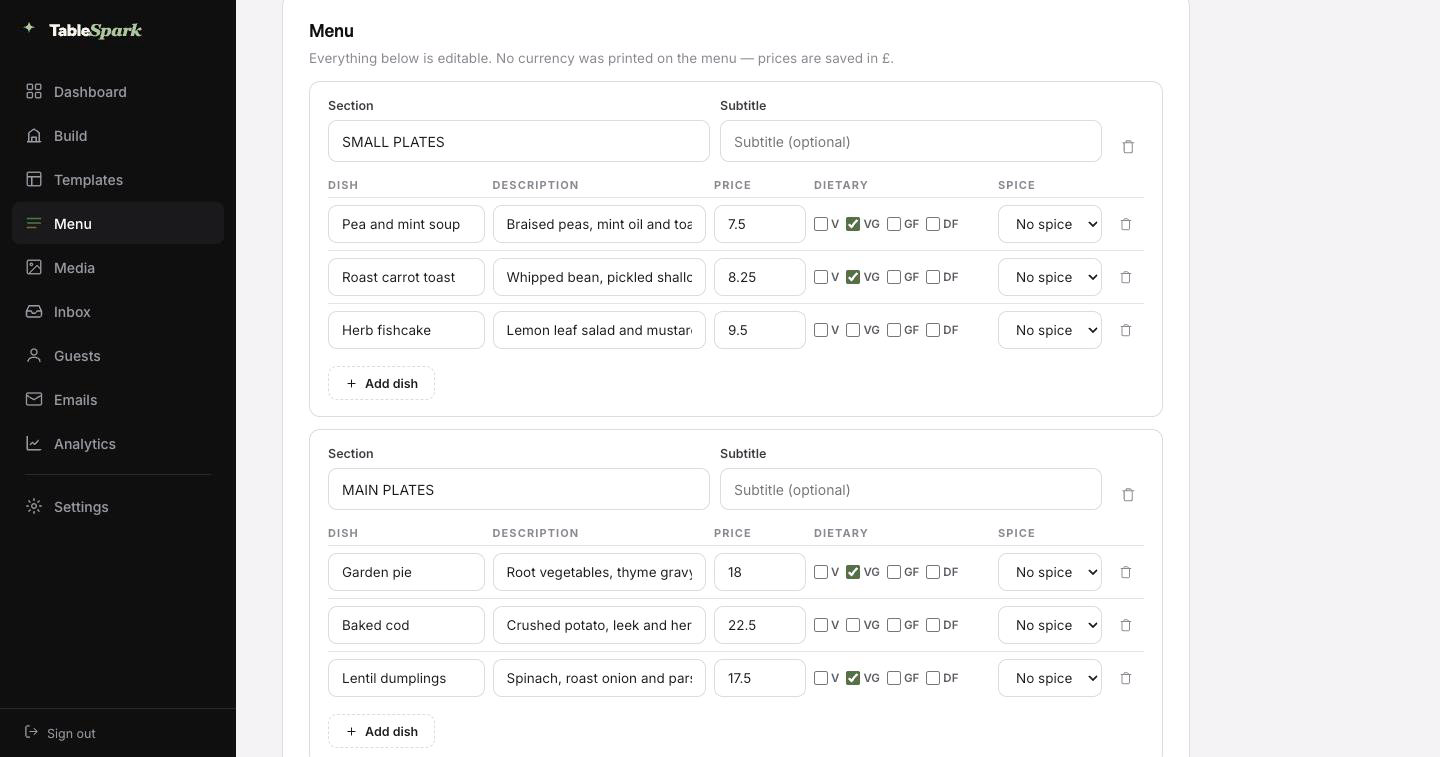
The tedious part comes first, and it is barely a part at all. Upload the menu exactly as it exists today, whether that is a printed card, a photograph of a board or an old PDF. Sections keep their order, dishes keep their descriptions, prices land in the price field, and dietary and spice marks come across where they were legible. You are the proofreader, not the typist.

That structure is the reason the rest of the site works. Everything downstream reads from it: the menu page, the ordering page, the highlights on the home page and the Restaurant structured data a search engine reads. Change a price once afterwards and all of them follow.

The title and description a search result shows are drafted for you too, by a Write with AI button that works from the page’s own content. You edit before it ships, every time.
Step one
Take a picture

Whatever your menu lives on today — card, board, PDF, ten pages of it.

Step two
It comes back structured

Ordered sections, named dishes, descriptions, prices and marks, all editable.

Step three
One source, many pages

Menu page, ordering page, home-page highlights and the Restaurant schema — all reading from the same menu.

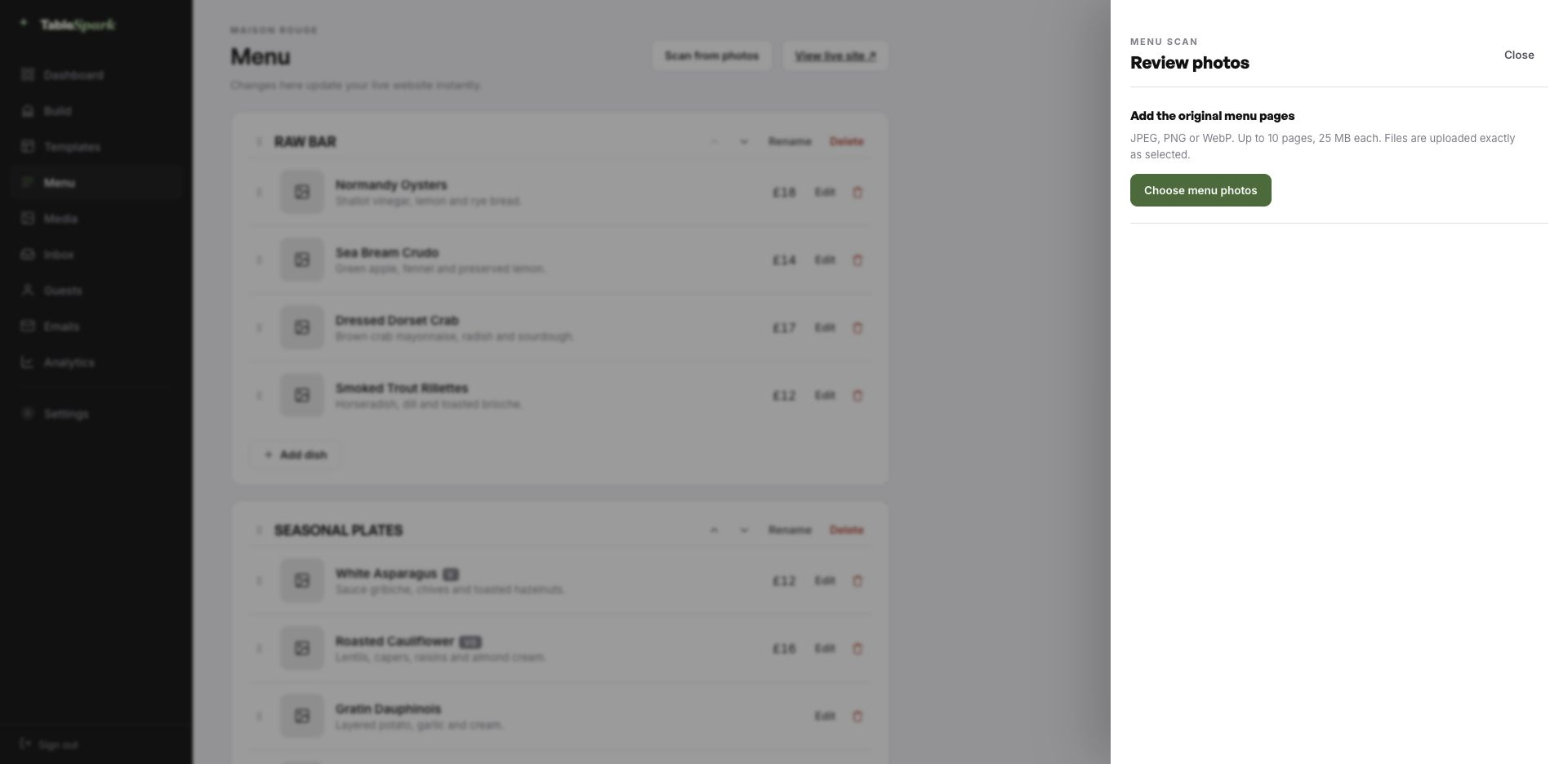
The TableSpark menu editor with the Scan from photos panel open, ready to take menu photographs
One · uploadThe upload panel: JPEG, PNG or WebP, ten pages at a time. A phone photograph of the card does the job.
The review screen after a menu scan: sections, dish names, descriptions, prices, dietary marks and spice levels, every field editable
Two · reviewThe review screen. Nothing is written until you approve it, and every value can be corrected here.

From nothing to taking reservations, in ten minutes

Most of the work was done before you arrived. The design, the layouts and the plumbing are all in place; what is missing is your restaurant. From opening the builder to a live site is usually about ten minutes, at which point guests can already book a table. Your inbox catches the booking; an automatic email catches the guest.

The money side is a single step: connect Stripe, and deposits and payments go directly into your account. Nothing is skimmed at any plan level — 0% commission. Stripe’s standard card-processing fees apply to online payments.

  1. Pick Plein CielThe complete site lands in your account, ready to edit.
    1 min
  2. Change the name and the wordsClick, type, replace a photograph. The name updates site-wide.
    4 min
  3. Upload your menuUpload a picture of the card; the AI does the sections and prices.
    3 min
  4. PublishPublished, on your own address, with the booking form answering.
    1 min
  5. Connect StripeNow you can take deposits on tables and payment on orders — direct to your account.
    1 min

Point your own domain at it

A restaurant’s address is part of its name. Publishing does not wait for a domain. Start on ours, move to yours — the same site, a different name over the door.

The technical work is ours: issuing and renewing the certificate, securing the connection, redirecting the bare domain, and keeping the search engines aimed at the live address through the change. You can keep the domain you have had for a decade — the change at your registrar is a single record.

pleinciel.tablespark.ukbecomeswww.pleinciel.co.uk

Every booking sends an email — in your colours

Something arrives in their inbox with your name on it. That is worth designing. It arrives at once, with the booking details, your address, your phone number and a link the guest can use to cancel without phoning. Everything after the booking — the reminder, the receipt, the cancellation — comes from here too.

What the guest sees is your identity, not our template. Six templates; your colour; your logo; a cover shot; a left, centred or banded header; your sign-off; your links; your social accounts. Your domain, once connected, becomes the sending address as well as the web address.

The email below is being generated live by the same code that sends it for real. Try the templates and the accent colours.

Loading the email…

All of it is yours

Everything a guest sees after they book, set in the same place as the site.

  • Six templates — Spark, Ink, Linen, Noir, Bistro, Plate.
  • Your accent, your logo, a cover photograph.
  • Sends from your own domain once it is connected.
  • Same design carries reminders, deposit receipts and cancellations.
  • Your sign-off — Nous vous attendons.

Try the buttons above — this is the live renderer, not a screenshot.

What is editable — which is nearly everything

  • Yours from the first minute: the restaurant name, every line of copy, all photography, the menu and its prices, opening hours, address, and the colours and typefaces in the Theme tab.
  • Kept for you: the layout logic — how the menu reads at 200 dishes, how the basket behaves on a phone, how sections stack on a small screen, and how the whole thing stays legible when you switch to a light palette.
  • Never locked: move sections, delete them, add new ones from the module library, create pages, remove pages. Nothing here is fixed.

The difference between published and discovered

Getting a page online is easy. Getting it discovered, read and understood is the actual work. Live and invisible is a common combination — caused by stray robots directives, canonical conflicts, unlinked pages, PDF menus, missing schema, or verification that stalled halfway. The restaurant ends up buying back its own customers, because the people searching for it are meeting someone else’s page.

You inherit it finished. Nobody can sell you a ranking or guarantee indexing. This sells you the groundwork that makes both possible.

Things worth knowing first

Can the site show a menu price without listing every dish?

Yes. A set-menu block lists the courses by name with one price for the whole menu, which is how most kitchens at this level publish. Individual dishes can be listed underneath or left out entirely; the price field is optional on every item, so nothing is forced onto the page.

Do wine pairings have somewhere to live?

Yes — a pairing block sits with the menu it belongs to, listing the wines by course with the supplement stated. There is also a full drinks list structure for the cellar, organised by region or style, which reads properly on a phone rather than requiring a PDF download.

What happens between the booking and the arrival?

A confirmation email sent on your behalf, carrying the date, time, party size, where you are, how to reach you, and a link to release the table if their plans change. Reminders before service, deposit receipts and cancellation notices come from the same system. The design is yours: six templates, your accent colour, your logo, a cover photograph, the header layout, your own sign-off, your links and your social accounts — and once your domain is connected it sends from your address too.

Who in the restaurant can actually edit the site?

No code, anywhere. You click a block and edit it in place; photographs are dragged in. Everything you can see was assembled from the module library rather than written by hand.

What does online ordering cost, and do you take a commission?

Online ordering sits on the Full plan, and we take 0% of what you sell. Stripe’s standard card-processing fees apply to online payments. Payments go to your own account. Nothing else is deducted.

Do we have to enter two hundred dishes manually?

You should not have to. Upload a photograph of the menu you already print and the AI turns it into structured sections, dishes, descriptions and prices, reading dietary and spice marks off the card where it can. Everything lands on a review screen for you to check before it saves. After that it is data rather than an image, which is why one price change updates the menu page, the ordering page, the home-page highlights and the structured data together.

Build on Plein Ciel

Start here rather than from a blank page: rename it, rewrite it, add your menu, publish. Nothing to pay until it is live.

Use this template free

Running a French kitchen? See all French restaurant website templates.

More Editorial Luxe templates

Read next

← Browse all 50 restaurant website templates