Template library · Adriatic seafood

Cala Marea — a coastal seafood restaurant website template

For beach restaurants with a serious kitchen: a dark template with an all-day opening, an editorial menu, and photo-tile ordering for a room that serves from breakfast to dinner.

Adriatic seafoodCuisine House · All-day Breakfast6 pages · 42 editable sections0% commission
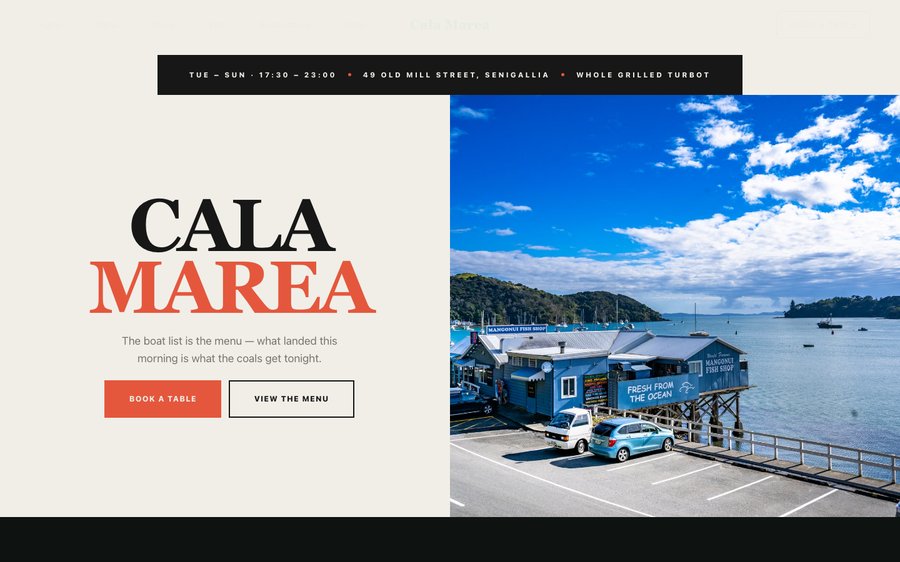
Cala Marea, a coastal seafood restaurant website template — the home page as it publishes
Cala Marea · Senigallia, Italy

Starter is £19/mo excl. VAT and includes a complete restaurant website, a live structured menu, enquiry and newsletter forms, and managed search readiness. Growth is £39/mo excl. VAT and adds direct live bookings, a custom domain with managed SSL, and table and floor-plan operations. Full is £69/mo excl. VAT and adds online ordering and multi-site management for up to five restaurant sites. TableSpark commission is 0%. Stripe's standard card-processing fees apply to online payments.

Which is the least an independent UK restaurant can pay for a complete website and management system. Nobody is quoting you four figures and a twelve-week timeline. The design is done — you fill it with your restaurant and press publish. After that the menu, the prices and the photographs stay in your own hands — no ticket, no developer, no waiting. It is designed for the phone first and looks right on everything larger, with reservations, tables, ordering and management in the plans — and 0% commission.

This is yours already. Prove it.

Cala Marea is a dark ground with a bright sea blue, the colours of an awning against water. Yours might be white tile and morning light, or brass and candles, or something nobody has built yet.

This is the product, not a picture of it. Left, the live site. Right, the builder’s own Theme panel. Everything you press takes effect immediately, nothing persists, and there is no sign-in wall in front of it. Go on.

Loading the live preview…

ThemePagesBlocks
Accent colour

Or pick any colour at all — the builder carries a full spectrum picker and a hex field.

Colours
Fonts
Two real things side by side — the builder’s Theme panel, and the site it changes.

Every page, as it publishes

6 pages, and every one of them is here. This is the live site, not a gallery. Every tab renders through the engine that publishes real restaurants, and the links inside it work. Try the Phone view.

Loading the live preview…

Live, and navigable. Use the frame’s own navigation or the tabs above it.

What kind of restaurant this is

A beach restaurant that also happens to be a serious kitchen has a positioning problem: it must not look like a shack, and it must not look like it has forgotten where it is. The design threads that by staying dark and typographic while leading with an all-day board — breakfast, lunch, aperitivo, dinner.

The blue accent is pitched bright rather than navy, which keeps the page from becoming a nautical cliché, and the soft serif over a plain sans reads as a restaurant rather than a beach club.

What is on the home page

Nine blocks, arranged around a long day:

  • Hero — Big opening image, name & buttons, in the All-day Breakfast treatment: Dark marquee strip over a split of copy and room.
  • Pull quote — A large standout quotation.
  • Menu preview — A few dishes on a sliding rail.
  • Numbers — Headline stats.
  • Seasonal calendar — What each month or season brings.
  • Gallery — Grid, masonry or moving strip.
  • Press bar — Press mentions or awards as a ruled band.
  • Reservation form — Live availability slot picker, saved to your Inbox.
  • Call to action — Headline + button band.

Loading the live preview…

The Editorial layout. The published menu page. Press Phone to see the same layout on a small screen.

Ordering: a delivery app that belongs to you

This is the part worth pressing. Cala Marea uses the Photo tiles ordering layout — every dish is a tile with an image, a price and an add button that becomes a quantity stepper. Photo tiles work here because much of what is sold to take away is visual — the fritto, the raw bar, the pastries in the morning.

Options are chips on the tile, the basket bar stays pinned with a running total, and collection asks only for a name and a phone number. Payment settles into your own Stripe account and TableSpark takes no commission. Stripe’s standard card-processing fees apply to online payments.

Dine-in asks for a table number, collection asks for a phone number, delivery asks for an address — and each mode only asks for what it actually needs.

Loading the live preview…

Use one hand

This is the frame that matters. It is the real ordering page at a real phone width — not a mock-up, not a video.

  • Switch section — your scroll position stays where it was.
  • The stepper sits on every row, so adding is one tap from anywhere in the list.
  • Count, total and Place order are pinned to the bottom throughout.
  • Sizes and choices arrive in a bottom sheet, within reach of the same thumb.

On a laptop the same page puts the basket in a panel beside the menu that follows the scroll.

The ordering page at a real phone width, opened at the ordering block. Add a dish and watch the bar at the bottom keep count.

Story, visit, and the practical pages

The story page carries the family, the beach and the boats, with a timeline, an interview and a gallery. The reservations page manages a room where lunch and dinner behave completely differently, and the visit page covers the season, the parking and the beach itself.

Loading the live preview…

The story page in full — everything a guest reads before they book.

Send a photograph, get a structured menu

This is the part that saves an afternoon. Take a picture of the menu you already have: the pressed card, the board behind the pass, a PDF from the printer. Back comes the whole menu as data: ordered sections, named dishes, their descriptions and prices, plus dietary and spice marks wherever the card showed them. Check it over — a smudged price or an ambitious accent is a two-second fix — and save.

What arrives is not a picture of a menu — it is real data. One menu then feeds the menu page, the ordering page, the highlights on the home page and the Restaurant structured data a search engine reads. Change a price once afterwards and all of them follow.

The search copy gets the same treatment: a Write with AI button reads the page and drafts its title and description, so those fields are never blank. Nothing is published on your behalf; the draft waits for you.

Step one
Send the menu in

Printed card, chalkboard photograph or an old PDF — any of them work.

Step two
Read into fields

Not a scan: real sections, dishes, prices and marks you can edit before saving.

Step three
Everything follows

Menu page, ordering page, home-page highlights and the Restaurant schema — kept in step automatically.

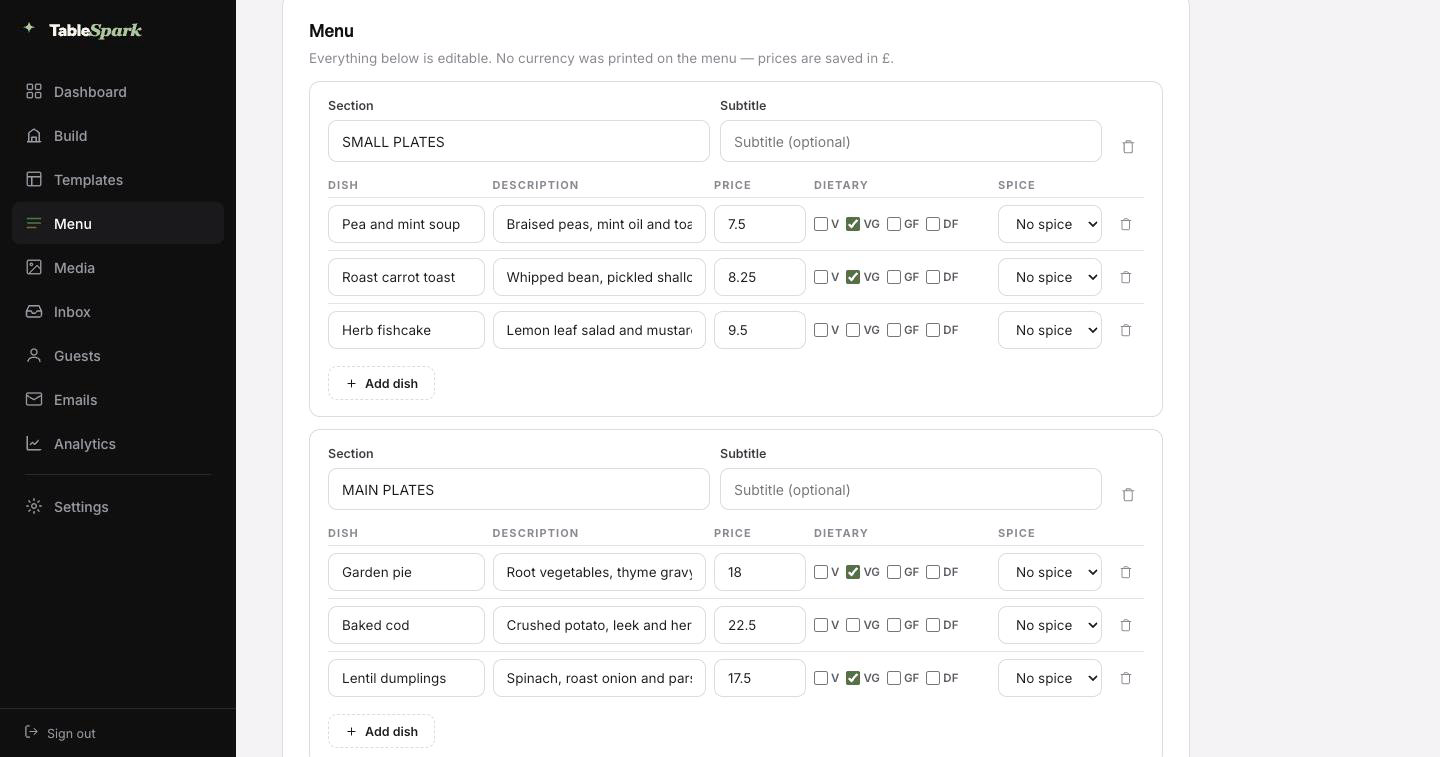
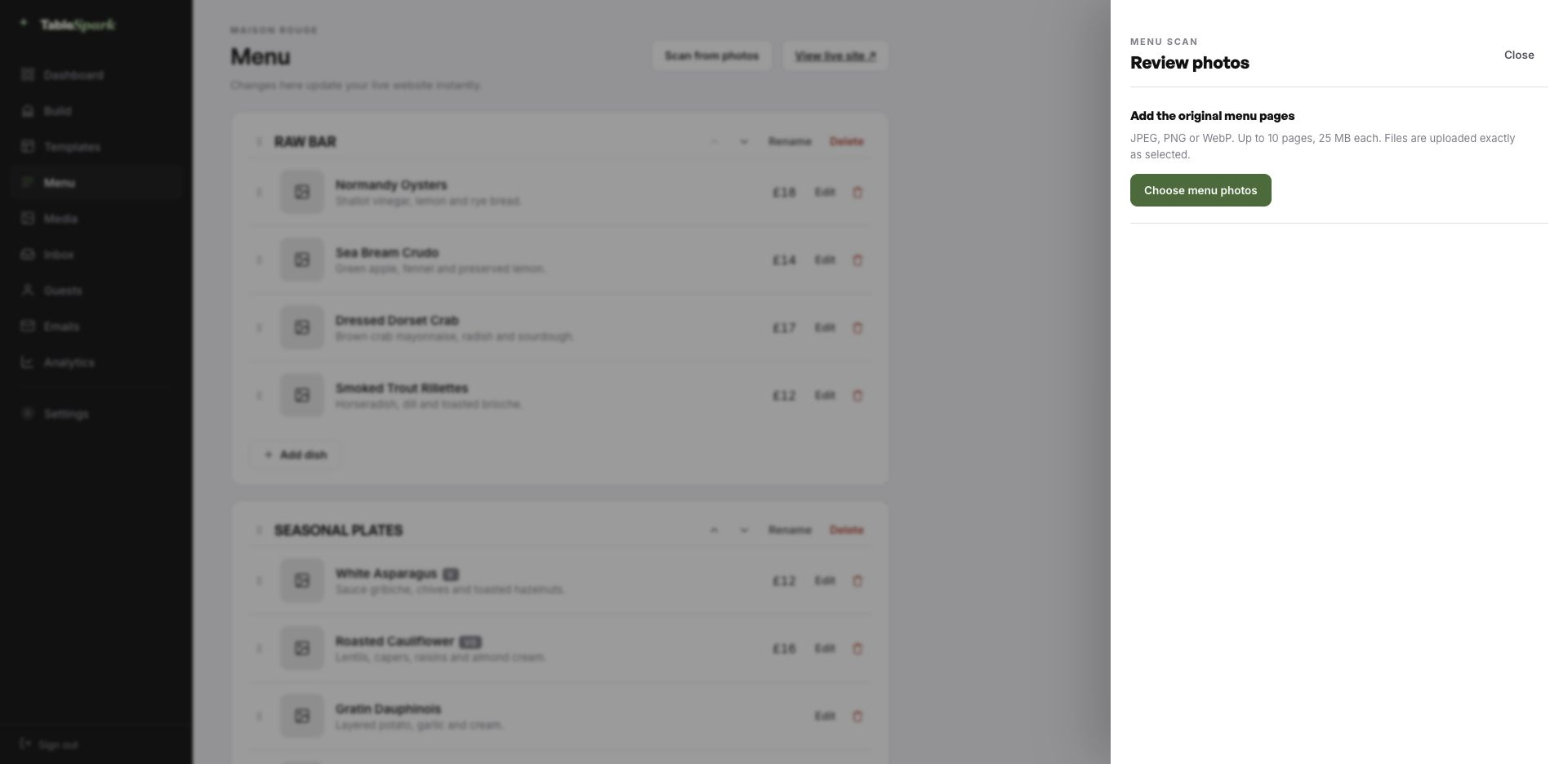
The TableSpark menu editor with the Scan from photos panel open, ready to take menu photographs
One · uploadThe upload panel: JPEG, PNG or WebP, ten pages at a time. A phone photograph of the card does the job.
The review screen after a menu scan: sections, dish names, descriptions, prices, dietary marks and spice levels, every field editable
Two · reviewBefore saving: the whole menu as fields. Fix a misread price or an over-confident accent and continue.

From nothing to taking reservations, in ten minutes

There is no build phase to wait through. Structure, styling and behaviour are done. Names, dishes and pictures are yours. Reckon on ten minutes to a published site, and reservations working from that same moment. Bookings land in your TableSpark inbox, and the guest gets a confirmation email straight away.

Taking money is a single connection: link Stripe and deposits on tables and payment on orders go straight to your own account. There is no cut for us — 0% commission on every plan. Stripe’s standard card-processing fees apply to online payments. Nobody else charges anything.

  1. Pick Cala MareaThe full site arrives in your account as a working draft.
    1 min
  2. Change the name and the wordsRewrite the words by clicking them; the name carries everywhere.
    4 min
  3. Upload your menuSend the menu in as a photograph and check what comes back.
    3 min
  4. PublishIt goes live on your address and starts taking bookings.
    1 min
  5. Connect StripeNow you can take deposits on tables and payment on orders — direct to your account.
    1 min

Run it on your own domain

A domain is signage, and signage matters. Nothing about going live depends on owning a domain first; connect yours later and the site simply answers to it.

The plumbing is ours: certificate, secure connection, redirect, and keeping canonical URLs, sitemap and robots pointing at the live address as the domain changes. Own it already? Good. The instruction is a single record, spelled out.

calamarea.tablespark.ukbecomeswww.calamarea.co.uk

After the booking: an email that looks like you

A confirmed booking is not the end of the conversation; it is the start of one. A confirmation is sent the second the booking lands, carrying the time, the covers, your address and contact details, and a self-service cancellation link. The same system sends the reminder before service, the deposit receipt and the cancellation notice.

The whole thing is yours to set, down to the sign-off. Six looks, one accent colour, your logo and cover photograph, the header layout, the sign-off line, and whichever links and social accounts you want on it. Add your domain and the from-line is yours too — the last detail that separates a real restaurant email from a system notification.

The email below is being generated live by the same code that sends it for real. Try the templates and the accent colours.
Loading the email…

Set by you, not us

Everything a guest sees after they book, set in the same place as the site.

  • Six templates — Spark, Ink, Linen, Noir, Bistro, Plate.
  • Your accent, your logo, a cover photograph.
  • Sends from your own domain once it is connected.
  • Same design carries reminders, deposit receipts and cancellations.
  • Your sign-off — The awning is up.

Try the buttons above — this is the live renderer, not a screenshot.

What is editable — which is nearly everything

  • Yours from the first minute: names, headings, body copy, pictures, dishes, prices, opening times, the address, and every colour and typeface.
  • Kept for you: everything that has to keep working at 200 dishes, at 390 pixels wide, and after you have changed every colour in the theme.
  • Never locked: change the order of anything, remove whatever you do not want, add modules from the full library, and add or delete pages at will.

The difference between published and discovered

Putting a page online is not the same as delivering a restaurant site that search engines can reliably discover and understand. A misconfigured robots file, a noindex left in place, canonical tags in conflict, pages with no internal links, a PDF menu, missing Restaurant schema or incomplete verification — any one is enough to keep a live site invisible. You feel it in the margin — guests reach commission-charging platforms first, and demand you should own outright becomes demand you rent.

This template ships with that work done. No one can promise rankings or guaranteed indexing — but nothing here is left for you to hire a technician to assemble.

Common questions

We serve four different services a day. Can the site show them separately?

Yes — each is a separate menu with its own sections, prices and publishing state, and all of them can appear on the menu page. Service hours drive the booking form independently, so lunch and dinner can have different sittings and different availability.

Fish is sold by weight and the price moves. Is that manageable?

Portion groups handle the weights, so a whole fish carries its sizes as chips, each with a price, and the price is edited between services in seconds. The structured data reports the lowest price, which is what a search result should show.

Will the site run on our own web address?

Yes. You start on a TableSpark address so you can publish the same day, and you can move onto your own domain whenever you are ready — including one you already own. TableSpark manages the certificate, the secure connection, the redirect from the bare domain, and keeps canonical URLs, the sitemap and robots pointing at the live address so the move does not cost you the search visibility you have built. Guest emails can send from your domain as well.

Does the guest hear anything after booking?

A confirmation email sent on your behalf, carrying the date, time, party size, where you are, how to reach you, and a link to release the table if their plans change. Reminders before service, deposit receipts and cancellation notices come from the same system. The design is yours: six templates, your accent colour, your logo, a cover photograph, the header layout, your own sign-off, your links and your social accounts — and once your domain is connected it sends from your address too.

Do I need to know how to code?

No. If you can edit a document you can run this: click a section, change what it says, replace the picture. There is no code view and no need for one.

Is there a commission on orders taken through the site?

Ordering comes with the Full plan. TableSpark takes 0% commission on every plan, so the order value lands in your own account. Stripe’s standard card-processing fees apply to online payments.

Cala Marea, with your name on it

Make this yours: the name, the words, the photographs, the menu. Free to build, and you only pay when you go live.

Use this template free

Running a Italian kitchen? See all Italian restaurant website templates.

More Italian Classic templates

Read next

← Browse all 50 restaurant website templates