The pages behind the menu
The story page suits a kitchen with a lineage and a manifesto: narrative, quote, interview, timeline and a gallery page for plating photography at full width.
Template library · Avant-garde Italian
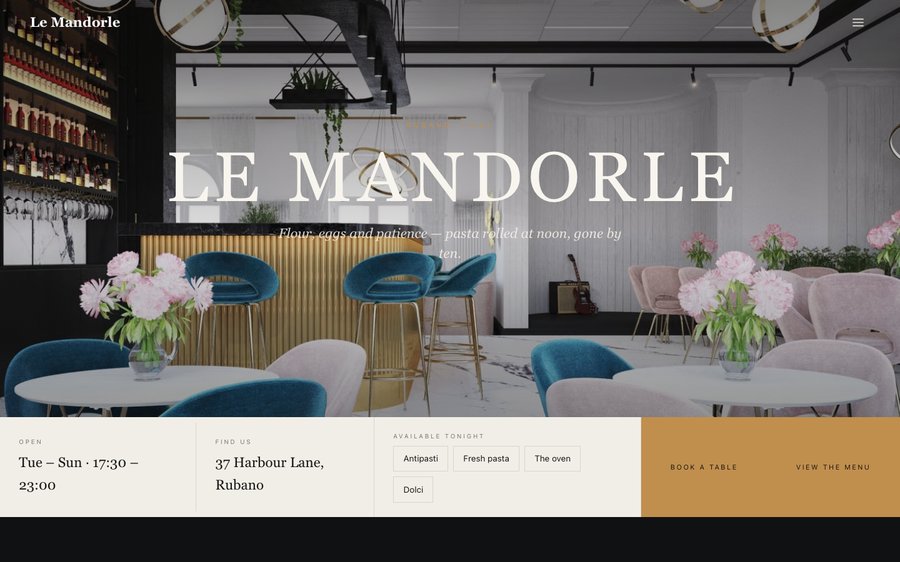
For Italian kitchens that have left tradition behind on purpose: a near-black editorial template with a reserve-bar opening, an editorial carte, and a booking-first structure.
Starter is £19/mo excl. VAT and includes a complete restaurant website, a live structured menu, enquiry and newsletter forms, and managed search readiness. Growth is £39/mo excl. VAT and adds direct live bookings, a custom domain with managed SSL, and table and floor-plan operations. Full is £69/mo excl. VAT and adds online ordering and multi-site management for up to five restaurant sites. TableSpark commission is 0%. Stripe's standard card-processing fees apply to online payments.
Le Mandorle is near-black with a terracotta that appears once and means something when it does. Yours might be white tile and morning light, or brass and candles, or something nobody has built yet.
So do not read about it. The panel on the right is the real Theme tab out of the builder, and the frame beside it is the real site — the same renderer that publishes a live restaurant. Nothing is a mock-up, nothing you touch is permanent, and nobody is asking you to sign in first. Go on.
Loading the live preview…
Or pick any colour at all — the builder carries a full spectrum picker and a hex field.
6 pages, and every one of them is here. Nothing below is a screenshot: the frame renders it through the same engine that publishes your site, so every tab is the real page and every link inside it works. Switch to Phone to watch the same design reflow.
Loading the live preview…
An avant-garde Italian kitchen has to signal that it is not the trattoria the guest is picturing, and it has to do it without abandoning Italy. This design does it typographically: an old-style serif set very large against a near-black ground, with none of the warm-wood cues the cuisine usually reaches for.
The opening is a reserve bar — the sittings, the menus, the route to a table. For a room where the decision is which menu rather than whether to come, that is the correct first screen.
Nine blocks, arranged for a room that sells menus rather than dishes:
The statement block currently reads Flour, eggs and patience — pasta rolled at noon, gone by ten. — one line you will rewrite in about four seconds.
Loading the live preview…
There is no basket in this template — it is built for a room that sells reservations. Everything routes to a booking form that offers only the sittings your service hours define, and collects the menu choice, party size and dietary requirements at the same time.
With Stripe connected, the same form can hold a card or take a deposit, paid directly into your account. Deposit receipts and cancellations are emailed automatically in your own branding.
Loading the live preview…
The story page suits a kitchen with a lineage and a manifesto: narrative, quote, interview, timeline and a gallery page for plating photography at full width.
Loading the live preview…
The worst job in setting up a restaurant site is typing the menu. You do not have to. Send in the menu you hand to guests — card, board, PDF, ten pages if it runs that long. What returns is not a scan but a structured menu: every section, every dish, every price, with dietary and spice marks read off the page where they were printed. Nothing saves until you have looked at it — every field is editable on the review screen.
And because it is data rather than a photograph, it can do work. Everything downstream reads from it: the menu page, the highlights on the home page and the Restaurant structured data a search engine reads. Change a price once afterwards and all of them follow.
Search titles and descriptions are drafted the same way: press Write with AI and it writes from the page in front of you. You still approve every line of it before it goes anywhere.
Of the menu exactly as it is today, from a phone.
Sections in the right order, dishes with their descriptions, prices and marks.
Menu page, home-page highlights and the Restaurant schema — all fed by the same structured menu.
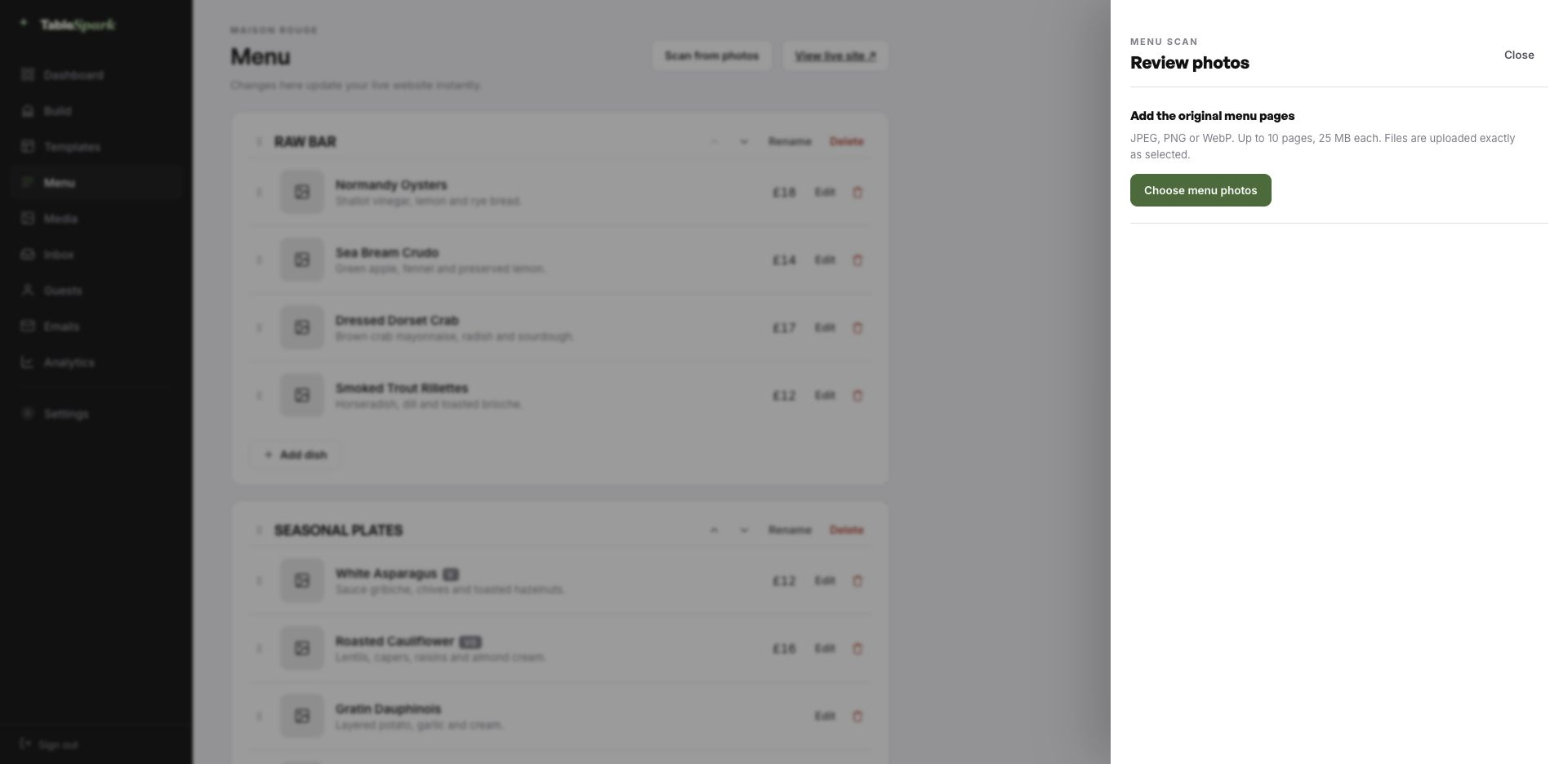
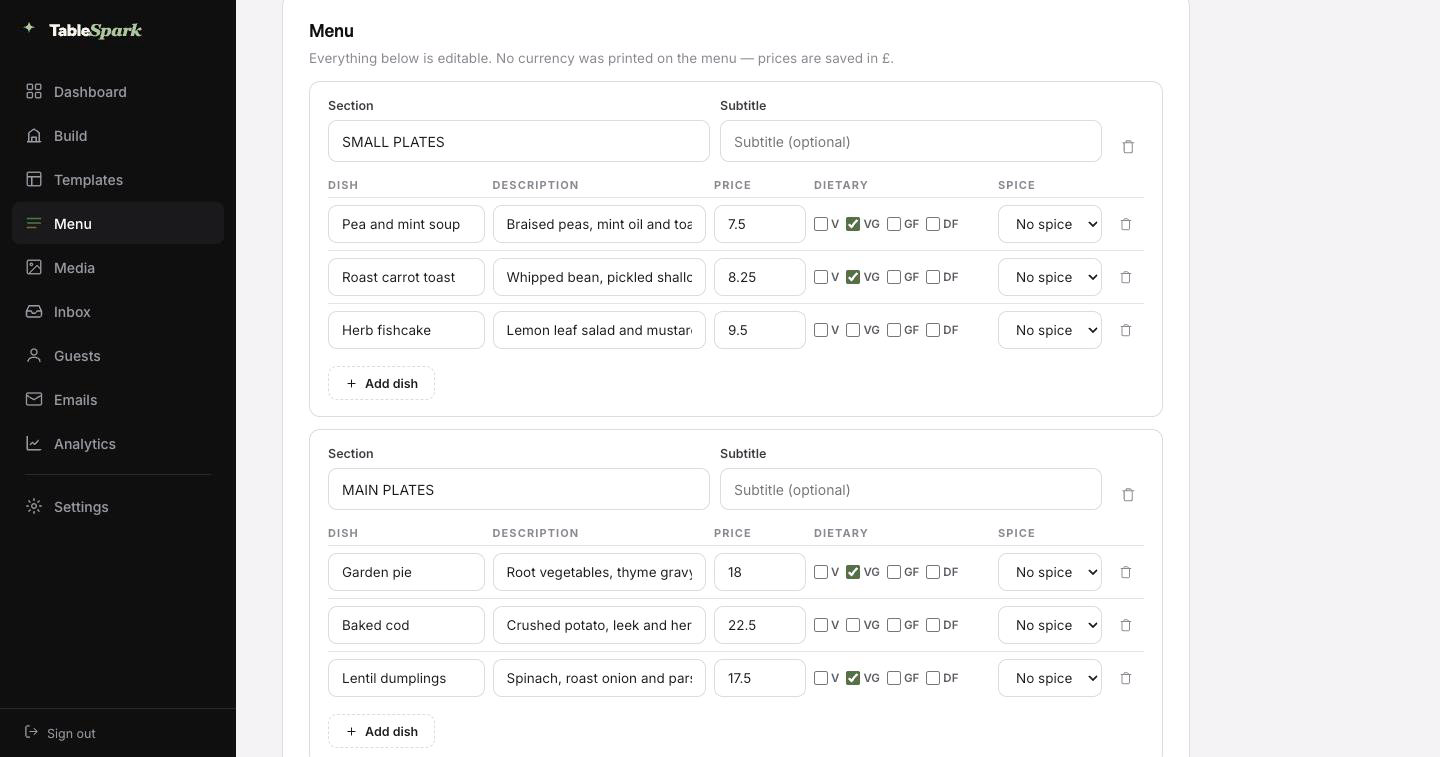
The waiting is the part that has been removed. Consider it a fully fitted kitchen waiting for your knives. One sitting to live, and the booking form does not need setting up: it is already answering. The booking appears in your inbox; the guest gets a confirmation before they have put their phone down.
One Stripe connection turns the site into something that collects money: deposits on tables, payment on orders, paid direct. Our commission is 0% at every plan level. Stripe’s standard card-processing fees apply to online payments. That is the only deduction.
Nobody prints someone else’s name on their menu, and a web address is no different. You start on a TableSpark address so you can publish today, and move the site onto your own domain whenever you are ready — the one on your menus, your napkins and your Google listing.
You do not touch a certificate or a redirect rule. TableSpark issues and renews the SSL, points the bare domain at your chosen host, and keeps the search signals consistent. If the domain is already yours, nothing needs buying; you are told precisely which DNS record to point where.
lemandorle.tablespark.ukbecomeswww.lemandorle.co.ukMost guests will see this email more often than they see your home page. On booking, an email goes out on your behalf with everything the guest needs — when, how many, where, how to reach you, and a one-click way to give the table back. Reminder emails, deposit receipts and cancellation notices are cut from the same cloth.
And the email is yours to design, not ours. Six templates, your accent colour, your logo, a cover photograph, the header layout, a sign-off in your own voice, your links and your social accounts. Once your domain is connected the email leaves from your address as well, not a generic one.
Not a mock-up: the frame runs the actual guest-email renderer. Press a template or an accent and watch it change.
Loading the email…
Everything a guest sees after they book, set in the same place as the site.
Try the buttons above — this is the live renderer, not a screenshot.
A live link proves the page exists. It does not prove Google can read it. Sites sit at a perfectly good address and never appear in search — because of a leftover noindex, canonicals that disagree, pages nothing links to, a menu trapped in a PDF, absent restaurant schema, or verification never finished. What follows is expensive: searches for your name, your dishes or your street send guests to marketplaces that take a cut of the booking you would have had for free.
None of it is left for you to assemble. Rankings and indexing are Google’s decision and no honest supplier promises either — but the configuration that makes them possible is done.
Yes — the reservation form can carry a menu choice alongside party size and dietary notes, and it arrives with the booking in your TableSpark inbox. That means the kitchen knows the shape of the service before the day rather than at the table.
Yes, once Stripe is connected. The booking form can hold a card or charge a deposit at the point of reservation, paid directly to your own account at 0% TableSpark commission. Stripe’s standard card-processing fees apply to online payments. Receipts and cancellation handling are automatic and branded as yours.
No. Photograph the menu and it comes back as structured data — ordered sections, named dishes, their descriptions and prices, with dietary and spice marks where the card showed them — for you to check and correct on a review screen. Being data rather than a photograph is what lets the same menu feed the menu page, the ordering page, the home-page highlights and the search engine’s structured data at once.
One sitting is a fair estimate. The template copies into your account complete, so the work is changing the name, editing the words and uploading the menu before you publish. Bookings work immediately on publishing, arriving in your TableSpark inbox with an automatic confirmation to the guest. Adding a payment account enables deposits on tables and payment on orders, paid direct to you at 0% commission. Stripe’s standard card-processing fees apply to online payments.
All of it lives in the Theme tab — the accent, the background, the text and surface colours, both typefaces, corner radius, motion and how the header behaves as you scroll. Nothing breaks when you change them, because every block reads from the theme rather than carrying its own colours.
Yes. You start on a TableSpark address so you can publish the same day, and you can move onto your own domain whenever you are ready — including one you already own. TableSpark manages the certificate, the secure connection, the redirect from the bare domain, and keeps canonical URLs, the sitemap and robots pointing at the live address so the move does not cost you the search visibility you have built. Guest emails can send from your domain as well.
Take this design, make it about your restaurant, and publish it today. Building costs nothing; you pay only when it goes live.
Running a Italian kitchen? See all Italian restaurant website templates.
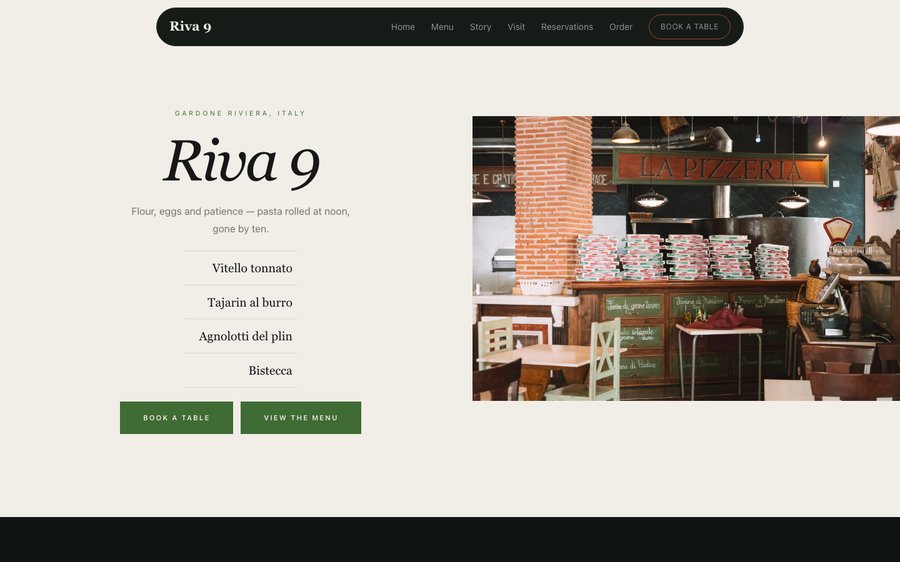 Riva 9Contemporary Italian · Italian ClassicView the template
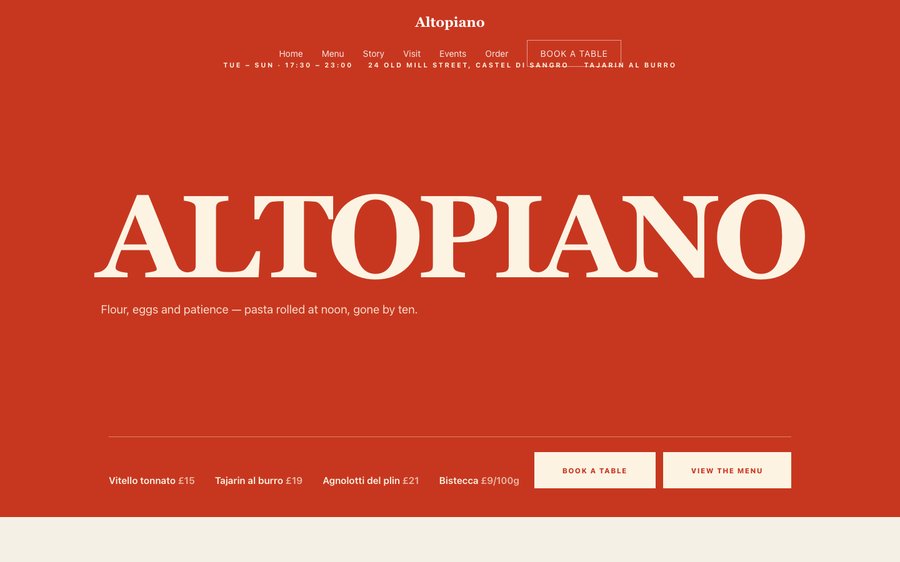 AltopianoContemporary Italian (Abruzzo) · Italian ClassicView the template
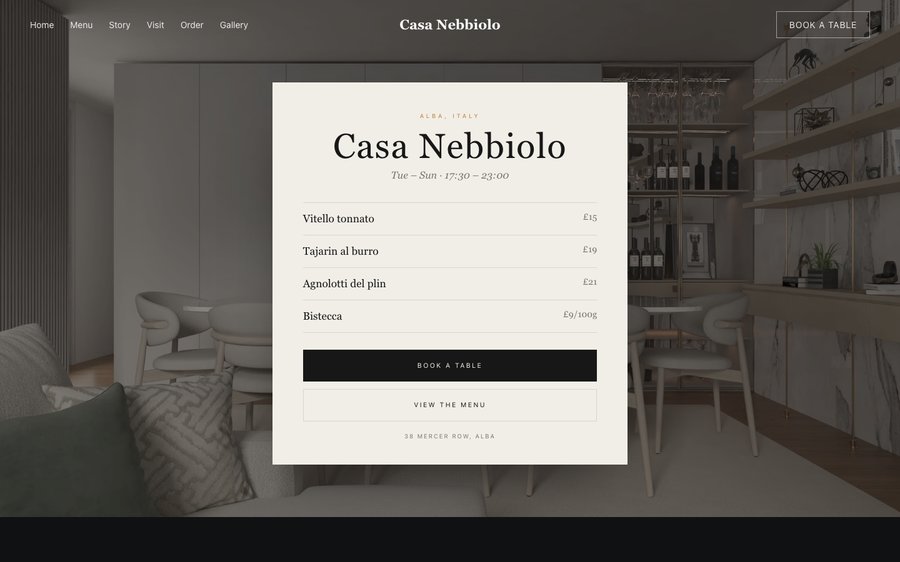 Casa NebbioloPiedmontese fine dining · Italian ClassicView the template