Template library · Piedmontese fine dining

Casa Nebbiolo — a wine country restaurant website template

For dining rooms in wine country: a near-black template with a carte opening, an indexed menu, and a cellar list that reads properly on a phone.

Piedmontese fine diningMaison Luxe · Carte6 pages · 41 editable sections0% commission
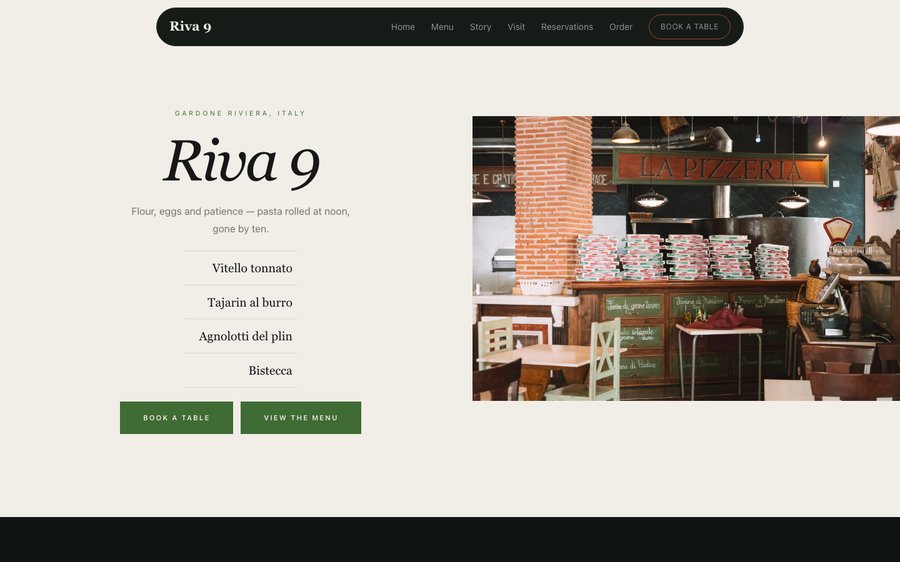
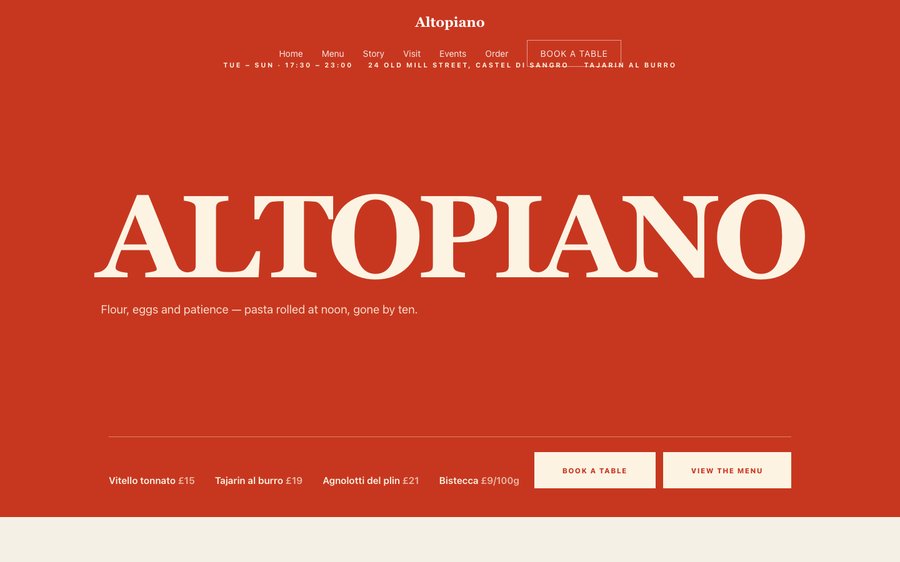
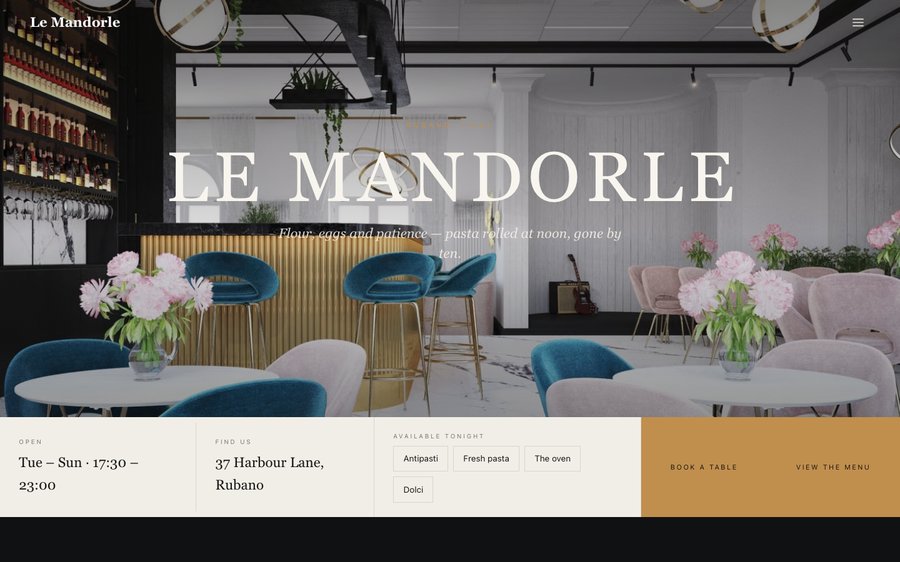
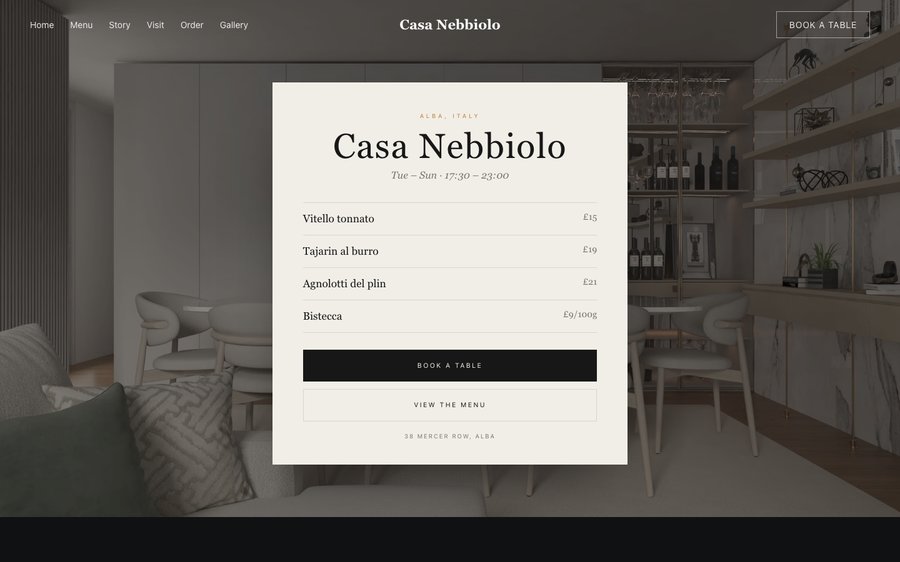
Casa Nebbiolo, a wine country restaurant website template — the home page as it publishes
Casa Nebbiolo · Alba, Italy

Starter is £19/mo excl. VAT and includes a complete restaurant website, a live structured menu, enquiry and newsletter forms, and managed search readiness. Growth is £39/mo excl. VAT and adds direct live bookings, a custom domain with managed SSL, and table and floor-plan operations. Full is £69/mo excl. VAT and adds online ordering and multi-site management for up to five restaurant sites. TableSpark commission is 0%. Stripe's standard card-processing fees apply to online payments.

No agency, no retainer, and the best value an independent UK restaurant can buy. Instead of spending thousands on a bespoke build and waiting months for it, you start from a finished design like this one and go live the same day. Then it is yours to keep current — and a menu that can be corrected in a minute is a menu that stays true. The layouts are built mobile-first and scale up, and the plans add reservations, table management, ordering and the tools to run them — 0% commission to us.

Press something. It is your restaurant now.

Casa Nebbiolo is near-black with a terracotta accent, the colours of a cellar with one lamp in it. Yours might be white tile and morning light, or brass and candles, or something nobody has built yet.

This is the product, not a picture of it. Left, the live site. Right, the builder’s own Theme panel. Everything you press takes effect immediately, nothing persists, and there is no sign-in wall in front of it. Go on.

Loading the live preview…

ThemePagesBlocks
Accent colour

Or pick any colour at all — the builder carries a full spectrum picker and a hex field.

Colours
Fonts
The real controls, the real site. Press anything on the right and watch the left redraw.

Every page, as it publishes

6 pages, and every one of them is here. Nothing below is a screenshot: the frame renders it through the same engine that publishes your site, so every tab is the real page and every link inside it works. Switch to Phone to watch the same design reflow.

Loading the live preview…

A live render. The links inside the frame work — use them, or the tabs above.

Why it looks like this

A restaurant in a wine region sells two things, and most restaurant websites only handle one. This design gives the cellar equal standing: a menu structure for the food and a drinks structure for the list, each with its own layout rather than the wine being appended as an afterthought.

The opening is a carte — the menu itself, set as type, at size. In a region where guests arrive knowing what they want to eat and needing to know what you have to drink with it, leading with the card is the confident move.

Everything on the home page, named

Nine blocks, split between the kitchen and the cellar:

  • Hero — Big opening image, name & buttons, in the Carte treatment: A printed menu card laid over a darkened room.
  • Pull quote — A large standout quotation.
  • Menu preview — A few dishes on a sliding rail.
  • Sourcing — The growers and makers behind the menu.
  • Numbers — Headline stats.
  • Press bar — Press mentions or awards as a ruled band.
  • Gallery — Grid, masonry or moving strip.
  • Reservation form — Live availability slot picker, saved to your Inbox.
  • Call to action — Headline + button band.

Loading the live preview…

The Index layout. The real menu page. Try it at phone width — the structure survives the squeeze.

Ordering that works like the apps — without the commission

This is the part worth pressing. Casa Nebbiolo uses the Photo tiles ordering layout — every dish is a tile with an image, a price and an add button that becomes a quantity stepper. The photo-tile ordering layout works here because what is sold online is usually wine and pantry goods, where the bottle is the picture and the label does the selling.

Quantities and case options are inline, the total stays visible, and payment lands in your own Stripe account with 0% taken by TableSpark. Stripe’s standard card-processing fees apply to online payments.

The form adapts to the mode. Eating in? A table number. Collecting? A phone number. Delivery? An address. Nothing more is demanded.

Loading the live preview…

Do this bit on the phone

This is the frame that matters. It is the real ordering page at a real phone width — not a mock-up, not a video.

  • Move between sections without losing your place.
  • Add with +; adjust with the same stepper.
  • A pinned bar carries the item count, the total and the order button.
  • Choices open in a sheet at the bottom of the screen, not a box in the middle.

On a laptop the same page puts the basket in a panel beside the menu that follows the scroll.

The real ordering page at 390 pixels. Press a plus and watch the basket bar respond.

Story, visit, and the practical pages

The story page carries the region, the family and the cellar — narrative, sourcing, interview, timeline. The gallery page holds the vineyard and room photography, and the visit page explains a rural location and its seasons.

Loading the live preview…

The story page. This is where a restaurant stops being a menu.

Send a photograph, get a structured menu

The worst job in setting up a restaurant site is typing the menu. You do not have to. Send in the menu you hand to guests — card, board, PDF, ten pages if it runs that long. What returns is not a scan but a structured menu: every section, every dish, every price, with dietary and spice marks read off the page where they were printed. Nothing saves until you have looked at it — every field is editable on the review screen.

And because it is data rather than a photograph, it can do work. That single menu is what powers the menu page, the ordering page, the highlights on the home page and the Restaurant structured data a search engine reads. Change a price once afterwards and all of them follow.

Search titles and descriptions are drafted the same way: press Write with AI and it writes from the page in front of you. You still approve every line of it before it goes anywhere.

Step one
Send the menu in

Printed card, chalkboard photograph or an old PDF — any of them work.

Step two
Read into fields

Not a scan: real sections, dishes, prices and marks you can edit before saving.

Step three
Everything follows

Menu page, ordering page, home-page highlights and the Restaurant schema — kept in step automatically.

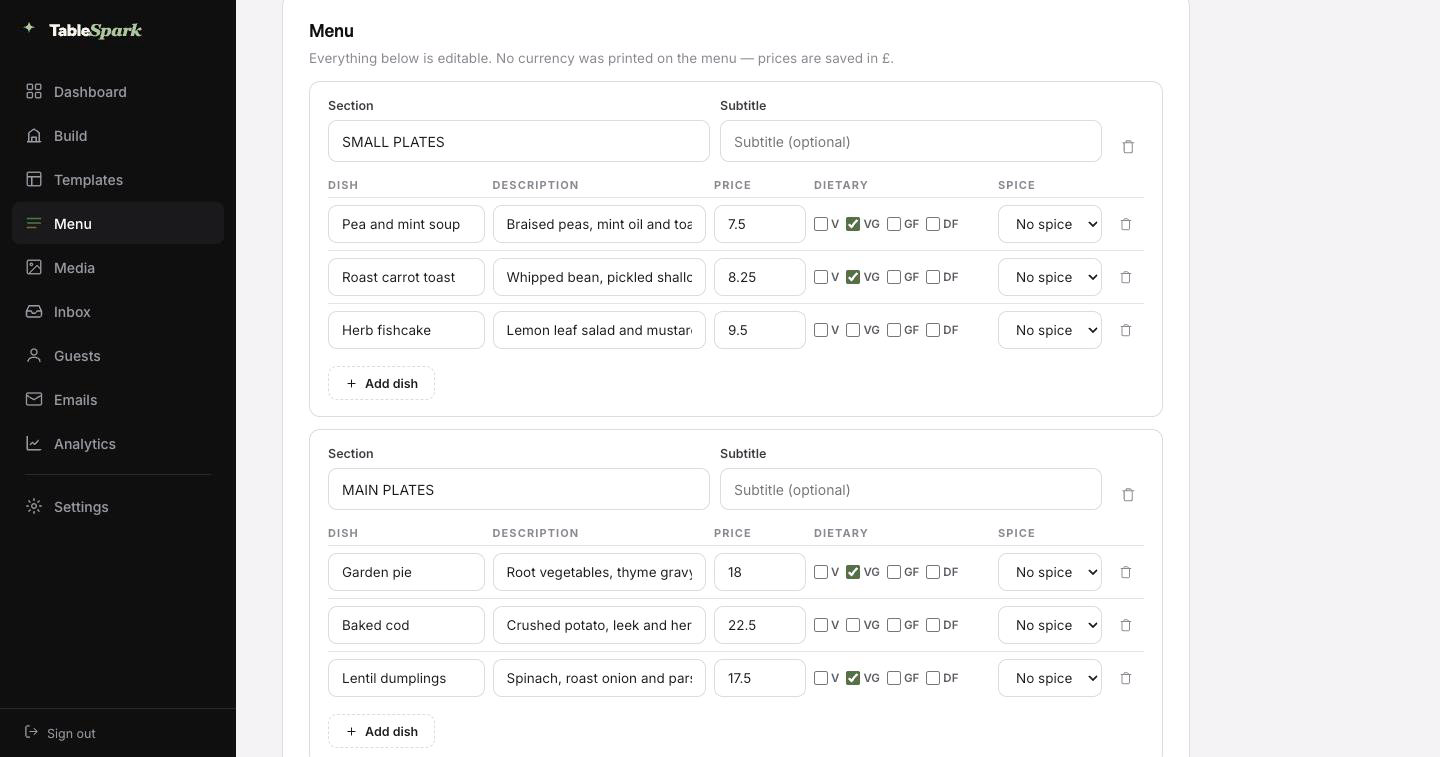
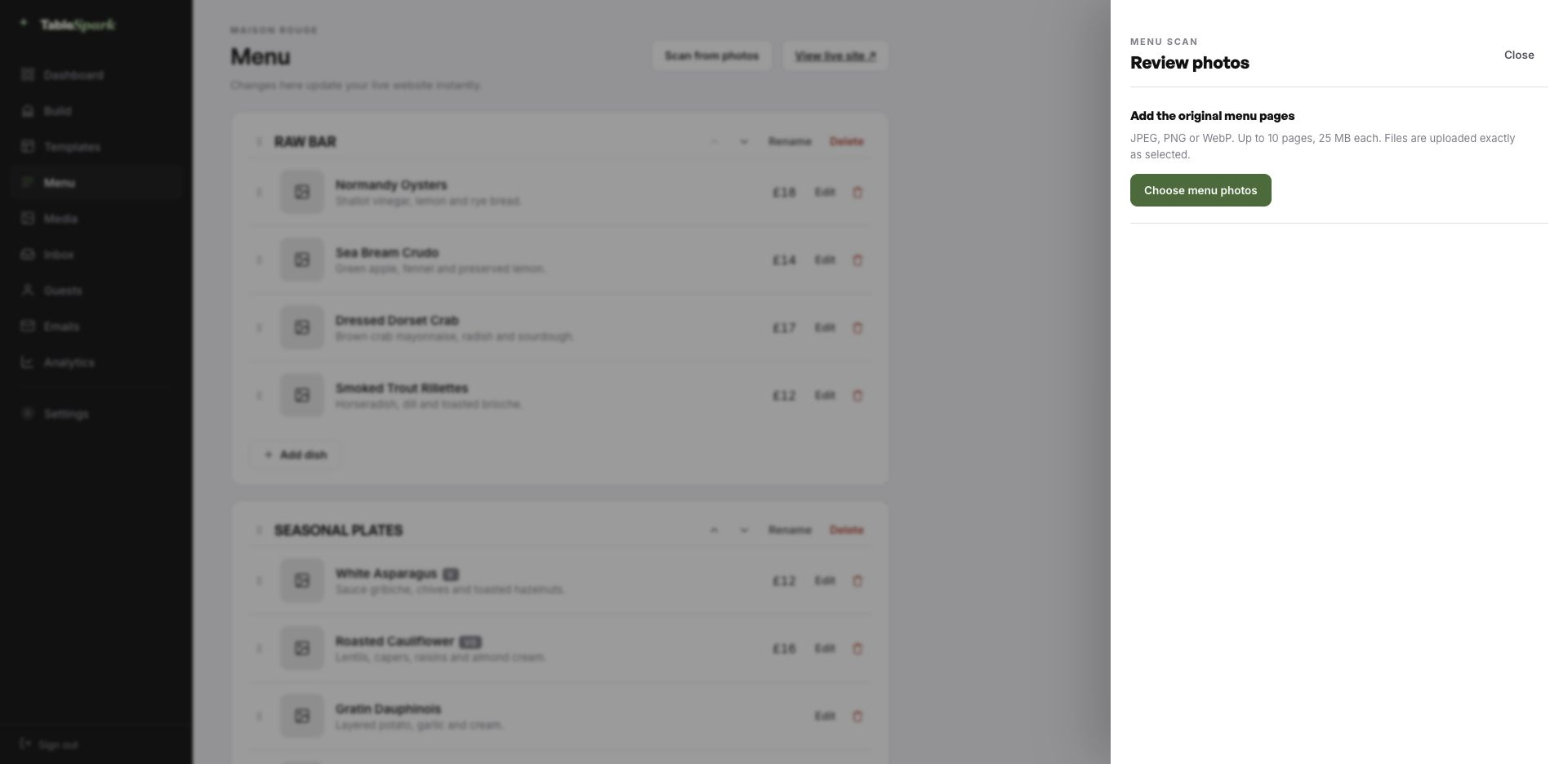
The TableSpark menu editor with the Scan from photos panel open, ready to take menu photographs
One · uploadThe upload panel: JPEG, PNG or WebP, ten pages at a time. A phone photograph of the card does the job.
The review screen after a menu scan: sections, dish names, descriptions, prices, dietary marks and spice levels, every field editable
Two · reviewWhat the scan produced, waiting for you to check it. Every field is editable in place.

Ten minutes to live — and taking bookings

The waiting is the part that has been removed. Consider it a fully fitted kitchen waiting for your knives. Ten minutes to live, and the booking form does not need setting up: it is already answering. The booking appears in your inbox; the guest gets a confirmation before they have put their phone down.

One Stripe connection turns the site into something that collects money: deposits on tables, payment on orders, paid direct. Our commission is 0% at every plan level. Stripe’s standard card-processing fees apply to online payments. That is the only deduction.

  1. Pick Casa NebbioloThe whole thing is duplicated into your account to edit.
    1 min
  2. Change the name and the wordsClick a block, change the words, swap the picture.
    4 min
  3. Upload your menuPhotograph the menu; review what the AI read back.
    3 min
  4. PublishLive on your address, with reservations working.
    1 min
  5. Connect StripeNow you can take deposits on tables and payment on orders — direct to your account.
    1 min

Point your own domain at it

Nobody prints someone else’s name on their menu, and a web address is no different. You start on a TableSpark address so you can publish today, and move the site onto your own domain whenever you are ready — the one on your menus, your napkins and your Google listing.

You do not touch a certificate or a redirect rule. TableSpark issues and renews the SSL, points the bare domain at your chosen host, and keeps the search signals consistent. If the domain is already yours, nothing needs buying; you are told precisely which DNS record to point where.

casanebbiolo.tablespark.ukbecomeswww.casanebbiolo.co.uk

The email after the booking is yours to design

Most guests will see this email more often than they see your home page. On booking, an email goes out on your behalf with everything the guest needs — when, how many, where, how to reach you, and a one-click way to give the table back. Reminder emails, deposit receipts and cancellation notices are cut from the same cloth.

And the email is yours to design, not ours. Six templates, your accent colour, your logo, a cover photograph, the header layout, a sign-off in your own voice, your links and your social accounts. Once your domain is connected the email leaves from your address as well, not a generic one.

What follows is not a screenshot of an email — it is an email, drawn by the module the booking system calls. Change the style or the colour and it redraws.
Loading the email…

All of it is yours

Everything a guest sees after they book, set in the same place as the site.

  • Six templates — Spark, Ink, Linen, Noir, Bistro, Plate.
  • Your accent, your logo, a cover photograph.
  • Sends from your own domain once it is connected.
  • Same design carries reminders, deposit receipts and cancellations.
  • Your sign-off — The cellar is open.

Try the buttons above — this is the live renderer, not a screenshot.

What is editable — which is nearly everything

  • Yours from the first minute: the restaurant’s name, the copy on every page, the photography, the dishes and prices, the opening hours and address, and the theme itself.
  • Kept for you: the load-bearing decisions: long-menu layout, mobile ordering behaviour, responsive stacking, and colour contrast that does not collapse when you change the palette.
  • Never locked: restructure any page, delete sections outright, add new modules, and create or remove pages. None of it is locked.

The difference between published and discovered

A live link proves the page exists. It does not prove Google can read it. Sites sit at a perfectly good address and never appear in search — because of a leftover noindex, canonicals that disagree, pages nothing links to, a menu trapped in a PDF, absent restaurant schema, or verification never finished. What follows is expensive: searches for your name, your dishes or your street send guests to marketplaces that take a cut of the booking you would have had for free.

None of it is left for you to assemble. Rankings and indexing are Google’s decision and no honest supplier promises either — but the configuration that makes them possible is done.

Questions before you start

Our wine list is enormous. Does it have to be a PDF?

It does not, and it should not be. The drinks list block holds bottles grouped by region, style or producer, with vintage and price fields, and it reads properly on a phone. Unlike a PDF, every producer and vintage is real text a search engine can index — which is how people looking for a specific wine find a restaurant that pours it.

Can we sell wine online as well as pour it?

Yes — an ordering page can carry bottles and cases with their own prices and options, settling into your own Stripe account with no commission from us. Stripe’s standard card-processing fees apply to online payments. It sits alongside the restaurant rather than replacing it.

Does the guest hear anything after booking?

The guest receives a branded confirmation straight away: date, time, number of covers, your address, your phone number, and a link to release the table. Reminders before service, deposit receipts and cancellation notices come from the same place. You choose from six templates and set the accent colour, logo, cover photograph, header layout, sign-off, links and social accounts — and with your domain connected, the sender address is yours.

Do I need to know how to code?

No. If you can edit a document you can run this: click a section, change what it says, replace the picture. There is no code view and no need for one.

Does online ordering carry a percentage fee?

Online ordering sits on the Full plan, and we take 0% of what you sell. Stripe’s standard card-processing fees apply to online payments. Payments go to your own account. Nothing else is deducted.

Do I have to type my whole menu in by hand?

You should not have to. Upload a photograph of the menu you already print and the AI turns it into structured sections, dishes, descriptions and prices, reading dietary and spice marks off the card where it can. Everything lands on a review screen for you to check before it saves. After that it is data rather than an image, which is why one price change updates the menu page, the ordering page, the home-page highlights and the structured data together.

Start from Casa Nebbiolo

Make this yours: the name, the words, the photographs, the menu. Free to build, and you only pay when you go live.

Use this template free

Running a Italian kitchen? See all Italian restaurant website templates.

More Italian Classic templates

More on the money side

← Browse all 50 restaurant website templates